Talent Assessment Framework: Parts and How to Build Them
By Synopsix · November 18, 2026 · 17 min read
The panel picked the candidate with the highest score on the assessment report. Eighteen months later that person had left the company, and the candidate they passed over was running the team.
Ask the panel what the score measured and the answers don't line up. One manager says leadership. Another says drive. A third says culture fit. Nobody can point to the sentence in the role profile that the number was supposed to predict.
That gap separates an assessment from a talent assessment framework. The score looked precise. The reasoning behind it was never written down.
Defining the Framework and Its Six Parts
Say a sales director clears the top band on an assessment, joins in March, and misses quota in two consecutive quarters. The review finds the tool rewarded confident presentation while the job punished slow pipeline discipline across a nine-month sales cycle. Nobody had written down what the role demanded, so nobody could see that the score was measuring the wrong thing.
A talent assessment framework is the documented system that ties a role's requirements to the methods that measure them, applies the same scoring rules to every candidate, and collects evidence that the scores predict performance. It behaves more like a building code than a single inspection: it governs how every part is designed, checked, and signed off before anyone moves in.
It is not a test, a personality label, or a manager's impression typed into a spreadsheet after a good conversation. Those are parts at best, and each is only as useful as the documentation holding it in place.
The six parts in build order
| Component | Core question | What to document | |---|---|---| | Job analysis | Which tasks and requirements define success in this role? | Critical tasks, knowledge, skills, abilities and other characteristics | | Competency model | Which competencies and behaviors support those tasks? | Named competencies with observable behavior indicators | | Assessment methods | Which tool measures each competency? | Tests, structured interviews, work samples, inventories and their purpose | | Scoring rules | How is every candidate scored the same way? | Rubrics, rater training, agreement monitoring and cut scores | | Validation evidence | Do the scores predict job performance? | Criterion correlations, reliability estimates and subgroup results | | Governance and review | Who owns the framework and when is it rechecked? | Owners, recalibration schedule, candidate appeal route and audit log |
The order matters because each part constrains the next. A competency model built before the job analysis turns into a list of traits the team admires. Methods chosen before the competency model become whatever tool was already on the procurement list.
The evidence chain is the whole framework
The [U.S. Office of Personnel Management's assessment strategy guidance](https://www.opm.gov/policy-data-oversight/assessment-and-selection/assessment-strategy/) makes a point that undercuts most vendor claims: validity is not a property a test carries around with it. It concerns whether scores support accurate, job-related inferences about future performance. That has to be argued from the job outward, not asserted from a product page.
In practice that means writing down four things and linking them: each construct, the item or exercise that measures it, the scoring rule that turns a response into a number, and the criterion measure the score is supposed to predict. Productivity, quality, sales attainment, retention and supervisor-rated performance are the usual criteria. For simulations, work samples, and behavioral interviews scored by several raters, monitor inter-rater agreement, because raters who diverge introduce measurement error and make candidate comparisons unstable.
> The trace test: pick any number on a candidate report and follow it back to a documented job requirement, then forward to an outcome you have measured. If either leg breaks, you have a gap, not a rounding error.
An incomplete framework leaves fingerprints. A single opaque score with no visible inputs. No written link between an item and a job task. Raters who score the same candidate differently and nobody noticing. A review schedule that exists in a slide but not in a calendar. And the quiet one: scores that have never been compared to anything that happened after the hire.
Reliability is the floor, not the ceiling. Inconsistent scores weaken the validity argument no matter how advanced the tool looks. Consistent scores prove only that the tool measures something steadily, not that the something matters.
Start With Job Analysis Before Choosing Any Test
Run the sequence backwards and you buy a test first, then hunt for a job it fits. Take a customer success manager role and start the other way round.
The blueprint that follows holds up when the role is measured on renewals and retention, and it transfers to almost any job with a clear output.
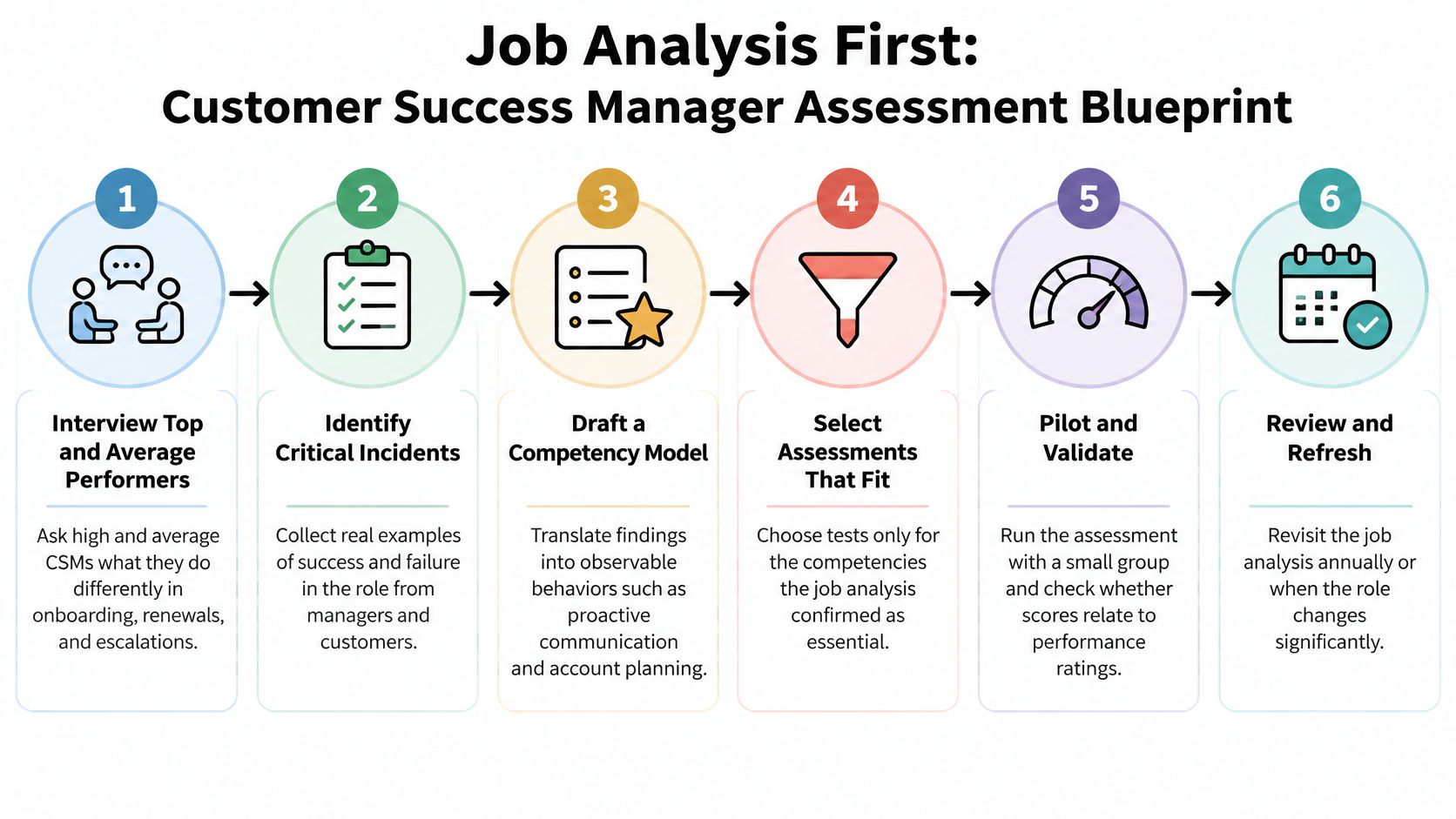
1. Interview high and average performers, then watch a few working days. Sit with two or three strong CSMs and two or three average ones. The contrast is where the signal lives, because a job description records tasks while people reveal the difference between doing them well and badly. 2. List the critical tasks from most to least important. Onboarding handoffs, quarterly business reviews, escalation handling, renewal negotiation. Without a rank order, every activity becomes a competency and the assessment turns into a wish list. 3. Translate each task into the knowledge, skills, abilities and other characteristics it needs. Product depth for a technical escalation, written clarity for a QBR deck, tolerance for conflict in a renewal call. This is the step that converts work into something measurable. 4. Rate each requirement for importance and how often it's used. A monthly task and a daily one don't deserve equal weight, even when both appear on the role profile. Frequency and importance together set the weighting. 5. Choose performance criteria you can measure after hire. Customer retention, renewal rate, time to resolve issues, supervisor ratings. A predictor needs a criterion, or there's nothing to test the framework against a year later. 6. Map each competency to one or two assessment methods that can observe it. One method per competency stops you running three tests that measure the same trait. A second method gives a cross-check where the decision is expensive.
The [SIOP validation principles](https://www.houstontx.gov/hr/hrfiles/classified_testing/siop_principles.pdf) formalize what steps one through six are doing: they distinguish content validity, construct validity, and criterion-related validity, and recommend job-analysis data to select both predictors and performance criteria. The same principles name the common predictors as cognitive-ability tests, personality inventories, biodata instruments, and structured interviews. They also require item-level analysis, keeping questions that separate candidates likely to perform well from those who aren't and dropping redundant items that measure the same characteristic twice.
The discipline moved personnel selection away from informal judgment and toward systems built on measurable job requirements. If the first step feels fuzzy, a structured method for [how to do a job analysis](https://synopsix.ai/blog/how-to-do-a-job-analysis) keeps it from collapsing into a list of adjectives.
Refresh the analysis when the role changes. A job description written three years ago often describes a job nobody currently does, and an assessment built on it will confidently measure the wrong demands.
Which Assessment Methods Predict Job Performance
Validity coefficients put numbers on the question most assessment marketing avoids: how closely does a score track later job performance? The [Office of Personnel Management's summary on designing an assessment strategy](https://www.opm.gov/policy-data-oversight/assessment-and-selection/assessment-strategy/designing-an-assessment-strategy/) reports the following approximate correlations between assessment scores and job performance.
| Assessment method | Approximate validity coefficient | What it captures | |---|---|---| | Work samples | 0.54 | Performance on a sample of real job tasks | | Structured interviews | 0.51 | Standardized questions scored against competencies | | Job-knowledge tests | 0.48 | Role-specific knowledge the job requires | | Assessment centers | 0.37 | Behavior observed across several exercises | | Biodata instruments | 0.35 | Verified past experience and background | | Reference checks | 0.26 | Third-party accounts of past behavior | | Cognitive-ability tests | Not reported in this comparison | General reasoning and learning capacity | | Personality inventories | Not reported in this comparison | Stable traits and tendencies at work |
Read the last two rows carefully. This comparison doesn't supply coefficients for cognitive-ability tests or personality inventories, so there's no figure to carry across from it. A number quoted for those methods has to come from a validation study run on your own applicant pool, not borrowed from a slide.
How to read a coefficient before comparing rows
A 0.54 for work samples means scores on a sample of real tasks track performance considerably better than the 0.26 for reference checks in this comparison. It doesn't mean a work sample gets you 54% of the way to a perfect hire, and it doesn't promise the same correlation in your company.
These are correlations, not guarantees, drawn from one cited comparison of methods. Use them to rank-order your options, then validate locally before a method carries real weight in a decision. Structured interviews land at 0.51 because they fix three variables at once: how questions are asked, how responses are observed, and how answers are scored.
A tool can produce stable scores on something irrelevant to the job, which is why consistency alone never settles an argument. Pair methods with different evidence sources for any high-stakes call. For a sales role, a work sample shows whether the candidate can build a territory plan, while a structured interview shows whether they can explain the trade-offs they made.
Weight before you score. Decide how much each competency counts, combine the standardized scores using those fixed weights, and record the reason for any override so the final decision can be read back later. Teams comparing tools for the first screen often end up on a [candidate screening software shortlist](https://toptooladvisor.com/best/best-pre-employment-testing-software), and the filter worth applying there is whether a vendor can show a coefficient for the role you're hiring rather than how long its feature list runs.
How to Prove an Assessment Predicts Real Outcomes
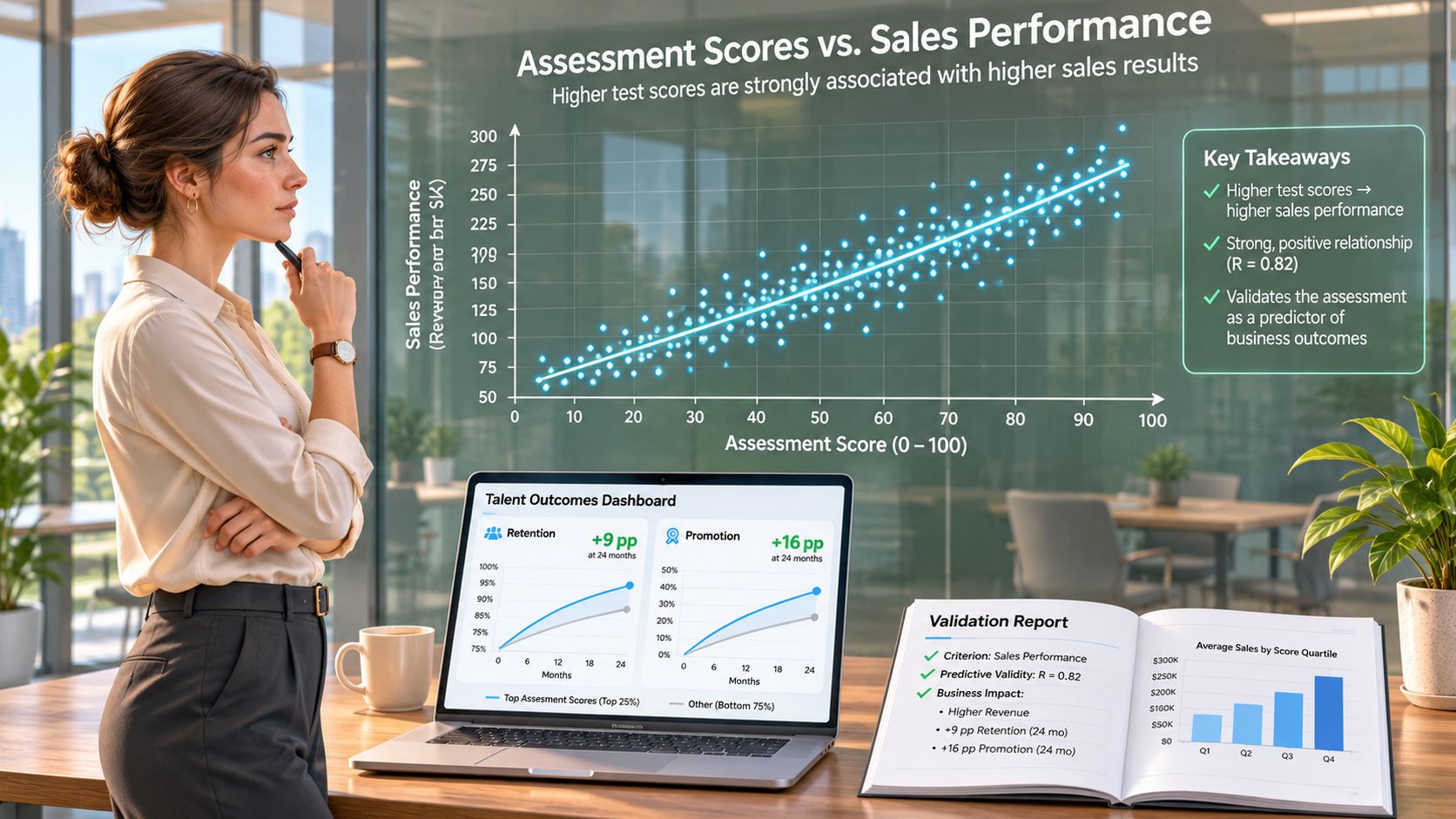
Most frameworks describe competencies in detail, report internal consistency, and compare candidates neatly. Almost none show that scores predict sales results, retention, promotion success, or quality of hire. That's the validation gap, and it's the part that decides whether the framework earns its budget.
The urgency has changed with the arrival of AI-based behavioral inference in recruiting. A 2025 review of 49 peer-reviewed studies found that AI can improve screening efficiency and standardization while leaving unresolved concerns about training-data bias and the need for stronger validation frameworks, as reported in [this review of AI in talent assessment](https://link.springer.com/article/10.1007/s44282-025-00246-w?error=cookies_not_supported&code=b20fbbb4-2d06-48d5-b596-2654e2bba79c). A related comparison in the same body of work found some AI personality-inference tools showed partial construct validity but did not consistently demonstrate predictive validity for real-world job outcomes.
The assessment-to-outcome model
1. Define the job signal. Name the observable performance you're trying to predict, such as renewal rate at 12 months or ramp time to full quota, before touching any assessment content. 2. Link it to observable behavior. Identify the behaviors that produce that signal, like proactive account planning or early escalation of risk, and confirm your methods can observe them. 3. Test it against a business measure. Compare scores to outcomes for people already in the role. A useful verdict needs effect sizes, precision, recall or area under the curve, not a p-value on its own. 4. Label the evidence. State plainly which parts of the model are predictive and which are exploratory. A team profile built for coaching is descriptive insight. A hiring recommendation is a selection claim, and the two need different evidence.
Run criterion-related validation by role rather than across the whole company, because a model that predicts performance for account executives may say nothing about engineers. Break results out by subgroup each cycle. Recalibrate when the job changes, not on a fixed annual date, since a restructured territory can invalidate a model in a quarter.
Here is the trap. A highly consistent assessment can be commercially weak if it predicts the profile managers prefer to see rather than measurable performance. The tool agrees with the interview panel, the panel feels confirmed, and nobody checks whether the people it ranked highest are the ones hitting target.
Quality-of-hire measurement is where this cashes out, and [TekRecruiter's quality-of-hire metrics guide](https://www.tekrecruiter.com/post/quality-of-hire-metrics) is a practical starting point for defining the outcome side before you look at the predictor side. The [mechanics of predictive validity](https://synopsix.ai/blog/what-is-predictive-validity) explain what a defensible study has to contain.
That discipline is the difference between a framework and a scoring ritual, and it's worth watching how it plays out in practice.
<iframe width="100%" style="aspect-ratio: 16 / 9;" src="https://www.youtube.com/embed/ZDSYGjpjt5c" frameborder="0" allow="autoplay; encrypted-media" allowfullscreen></iframe>
Keeping Assessments Fair, Transparent and Reviewable
A shortlist can look tidy and still break the validation chain. Every score has to trace back to a documented job requirement and forward to a result someone can reconstruct later. Without that path, fairness is a claim with no record.
The [2025 CandE benchmark statistics](https://survale.com/2025-candidate-experience-cande-benchmark-research-key-statistics/), drawn from more than 66,000 completed candidate surveys, rank AI or automated screening complaints and impersonal rejections among the leading negative themes, and report a 23% higher perception of assessment fairness among organizations recognized for candidate experience. That same analysis found human reviewers followed moderately biased AI recommendations roughly 90% of the time.
A reviewer who clicks approve is not a safeguard. The click only checks the model when the person applies a written standard and stores a reason. Otherwise the human step copies the score.
> Transparency is a documented answer to what was measured and how that result was used.
Regulators in several jurisdictions are increasing scrutiny of automated employment decisions, including whether a tool is job-related and whether employers test for discriminatory effects before they rely on it.
The five design requirements
1. State what is measured and how scores are used. Name the competencies, the method, and whether the score filters, ranks, or only informs an interview. Tie each item to a documented job requirement so the score is not judged by how polished the report looks. 2. Offer a route to challenge an error. A candidate who flags a factual mistake in the record should get a response and a correction path. 3. Monitor adverse impact by subgroup each cycle. Compare selection rates by group on a set schedule, not after a complaint arrives. 4. Define when a human must override the model. Write the trigger conditions in advance so an override is a recorded decision, not a mood. 5. Record the reason for every human decision. Keep it short, specific, and stored with the candidate record so the call can be rebuilt months later and set against the outcome it was meant to predict.
Those five rules are the governance half of the framework. The [practical ethics of assessment](https://synopsix.ai/blog/ethics-in-assessment) need the same design attention as the scoring model. A consistent narrative does not show that the people ranked highest later met the standard the role required.
Matching Assessments to Each People Decision
One framework can serve several decisions, but the question shifts each time, so the weight on each method shifts with it. A work sample that settles a hiring call says little about who is ready for a stretch assignment.
| Decision | Key question | Assessment emphasis | Evidence to check | |---|---|---|---| | External hiring | Can this candidate perform in this role and team? | Work samples, structured interview, team-fit analysis | Supervisor-rated performance after the first year | | Internal mobility | Who is ready for the next role? | Learning agility, competency gap review, scenario tasks | Results in stretch assignments | | Promotion | Already performing at the next level? | Work samples at target level, multi-rater feedback | Results against the target-role KPIs | | Succession | Who could step into a critical role, and when? | Leadership assessment, scenario simulation | Readiness reviews and retention in the role | | Team design | Does the team have the skills and styles it needs? | Competency coverage mapping, interaction profiles | Team output and recurring friction indicators |
The promotion case shows the difference
Consider a team lead role. A promotion decision should lean on work samples performed at the target level and results measured against that level's KPIs, because the person is already inside the organization and you can observe them doing the higher-level work.
A hiring decision for the same team lead role can't rely on that evidence, so it leans on a structured interview and a work sample built around the entry-level version of the tasks. Same job title, different evidence, different weights.
Reusing a hiring assessment for succession without re-validating it is the common version of this mistake. The criterion has changed from "will this person perform in the role" to "who can hold this role, and how soon," and a model validated against the first question hasn't answered the second.
Record two things for every decision: which competencies carry the most weight, and which outcome will confirm the choice was right. Without the second, nobody learns anything from the decision six months later, and the framework stays frozen at the level of opinion.
Confirm Your Framework Before the Next Hire or Promotion
Pick one live decision, such as a team lead hire already in the pipeline, and audit it against the six components before changing anything else. Is the job analysis current? Does every competency on the scorecard map to a named method? Are scoring rules written down, including cut scores and rater guidance? Does any outcome data exist to validate against?
Then run a small pilot with recent hires or promotions. Compare assessment scores with later performance, report results by subgroup, and note where the sample is too small to say anything. Small samples are normal at this stage, and saying so is more credible than a confident chart built on eleven people.
Any tool, including a platform's own behavioral profile, still needs your framework's own validation evidence. External claims about accuracy don't transfer to your roles, your criteria, or your candidate pool.
Our AI personality and competency assessments read each person against the specific role rather than a generic profile, and the personal professional assessment is free, takes about 10 minutes, and returns a full downloadable PDF report that stays private and confidential. Treat that as one way to see a role-based profile, not as validation in itself. The next step after any profile is the same: trace a score to a job requirement, then forward to an outcome you measured.
---
The framework only earns its name once someone can trace the number. Synopsix builds AI personality and competency assessments that read each person against the role in question, then packages the output as fit recommendations, risk indicators, and interview questions a hiring manager can put to use. Start with the free personal professional assessment, about 10 minutes with a downloadable PDF report, and see whether the profile survives your own trace test against the role you're filling. Visit [Synopsix](https://synopsix.ai) to run it.