Talent Development Plan Template That Actually Works
By Synopsix · September 26, 2026 · 16 min read
You're probably looking at a familiar document: an employee's name, a few broad goals, a training course, an owner, and a review date. It looks complete until the next 1:1, when nobody can explain what changed, which behavior was practiced, or whether the plan still supports the employee's role.
A useful talent development plan template has to do more than record intentions. It should turn behavioral evidence into observable actions, give managers prompts they can use in regular conversations, and connect progress to outcomes the employee and team already understand. That design matters as organizations move toward skills-based workforce planning. LinkedIn's 2026 talent data reported that 30% of organizations globally were using skills-based workforce planning, with regional variation across Asia-Pacific, Europe, the Middle East and Africa, and North America, as summarized in this [global talent development report](https://www.fifatrainingcentre.com/en/environment/talent-development/talent-development/global-report.php).
Why Most Talent Development Plan Templates Fail
The common assumption is that a development plan fails because the employee doesn't care enough. In practice, the document often creates the failure. A grid that says “improve communication,” “complete leadership training,” and “review progress later” records activity without defining behavior change.
That distinction matters. A development plan should answer, What will this person do differently at work, in which situations, and how will we know? A course may provide useful input, but it doesn't prove that an employee can apply the skill under pressure, with real stakeholders, and within the constraints of the role.
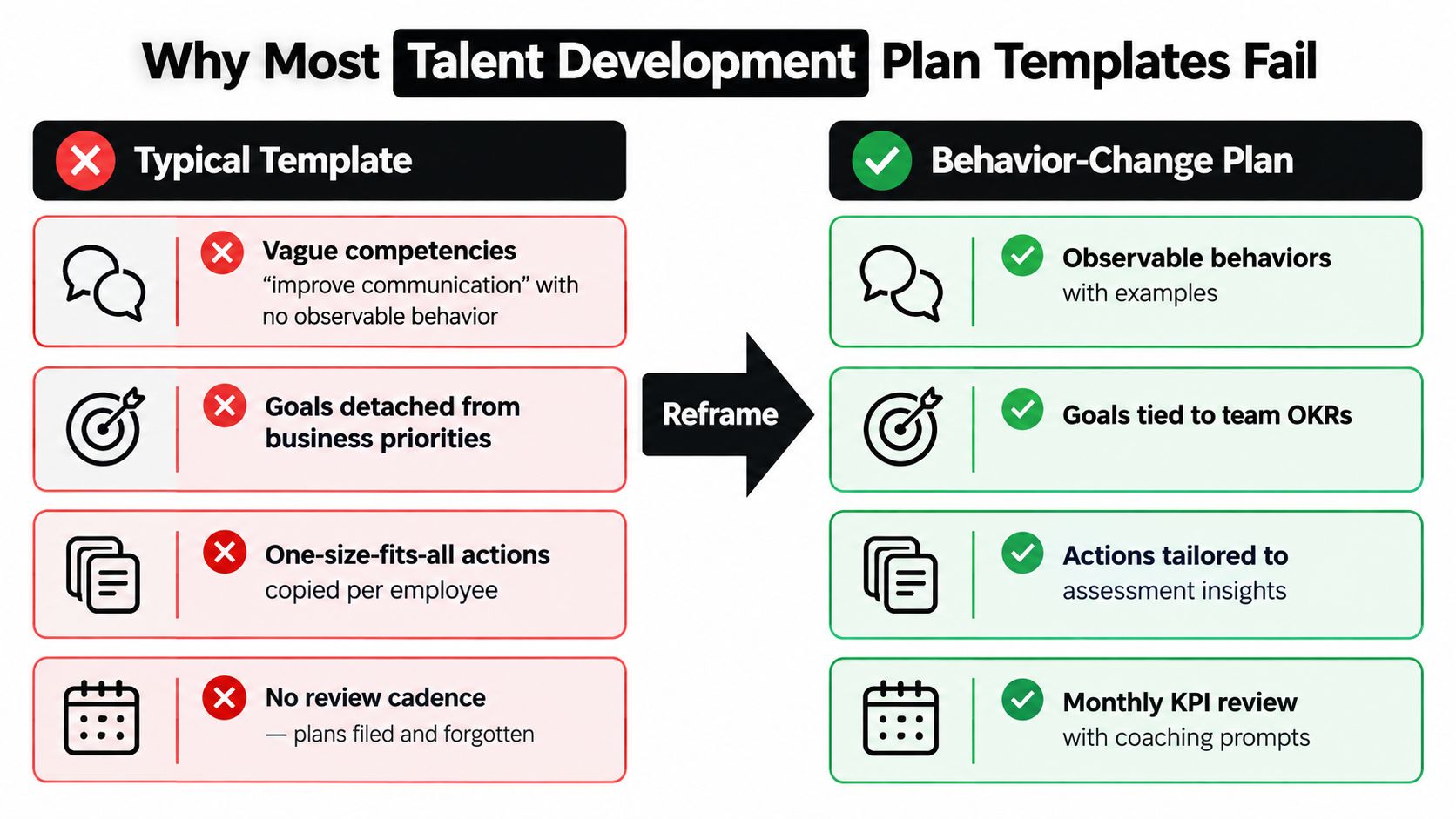
The four recurring breakdowns
A working template fixes those weaknesses in sequence. It uses behavior-first wording, selects priorities from assessment and role evidence, embeds manager prompts in 1:1s, and assigns named metrics with review dates. The priority set should stay narrow. Practical guidance recommends one to three development priorities per quarter, because a longer list fragments attention and weakens follow-through, as described by the [Talent Strategy Group's development planning guidance](https://talentstrategygroup.com/delusions-of-employee-development-2022/).
> Practical rule: If a manager can't observe the behavior, coach it, or connect it to a meaningful outcome, it doesn't belong in the priority field.
The document itself is inert. The system around it drives growth. A strong template makes that system visible and repeatable.
Anatomy of a Fillable Talent Development Plan Template
Fill the plan in the order a manager and employee will use it. Starting with a course catalogue or a list of competencies usually produces generic actions.
Start with context, then narrow the plan
Employee and role context should capture the current role, scope, key responsibilities, target role or project, and business outcomes connected to the work. Good content describes the employee's operating environment, such as “owns onboarding conversion across product and customer success.” Filler content repeats the job title without showing what success requires.
Assessment snapshot comes next. Paste or summarize the relevant profile signals, not the entire report. Include strengths to build on, likely derailers under pressure, and growth edges that appear during stretch situations. Behavioral assessments can illuminate tendencies in communication, decision-making, collaboration, and response to change, but they don't establish capability or future performance by themselves. Use them alongside work samples, structured interviews, feedback, and role evidence, consistent with this [guide to behavioral assessments](https://www.thomas.co/resources/type/hr-guides/behavioral-assessments-guide).
Choose the top three development priorities only after reviewing that context. Each priority should contain an observable behavior and a context clause. “Collaborate more” is weak. “Before escalating a cross-functional dependency, ask the partner to confirm constraints and propose two options” is testable.
Specify action, measurement, and support
The actions block should include weekly behaviors, stretch assignments, learning inputs, and stakeholder exposure. A useful entry names the frequency, setting, and owner. “Lead the weekly launch risk review and request feedback from engineering afterward” is stronger than “attend stakeholder meetings.”
The KPI table needs a baseline, target, owner, and review date. Use leading indicators for practice and lagging indicators for outcomes. Don't disguise course completion as performance evidence.
The manager support block records coaching commitments, access the manager will provide, and prompts for 1:1s. Include workload trade-offs and protected learning time. This is essential because research cited in a [review of individual development plans](https://www.businessmanagementdaily.com/51186/individual-development-plans-trap/) found that a plan alone did not increase intended learning activity or perceived skill strength, while time demands commonly block development.
Finally, add 30, 60, and 90-day checkpoints. Each checkpoint should state what evidence will be reviewed, what might change, and who makes the decision.
| Section | Purpose | Fill With | Weak Content Red Flag | |---|---|---|---| | Employee and role context | Establish the operating environment | Role scope, responsibilities, target role, business outcome | Job title only | | Assessment snapshot | Identify tendencies that shape development | Strengths, derailers, growth edges, supporting evidence | A score treated as a verdict | | Development priorities | Focus effort | One to three observable behaviors with context | Broad competency labels | | Actions | Create practice opportunities | Weekly behaviors, stretch work, learning, exposure | Course list without application | | KPIs | Define evidence of progress | Baseline, target, owner, review date | “Manager feels improvement” | | Manager support | Make accountability mutual | Coaching commitments, access, 1:1 prompts | Employee owns everything | | Review checkpoints | Keep the plan current | 30, 60, and 90-day evidence and decisions | Annual review only |
For additional ideas on structuring goals, actions, and review questions, the [Productivity Radar manager's AI guide](https://productivityradar.com/employee-development-plan/) offers a useful complement to this field map.
<iframe width="100%" style="aspect-ratio: 16 / 9;" src="https://www.youtube.com/embed/fgEcRlrQp6c" frameborder="0" allow="autoplay; encrypted-media" allowfullscreen></iframe>
Turning Behavioral Assessment Insights Into Development Actions
Assessment output becomes useful only after a manager converts it into a work situation. I use a simple pipeline: signal, risk or advantage, action, feedback, measure.
Start by extracting three inputs from a Synopsix report or equivalent profile:
1. Top strengths to build on: Choose stretch assignments where the strength creates value without becoming a comfort-zone trap. 2. Primary derailers under pressure: Build pressure-test scenarios, then add explicit coaching touchpoints before and after the event. 3. Growth edges under stretch: Design deliberate practice with a feedback loop, rather than assigning abstract learning.
Behavioral evidence should guide likely tendencies, not label the person permanently. Human behavior is only partially predictable, so plans should be treated as hypotheses that managers test through observation and review, as explained in this [overview of behavioral predictability](https://openstax.org/books/introduction-political-science/pages/2-3-human-behavior-is-partially-predictable).
Example one for a sales manager
Suppose a sales manager's profile shows high drive and a tendency toward low collaboration under pressure. The plan shouldn't say “be more collaborative.” It should translate the signal into work:
The manager's coaching prompt is specific: “Where did urgency make you narrow the conversation, and what partner input did you recover?” That question connects the profile signal to a visible moment.
Example two for an individual contributor
For an individual contributor whose derailer is perfectionism, the action shouldn't be “work faster.” Set shipped-with-iteration targets instead:
The manager can reinforce the shift by asking, “What was good enough to test, and what did the test teach you?” For more detail on interpreting profile outputs responsibly, use this [assessment interpretation resource](https://synopsix.ai/blog/assessment-interpretation).
The strongest plan doesn't treat assessment data as a diagnosis. It uses the data to choose a situation where practice matters, then checks whether the employee's behavior and results change.
Role-Specific Development Plan Examples
The same template should produce different plans for different scopes. A people leader needs to change how a team operates through other people. An individual contributor usually needs to influence decisions, improve craft, and manage a wider stakeholder network without formal authority.
Example one for an Engineering Manager
Context: Engineering Manager leading a team of eight, responsible for delivery predictability and collaboration with product and customer support.
Assessment signal: Strong execution focus, with a collaboration risk under delivery pressure.
Priority: Make cross-functional planning more inclusive before committing the team.
Target behavior: In planning meetings, ask product and support partners to identify customer impact and constraints before confirming scope. Summarize the trade-off and invite disagreement before assigning work.
Actions: The manager will run a structured pre-planning review, document unresolved dependencies, and request one piece of feedback from a product partner after each planning cycle. The manager's manager will observe one planning session and coach the close.
Milestones:
Manager accountability: The manager's manager reviews the decision notes during the monthly 1:1 and protects time for the observation.
Example two for a Senior Product Designer
Context: Senior Product Designer working across product, research, engineering, and marketing on a complex workflow.
Assessment signal: Strong independent problem-solving, with a growth edge around early stakeholder alignment.
Priority: Surface design assumptions before investing in high-fidelity work.
Target behavior: Share an early concept with explicit questions, invite critique from engineering and research, and record which assumptions changed.
Actions: Run an early critique for each major workflow, pair with a researcher on one discovery activity, and publish a short decision log after key reviews.
Milestones:
Manager accountability: The design manager reviews one decision log in each 1:1 and arranges stakeholder feedback at the midpoint.
| Template Field | Engineering Manager, People Leader | Senior Product Designer, Individual Contributor | |---|---|---| | Role context | Team of eight, delivery and cross-functional planning | Complex workflow, broad stakeholder network | | Behavioral signal | Execution drive, collaboration risk under pressure | Independent problem-solving, early alignment gap | | Priority | Include partner constraints before commitment | Surface assumptions before high-fidelity work | | Weekly action | Structured pre-planning review and feedback request | Early critique and decision log | | Stretch assignment | Lead cross-functional planning | Facilitate discovery across functions | | 30-day evidence | Agendas and decision notes show the behavior | Concepts include questions and risks | | 60-day evidence | Partners describe meaningful input | Partners engage before final review | | 90-day evidence | Delivery and feedback reviewed together | Decision quality and product outcome reviewed | | Manager support | Observe planning and coach the close | Review logs and arrange stakeholder feedback |
The template stays stable, but the evidence changes with scope, authority, and stakeholder range. A separate [leadership development plan template](https://synopsix.ai/blog/leadership-development-plan-template) can help when the plan centers on people leadership rather than individual craft.
KPIs Review Cadence and Manager Coaching Prompts
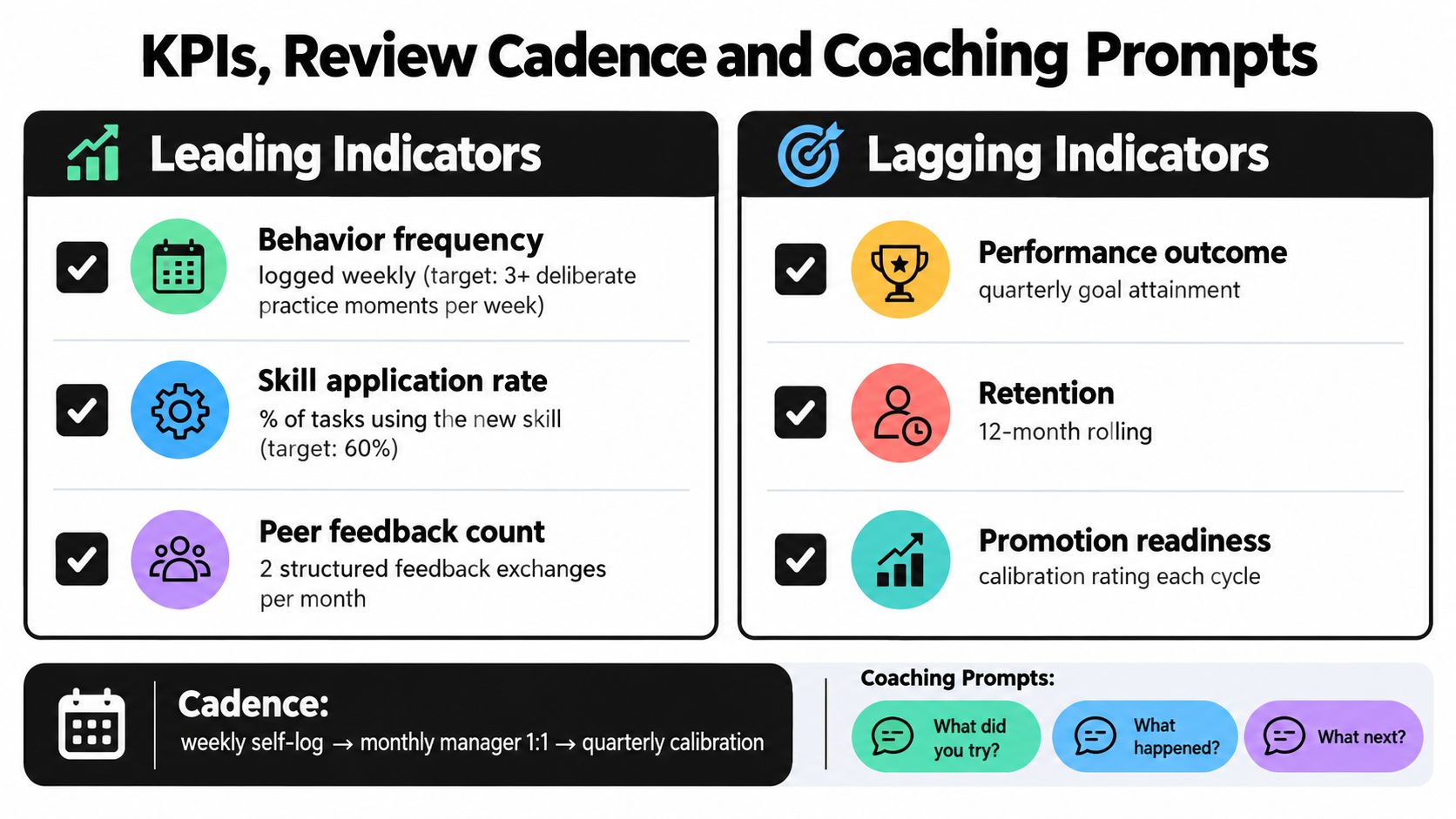
A plan needs two kinds of measurement. Leading indicators show whether the employee is practicing the behavior. Lagging indicators show whether that practice is contributing to role performance and readiness.
Use a small KPI set:
Avoid turning the plan into a measurement contest. If a metric encourages performative activity, replace it with evidence that reveals judgment, application, or outcome.
The three-touch cadence
Week 2 micro-check: Confirm that the first practice opportunity occurred. If not, remove the blocker, revise the action, or acknowledge that the plan isn't feasible in the current workload.
Week 6 progress review: Compare behavior evidence with the original assessment signal. Escalate when the employee lacks access to practice, the manager hasn't delivered support, or the priority no longer matches the role.
Week 12 outcome review: Review the leading and lagging indicators together. Keep, revise, or replace the priority based on evidence, not completion of assigned activities.
When a plan drifts into task completion, redirect it plainly: “Finishing the course is an input. Show me where the behavior appeared in your work and what changed because of it.”
Twelve prompts for 1:1 conversations
1. Which assessment signal showed up most clearly this week? 2. What did you do differently in the situation? 3. What happened after you changed the behavior? 4. Which part of the action felt unnatural or difficult? 5. What feedback did you request? 6. What feedback did you receive without requesting it? 7. Where did pressure pull you back toward the old pattern? 8. Which stakeholder experienced the change directly? 9. What evidence shows that the skill was applied? 10. What support or access is missing? 11. What will you practice before the next 1:1? 12. Should the priority stay the same, become narrower, or change?
The cadence works because it makes development part of operating management. The manager doesn't need a separate ceremony. The manager needs a consistent question, a visible piece of evidence, and a decision about the next practice opportunity.
Rolling Out the Template Without Losing Momentum
A fifty-person product organization rolled out its new template over twelve weeks. The HR lead avoided a company-wide launch at the start because managers needed to test whether the fields worked in real conversations.
Weeks one through four
In week one, HR and three pilot managers co-built one plan each. They challenged every field that produced generic answers and tested whether a manager could identify the next weekly behavior without translating the document first.
During weeks two through four, the pilot managers completed plans for their direct reports. They met weekly to flag broken fields. Three problems surfaced quickly:
Weeks five through twelve
Weeks five through eight expanded the process to all people managers. A mandatory calibration session compared plan quality, not employee quality. Managers reviewed whether priorities were observable, whether actions were feasible, and whether evidence could be collected during normal work.
During weeks nine through twelve, HR embedded the template into the existing performance system and retired the spreadsheets. Managers used the same fields in 1:1s and performance conversations, while employees could update context when priorities shifted.
The organization also treated adoption friction as a design problem. Guidance on [organizational change fatigue](https://synopsix.ai/blog/organizational-change-fatigue) is relevant here because adding another process without removing an old one makes participation feel like administrative debt.
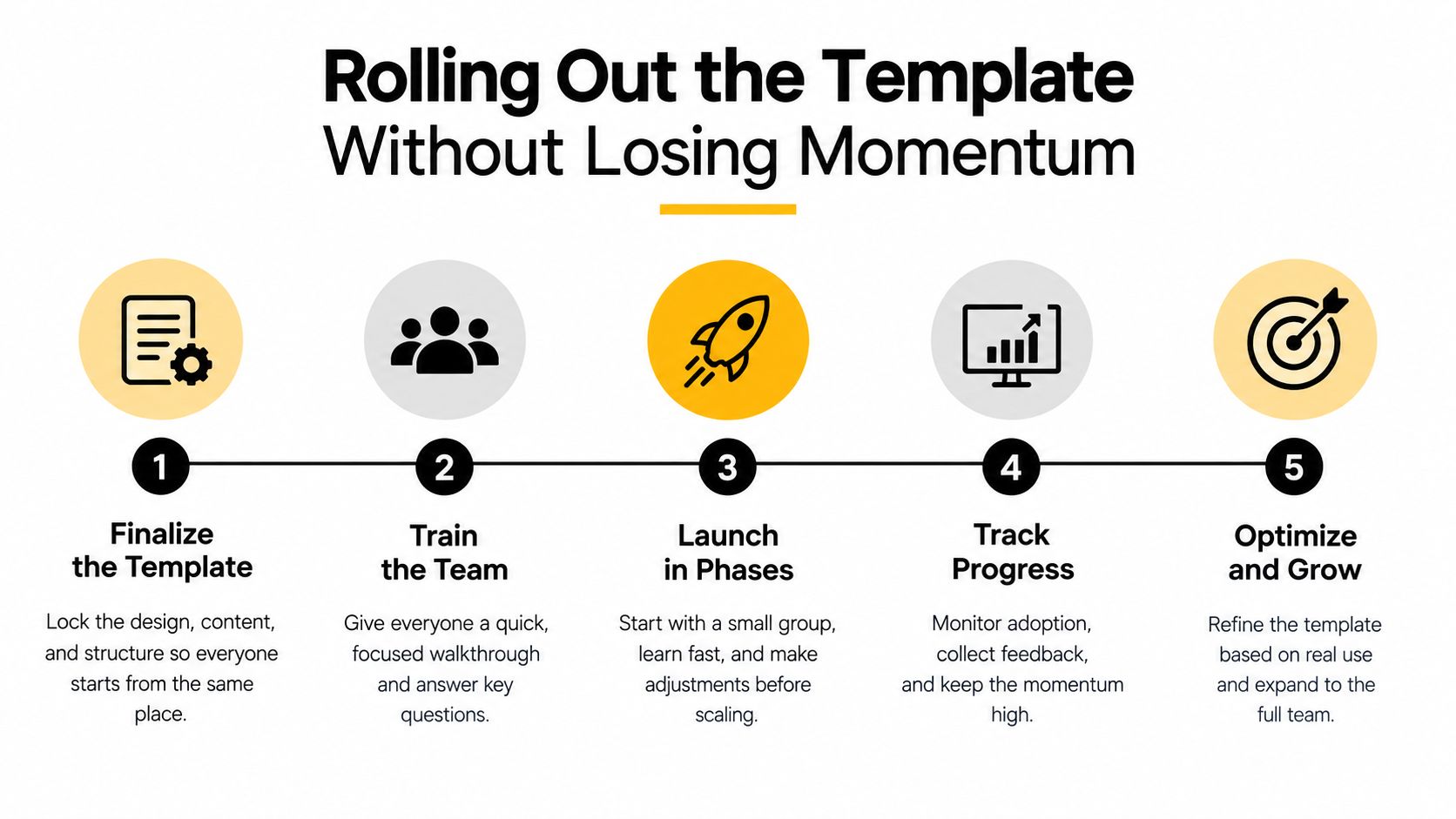
The rollout succeeded because the team fixed the operating model, not just the wording. Employees contributed to the plan, managers calibrated quality, and the performance system became the place where progress was discussed.
Habits That Make the Template Stick
Four habits keep a talent development plan template alive.
1. Review on a fixed cadence. Waiting for a performance problem turns development into remediation. Put the conversation in the existing 1:1 rhythm. 2. Update context in real time. A new project, manager, customer, or team structure can invalidate an action. Edit the relevant field instead of restarting the plan annually. 3. Name the business outcome. Every action should connect to an outcome the employee can explain, such as clearer decisions, stronger stakeholder alignment, or more reliable delivery. 4. Use behavioral evidence, not personality labels. “You're not collaborative” creates defensiveness. “In the last escalation, you made the decision before gathering partner constraints” gives the employee something to examine.
Before each 1:1, the manager should check:
A template gathers dust when nobody uses it to make a decision. Keep it attached to evidence, conversation, and the next piece of work.
---
Synopsix turns behavioral assessment data into practical guidance for hiring, team design, and talent development, including comparable profiles, role-relevant signals, and development plans that managers can use in 1:1s. Visit [Synopsix](https://synopsix.ai) to see how your team can move from assessment insight to specific, evidence-based development actions.