Talent Development Strategy: The 2026 Playbook
By Synopsix · August 25, 2026 · 16 min read
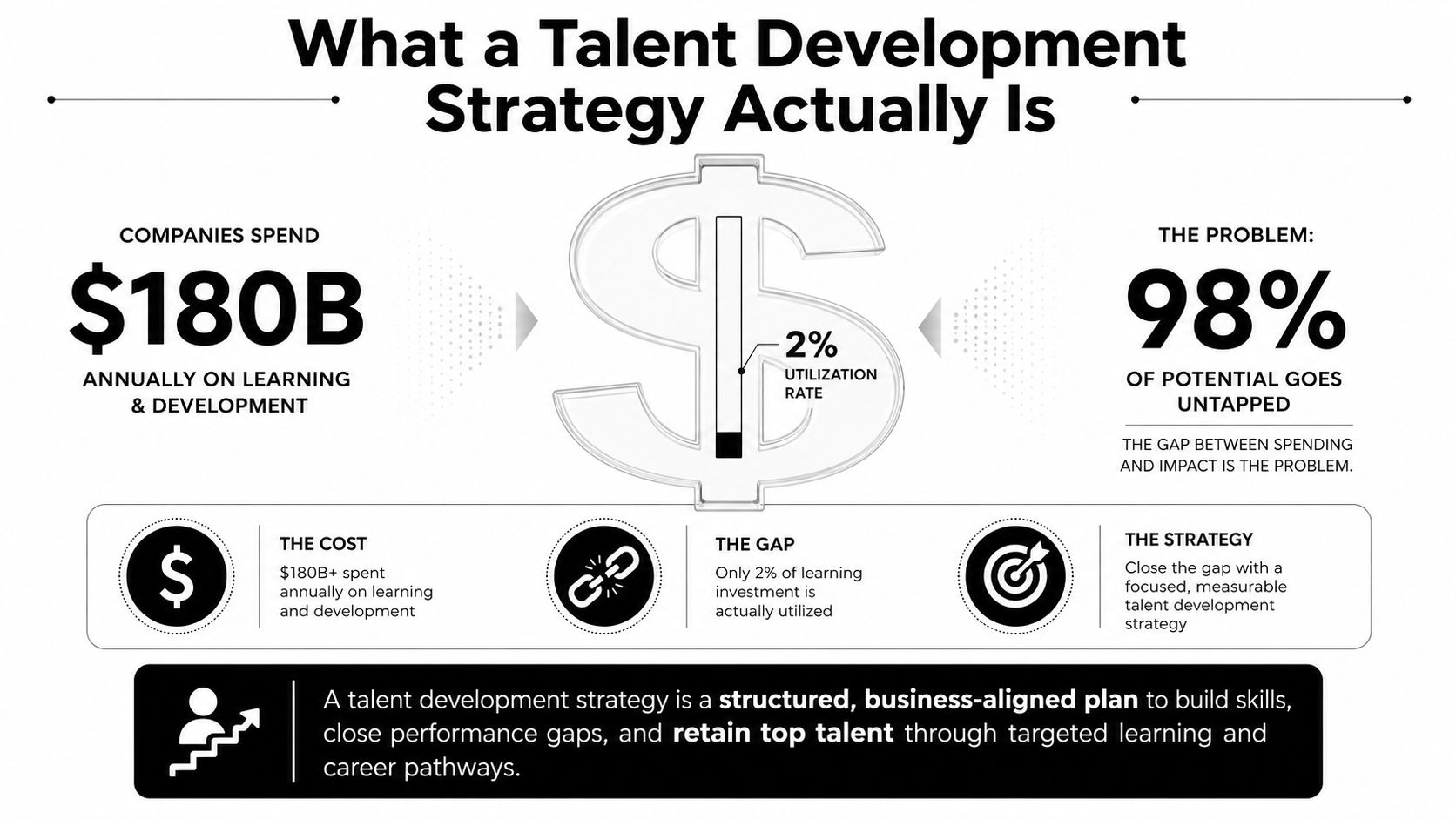
U.S. corporations spend nearly $180 billion annually on formal training and talent development, including about $28 billion on tuition reimbursement, yet only 2% of employees use employer tuition assistance programs according to [talent development statistics from InStride](https://www.instride.com/insights/talent-development-statistics/). That isn't a learning problem. It's an execution problem.
A serious talent development strategy turns business priorities into capability decisions. It identifies which roles matter, what strong performance looks like, who can deliver it, how gaps will close, and whether the investment changes hiring, promotion, leadership depth, retention, or productivity. Frameworks help, but frameworks alone don't move people into better decisions. The operational layer is people intelligence, behavioral evidence, simulations, and interlink analysis that give leaders something more useful than another polished competency deck.
What a Talent Development Strategy Actually Is
A talent development strategy is a documented operating system for building the capabilities a company needs. It should connect the organization's plan for the next 24 to 36 months with the people and roles expected to deliver it. That means identifying current capability, locating the gaps, choosing whether to close them through hiring, internal mobility, or learning, and tracking the business result.
The spending and utilization gap shows why many programs fail before launch. Companies can allocate substantial money to tuition, courses, and development platforms, but employees won't participate solely because access exists. In the same InStride reporting, 88% of C-suite executives said employee access to education was critical to business strategy, while 80% planned to continue that investment for the 2020 to 2021 academic year. The strategic intention was strong. The employee operating experience was not.
Build the strategy around decisions
Start with the operating plan, not the learning catalog.
1. Name the business outcomes: Identify the growth, efficiency, transformation, or continuity goals that require new capability. 2. Map critical roles: Specify which roles influence those outcomes and what excellent performance requires at each level. 3. Assess the workforce: Determine who already demonstrates the required behaviors and where evidence is incomplete. 4. Choose the intervention: Use hiring for unavailable capability, mobility for adjacent capability, and learning for capability that can be built. 5. Measure the effect: Track changes in proficiency, time to proficiency, internal movement, performance, retention, and role readiness.
A generic training program usually measures activity. A strategy measures capability and business impact. It names the people and roles involved, assigns accountability to managers, and makes the trade-offs visible.
That distinction matters because 46% of global workers said they would likely leave if employers didn't offer upskilling opportunities, as reported by [InStride's talent development research](https://www.instride.com/insights/talent-development-statistics/). Access isn't the outcome. Applied development, visible career movement, and stronger performance are the outcomes. People-intelligence tools make that system more practical by showing how individuals are likely to think, decide, collaborate, and respond under role-specific demands.
How Talent Development Strategy Evolved Into a Business System
Talent development has always responded to business pressure. In 1872, Hoe and Company established the first documented factory school to produce machinists faster and more consistently. The model moved organizations away from informal apprenticeship toward repeatable corporate training, a history documented in the [timeline of talent development milestones](https://futurehistory.earth/timeline/13-1151).
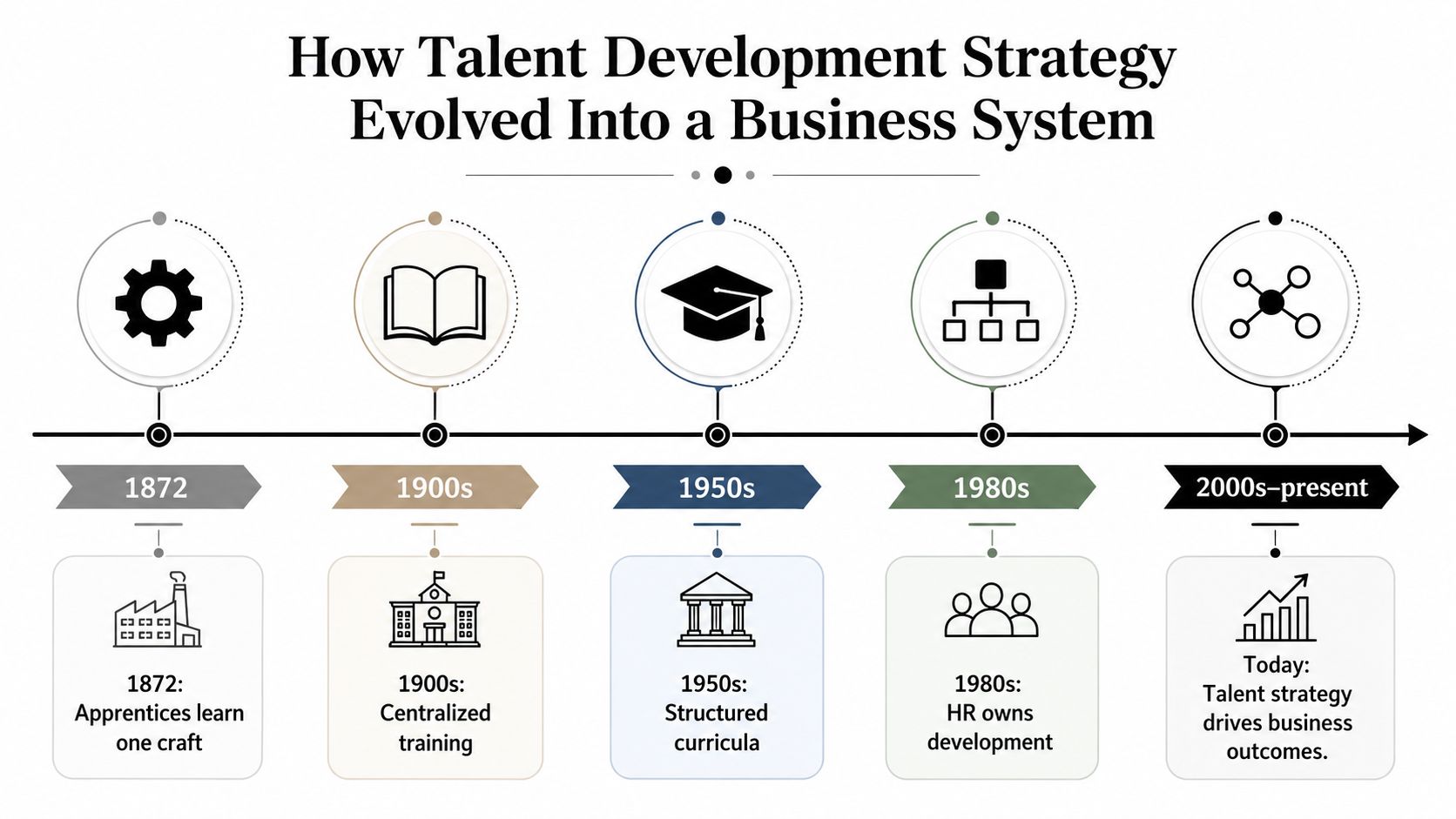
Industrial scale then demanded standardized instruction. In 1940, the U.S. War Manpower Commission launched Training Within Industry, creating a systematic approach for preparing workers during wartime labor shortages. In 1975, researchers at Florida State University working on a U.S. Army contract developed ADDIE, Analyze, Design, Develop, Implement, Evaluate. The framework remains one of instructional design's most recognized structures because it makes development repeatable and assessable.
From training activity to capability allocation
The historical progression is more important than the labels. Each stage expanded the question leaders asked:
The UK government's 2025 systematic review found that nearly 90% of reviewed results showed a positive association between workforce skills and productivity, while warning that causality is harder to establish than correlation, according to its [executive summary on workforce skills and productivity](https://assets.publishing.service.gov.uk/media/6895e43cad0cbc0e27643194/Executive_summary.pdf). That caveat should sharpen strategy, not weaken it. Leaders need evaluation designs that distinguish selection effects from genuine learning effects.
The modern talent development strategy therefore treats talent as a portfolio to allocate, not a cost center to control. A role with observable output and a large capability gap deserves more targeted investment than a broad course library with no operating owner. The vocabulary has changed, but the underlying problem is familiar: build the right capability quickly enough to protect the business.
The Core Pillars of a Modern Talent Development Strategy
A working strategy rests on competency models, succession planning, and learning pathways. The pillars only work together when someone owns the execution. Mercer's 2024/2025 survey identified HR capacity and capability as a barrier for 40% of organizations, excessive change for 38%, and funding or perceived cost risk for 30%, as summarized in the [skills snapshot survey report](https://learnworkecosystemlibrary.com/initiatives/research-2024-2025-skills-snapshot-survey-report/). The architecture can be elegant and still fail if managers can't operate it.
Competencies must describe behavior
A competency model should define what good performance looks like at each level, then translate every competency into observable behavior. “Strategic thinking” is too vague. “Reframes a regional sales plan when customer concentration creates risk, explains the trade-off, and secures cross-functional agreement” gives a manager something to evaluate.
Use evidence from work products, simulations, structured interviews, manager observations, and performance outcomes. The model should also distinguish threshold behaviors from differentiating behaviors. Otherwise, every role becomes a list of admirable traits that nobody can consistently assess.
Succession planning exposes the real gaps
Succession planning identifies critical roles, bench depth, and readiness gaps. For every role that could disrupt operations, name at least one ready-now successor and one ready-in-two-years candidate. Don't confuse a high performer with a prepared successor. Current output is evidence, not proof of readiness for a different job.
One missing mid-level leader can stall three downstream initiatives because the person who should coordinate priorities, coach managers, and resolve dependencies doesn't exist. The organization then promotes reactively, hires expensively, or leaves senior leaders doing work below their level.
Learning pathways must change the work
Each priority gap needs a sequence of experiences. Combine on-the-job projects, mentoring, formal courses, stretch assignments, and manager coaching. External or expert-led instruction can help when a team must absorb unfamiliar methods quickly, while application tasks make transfer more likely.
The [2026 leadership development guide](https://www.corporatechallenge.com.au/leadership-development-plan/) offers useful context for designing leadership experiences beyond classroom instruction. The principle is simple: development should create evidence of improved performance before a promotion decision arrives.
| Pillar | Primary Output | Inputs From | Feeds Into | |---|---|---|---| | Competency model | Observable performance standards | Business plan and role analysis | Succession assessment and learning design | | Succession planning | Readiness map for critical roles | Competency evidence and performance data | Priority development pathways | | Learning pathways | Sequenced development experiences | Readiness gaps and employee goals | New evidence for promotion and succession |
Implementing the Strategy Across Hiring, Promotion, Leadership, and Sales
Rollout should follow four phases: Diagnose, Design, Deploy, Defend. Each phase changes how managers make people decisions, not just what HR publishes.
Diagnose
Audit current skills, turnover patterns, promotion decisions, pipeline gaps, and assessment practices. For hiring, compare interview notes with later performance evidence. For promotion, examine whether tenure and manager advocacy dominate the decision. For leadership, identify roles without credible successors. For sales, isolate the behaviors that separate effective calls from weak ones.
A 600-person SaaS company might discover that manager promotions take 45 days and rely heavily on subjective discussion. The diagnostic isn't “we need leadership training.” It's “we lack consistent evidence for readiness, and the review process consumes too much operating time.”
Design
Build role-specific scorecards and behavioral anchors. Hiring managers should replace gut interviews with structured questions and consistent ratings. A 2022 evidence review identified structured behavioral interviewing as the strongest predictor of job performance among the methods it reviewed, with a reported validity of r = .42, as detailed in the [evidence base review of structured behavioral interviews](https://kanbanforhiring.com/audits/samples/pbh-evidence-base-review.html).
Promotion committees should combine a nine-box view with behavioral evidence and review the calibration regularly. Leadership pipelines should use 18-month rotation tracks, executive sponsorship, and stretch assignments mapped to successor slates. Sales teams should pair product instruction with role-play simulations scored against the call patterns of strong performers.
Deploy
Give each audience a concrete workflow:
Use concise [onboarding video templates](https://wideo.co/video-templates/employee-onboarding/) when a repeatable visual explanation will help managers or new hires understand the process. For leadership teams, connect the rollout to [leadership development planning](https://synopsix.ai/blog/leadership-development-planning) so development actions remain tied to role readiness.
A short process explainer can reinforce the operating model:
<iframe width="100%" style="aspect-ratio: 16 / 9;" src="https://www.youtube.com/embed/txn9EVMuHos" frameborder="0" allow="autoplay; encrypted-media" allowfullscreen></iframe>
Defend
Measure impact, challenge weak assumptions, and protect the budget with evidence. The SaaS company could reduce promotion review time from 45 days to 14 days by using standardized evidence, but the trade-off is real: leaders spend more time calibrating upfront and face fewer surprises at year-end. That's a good trade when the alternative is an urgent promotion based on confidence, politics, or availability.
Metrics and ROI That Hold Up to a CFO
A CFO won't approve a dashboard filled with course completions. The finance conversation starts with a baseline, a defined intervention, and a business outcome that can be tracked over time.
The International Labour Organization cites an empirical finding that each additional training day was associated with a 3% productivity increase, and it notes that external courses had a higher average impact than in-house training. The same report says training explained about 16% of overall productivity growth in the European analysis it cites, as described in the [ILO report on training and productivity](https://www.ilo.org/sites/default/files/wcmsp5/groups/public/@ed_norm/@relconf/documents/meetingdocument/wcms_092054.pdf). These findings don't justify indiscriminate training. They support targeted intensity, appropriate modality, and measurement of transfer.
Build three metric tiers
Leading indicators tell you whether the system is operating: assessment scores, manager confidence, internal mobility, time to proficiency, pathway participation, and completed application tasks.
Lagging indicators show whether the business benefited: regrettable attrition, promotion success, sales quota attainment, leadership bench strength, and role-specific productivity.
Financial measures translate the effect: replacement cost avoided, revenue per FTE change, and time-to-productivity savings. For a 30-day ramp reduction, use:
Annualized value = number of affected hires × daily value of productive work × 30 days
Define “daily value” with finance-approved contribution or output assumptions. Don't invent a benchmark after seeing the result. Agree on the baseline, comparison group, time period, and decision threshold before launch.
| Metric | Tier | Calculation | CFO-Ready Benchmark | |---|---|---|---| | Time to proficiency | Leading | Days from start date to defined role standard | Improvement against the agreed baseline | | Internal fill rate | Leading | Critical roles filled internally divided by critical roles filled | Trend compared with the baseline | | Promotion success | Lagging | Promoted employees meeting role outcomes divided by promoted employees assessed | Sustained improvement by role family | | Revenue per rep | Lagging | Revenue divided by active sales representatives | Change against a matched comparison | | Ramp savings | Financial | Affected hires × daily productive value × days saved | Finance-approved annualized value |
Before the first QBR, prepare a one-page defense: business problem, intervention, comparison method, result, cost, and next decision. The [assessment validity and reliability guidance](https://synopsix.ai/blog/assessment-validity-and-reliability) is useful when leaders challenge whether an assessment measures what the organization claims it measures.
How People-Intelligence Accelerates Every Stage of the Strategy
Frameworks define the destination. People intelligence supplies the operating signal that helps managers decide who fits a role, who is ready for a broader mandate, where a team will struggle, and what development action should come next.
Behavioral assessments make candidate and employee patterns comparable. They can add information that interview scores, resumes, and references often miss, particularly when a role depends on decision style, ambiguity tolerance, collaboration, or response to pressure. A review of behavior profiling found that general mental ability combined with an integrity test, and general mental ability combined with a structured interview, were among the best-supported combinations for predicting job performance among common selection procedures, as discussed in the review of behavior profiling for recruitment and team building.
Assessments, simulations, and interlink maps
A simulation tests behavior in context. It can show how a prospective manager prioritizes conflicting demands, how a sales candidate handles an objection, or how an executive responds when information is incomplete. That evidence is more actionable than a generic “high potential” label because it points to the behavior that needs reinforcement.
Interlink analysis maps complementarity and friction across a team. A leadership pipeline can look strong on paper while depending on one person to translate strategy, resolve conflict, and connect functions. The map exposes that dependency before it becomes a succession failure.
A 2026 eLife study demonstrated a mechanism for extracting an individual latent representation from behavior in one task condition and using it to predict behavior in another task condition, as described in [the study on predicting human decision-making](https://elifesciences.org/articles/107163). For business leaders, the practical lesson is that behavior data can support context transfer when the measurement design and target task are clear.
Synopsix is one example of this operational layer. Its platform uses behavioral assessments to generate comparable profiles, translate psychometric results into business signals, and support simulations, compatibility analysis, and development plans through [its talent intelligence platform](https://synopsix.ai/blog/talent-intelligence-platform).
The trade-off is not data versus judgment. It's subjective debate versus data-driven disagreement. Humans still make the decision, but they spend less time defending personal impressions and more time examining evidence. That can compress hiring shortlists, speed promotion calibration, and make sales coaching specific enough to use on the next call.
Pitfalls That Kill Talent Development Programs
Programs fail when leaders tolerate weak adoption, vague evidence, and unclear ownership. The framework rarely deserves the blame. The operating model does.
CompTIA reports that only 34% of companies have a formal organization-wide reskilling or upskilling program, according to the [2026 learning and development trends analysis](https://www.ciphr.com/blog/ld-trends-2026). That gap should change how CHROs diagnose failure. If executives endorse development but ignore the system in hiring, promotion, and operating reviews, employees correctly conclude that participation is optional.
| Pitfall | Early-Warning Signal | Counter-Move | |---|---|---| | Executive endorsement without use | Leaders skip pathways and nominate talent informally | Require executives to use the same evidence in succession reviews | | Job rotation as a slogan | Cross-functional bench depth remains thin | Make rotations part of critical-role readiness plans | | Vague competency language | Managers cannot cite observable behavior | Rewrite competencies as role-specific actions and outputs | | Measurement theater | Reports show completion instead of changed behavior | Track application, proficiency, mobility, and business outcomes | | HR-only ownership | Line leaders treat development as a service | Assign business owners and review results in operating cadence |
Job rotation makes weak adoption visible. Ninety-three percent of HR professionals view it as highly effective, but fewer than 25% of HR teams use it, according to Ciphr's 2026 L&D trends reporting. Assign rotations to specific successors, attach a business deliverable, and hold the sponsor accountable for reviewing the result. A rotation without an owner is a scheduling exercise, not development.
As noted in the earlier discussion of barriers, Mercer's reporting found that only 27% of organizations make employee skill profiles broadly visible, while only 8% use AI-driven skills mapping, according to the [2024/2025 skills snapshot survey](https://learnworkecosystemlibrary.com/initiatives/research-2024-2025-skills-snapshot-survey-report/). Limited visibility restricts internal mobility. Managers cannot see available capability, and employees cannot see credible pathways. People-intelligence tools should connect behavioral evidence, simulations, and interlink maps to these decisions, rather than leaving development data in a separate HR system.
Require a business case before renewing any program. The owner must identify the role gap, the behavior that should change, and the metric expected to move. If those links are missing, stop funding the activity and redirect the money.
A 90-Day Starter Plan and the First Question to Answer
Execution starts with a narrow pilot, not a company-wide transformation announcement. Choose one role family where the business impact is visible and where managers will review evidence frequently.
Days 1 to 30
Instrument the baseline. Capture turnover, internal fill rate, time in role, and revenue per representative where relevant. Then run a behavioral diagnostic against the organization's strongest performers, using the results to identify patterns worth testing rather than treating top performers as a personality template.
Days 31 to 60
Pilot one competency model with one role family. Pair it with a simulation or behavioral assessment, then identify ten successors for critical roles and document the evidence behind each readiness judgment. Select three critical skill gaps, design one pilot program, and assign managers to the application work.
Days 61 to 90
Hold the first succession review with line leaders. Retire the lowest-performing learning programs, commit to two role-specific pathways, and measure the shift in two baseline metrics. The pilot should include 20 participants only if that is the approved design, not because a round number makes the program look complete.
The first question every CHRO should answer before approving the next training budget is direct:
> Can you name the three people who will run your largest P&L in 24 months, and what evidence supports that forecast?
If the answer is no, the strategy isn't operational. Start by mapping the roles, collecting behavioral evidence, and giving each successor a measurable development assignment. Synopsix helps teams turn behavioral assessments into comparable profiles, role-specific intelligence, simulations, and interlink views for hiring, promotion, team design, and leadership development. Visit [Synopsix](https://synopsix.ai) to see how people intelligence can connect your talent development strategy to faster, evidence-based decisions.