Talent Risk Assessment: A Practical Playbook for HR Leaders
By Synopsix · July 25, 2026 · 16 min read
Most advice about talent risk assessment starts in the wrong place. It treats the problem as a guess about who might leave, then stops at retention metrics and manager intuition. That misses the core purpose, which is to protect execution capacity, spot future skill gaps, and decide where the business is exposed before people walk out the door.
A stronger approach is structured and forward-looking. McLean & Company's guidance on flight risk emphasizes that informal judgments aren't reliable on their own, and recommends combining data analysis, stay conversations, and human-centered insight to forecast future talent gaps and reduce turnover risk, while also using workforce financial data like headcount and total cost of workforce, plus external labor-market scans and supply-demand analysis, so the work becomes part of business planning, not just HR reporting. Mercer frames the same idea inside enterprise risk management, which is the right lens when people risk can affect delivery, continuity, and competitive position. [McLean & Company on assessing flight risk of key talent](https://hr.mcleanco.com/research/ss/guide-to-assessing-flight-risk-of-key-talent)
That broader view also changes the conversation about talent data. A useful parallel is how product teams study customer success, not just customer churn, because the core question is whether the system can keep delivering value over time. A practical example is the [guide from Mava on customer success](https://www.mava.app/blog/customer-success-for-saas), which shows how retention-related work becomes more useful when it is tied to behavior, adoption, and future value rather than a single outcome.
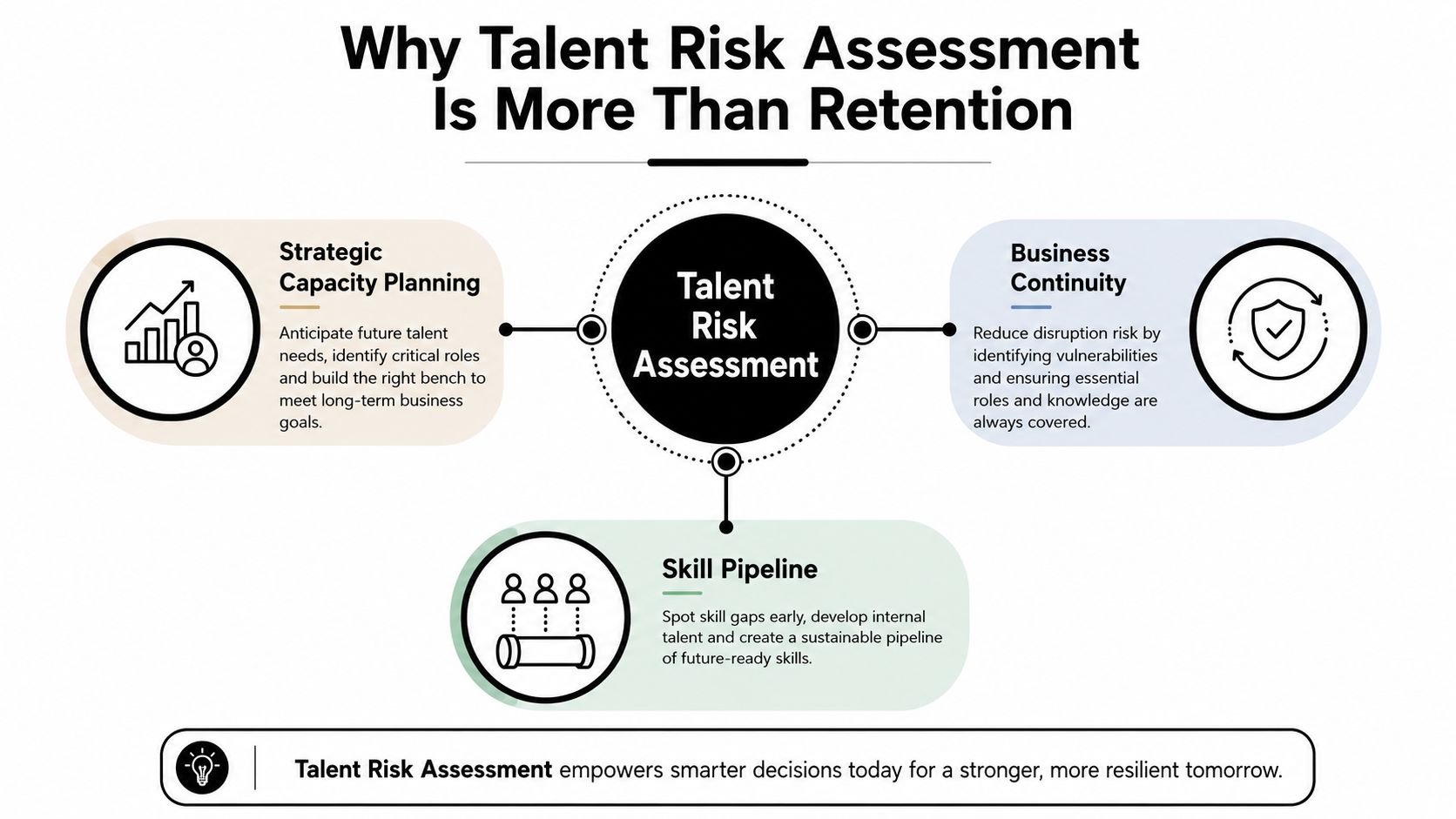
Why Talent Risk Assessment Is More Than Retention
The easiest mistake is to equate talent risk with flight risk. That view is too narrow because a team can stay fully staffed and still lose the ability to execute if critical skills age out, knowledge sits with one person, or contingent workers carry too much of the load. A stable headcount does not guarantee stable capability.
Capacity, continuity, and capability belong in the same frame
A useful talent risk assessment asks three questions at once. Can we keep the work moving, can we replace key knowledge if someone leaves, and do we still have the skills to meet what the business needs next?
That shift matters because the issue is not only who might resign. It is also whether the organization can meet future demand with the people, skills, and labor mix it has today. i4cp defines talent risk as comparing current technical and professional capacity against one-to-three-year demand, and that is the right time horizon for planning. [i4cp talent risk management step one assess the business](https://www.i4cp.com/productivity-blog/talent-risk-management-step-one-assess-the-business)
> Practical rule: if a role, skill, or knowledge area would create a bottleneck when removed, it belongs in the risk model.
The best teams treat this as part of enterprise risk management, not a side HR project. They assess emerging risks, estimate impact, and decide how to respond across the organization, which is exactly where labor availability, leadership continuity, and skill obsolescence belong. The payoff is better planning, not just better retention talk. [Mercer on talent risk management strategies](https://www.mercer.com/insights/total-rewards/employee-benefits-optimization/talent-risk-management-strategies-to-address-the-growing-labor-gap/)
Why subjective judgment falls short
Manager instinct is useful, but it can't carry the whole assessment. One leader may overrate a strong performer who lacks mobility, while another may miss a quiet expert who holds the only workable process knowledge in the unit. That's why a structured model beats anecdotal concern.
The best assessments use data as the starting point and conversations as the context. Stay conversations, workforce financial data, and external labor-market signals give the assessment depth, while a standard process keeps it from turning into a popularity contest. If you want a useful cross-check, the same discipline shows up in other operational planning work too, including the [Synopsix skills inventory management guide](https://synopsix.ai/blog/skills-inventory-management), where the core idea is to make capabilities visible before they become a problem.
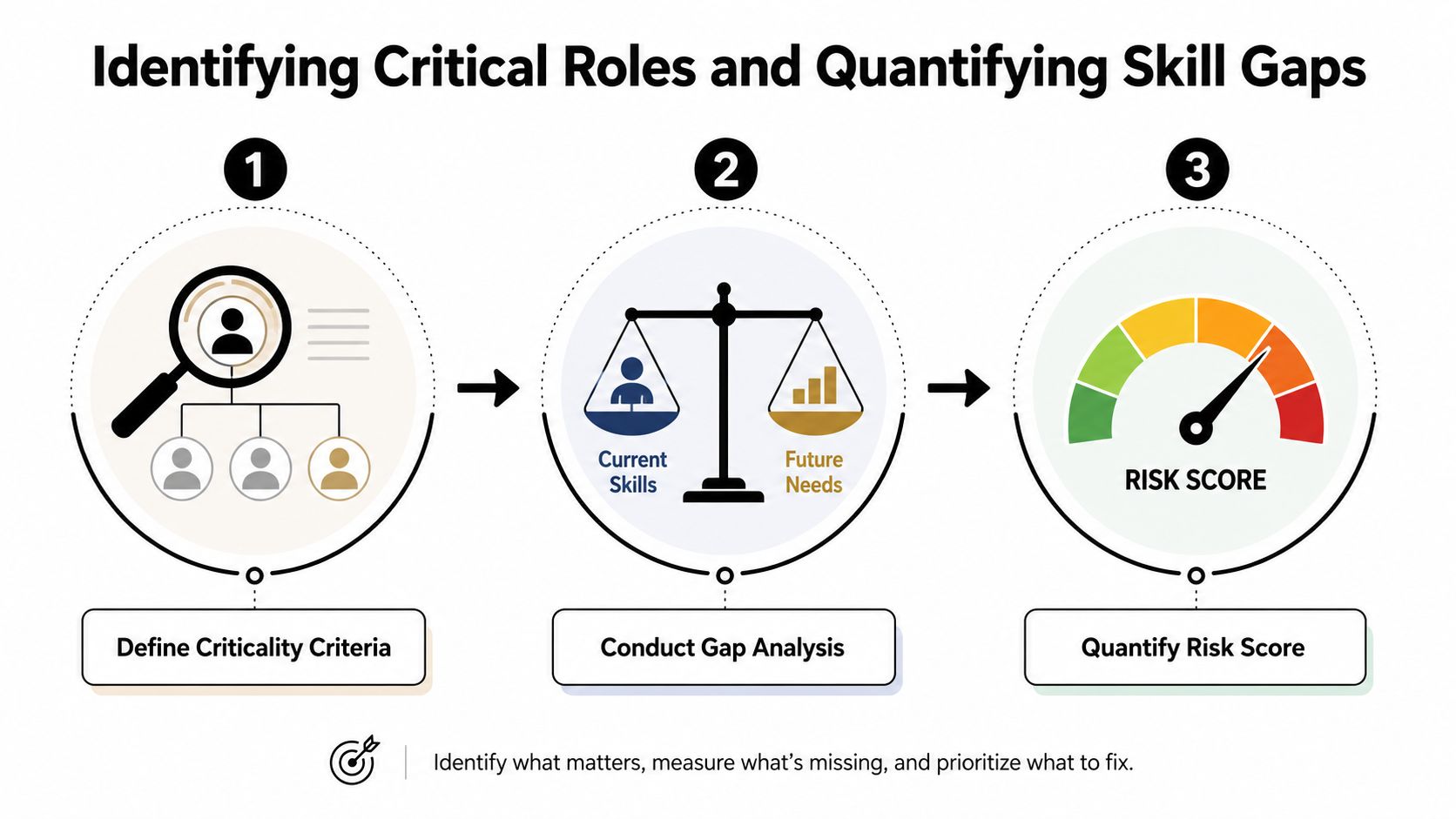
Identifying Critical Roles and Quantifying Skill Gaps
A talent risk review gets useful only when it starts with a narrow target list. A role can matter to the business without being a continuity risk, and that distinction changes how you assess it. A finance analyst may be important. The only engineer who understands a legacy system may be critical.
Define criticality before you measure gaps
The first step is to identify critical roles, then separate business-critical work from the work that only looks busy. The Enterprise Risk Management Academy recommends that sequence because risk becomes clearer once the organization names the few roles that would disrupt delivery, customer service, compliance, or knowledge continuity if they were left empty. [ERM Academy on talent risk issue and concern](https://www.erm-academy.org/publication/risk-management-article/talent-risk-issue-concern/)
After that, move to skill gaps. i4cp's workflow is straightforward, identify the critical roles, analyze the current-versus-future skill gap, then examine the talent risks embedded in each skill set. That order matters because role labels alone hide exposure. A role may stay the same on paper while the needed skills shift underneath it. [i4cp talent risk management step one assess the business](https://www.i4cp.com/productivity-blog/talent-risk-management-step-one-assess-the-business)
A practical way to do this is to map the talent supply chain across the next one-to-three-year horizon. Ask which skills will still matter, which will become scarce, and which teams depend on one or two people to keep operating. In manufacturing, that may surface single points of failure in maintenance knowledge. In a SaaS company, it may expose product, support, or implementation skills that are too concentrated in one region or team.
Use business inputs, not just HR files
Good role mapping uses business strategy, workforce financial data, external labor-market scans, and supply-demand analysis. That combination shows both what the business needs and how hard it will be to replace or grow it. A role can look stable inside the organization while the external market makes the underlying skill hard to hire.
The main mistake is stopping after a role inventory. That gives you a list, not a risk model. A real assessment links criticality to measurable gaps, then records the mitigation path and monitorable owner so the organization can see whether exposure is shrinking or growing over time.
One useful reference point for building the skill layer is [how Synopsix organizes skills inventory management](https://synopsix.ai/blog/skills-inventory-management), because capability mapping works better when the underlying signals are explicit, not assumed.
A second lens matters too, the contingent workforce. Contractors, vendors, and other non-employee specialists often carry skills that sit outside the formal org chart, which means the risk picture is incomplete if you only review employee files. [About LunaBloom AI](https://www.lunabloomai.com/about) is a useful reminder that capability mapping has to surface those signals as well, especially where a business depends on external expertise to keep work moving.
Building Your Data Foundation and Risk Scoring Model
Once the critical roles are clear, the next step is to make the scoring honest. A talent risk assessment gets weak fast when it relies on one manager's opinion or a pile of inconsistent spreadsheets. The better path is to standardize the inputs and keep the score interpretable.
Start with structured data, then add human signals
The strongest models pull from performance history, 360-degree feedback, skills assessments, manager input, career aspirations, and mobility preferences. Those sources give you enough texture to place employees on a performance-versus-potential grid without pretending that any single signal tells the whole story. That grid is useful because it forces consistency across teams and reduces the bias that comes from anecdotal judgments.
> Practical rule: if two managers would rate the same employee differently with no evidence change, the model is too subjective.
The point is not to create a perfectly objective machine. It's to make comparisons fair enough that the organization can spot patterns over time. Stay conversations matter here, because turnover risk rarely shows up in a single metric, and a person who looks fine on paper may be signaling disengagement, burnout, or low mobility in conversation.
Keep the model tied to real operating signals
A workable scoring model should include KPIs such as turnover rate, time-to-fill, training completion, and employee satisfaction. Those indicators don't replace judgment, but they keep the conversation anchored in measurable outcomes. If a team has slow time-to-fill and weak training completion in a critical capability area, the risk is not theoretical.
| Talent Risk Data Sources and Weighting | Typical Weight | Reliability | Update Frequency | | --- | --- | --- | --- | | Performance history | Higher | Strong when review standards are consistent | Regular review cycle | | 360-degree feedback | Medium | Useful, but can vary by rater quality | Periodic | | Skills assessments | Higher | Strong when the assessment is standardized | When roles or skills change | | Manager input | Medium | Helpful, but prone to bias | Ongoing | | Career aspirations | Medium | Important for mobility and succession | As needed | | Mobility preferences | Medium | Useful for retention and deployment | Ongoing |
That table is only useful if it stays comparable across teams and time. Many organizations build a score once, then never refresh the definitions, which means the data slowly drifts away from reality. A better control is a standard review cadence plus clear owner accountability for every critical role.
If you want a deeper model-building reference, the [predictive modeling guide](https://synopsix.ai/blog/what-is-predictive-modeling) is a useful companion because it reinforces the discipline of comparing signals consistently rather than relying on intuition alone.
The Hidden Risks in Skills and Contingent Workforce
The most outdated version of talent risk assessment still assumes that jobs are stable and workers are mostly permanent employees. That's no longer enough. AI, automation, and work redesign are splitting roles into smaller skill bundles, and the risk is increasingly in the skills themselves, not just in the job title.
Skills can age faster than roles do
A role can survive while the capabilities inside it change radically. That means a talent review should ask which skills are becoming more portable, more scarce, or more exposed to decomposition over the next six to twelve months. A sales team, for example, may still have the same org chart while the value shifts from manual prospecting to AI-supported pipeline management and consultative expertise.
Role-based succession planning starts to break down here. The World Economic Forum's 2025 Future of Jobs reporting shows employers expect major disruption from AI and digitalization while also planning large-scale reskilling and upskilling, which makes skill reallocation a planning problem rather than a training afterthought. [World Economic Forum Future of Jobs report](https://www.weforum.org/publications/the-future-of-jobs-report-2025/) A key risk is sometimes not shortage, but overinvestment in a role that's being decomposed while adjacent skills become more valuable.
Don't ignore contractors, temps, and part-timers
A second blind spot is contingent labor. Many assessments focus on permanent staff, even when critical work is being delivered by contractors, part-timers, or temps. That creates hidden concentration risk, especially when the organization depends on a small external group for scarce technical or operational knowledge.
A serious risk review should ask:
The [managing a contingent workforce guide](https://synopsix.ai/blog/managing-a-contingent-workforce) is useful because it reinforces the point that the workforce boundary is operational, not just legal. A team can look fully staffed while still carrying fragility in outsourced support, contract engineering, or temporary coverage.
The practical move is to stress-test leadership pipelines, technical functions, and customer-facing teams against skill obsolescence and external labor scarcity. If a skill is highly portable, the replacement risk may be higher than the job title suggests. If a skill is embedded in contingent labor, the concentration risk may be hidden until the moment the contract changes.
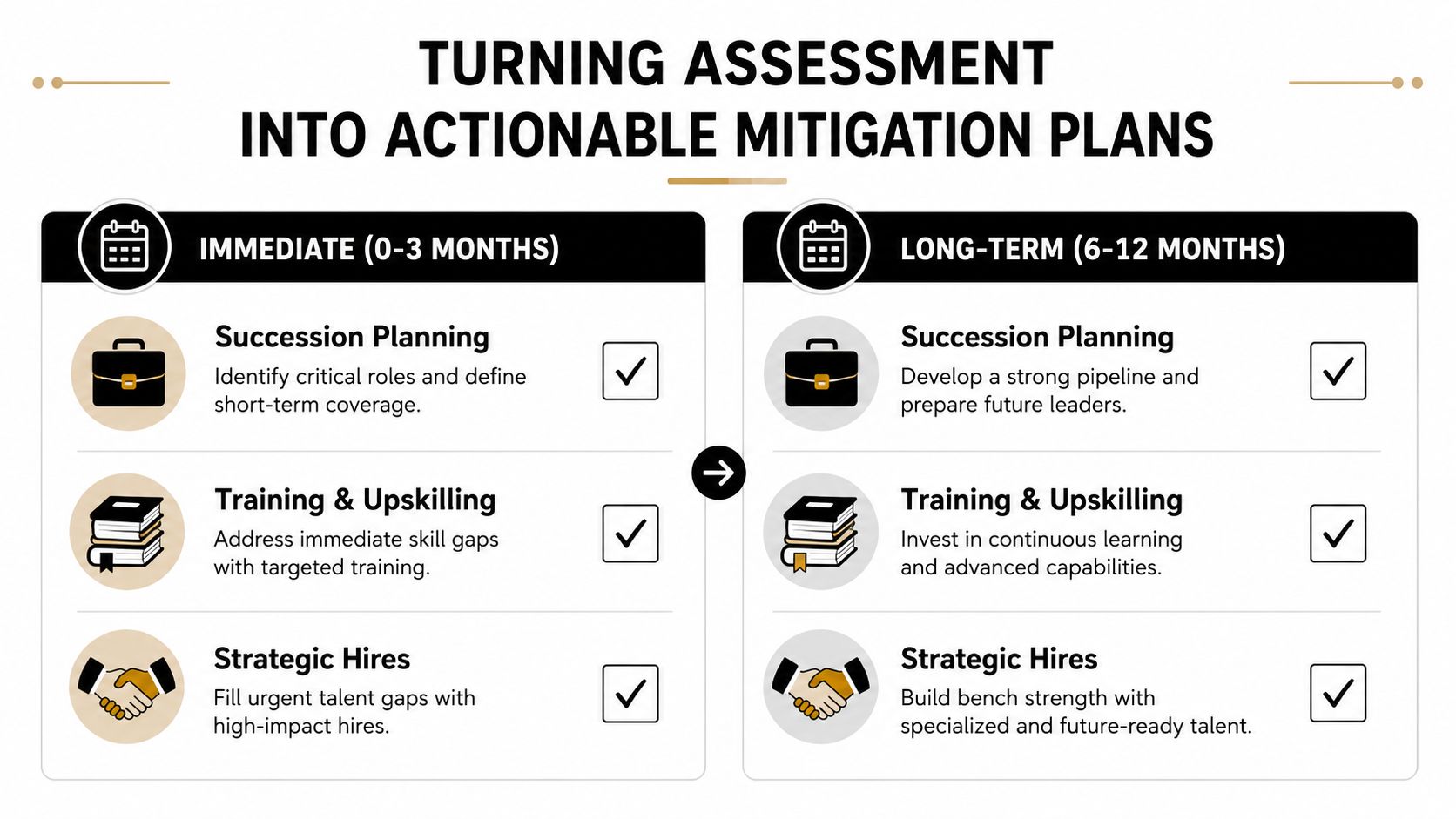
Turning Assessment Into Actionable Mitigation Plans
A risk model that ends in a dashboard is unfinished. The value comes from turning the findings into interventions that match the type of exposure, the time horizon, and the business impact. If the organization can't act, the assessment becomes a reporting exercise.
Match the response to the risk
A good mitigation plan usually falls into one of three buckets. Build succession or development plans for high-potential people in critical roles. Create knowledge transfer protocols where one person holds unique process knowledge. Or design targeted retention work where the issue is flight risk rather than capability loss.
These options are not interchangeable. If the risk is a single point of failure, retention bonuses won't solve it. If the risk is skill obsolescence, a stay conversation won't solve it either. The right response starts with the diagnosis, then chooses the cheapest intervention that reduces exposure.
> Use the lightest control that materially lowers the risk. Heavy-handed hiring fixes for a development problem usually waste money and time.
Prioritize by impact and feasibility
Not every gap deserves immediate action. A manageable plan ranks risks by business impact, ease of implementation, and time to exposure. A knowledge transfer plan for a critical legacy system may come first because the failure cost is immediate. A broader capability build can follow if the underlying skill set will still matter over the next several cycles.
Organizations close these gaps in different ways. Some move people laterally to strengthen internal mobility. Others use strategic hiring for rare skills, then pair that with upskilling so the skill doesn't remain trapped in one hire. In some cases, they adjust contingent staffing to reduce concentration risk or create backup coverage.
Synopsix is one option that can support the assessment-to-action step because it turns behavioral assessments into comparable profiles, risk indicators, and development guidance, which can help teams connect people signals to role decisions without forcing every manager to interpret the data differently.
The best monitoring systems track whether the intervention reduced the risk. If time-to-fill stays high, training completion stalls, or critical roles remain overly concentrated, the mitigation hasn't done its job. The point is not to launch more programs. It is to make the exposure smaller.
Common Pitfalls and How Successful Organizations Avoid Them
Most failed talent risk programs don't fail because the idea is weak. They fail because the operating rhythm is wrong. One team I've seen had a strong role list, but it treated the assessment as an annual event, so by the time leaders reviewed it, several skills had already shifted and one critical expert had moved on.
The common mistakes are predictable
The first mistake is one-and-done analysis. Talent conditions move too quickly for a yearly review to be enough. The second is overindexing on retention while ignoring capability, which leads to fixing the wrong problem. The third is disconnecting the assessment from business strategy, so the results feel abstract to operating leaders.
That last mistake is usually fatal. If the business doesn't see how the risk connects to revenue, customer delivery, compliance, or transformation work, the assessment gets ignored. I've seen teams recover by tying each critical role to a specific initiative or operational dependency, which made the exposure visible to the people who controlled resources.
A related issue is weak measurement discipline. If training is the fix, the organization has to know whether training was effective. The [measuring training effectiveness accurately guide](https://videolearningai.com/blog/training-effectiveness-measurement) is a useful reminder that completion alone never proves readiness, and that lesson matters just as much in capability building as it does in formal learning programs.
Executive sponsorship changes the quality of the work
Successful organizations assign ownership outside HR, then bring HR in as the method owner. That keeps the conversation focused on enterprise risk instead of people administration. Cross-functional alignment matters too, because the risks often sit at the boundary between operations, finance, and talent.
The cleanest recovery pattern I've seen is simple. A company narrows the scope to the most critical roles, standardizes the data, defines a review cadence, and gives business leaders a clear mitigation choice. Once that happens, the program stops feeling like a compliance exercise and starts feeling like part of management.
Your 90-Day Talent Risk Assessment Launch Plan
A good launch plan keeps ambition realistic. Most organizations don't need a perfect model on day one, they need a defensible start, a small pilot, and a way to improve it without losing executive attention. The best first move is to build around the roles where failure would matter most.
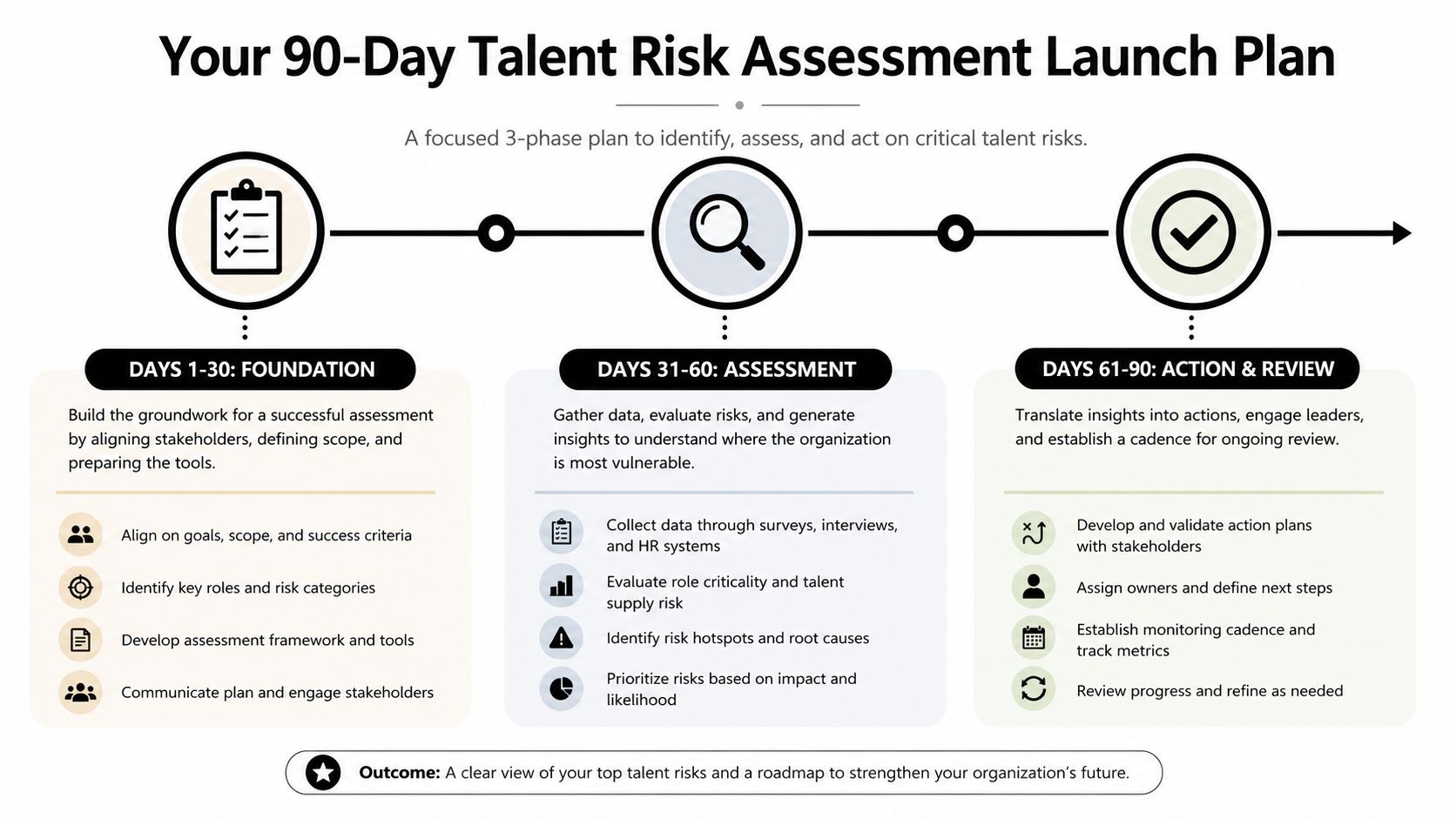
Days 1 to 30 build the foundation
Start with stakeholder alignment, the business problem statement, and a clean data inventory. Identify the critical roles, the decision owners, and the measures you already have. If the data is messy, don't wait for perfection, document the gaps and move forward with the best available version.
Days 31 to 60 run a pilot
Pick a small set of critical roles and test the scoring model. Compare manager judgment with structured evidence, then pressure-test the result with stay conversations, skill review, and workload reality. You find out whether the model is usable or just elegant on paper.
Days 61 to 90 turn findings into action
Choose a short list of mitigation actions, assign owners, and define how you'll monitor change. A useful launch metric is not whether every risk disappears, because that's unrealistic. A better test is whether leaders can see the most exposed roles, understand why they're exposed, and name the next action without asking for a new slide deck.
The work becomes easier once the process is repeatable. You can start with available data, add external labor signals later, and improve the sophistication over time. What matters first is that the organization stops guessing.
<iframe width="100%" style="aspect-ratio: 16 / 9;" src="https://www.youtube.com/embed/JBEcZMGqGOE" frameborder="0" allow="autoplay; encrypted-media" allowfullscreen></iframe>
If you're ready to turn workforce visibility into a real operating habit, start by mapping your critical roles, comparing current skills to future demand, and assigning a single owner for every major risk. Then use the next planning cycle to make those findings visible in leadership reviews and budget decisions. A CTA for [Synopsix](https://synopsix.ai).