Talent Risk Management: Identify, Measure, and Mitigate
By Synopsix · August 6, 2026 · 14 min read
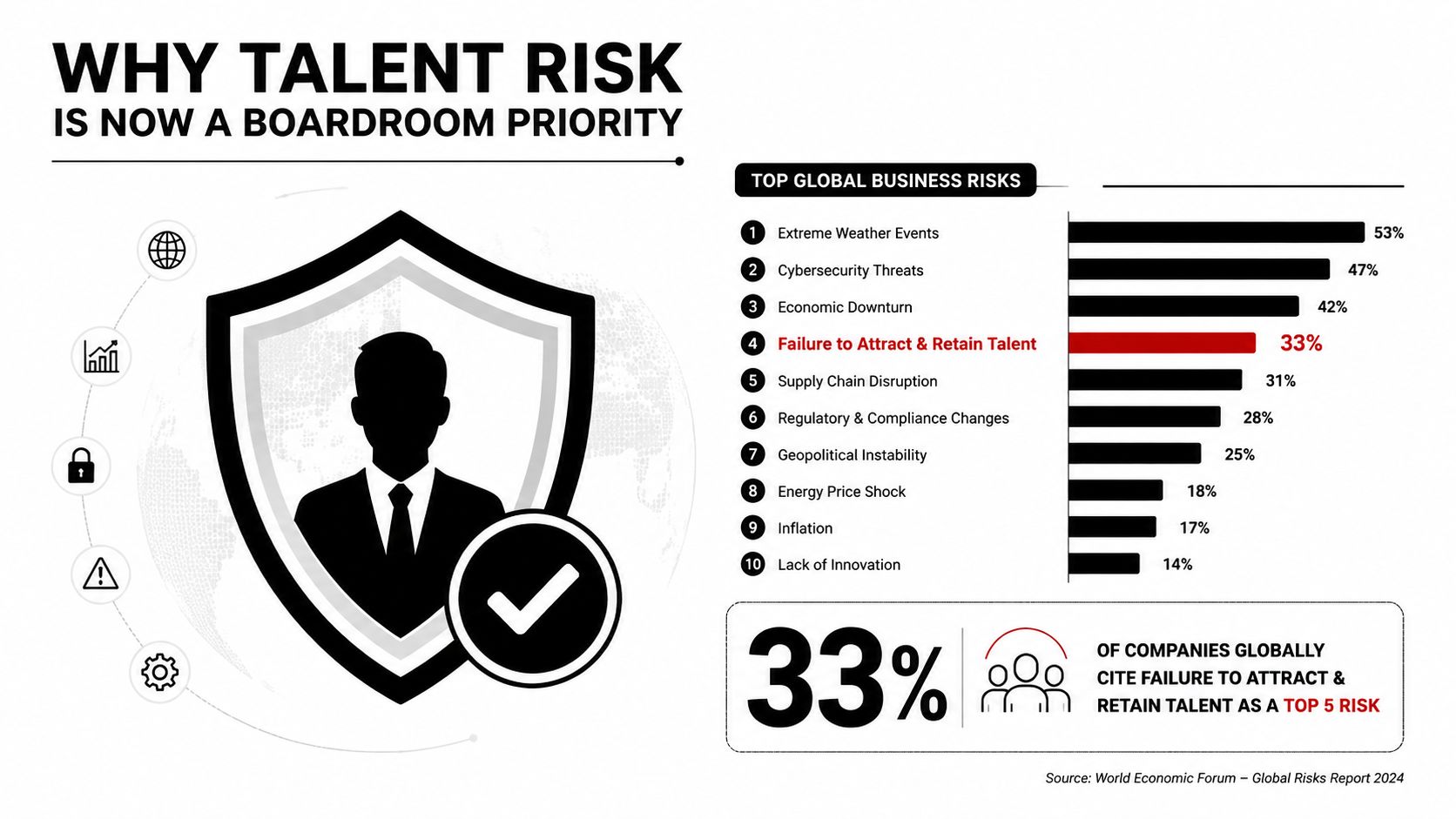
Failure to attract or retain top talent is the fourth biggest global business risk, and it's predicted to stay there through 2026. 33% of organizations reported a loss from this risk in the past 12 months, which is why talent risk management belongs in the boardroom, not just in HR.
A company usually doesn't feel the danger when the plan is on paper. It feels it when a critical executive leaves without warning, a project owner disappears midstream, and the internal bench is too thin to absorb the hit. That's when leaders discover that retention, skills availability, and replacement capability were never just hiring problems, they were enterprise exposure.
Why Talent Risk Is Now a Boardroom Priority
The smartest boards have stopped treating people risk like a soft issue. Aon's global survey places failure to attract or retain top talent at fourth among global business risks, and it expects that ranking to hold through 2026. The same research says 33% of respondents had already suffered a loss from this risk in the previous 12 months, which makes the issue concrete, not theoretical. [Aon's Global Risk Management Survey on top talent risk](https://www.aon.com/en/insights/reports/global-risk-management-survey/top-global-risk-4-failure-to-attract-or-retain-top-talent?collection=6f6db0f9-59a5-48fb-ad90-9b82def899b7)
A typical failure pattern looks like this. A key leader exits, the work doesn't stop, and everyone assumes the team will “figure it out.” Then deadlines slip, decision rights get fuzzy, and one person's tacit knowledge turns out to be the glue holding three functions together.
What changes when leaders take it seriously
Talent risk stops being about backfilling seats and starts being about continuity of execution. That shift matters because labor-market pressure doesn't behave like a one-quarter disruption anymore, it behaves like a persistent operating condition. Organizations are being forced to think about succession, retention, and capability as recurring strategic risks, the same way they think about cash flow or supply continuity.
> Practical rule: if a role would stall revenue, compliance, customer delivery, or transformation work, it belongs on the enterprise risk map.
The boardroom conversation changes when the business can see the downstream cost of vacancy, replacement, and lost context. That is where people analytics becomes useful, not as a dashboard vanity project, but as a way to connect workforce signals to business exposure. [People analytics in practical terms](https://synopsix.ai/blog/what-is-people-analytics)
For most companies, the warning sign isn't the resignation letter. It's the slow build of fragility before the resignation ever happens.
Defining Talent Risk Management
Talent risk management is the discipline of identifying, measuring, and reducing people-related threats before they damage business goals. Mercer's research shows why the old HR playbook isn't enough, 70% of companies say they do not have an effective employee value proposition in place, and labor shortages rank as the second-greatest people-related risk over the next one to two years. [Mercer's talent risk management research](https://www.mercer.com/insights/total-rewards/employee-benefits-optimization/talent-risk-management-strategies-to-address-the-growing-labor-gap/)
The discipline has moved beyond reactive hiring. It now covers capability, capacity, compliance, cost, connection, and broader workforce exposure, so the risk surface is wider than turnover or succession alone. KPMG's approach to talent risk is useful here because it names the structural failure points that keep showing up in organizations, lack of internal candidate depth, weak succession pipelines, poor retention of key people, and missed development of future skills. [KPMG's approach to talent risk](https://assets.kpmg.com/content/dam/kpmg/pdf/2016/06/pl-time-for-a-more-holistic-approach-to-talent-risk.pdf)
Turnover is a lagging signal, not the model
Turnover matters, but it arrives late. By the time resignation rates move, the underlying problem has usually already shown up in workload, manager quality, internal mobility, or skill mismatch. A defensible model looks for those causes first, then uses turnover as one outcome among several.
The question many teams miss is more practical. Who left is useful only after leaders understand what conditions made departure more likely, and how exposed the business was if that person went.
A useful way to think about talent risk is as a chain. Pressure builds, capability gaps widen, capacity gets thin, and eventually the organization loses either performance, continuity, or both. Once you see that chain, you can interrupt it earlier with better workload design, clearer role architecture, or targeted development.
> Bottom line: a talent risk model should expose business fragility, not just summarize HR sentiment.
For readers building the structure behind that model, a competency lens is often the best starting point because it forces clarity about what the role requires. [Competency gap analysis as a starting point](https://synopsix.ai/blog/competency-gap-analysis)
The goal is not a perfect score. The goal is a system that surfaces the right people risks early enough to act.
Building a Talent Risk Assessment Framework
A strong framework should stay narrow. Gartner's approach is practical here, prioritize only the 3 to 5 most critical risks, then score each one by likelihood, impact, time horizon, and current mitigation capability. That keeps noise out of the model and forces leaders to focus on the risks that could disrupt the business. [Gartner talent management guidance](https://www.gartner.com/en/human-resources/topics/talent-management)
The key insight is simple. Risk is highest when a critical role has both a strong chance of loss and low organizational absorptive capacity. If you can't redistribute the work, backfill fast, or absorb the knowledge gap, the business exposure spikes.
What to score
The scoring matrix below is the simplest defensible version. It isn't about making numbers feel scientific, it's about making trade-offs visible.
| Risk Dimension | Score 1, Low | Score 3, Medium | Score 5, High | |---|---|---|---| | Likelihood | Unlikely to change in the near term | Some signs of instability | Clear departure or capability risk | | Impact | Limited business disruption | Noticeable disruption to one team or process | Material impact on delivery, revenue, or compliance | | Time Horizon | Risk is distant | Risk could materialize within a planning cycle | Risk is immediate or already active | | Current Mitigation Capability | Strong backup or cross-training exists | Partial coverage exists | No realistic short-term coverage |
A defensible model blends leading indicators with lagging outcomes. Leading signals include workload pressure, role criticality, succession depth, internal mobility, and manager quality. Lagging signals include attrition, absence, and performance decline. Used together, they help separate a temporary morale dip from a role that is at risk.
The output should be an action queue, not a generic engagement score. One role may need succession coverage, another may need manager intervention, and a third may need workload rebalancing. If everything sits in one average score, nothing gets fixed.
> Score the role, not the mood. Mood matters, but exposure is what hurts the business.
Many systems fail. They produce dashboards that look polished but don't tell leaders what to do on Monday morning. A real model must tell you which risks deserve intervention first, and what kind of intervention makes sense.
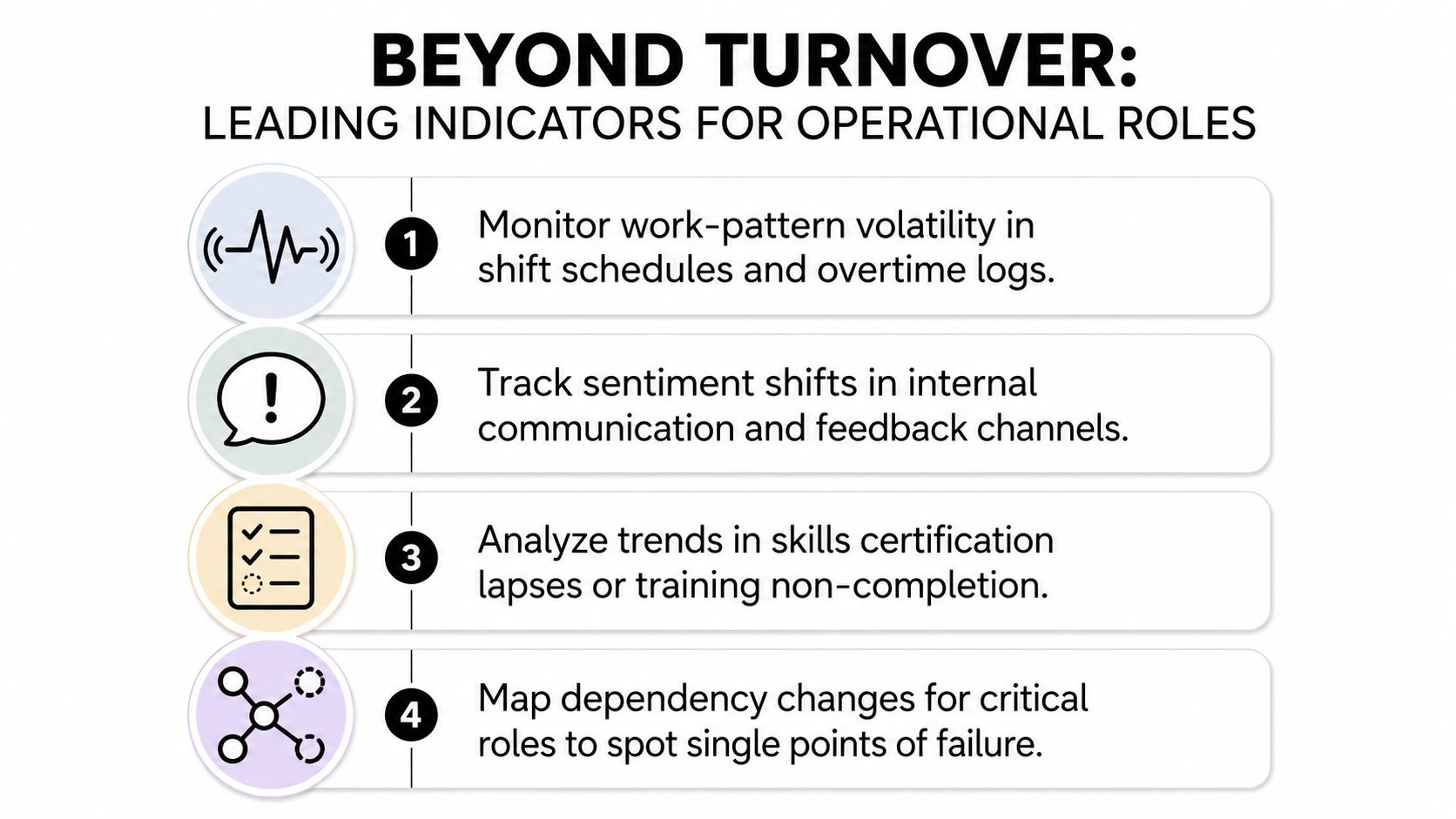
Beyond Turnover Leading Indicators for Operational Roles
In frontline and operational environments, turnover is often the last thing to move. By then, the team has already been carrying too much, making too many fixes, or compensating for poor process design. That's why work-pattern volatility matters more than headcount alone.
What to watch before people quit
The most useful indicators are usually already in existing systems of record. Overtime streaks show whether the same people keep stretching past a sustainable load. Exception and rework ratios show whether quality is slipping. Near-miss or error rates show whether fatigue or friction is starting to show up in execution. [Operational KPIs that predict talent risk](https://www.cleverence.com/articles/business-blogs/operational-kpis-that-predict-talent-risk-5832/)
Absolute volume tells only part of the story. Week-to-week variability matters too, because one heavy week is not the same as several consecutive weeks of strain. Repeated overload is where burnout, safety issues, and inconsistent output usually begin to surface.
Why operations leaders need the alert, not just HR
HR can't interpret these signals alone. Operations leaders know when a spike is temporary and when it points to a broken schedule, a skills mismatch, or a bad process handoff. That's why red-flag thresholds should be set jointly, then reviewed in daily huddles before anyone automates intervention logic.
A practical workflow looks like this.
Turnover still matters, but it belongs at the end of the sequence. Work-pattern volatility is what gives you time to respond.
A Stepwise Roadmap for Implementing Talent Risk Management
A talent risk program starts with business exposure, not with HR software. The first pass should identify which roles protect revenue, service continuity, customer trust, or operational control, then separate those from positions that are just busy. A role only belongs in the first wave if a failure there would create meaningful business risk.
Phase 1 Identify the exposed roles
Start with a business impact analysis. Identify the functions that would hurt most if they were vacant, then map the dependencies around them. Leaders usually find hidden single points of failure at this stage, a person who owns a niche process, a manager who is the only one who understands a major customer relationship, or a technical expert whose work has never been documented.
That exercise also reveals where the fragility sits. A role can look ordinary on paper and still carry outsized exposure because the knowledge is concentrated in one person, the handoffs are informal, or the team has no backup when something goes wrong.
Phase 2 Measure the risk consistently
Once the critical roles are clear, apply the scoring framework in the same way every time. Use the same dimensions, likelihood, impact, time horizon, and mitigation capability, so leaders can compare risks across teams instead of arguing from anecdotes. Leading and lagging indicators should sit together in one view, because turnover alone does not show where strain is building before it becomes visible.
The point is to create a defensible model, not a spreadsheet full of opinions. If one team scores high because of skill concentration, another because of weak bench strength, and a third because of unstable workload, the framework has to keep those differences visible.
Phase 3 Mitigate with targeted controls
Mitigation should match the risk pattern. Succession planning helps when the problem is depth. Internal mobility helps when capability needs to move faster than external hiring can support. Workload balancing helps when pressure is the main driver. Manager training helps when the role looks stable on paper but is brittle in practice.
The trade-off is that every control has a cost. Cross-training takes time away from delivery. Internal moves can create short-term gaps elsewhere. A broader control set usually works better than a single fix, especially when the business is trying to protect both continuity and speed.
Teams that need a structured way to [design AI-powered onboarding](https://andypartner.com/en/blog/employee-onboarding) can use it to shorten ramp-up and reduce early-role exposure, provided the process is tied to actual job risk rather than a generic checklist.
Phase 4 Monitor and refresh
Monitoring is where most programs lose momentum if no one owns the cadence. Put the risk list into regular dashboard reviews, track early-warning triggers, and revisit the scoring as business priorities change. The point is not to turn the work into a static annual review, it is to create a repeatable management rhythm that keeps pace with the business.
A useful governance pattern is to assign one owner in HR, one in the business, and one in analytics. That shared ownership keeps the model grounded in operating reality and prevents it from turning into a reporting artifact.
> A talent risk program only works when leaders can see the same risk, agree on the business impact, and act before the gap opens.
For teams formalizing these practices, role-based assessment and comparative reporting can help turn abstract signals into decisions. As noted earlier, [Synopsix](https://synopsix.ai) translates behavioral assessment data into role, team, and development insights, which can support that workflow alongside broader HR processes.
Real-World Applications in Hiring, Promotion, and Team Design
In hiring, the most expensive mistake isn't a slow interview cycle. It's a confident mis-hire that looks good on paper and then drains time, attention, and morale after the offer is signed. Behavioral assessment data can add a second lens, especially when the role has hidden pressure points that a resume won't reveal.
In promotion, the question changes from “Can this person do the current job?” to “Can this person handle the broader scope, ambiguity, and people load of the next one?” That's where compatibility analysis matters. A high performer can still struggle badly in a leadership role if the work shifts from individual output to coaching, conflict, and coordination.
Team design brings the issue into focus even faster. Some squads look balanced because everyone is strong, but they still clash because strengths overlap in the wrong places or no one covers the weak spots. Visualizing complementarity and tension points helps leaders build teams that can execute together, not just impress on org charts.
Synopsix fits here as one example of a people intelligence platform that turns scientifically validated assessments into behavioral profiles, compatibility analysis, and predictive simulations for hiring, leadership, and team design. In practical terms, that kind of output is useful when managers need a clearer read on fit, friction, and development needs without having to interpret technical psychometrics themselves.
For onboarding, the same logic applies. Strong onboarding reduces uncertainty and speeds up the point at which a new hire becomes useful, and resources like [design AI-powered onboarding](https://andypartner.com/en/blog/employee-onboarding) show how structure can make that transition more consistent.
The bigger lesson is that people decisions get better when they're treated as risk decisions. That doesn't replace judgment, it sharpens it.
The Untapped Frontier Managing Risk Across Non-Traditional Workforces
Most talent risk programs still center the full-time employee population. That leaves a real blind spot, because contingent workers, gig workers, remote staff, people with disabilities, and second-chance hires can all shape delivery, compliance, and customer experience. If the workforce is distributed, the risk model has to be distributed too.
That doesn't mean treating every group the same. It means monitoring the right signals for the right relationship type, contractor quality where external labor is involved, access and accommodation where inclusion affects performance, and retention or re-engagement where hard-to-staff roles depend on trust. A one-size-fits-all employee model misses the way risk moves through the enterprise.
What a holistic model looks like
A more complete approach expands the lens from headcount to ecosystem exposure. It asks which populations are most fragile, which roles are most dependent on external labor, and where compliance or continuity would be hardest to recover if a relationship broke down. That framing is especially useful when work is split across offices, home settings, vendors, and short-term labor pools.
The old model assumed the workforce was mostly internal and stable. That assumption no longer holds in many organizations, which is why broader workforce oversight has become so important. For teams thinking about this in more operational terms, [managing a contingent workforce](https://synopsix.ai/blog/managing-a-contingent-workforce) is a useful complement to a traditional people-risk lens.
> If you only measure core employees, you're measuring a shrinking slice of the workforce risk picture.
The practical move is to build one talent risk language, then apply it across employment types with different indicators and controls. That gives leaders a more honest view of resilience, and it helps them see opportunity where older models only saw administrative complexity.
---
Synopsix helps organizations turn behavioral assessments into role fit, team compatibility, and development decisions that support this kind of talent risk management. If you want to reduce mis-hires, spot friction earlier, and make people decisions with more evidence, visit [Synopsix](https://synopsix.ai) and explore how its assessments, predictive simulations, and team insights can support your workforce strategy.