Team Building Effectiveness: The HR Guide
By Synopsix · September 21, 2026 · 15 min read
Most team-building advice is built on a weak premise. It assumes the main problem is low morale, so the solution becomes an offsite, a retreat, or a shared experience that helps people “connect.”
That's too shallow for most of the team problems CHROs face.
Teams rarely fail because people never did a ropes course. They fail because work is poorly divided, goals compete, responsibilities blur, decision rights are fuzzy, and behavioral styles collide under pressure. If you want real team building effectiveness, you have to treat team dynamics as an operating issue, not an entertainment budget line.
That shift matters because the evidence behind team building doesn't point to fun as the primary lever. It points to structure, coordination, and clearer ways of working. For HR leaders, that means the question isn't “What activity should we run?” It's “What behavior are we trying to change, and how will we know it changed?”
Rethinking Team Building for Modern HR
Traditional team building is often designed for atmosphere. That isn't useless. Teams do need trust, familiarity, and some social glue. But morale alone is a poor proxy for performance.
The more useful lens is to treat team building as a behavioral intervention. A good intervention changes how people coordinate, how they interpret roles, how they handle disagreement, and how quickly they recover when work gets messy. That's a very different standard than asking whether people enjoyed the afternoon.
Why morale-first programs disappoint
CHROs know the pattern. A team spends a day together, feedback forms look positive, and within a week the same bottlenecks return. Meetings still drag. Priorities still conflict. Strong contributors still over-function while others wait for direction.
That doesn't mean group activities never help. It means they're often deployed without a diagnosis.
> Team building should be judged by what changes on Monday, not by what people said on Friday.
For distributed teams, even social activities need a sharper purpose. Practical ideas like these [team building activities for remote workers](https://madeiraremote.com/blog/team-building-activities-for-remote-workers) can help create connection across distance, but HR leaders still need to tie the activity to a work-relevant outcome such as communication norms, conflict handling, or handoff quality.
What modern HR should optimize instead
A stronger model starts with team design. That includes:
People analytics becomes practical. Teams generate signals constantly. Assessment data, performance patterns, manager observations, and collaboration friction all help HR move from intuition to diagnosis. Once you view teams as data-rich systems, team building stops being a soft initiative and becomes a measurable management practice.
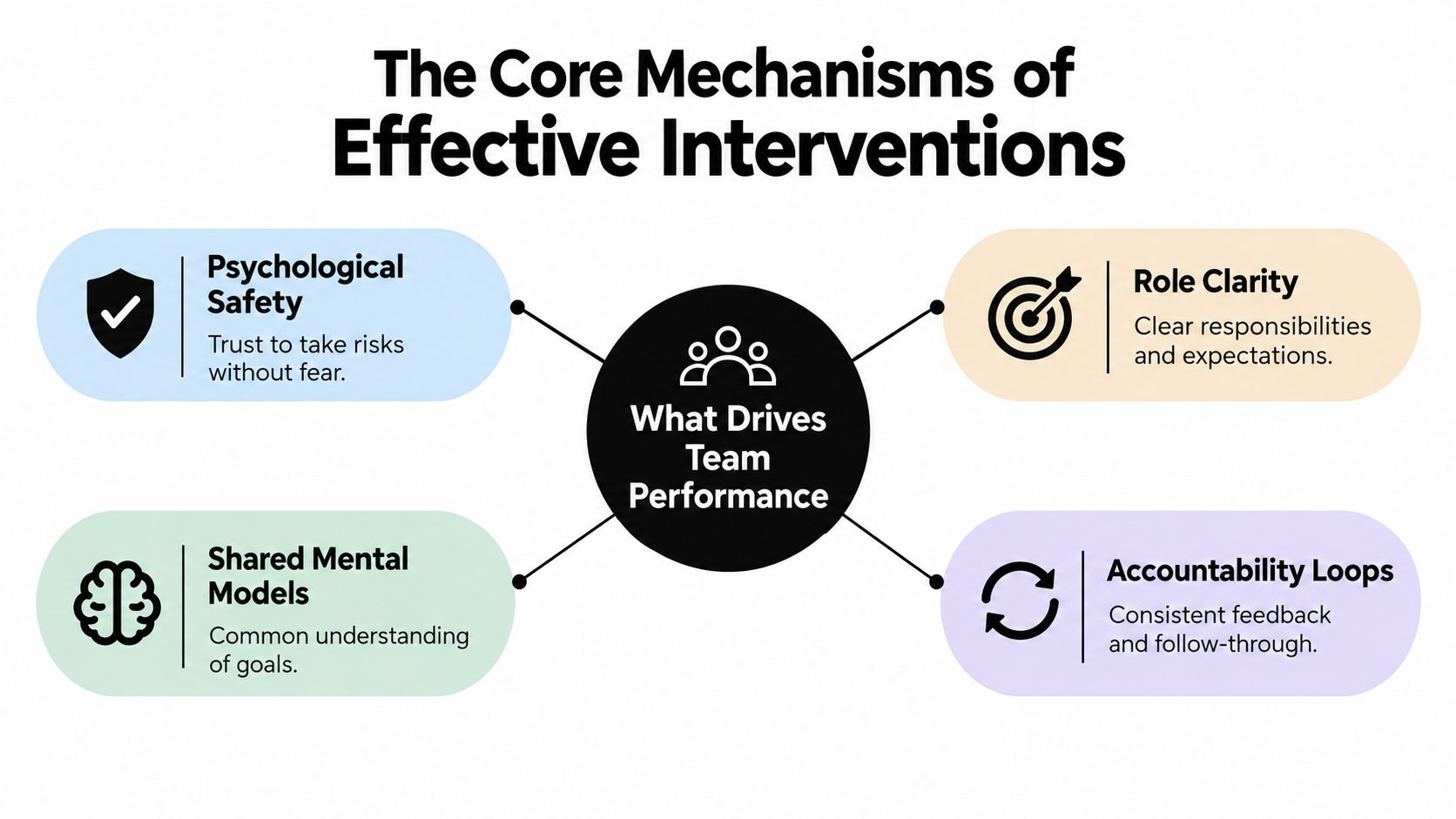
The Core Mechanisms of Effective Interventions
The strongest evidence on team building doesn't support a single generic playbook. It shows that different intervention mechanisms produce different results, and some are far more relevant to work performance than others.
A 2009 meta-analysis examined 60 correlations across 1,562 teams and found a positive, moderate overall effect on team outcomes, with a mean true-score correlation of 0.31. It also found stronger effects for affective outcomes (0.44) and process outcomes (0.44), while role clarification (0.35) and goal setting (0.37) stood out as especially effective components. Larger teams benefited more, with a correlation of 0.66 for team size ([Klein et al. summary](https://www.scribd.com/document/749302078/SmallGroupResearch-2009-Klein-1046496408328821)).
Four mechanisms matter more than the activity format
Another summary of the same research breaks team building into four mechanisms: goal setting, interpersonal relations, problem solving, and role clarification, with the strongest interventions improving shared goals, reducing ambiguity, and strengthening coordination rather than relying on morale alone ([team-building mechanisms review](https://stars.library.ucf.edu/scopus2000/11973/)).
Those four mechanisms give HR leaders a better filter than “onsite versus offsite” or “virtual versus in person.”
Why bonding helps, but doesn't carry the load
A lot of HR teams overcorrect against “soft” activities, and that's a mistake too. Social connection isn't fluff. It often creates the conditions for candid communication. A useful primer on [why team bonding matters](https://benely.com/the-importance-of-team-bonding-for-your-employees/) captures that interpersonal side well.
But bonding should support execution, not substitute for it.
> Practical rule: If an intervention can't be linked to one of four mechanisms, it probably won't produce durable team building effectiveness.
The right question after any session is simple. Did the team leave with clearer goals, stronger trust for work-related candor, better ways to solve recurring problems, or cleaner role boundaries? If the answer is no, the event may have been pleasant, but it wasn't strategic.
Diagnostic Frameworks for Team Friction
Most team interventions fail before they begin because the diagnosis is vague. “Communication issues” usually means several different problems collapsed into one label. Sometimes the issue is style mismatch. Sometimes it's duplicate ownership. Sometimes it's a capability gap disguised as conflict.
HR leaders need a tighter method.

A five-part diagnostic sequence
Start with work, not personality. Define the team's operating demands before looking at individual profiles.
1. Clarify the mission
Spell out what the team is expected to deliver, where interdependence is highest, and which moments carry the most execution risk. Product launch teams, client service teams, and executive teams don't fail in the same way.
2. Map role requirements
Separate formal titles from actual responsibilities. In many teams, friction appears where work is shared informally but authority is still assumed formally.
3. Assess behavioral patterns
Use validated assessments to understand tendencies in decision speed, communication, need for structure, social assertiveness, and tolerance for ambiguity. The goal isn't labeling people. It's identifying where work styles may collide.
4. Review team composition
Look for clusters and gaps. Too much similarity can create blind spots. Too much divergence without clear norms can create drag.
5. Test the findings against observed friction
Compare the assessment picture with what managers and team members report. If the friction pattern and the profile pattern line up, you have a working hypothesis.
A more detailed team-level assessment approach is outlined in this guide to [team dynamics assessment](https://synopsix.ai/blog/team-dynamics-assessment).
What to look for in the pattern
The most useful diagnostics look at interaction effects, not isolated traits.
> If every tension point is attributed to personality, HR misses the design problem. If every issue is blamed on structure, HR misses the human one.
That's why diagnosis has to hold both views at once. Team friction usually emerges where role design and behavioral tendencies intersect. Once you can name that intersection clearly, interventions become much more precise.
Evidence-Based Interventions and Simulations
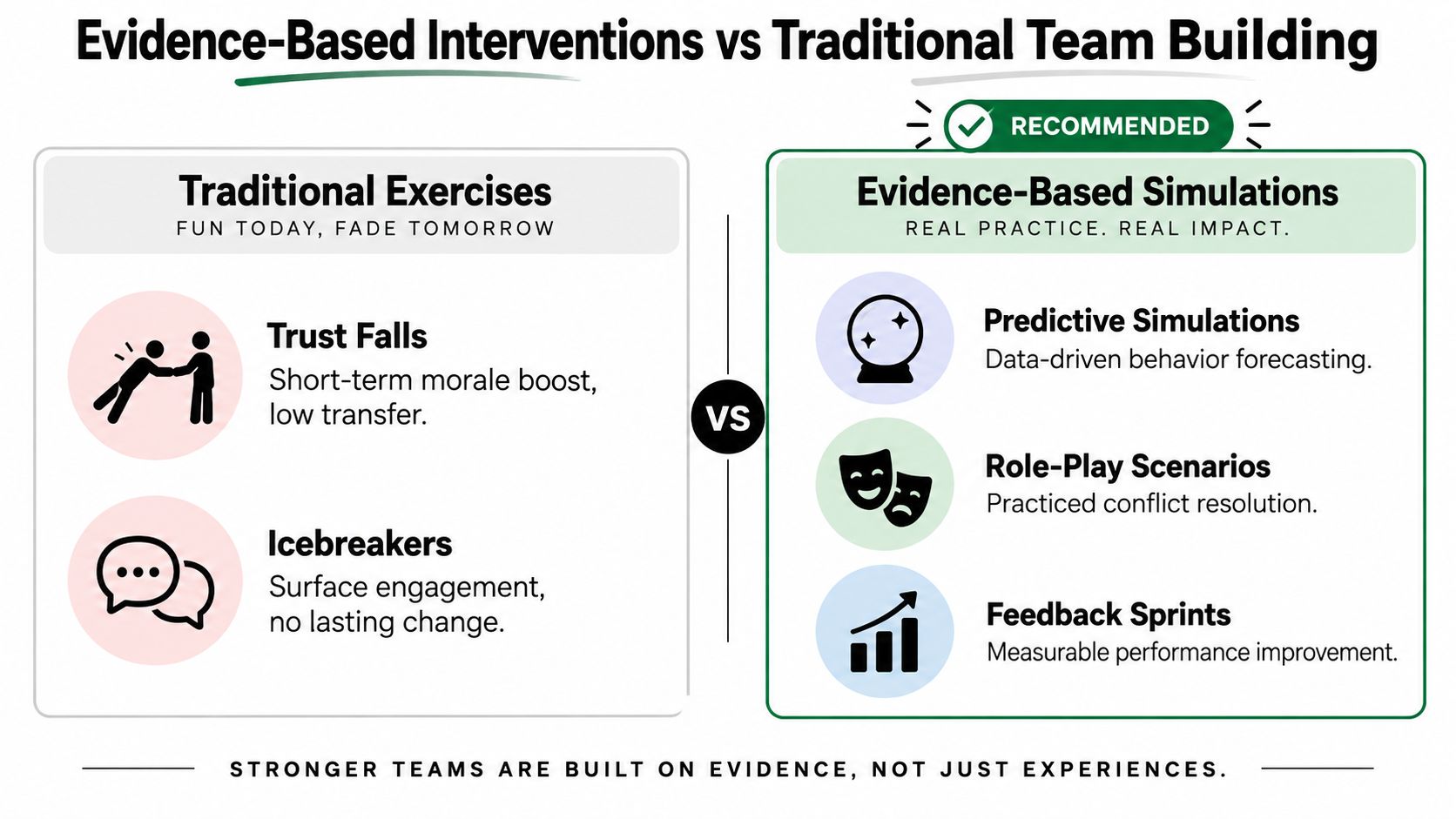
Once the diagnosis is credible, the intervention design becomes easier. The core choice is whether you want temporary energy or repeatable behavior change.
Traditional team-building exercises still have a place. Shared experiences can reset tone, build familiarity, and lower social distance. For some teams, especially newly formed ones, that matters. If you're planning a bonding-heavy event, options like [unique team adventures in Triglav](https://outdoor-slovenia.com/corporate-team-building-activities/) can create memorable shared experiences.
But if the business problem is poor coordination, misread intent, or role overlap, experience alone won't fix it.
What stronger interventions look like
A 2017 systematic review and meta-analysis of controlled interventions found that teamwork training produced a significant medium-to-large improvement in teamwork behaviors, with d = 0.683, 95% confidence interval of 0.43 to 0.94, and p < 0.001 across 39 effect sizes. The review also reported I² = 94.2%, which means results varied widely by context even though the overall direction was positive. A later 2024 meta-analysis focused on cohesion found a moderate effect size of 0.65 across 23 studies, with 95% CI [0.40, 0.91] and I² = 96.9% ([systematic review and later cohesion meta-analysis reference](https://journals.plos.org/plosone/article?id=10.1371/journal.pone.0169604)).
That variability is the lesson. Team-building interventions can work, but they don't work uniformly. Design matters.
Compare the options by transfer to work
Here's the practical difference.
A short example helps. If a revenue team struggles because sales, customer success, and product all define urgency differently, an escape room won't solve that. A simulation of a renewal risk scenario might. It forces the team to make tradeoffs, expose assumptions, and define decision rules under pressure.
This video offers a useful way to think about applying structured development to team behavior, not just individual skill.
<iframe width="100%" style="aspect-ratio: 16 / 9;" src="https://www.youtube.com/embed/G94xmz7gkpY" frameborder="0" allow="autoplay; encrypted-media" allowfullscreen></iframe>
For HR teams looking at tool-enabled options, Synopsix is one example of a platform that translates validated behavioral assessments into compatibility analysis and predictive simulations that can surface likely tension points before they affect execution. The broader principle matters more than the vendor category. Use methods that let teams rehearse the work they need to do.
For a practical view of intervention design tied to outcomes, this guide on [team performance improvement](https://synopsix.ai/blog/team-performance-improvement) is a useful complement.
Predicting Team Outcomes Through Composition
Most talent systems still overweight the individual. They ask whether a person is smart, driven, stable, persuasive, or promotable. Those are valid questions, but they don't answer the team question.
A team is not the sum of its top performers. It's a pattern of interacting attributes.
A large-scale study in an online multiplayer setting found that team-composition features consistently outperformed individual-player information for predicting outcomes, and the researchers tested that across winning, surrendering, and abusive behavior to isolate effects on performance, tenacity, and rapport ([team composition study](https://ar5iv.labs.arxiv.org/html/1902.06432)). The setting is unusual, but the implication is familiar to anyone in people analytics. Composition often tells you more than star power.
What individual validity tells us, and what it doesn't
Selection science still matters here. A personnel-selection review reported that general mental ability tests had an operational validity of .27 for overall job performance, while predictive validity rose for more specific criteria, reaching .72 for job-specific task proficiency and .81 for non-job-specific task proficiency ([personnel selection review](https://pure-oai.bham.ac.uk/ws/portalfiles/portal/26315681/The_relationships_between_traditional_se.pdf)).
That should push HR toward precision. “High potential” is too blunt. The better question is whether a person's capabilities match the kind of contribution the team needs.
A meta-analysis of assessment center dimensions also found that specific dimensions had incremental criterion-related validity beyond cognitive ability and personality, and that four assessment center dimensions combined explained 20% more variance in job performance than prior estimates of overall assessment-center ratings (assessment center meta-analysis.docx)).
Why composition beats isolated excellence
At the personality level, evidence from a South African meta-analysis of 33 studies covering 6,782 individuals found that the Big Five showed similar validity for job performance as in other cultural contexts, with conscientiousness emerging as the strongest predictor across performance criteria ([Big Five meta-analysis](https://repository.up.ac.za/items/43845478-fe0d-4ed6-9972-7d0e4db1428e)).
That doesn't mean HR should build teams by maximizing conscientiousness and stopping there. It means some traits are useful ingredients, but the team outcome depends on configuration:
| Composition question | Why it matters | |---|---| | Do we have enough execution discipline? | Teams need reliable follow-through, not just ideation. | | Are communication styles too similar? | Uniform styles can create ease, but also blind spots. | | Is cognitive range productive or chaotic? | Diversity helps only when norms convert difference into coordination. | | Who stabilizes conflict under pressure? | Teams need members who regulate tension, not only those who escalate action. |
> The best team isn't the one with the strongest resumes. It's the one whose members make each other more effective.
That's where team-building decisions and talent decisions converge. Hiring, promotion, succession, and internal mobility should all be informed by likely contribution to team composition, not just individual capability in isolation.
Metrics for Measuring Team Building ROI
If team building is treated as a serious intervention, it needs a measurement model that survives executive scrutiny. Smiles, attendance, and post-event enthusiasm won't do that.
The cleanest approach is to measure at three levels. First, the behavior you intended to change. Second, the team process affected by that behavior. Third, the business outcome that process should influence.
Build the metrics chain
Start with a simple logic chain:
If the chain is broken, your ROI story will be weak. For example, if a role clarification workshop aimed to reduce duplicated work, your first evidence should be changes in ownership and handoff quality, not a broad annual engagement score.
Team Building Effectiveness Metrics Matrix
| Metric Category | Specific KPI | Measurement Method | |---|---|---| | Behavioral adoption | Role clarity by member | Pulse survey, manager review, meeting observation | | Interaction quality | Escalation speed | Workflow timestamps, project retrospectives | | Coordination | Handoff reliability | Error logs, rework tracking, stakeholder feedback | | Conflict management | Resolution quality | Manager calibration, incident review notes | | Execution rhythm | Decision-cycle consistency | Meeting audits, project milestone review | | Talent stability | Retention in targeted teams | HRIS trend analysis | | Performance | Team output quality | Functional scorecards, leader assessments |
A useful rule is to define measurement before the intervention starts. Otherwise, HR ends up proving impact with whatever data happens to be available later.
For teams building a more rigorous dashboard, this framework for [how to measure team performance](https://synopsix.ai/blog/how-to-measure-team-performance) is a practical starting point.
> Track leading indicators first. By the time lagging indicators move, the team has already been operating in a new way for a while.
What boards and CFOs care about
Executives usually don't object to team development. They object to imprecision.
So translate results into operating language. If conflict dropped, show what improved in throughput or delivery. If role clarity improved, show whether decision latency or rework changed. If a manager became better at structuring the team, show whether execution became more dependable.
That's how team building effectiveness stops sounding discretionary and starts looking like risk reduction.
Building a Continuous Team Design Strategy
The biggest mistake in team development is treating it as an event. Teams are dynamic systems. Membership changes, business pressure shifts, leaders rotate, and strategy evolves. A one-time intervention can help, but it can't carry that complexity for long.
CHROs need a continuous team design approach instead. That means using behavioral insight before teams break, not after. It means reviewing composition when promotions happen, when major projects launch, and when cross-functional work starts to stall. It also means teaching managers to spot whether they're dealing with a trust issue, a role issue, a pacing issue, or a capability issue.
What durable practice looks like
Strong organizations build recurring habits around team design:
HR can become more strategic than most business leaders expect. Instead of approving another generic team-building day, HR can shape the conditions under which teams perform.
The strategic advantage
The long-term value isn't just stronger cohesion. It's better deployment of talent across the enterprise.
Organizations that treat team building as design gain an edge in several places at once. They make smarter internal moves. They reduce avoidable conflict. They identify leaders who improve group performance, not just individual output. And they create a talent system that connects assessment, team composition, and business execution.
That's the standard for team building effectiveness. Not whether people had a good experience, but whether the organization got better at assembling teams that can deliver under pressure.
---
Synopsix helps HR leaders turn behavioral assessment data into practical team decisions through profiles, compatibility analysis, and predictive simulations that surface likely friction before it slows execution. If you want a more rigorous way to design teams, diagnose conflict, and improve team building effectiveness, visit [Synopsix](https://synopsix.ai).