10 Data-Driven Team Building Strategies for 2026
By Synopsix · July 12, 2026 · 25 min read
Senior HR leaders do not need more icebreakers. They need a repeatable way to build teams that perform under pressure, adapt to change, and sustain output without driving preventable turnover.
Traditional team-building advice still centers on social bonding exercises. Those activities may improve short-term sentiment, but they are weak instruments for solving structural team problems such as role ambiguity, behavioral mismatch, uneven decision speed, and avoidable conflict. In organizational psychology, those problems are better addressed through design choices than through morale events.
The practical shift is straightforward. Treat team building as a business process, not as a calendar activity. That means using comparable behavioral data, defining the interaction patterns a team needs, and tracking outcomes such as retention, productivity, manager span effectiveness, internal mobility, and time to full team contribution.
This article takes that approach. The focus is not on traditional activities, but on strategic methods grounded in people intelligence and behavioral science. Used well, [behavioral assessment in team design](https://synopsix.ai/blog/what-is-behavioral-assessment) helps HR leaders reduce guesswork in hiring, team formation, leadership selection, and integration planning. The same logic also sharpens selection standards upstream, especially for leaders using this [practical guide for leaders on hiring](https://www.theokrhub.com/insights/cultural-fit-assessment) to assess cultural fit with more rigor.
That distinction has operating consequences. Teams rarely fail because employees lacked one more off-site. They fail because organizations overvalue credentials, undervalue work-style compatibility, and wait too long to diagnose friction. A data-oriented CHRO can address those risks earlier by treating team composition, role alignment, conflict prevention, and succession planning as linked decisions rather than isolated HR programs.
The result is a more disciplined approach to [leadership team development for startups](https://capstacker.io/blog/team-building-for-leaders/), as well as for larger enterprises. The question is no longer which activity might improve morale. The question is which team design choices are most likely to produce consistent performance, lower coordination cost, and stronger retention over time.
1. Behavioral Assessment-Driven Team Composition
The first strategic move happens before kickoff meetings and off-sites. Team composition should begin with comparable behavioral data, not with the org chart alone.
Research cited by [Caliper on effective team-building strategies](https://calipercorp.com/blog/10-effective-team-building-strategies/) notes that 40% of team failures stem from personality clashes and misaligned working styles. That's the hidden cost of assembling teams strictly by function, availability, or seniority. A cross-functional innovation team may look balanced on paper while carrying obvious collision risks in communication tempo, decision style, and tolerance for ambiguity.
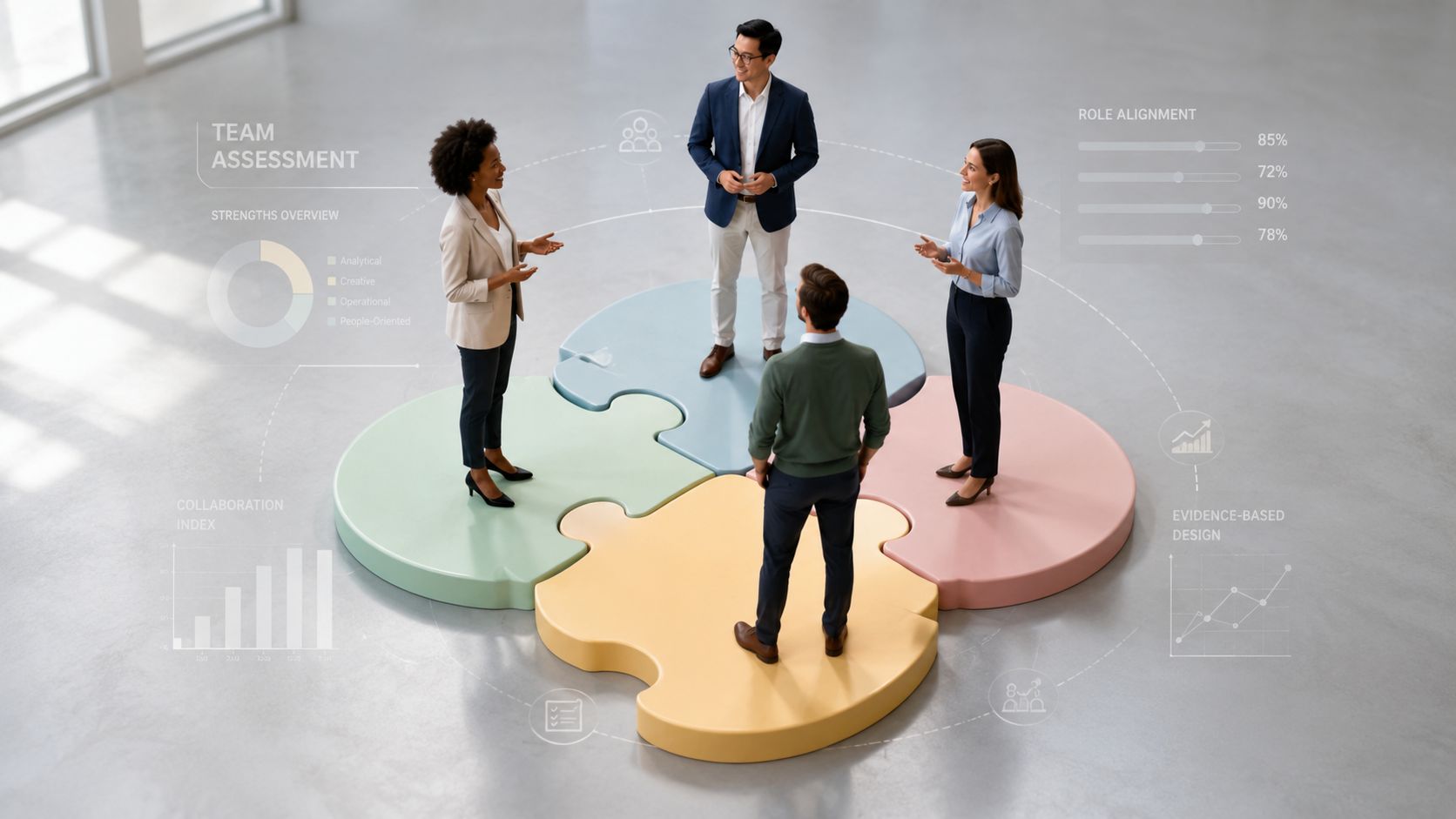
A stronger process starts with a common framework. Every team member completes the same assessment, leaders review comparable profiles, and proposed team mixes are tested for complementarity before roles are assigned. That's the practical value of [behavioral assessment in team design](https://synopsix.ai/blog/what-is-behavioral-assessment). It turns “good chemistry” from a vague aspiration into a set of observable interaction patterns.
What this changes in practice
A Fortune 500 innovation team, a startup engineering pod, and a professional services account team all face the same design question: who balances whom under stress? The extroverted driver may push speed. The reflective analyst may protect decision quality. The relationship builder may absorb stakeholder tension that would otherwise derail execution.
> Practical rule: Build teams for interaction patterns first, then for task coverage. Most teams already have the skills they need. They fail in how those skills collide.
A few operating rules make this strategy work:
For leaders hiring or staffing around culture and compatibility, the same logic also applies to this [practical guide for leaders on hiring](https://www.theokrhub.com/insights/cultural-fit-assessment).
2. Complementary Strengths Mapping and Role Alignment
Many teams don't fail because they lack talent. They fail because talent is stacked in the same direction. You end up with too many initiators and not enough finishers, or too many careful evaluators and no one willing to force a decision.
Strength mapping corrects that. Instead of treating a job description as the whole story, HR and business leaders identify how each person naturally solves problems, processes information, handles detail, and influences others. Then they assign work so one person's default strength offsets another person's predictable weakness.
Pair the work, not just the people
In consulting firms, this often means pairing a big-picture partner with an operations-heavy delivery lead. In software teams, it can mean separating architecture ownership from implementation discipline while ensuring the handoff is intentional. In sales, the strongest pairings often mix a hunter's urgency with an account manager's steadiness.
The point isn't to stereotype people into fixed boxes. It's to reduce avoidable drag. A strategist who's forced into repetitive execution often burns energy. A precision-minded operator asked to carry an ambiguous market-creation mandate may do equally well on effort and poorly on fit.
Team building strategies become a role design exercise. The manager's task is to line up strengths with recurring demands, then create visible partnerships where complementarity is obvious to the team.
Useful design choices
One pattern shows up repeatedly in healthy teams: role clarity lowers defensiveness. When people know why someone else leads a given workstream, they're less likely to interpret difference as incompetence.
3. Predictive Friction and Conflict Prevention
Most organizations intervene too late. They wait until a manager reports tension, a project stalls, or key people stop sharing information. By then, the team has usually built a story about each other that's much harder to unwind.
A prevention model starts earlier. Leaders simulate likely flashpoints before launch: disagreement under deadline pressure, sudden changes in scope, ambiguity in ownership, or conflict between speed and precision. Those simulations won't remove tension. They let you surface where tension is most likely to become costly.
For teams using predictive tools, the issue isn't whether conflict will appear. It's whether the organization can identify it while it's still procedural rather than personal. That's where [conflict risk assessment for teams](https://synopsix.ai/blog/conflict-risk-assessment) becomes useful. It gives HR and line leaders a way to identify probable breakdowns in communication, escalation, and decision flow before those patterns harden.
The remote and hybrid wrinkle
This matters even more in distributed teams. [Gallup's teamwork guidance](https://www.gallup.com/cliftonstrengths/en/278225/how-to-improve-teamwork.aspx) highlights that 60% of remote workers report isolation, and cited 2025 to 2026 research indicating that scheduled, role-aligned micro-touchpoints outperform monthly virtual parties by 35% in sustaining trust. The implication for conflict prevention is straightforward. Low-frequency social events don't reliably protect collaboration. Structured, role-relevant contact does.
> Teams rarely fracture because people had one disagreement. They fracture because no one designed a safe way to have recurring disagreement.
In practice, predictive friction work often changes three things before a team ever launches:
This is one of the most neglected team building strategies because it doesn't look festive. It looks operational. That's exactly why it works.
4. Diversity-by-Behavior Inclusion Strategy
Most inclusion strategies stop at representation categories and broad culture statements. Those matter. But team effectiveness also depends on whether the group contains enough diversity in thought, interpretation, pacing, and risk orientation to avoid collective blind spots.
Behavioral diversity gives leaders another inclusion lens. A team made up entirely of forceful decision-makers may move fast and miss nuance. A team full of consensus-seekers may surface every perspective and still fail to commit. Teams need differences in cognitive style, not just demographic composition.
Build for productive difference
A product team benefits when analytical scrutiny and intuitive concept generation coexist. A marketing department is stronger when evidence-oriented planners and bold creative pattern-breakers both influence decisions. Executive teams need varied approaches to risk, because strategy fails when caution dominates every room or when caution is dismissed in every room.
The strongest team building strategies diverge from generic “communication workshops.” Inclusion isn't only about helping people feel welcome once they arrive. It's also about making sure the team was designed to value different modes of contribution in the first place.
A practical method is to map the team's current behavioral spread and ask uncomfortable questions. Who consistently introduces challenge? Who slows decisions enough to improve them? Who notices stakeholder impact early? Who translates complex issues into executable action?
Inclusion that changes decision quality
Behavioral inclusion is especially relevant in functions that rely on innovation, judgment, and stakeholder navigation. It widens the range of options a team can see before a decision closes.
5. Evidence-Based Leadership Pipeline Development
Leadership pipelines fail less from talent scarcity than from poor inference. Organizations often treat visibility, confidence, and success in a current role as proof of readiness for a larger one. In practice, that approach overweights performance in familiar conditions and underweights the behavioral demands of future complexity.
A stronger method starts with role diagnostics. Operational leadership, turnaround leadership, founder-transition leadership, and enterprise stakeholder leadership require different patterns of judgment, tolerance for ambiguity, decision speed, and influence. Pipeline quality improves when HR defines those requirements in advance, then evaluates candidates against them using consistent behavioral criteria rather than manager intuition.
This is why a [leader development strategy grounded in behavioral data](https://synopsix.ai/blog/leader-development-strategy) produces better succession decisions than informal high-potential labels. It gives HR a repeatable process: specify target capabilities, assess current behavioral fit, identify predictable derailment risks, and assign development experiences that test readiness before the role becomes urgent.
The business case is straightforward. Promotion errors are expensive. They raise regrettable attrition, delay execution, and force organizations into reactive external hiring when an internal successor stalls. A disciplined pipeline reduces those costs because it distinguishes promotability from current-role excellence.
Context still matters. A family business choosing among next-generation leaders faces loyalty dynamics and identity issues that differ from a public company succession process. The evaluation principle should stay constant. Compare the person to the future role, not to a manager's preferred style or the profile of the last successful incumbent.
> Leadership signal: Promote for complexity handling, decision range, and learning velocity. Do not promote for polish alone.
This approach also broadens who gets recognized as leadership material. Clear role criteria reduce the tendency to mistake one communication style for executive presence. That matters for organizations building wider pathways to advancement and for those examining the [neurodiversity in the workplace advantages](https://sachscenter.com/the-benefits-of-neurodiversity-in-the-workplace/). The more precisely leadership work is defined, the less often selection systems reward mimicry over capability.
6. Real-Time Team Performance Monitoring and Optimization
Strong team design at launch does not protect performance six months later. Work changes faster than team habits do. Scope expands, interdependencies multiply, and time pressure shifts behavior in predictable ways. A group that looked well balanced on paper can become fragile once decision rights blur or coordination load rises.
The practical question for HR leaders is not whether to monitor teams. It is what to monitor, how often, and under what governance. Effective systems treat team effectiveness as an operating metric. They track whether the conditions that support execution are strengthening or deteriorating before missed targets, burnout, or regrettable attrition show up in quarterly reviews.
As noted earlier, repeated reinforcement tends to outperform one-off team-building events. The implication is operational. Team building should function as a feedback loop, not a calendar activity.
What leaders should actually monitor
Start with indicators that sit close to business performance. Rework rates, handoff delays between functions, cycle time variance, escalation frequency, decision latency, and uneven participation in key meetings usually reveal coordination problems earlier than engagement surveys do. Those signals matter because they capture how work is getting done, not just how people say they feel about it.
Then add behavioral interpretation. A spike in response time may indicate overload, role ambiguity, conflict avoidance, or a manager bottleneck. The metric alone cannot distinguish among those explanations. The value comes from combining workflow data with manager observation, employee check-ins, and a clear hypothesis about the behavior behind the pattern.
Many dashboards demonstrate failure here. They over-index on sentiment because sentiment is easy to collect, then miss the mechanisms that are degrading execution.
Transparent governance also determines whether monitoring helps or harms. Employees should know which data is collected, the decision it informs, who can see it, and how long it is retained. That level of clarity protects trust and supports psychological safety, which behavioral science consistently links to speaking up, error reporting, and adaptive learning.
Later in the monitoring cycle, a live walkthrough helps. This overview gives a concrete example of how teams can translate signals into action:
<iframe width="100%" style="aspect-ratio: 16 / 9;" src="https://www.youtube.com/embed/_nnOySwZmC0" frameborder="0" allow="autoplay; encrypted-media" allowfullscreen></iframe>
Keep the human in the loop
The [PQE Group explanation of Human-in-the-Loop validation](https://blog.pqegroup.com/artificial-intelligence/why-life-sciences-needs-responsible-ai-use-with-human-validation) applies directly to people analytics. Analysts and managers should review patterns, test alternative explanations, and decide whether intervention is warranted. No dashboard should trigger a role change, team redesign, or performance judgment without contextual review.
That distinction matters for both ethics and accuracy. Behavioral signals are probabilistic, not deterministic. A sudden drop in participation may reflect disengagement, but it can also reflect a poorly structured meeting, an unresolved cross-functional dependency, or a temporary surge in individual workload. Human review prevents category errors.
For CHROs, the highest-value use case is continuous optimization tied to specific KPIs. If a product team shows rising rework and slower decisions, the intervention might be role clarification, meeting redesign, or manager coaching. If those actions work, cycle time falls, error correction drops, and capacity returns to revenue-producing work. That is team building as a repeatable business process, measured through execution quality rather than good intentions.
7. Behavioral Onboarding and Team Integration Programs
Most onboarding programs still optimize for compliance and orientation. They explain benefits, systems, and policies. They don't do enough to help a new hire understand how this specific team works, where tension typically appears, and how their own style will land with colleagues.
Behavioral onboarding fixes that by personalizing integration. A new engineer who learns best through documentation and independent processing shouldn't receive the same ramp plan as a relationship-led account manager who learns by live interaction and rapid feedback. Both need standards. They don't need identical pathways.
Start integration before day one
The most effective versions begin during hiring. Behavioral insight informs mentor pairing, manager briefings, and role-specific expectations before the employee arrives. In a tech company, that may mean assigning a steady implementation peer to a highly creative but less structured new hire. In a sales organization, it may mean choosing a mentor whose communication style complements rather than mirrors the new rep.
This is especially useful in hybrid environments, where social ambiguity tends to slow belonging. If the new hire doesn't know how decisions are made, who prefers what medium, or how disagreement is handled, they often misread team norms as personal rejection.
A strong onboarding design also gives managers a script for adaptation. Instead of generic advice like “check in often,” the manager can calibrate frequency, communication mode, and autonomy level to the employee's profile.
Elements worth building into the process
This is one of the most impactful team building strategies because it shapes team dynamics before habits and misinterpretations calcify.
8. Cross-Functional Team Design for Organizational Initiatives
Cross-functional work is where weak team design becomes expensive. Digital transformation, M&A integration, pricing redesign, and product launches all depend on people who represent different incentives, timelines, and definitions of success. If leaders assemble those teams by title and calendar availability, conflict is almost guaranteed.
A more disciplined approach defines the behavioral requirements of the initiative first. Does the work need political navigation, analytical rigor, execution stamina, creative reframing, or high tolerance for uncertainty? Usually it needs all five, but not in equal proportion.
Design around the initiative's pressure points
A transformation team balancing IT, operations, and commercial leadership needs more than subject matter experts. It needs people who can translate across vocabularies and maintain trust when one function feels another is slowing progress. An M&A integration team often needs unusual levels of emotional steadiness and ambiguity tolerance because priorities shift quickly and identities feel threatened.
The best CHROs I've worked with treat these teams as temporary but high-stakes systems. They establish decision rights at kickoff, map likely fault lines between functions, and monitor whether one style is dominating to the point that another function disengages.
This is also where simulation becomes practical. Leaders can pressure-test proposed team mixes against expected scenarios: delayed milestone, stakeholder escalation, data conflict, or conflicting regional priorities. If the same small set of people is likely to carry every hard conversation, the design is already telling you something.
A better staffing lens
Cross-functional teams are where strategic team building strategies prove whether they're serious or cosmetic.
9. Behavioral Data-Driven Promotion and Succession Decisions
Promotion errors often begin with a category mistake. Organizations confuse excellence in the current role with readiness for a different one. The top individual contributor becomes a manager. The best regional leader gets an enterprise remit. The trusted operator inherits a strategic portfolio. Sometimes it works. Often the role changed more than the criteria did.
Behavioral data gives HR a way to separate present performance from future fit. Instead of asking whether someone deserves promotion, leaders ask whether the person's profile aligns with the decision load, ambiguity level, interpersonal complexity, and stakeholder demands of the target role.
Validate before you elevate
AI-enabled prediction requires discipline. [UNC Health reporting on medical AI validation gaps](https://news.unchealthcare.org/2024/08/researchers-highlight-need-for-published-validation-data-as-artificial-intelligence-is-thrust-into-patient-care/) noted that approximately 43% of FDA-approved medical AI devices, or 226 out of 521, lacked published clinical validation data. HR isn't medicine, but the governance lesson transfers cleanly. If you're using predictive tools for promotions or succession, you need evidence that the model has been validated, not just marketed.
The same principle appears in [Toluna's guidance on validating AI with human review](https://tolunacorporate.com/ai-validation-human-touch-reliable-ai/). Effective behavioral prediction requires cross-validation, benchmarking against known human data, and expert review panels that can catch cultural or contextual misinterpretation. In succession planning, that means any model output should be reviewed by leaders who understand the role, the team, and the environment.
A promotion process becomes more defensible when candidates receive clear developmental feedback. “Not yet” is easier to accept when the organization can specify which demands of the next role require stronger evidence.
Better succession decisions depend on clear thresholds
[Guidance on AI model validation and drift controls](https://www.youtube.com/watch?v=lKWapFeZkDU&vl=en) emphasizes baseline performance criteria, confidence scores, and retraining when drift exceeds predefined acceptance limits. For talent systems, the analogue is straightforward. Define what acceptable predictive quality looks like before you trust the output, and review performance if the workforce, role requirements, or data inputs materially change.
That's how you keep promotion decisions evidence-based without pretending the model is infallible.
10. Behavioral Compatibility Analysis for Client and Vendor Partnerships
External partnerships often fail for reasons procurement dashboards miss. The service scope is sound, the SLA is clear, and the economics work. Execution still degrades because the people managing the relationship process information differently, escalate at different thresholds, and interpret the same message through conflicting norms for speed, candor, and risk.
That makes partnership quality partly a staffing variable, not just a contract variable.
In organizational psychology, this sits at the intersection of person-environment fit and relational coordination. A client lead who wants rapid iteration can experience a highly accurate but slow-moving vendor as unresponsive. A vendor team that values diplomatic communication can read a direct operator as hostile rather than time-constrained. Those misreads create attribution errors, then operational drag: slower decisions, avoidable escalations, and lower renewal odds.
The practical implication is straightforward. Relationship managers should be assigned with the same discipline used for internal team design. Communication style, tolerance for ambiguity, decision cadence, and conflict orientation all shape whether a partnership absorbs stress or amplifies it.
Similarity is not always the goal. Complementarity often performs better.
A volatile client may benefit from an account lead with high emotional regulation and structured follow-through. An indecisive stakeholder may need a partner who reduces ambiguity by clarifying choices, owners, and timelines. The relevant question is not whether two parties look alike behaviorally. It is whether their pattern of interaction improves coordination under pressure.
A useful operating model includes four parts:
This approach also improves commercial forecasting. Accounts with repeated behavioral mismatch often appear healthy in pipeline reviews until trust deteriorates suddenly. Firms that code partnership risk only in financial or delivery terms miss a leading indicator sitting in plain sight: interaction quality between the people running the relationship.
The wrong external pairing can make a disciplined internal team appear inconsistent. The right pairing can stabilize a difficult account without changing the product, the price, or the contract. For CHROs and senior HR leaders, that shifts team building from an internal culture initiative to a business process that affects retention, margin protection, and vendor performance.
Behavioral Team-Building Strategies: 10-Point Comparison
| Strategy | Implementation Complexity 🔄 | Resource Requirements ⚡ | Expected Outcomes 📊⭐ | Ideal Use Cases 💡 | Key Advantages ⭐ | |---|---:|---:|---|---|---| | Behavioral Assessment-Driven Team Composition | Medium, needs validated assessments and process change | Moderate, assessment tools, training, AI compatibility analysis | Faster cohesion, lower friction, improved retention and productivity | Cross-functional team assembly, hiring, scaling engineering/product teams | Evidence-based team design; predicts compatibility and leadership fit | | Complementary Strengths Mapping and Role Alignment | Medium, requires mapping and role documentation | Low–Moderate, behavioral profiles and role competency work | Higher individual contribution, less burnout, better project outcomes | Role redesigns, consulting, software teams, sales pairings | Maximizes strengths, improves engagement, reduces non-core training | | Predictive Friction and Conflict Prevention | High, needs simulation models and scenario design | High, robust behavioral data and analytics capability | Fewer conflicts and turnover; targeted coaching and proactive fixes | High-stakes leadership teams, finance, healthcare, remote teams | Prevents dysfunction via simulations; enables proactive interventions | | Diversity-by-Behavior Inclusion Strategy | Medium, needs diversity metrics and hiring adjustments | Moderate, assessments, recruitment strategy, training | Increased innovation, reduced groupthink, better decision quality | Product R&D, marketing, leadership teams seeking cognitive diversity | Boosts creativity and resilience by combining varied thinking styles | | Evidence-Based Leadership Pipeline Development | High, complex competency modeling and development plans | High, leadership assessments, coaching, benchmarking datasets | Fewer mis-promotions, stronger succession readiness, faster leader readiness | Enterprise succession planning, leadership development programs | Objective promotion criteria; accelerates leadership readiness | | Real-Time Team Performance Monitoring and Optimization | High, continuous collection, dashboards, alerting | High, monitoring infrastructure, privacy safeguards, analysts | Early issue detection, rapid interventions, improved retention | Remote-first orgs, trading/operations, high-performance teams | Enables rapid response and objective team-health insights | | Behavioral Onboarding and Team Integration Programs | Low–Medium, personalization and mentor coordination | Moderate, pre-hire assessments, mentor training, pathway design | Faster time-to-productivity, better retention, smoother integration | New hires, high-volume recruiting, professional services | Personalized onboarding; strategic mentor/buddy matching | | Cross-Functional Team Design for Organizational Initiatives | Medium–High, larger pool assessment and governance | Moderate–High, cross-functional profiling, simulations, project governance | Improved collaboration, faster decisions, higher initiative success | M&A integrations, digital transformation, major projects | Balances perspectives and improves stakeholder alignment | | Behavioral Data-Driven Promotion and Succession Decisions | Medium, role-to-role comparisons and scoring systems | Moderate, assessments, readiness simulations, leadership alignment | Reduced mis-promotions, transparent development paths, better succession | Promotion cycles, succession planning, fairness initiatives | Objective, defensible promotion decisions and clear development paths | | Behavioral Compatibility Analysis for Client and Vendor Partnerships | Medium, external profiling and compatibility modeling | Moderate, stakeholder profiling, consent processes, analytics | Better client/vendor satisfaction, reduced conflict, improved deals | Account management, consulting engagements, vendor selection | Optimizes partnership staffing to reduce friction and boost outcomes |
From Guesswork to Strategy: Your People Intelligence Roadmap
Team building fails when organizations treat it as an event category instead of an operating discipline. A well-produced offsite can improve mood for a week. It rarely changes decision quality, coordination patterns, or the way conflict is handled under pressure. Senior HR leaders do not need more activities. They need a repeatable method for designing teams that perform well in real work.
That method runs through people intelligence. Across the ten strategies above, the common thread is simple: assess behavior, match demands to strengths, identify likely friction early, and monitor whether the intervention changed business outcomes. This shifts team building from a discretionary culture expense to a workforce design process with defined inputs, governance rules, and measurable outputs.
The implications for HR are larger than they first appear.
Once behavioral data is used systematically, several chronic talent problems become easier to address at the source. Hiring decisions improve because role fit is specified more clearly. Promotion decisions become more defensible because readiness is evaluated against observable leadership demands rather than visibility or tenure. Cross-functional initiatives gain speed because teams are assembled with coordination risk in mind, not just with whoever is available. Conflict also becomes easier to prevent because differences in pace, communication style, risk tolerance, and decision orientation can be anticipated before they become interpersonal disputes.
This is the strategic break from traditional team-building logic. Conventional programs ask whether employees enjoyed the experience. A people intelligence model asks whether the team became more effective after role clarification, behavioral alignment, and manager intervention. Those are different standards of evidence. Only one of them can justify ongoing investment to a CFO or board.
The measurement model should reflect that difference. Start with operational KPIs tied to the team's mandate: time to productivity, error rates, escalation frequency, regrettable attrition, internal mobility success, project cycle time, customer satisfaction, or manager span-of-control effectiveness. Then pair those outcomes with behavioral indicators such as collaboration quality, decision clarity, and role-related stress points. That combination helps HR distinguish between a team that feels more connected and a team that performs better.
Technology can support this process, but software is not the strategy. Assessment tools, compatibility models, and AI-assisted recommendations are useful only when the organization has clear decision rights, consent standards, score interpretation rules, and manager capability to act on the findings responsibly. Without that infrastructure, behavioral data becomes another dashboard that creates interest without changing behavior.
Platforms such as [Synopsix](https://synopsix.ai) can support this roadmap by translating psychometric and compatibility signals into practical guidance for hiring, team design, and talent development. The value is operational consistency. Leaders get a clearer basis for staffing decisions, HR gets a more structured way to test interventions, and the organization gets a stronger link between team design and business performance.
The central question is no longer whether team building matters. It is whether the organization is willing to run team effectiveness with the same rigor it applies to finance, sales, or operations. Once that shift happens, guesswork stops looking like culture work and starts looking like unmanaged risk.