Team Dynamics and Performance: Key Drivers for 2026
By Synopsix · October 10, 2026 · 14 min read
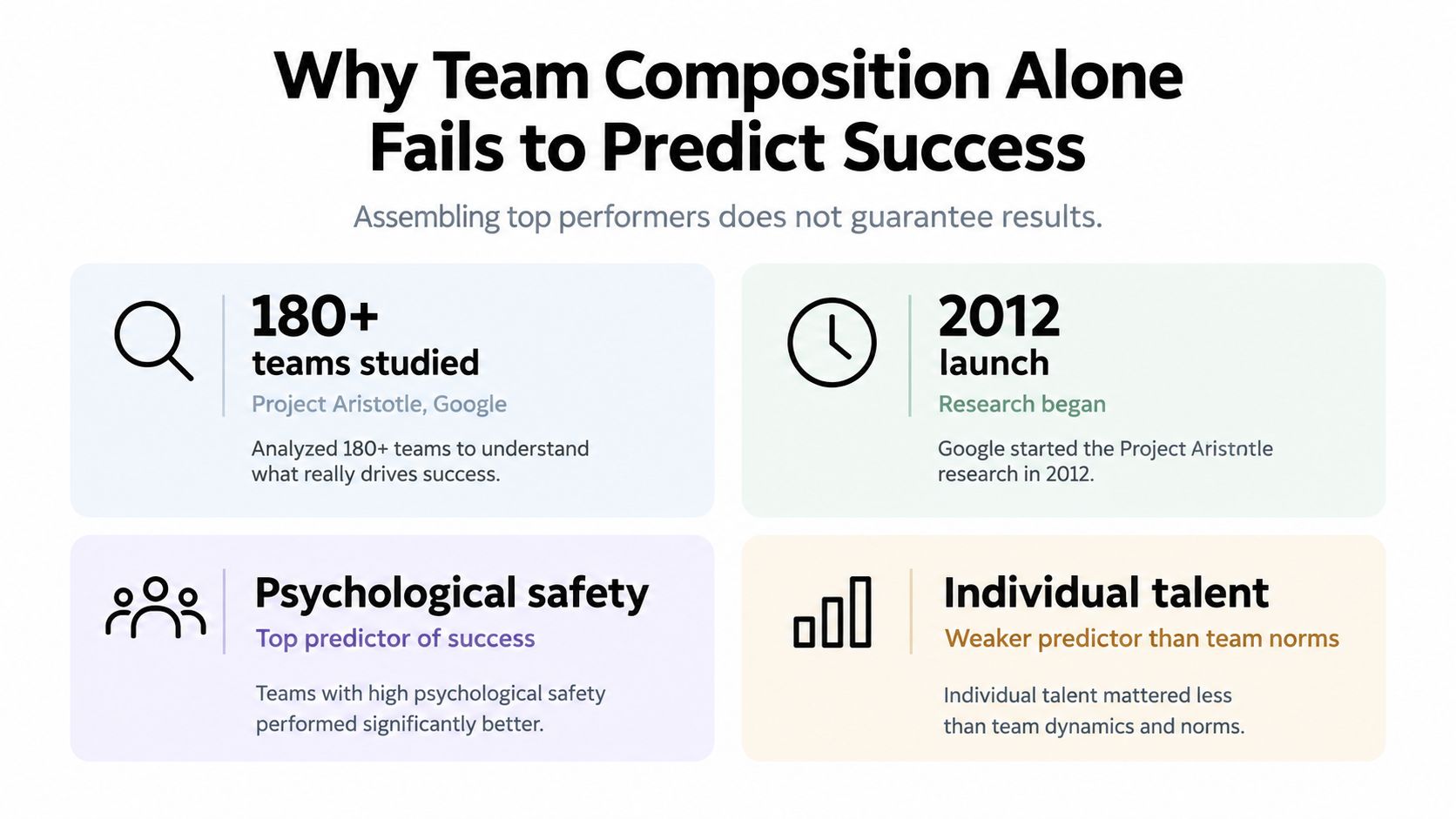
Google's Project Aristotle found that psychological safety was the strongest predictor of team effectiveness, ahead of seniority, education, and individual expertise. High-safety teams achieved 19% higher productivity, 31% more innovation, and 27% lower turnover than lower-safety teams.
That finding changes the hiring question. The issue isn't whether an organization has talented people, but whether its teams allow those people to exchange information, challenge assumptions, report errors, and turn different perspectives into coordinated action. Team dynamics and performance are therefore connected through observable behaviors, not vague cultural fit.
Why Team Composition Alone Fails to Predict Success
Google launched Project Aristotle in 2012 and analyzed more than 180 engineering and sales teams over approximately two years. The project evaluated roughly 250 potential team-performance attributes, then compared conventional composition variables with the way members worked together. Its central conclusion challenged the assumption that the strongest collection of individual performers will automatically produce the strongest team. [Google's Project Aristotle findings](https://www.linkedin.com/posts/pedro-pinto-5463b614_in-2012-google-launched-project-aristotle-activity-7476625536564432896-LoMv) showed that seniority, educational background, and individual expertise were less predictive than interaction patterns.
Psychological safety ranked first among the identified dynamics. It means that team members share a belief that they can speak up, ask questions, admit mistakes, and challenge ideas without humiliation or punishment. That condition changes the information available to a team. A specialist who flags a risk early, a junior employee who questions an assumption, or a manager who admits an error can prevent a problem that credentials alone wouldn't reveal.
Composition creates potential, interaction converts it
This doesn't make expertise irrelevant. A team still needs the knowledge to perform its work. The evidence shows, however, that capability becomes useful only when interaction norms let people access and combine it. A highly experienced employee who withholds concerns, dominates discussion, or rejects external input can reduce collective performance despite strong individual credentials.
The implication for CHROs is practical. Hiring systems should assess not only whether a candidate can perform a role, but also how that person responds to uncertainty, disagreement, feedback, and mistakes. Leaders designing cross-functional groups may also benefit from reviewing [team structure for DXP success](https://www.kogifi.com/articles/digital-marketing-team-structure), particularly when specialized roles must coordinate across a complex delivery process.
A behavioral profile can make these questions more concrete. Synopsix's [compatibility matches](https://synopsix.ai/blog/compatibility-matches) resource illustrates how leaders can examine potential fit through interaction patterns rather than treating “culture fit” as an informal impression.
> Practical rule: Don't ask only who is on the team. Ask what information each person is likely to share, suppress, challenge, or miss when the pressure rises.
The Five Measurable Drivers of Team Effectiveness
Project Aristotle identified five dynamics that give leaders a more useful diagnostic framework: psychological safety, dependability, structure and clarity, meaning, and impact. Psychological safety matters because it determines whether information can enter the team. The other four determine whether the team can convert that information into reliable work.
Start with the conditions for useful information
Psychological safety appears in ordinary operating moments. People ask for help before a deadline becomes a crisis. They report a mistake while correction is still possible. They challenge a proposal without turning the discussion into a personal contest. A meta-analytic summary reports a significant positive relationship between psychological safety and team performance, learning behavior, job satisfaction, and organizational commitment across 136 studies involving more than 22,000 participants. [The research summary on psychological safety](https://www.si-labs.com/en/articles/psychological-safety/) links the mechanism to learning, because teams gain access to information that would otherwise remain hidden.
Dependability is more operational. Team members deliver what they commit to, communicate when a commitment is at risk, and maintain an expected standard of quality. Without it, psychological safety can produce open conversation without dependable execution.
Make work legible
Structure and clarity answer basic questions: Who owns the decision? What does completion mean? Which priorities take precedence? When those answers remain ambiguous, teams spend energy interpreting responsibilities instead of completing work. Clear ownership also makes accountability fairer, because leaders can distinguish an execution failure from a design failure.
Meaning connects work to something personally significant, such as learning, craft, service, or contribution. Impact connects it to consequences beyond the immediate task, including a customer outcome, an organizational priority, or a result that matters to stakeholders. A role can have clear tasks and still feel disconnected if people can't see why the work matters.
Leaders can test these dynamics through a short review:
Clear agendas, decision records, and explicit ownership can also [reduce meeting confusion](https://withstoa.com/blog/cross-functional-alignment). For a broader view of how these conditions interact, leaders can compare their operating norms with the [qualities of effective teams](https://synopsix.ai/blog/qualities-of-effective-teams).
The Misunderstood Role of Psychological Safety
Psychological safety isn't a permission slip for every disagreement to improve performance. Research published in 2025 found that encouraging different perspectives alone didn't directly improve team performance. Psychological safety enabled those perspectives to be expressed, and that expression supported performance indirectly through the way teams used the information. [The 2025 research on perspectives and team performance](https://www.tandfonline.com/doi/full/10.1080/03075079.2025.2509148) therefore points to a conditional relationship, not a universal formula.

The distinction matters because task conflict and interpersonal conflict produce different organizational consequences. Task conflict concerns the work: assumptions, evidence, priorities, design choices, or risk. Interpersonal conflict targets identity, competence, motive, or status. The first can improve scrutiny when the team keeps it focused and converts it into a decision. The second damages trust and makes future participation more costly.
Diagnose the quality of disagreement
Leaders should look for behavioral signals rather than asking whether a team feels harmonious. Silence after a senior person speaks may indicate agreement, or it may indicate that dissent feels unsafe. Repeatedly revisiting decisions can signal healthy caution, or it may reveal that the group never established a decision owner. A debate that ends with clearer criteria is productive. A debate that ends with people avoiding one another is not.
Useful safeguards include:
A team doesn't need maximum harmony. It needs safe, focused friction that improves judgment and leads to action.
<iframe width="100%" style="aspect-ratio: 16 / 9;" src="https://www.youtube.com/embed/65P-Dk7crvU" frameborder="0" allow="autoplay; encrypted-media" allowfullscreen></iframe>
Strengths Awareness Versus Strengths Composition
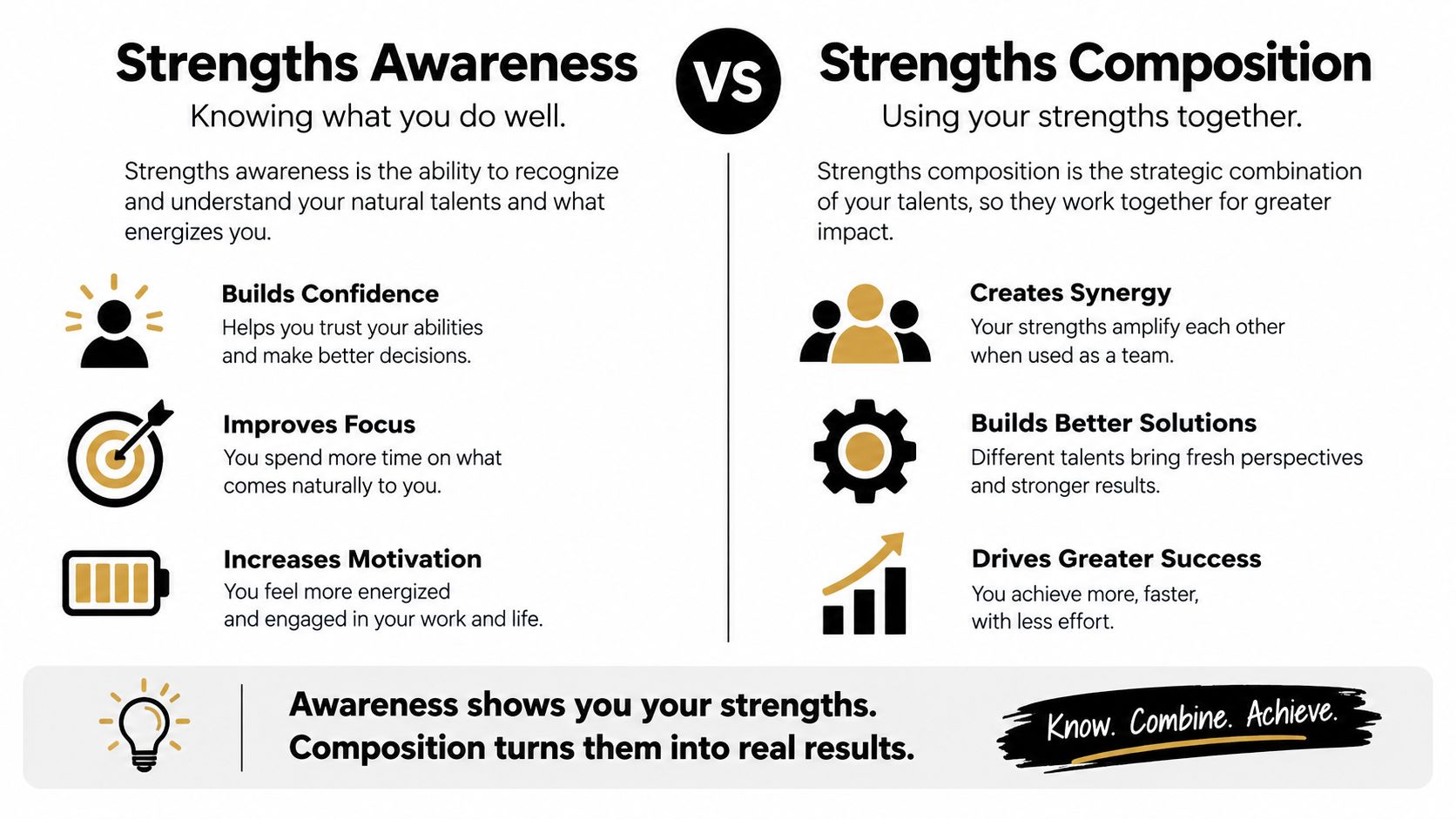
Leaders often try to create balance by assembling complementary personality types. That approach assumes the value lies mainly in the mix. Gallup's study of more than 11,000 teams across six industries offers a different conclusion: strengths awareness had twice the influence on performance as the composition of strengths within the team. [Gallup's team experience research](https://www.gallup.com/cliftonstrengths/en/713282/cliftonstrengths-team-experiences.aspx) shifts attention from what a team contains to what its members understand about one another.
Awareness makes differences usable. A team member who knows that a colleague needs more context before acting can provide it instead of interpreting caution as resistance. Someone who recognizes another person's role in spotting execution risk can invite that perspective before a decision, rather than treating it as an interruption. The profile matters less than the shared operating knowledge it creates.
Turn difference into operating agreements
A behavioral assessment becomes valuable when it answers practical questions:
| Team question | Useful operating agreement | |---|---| | Who challenges assumptions? | Assign a rotating role for pre-mortems or risk review | | Who closes decisions? | Name the decision owner before debate begins | | Who needs context? | Define the minimum information required before action | | Who detects execution risk? | Add a checkpoint before handoffs or launch | | Who connects stakeholders? | Give one person responsibility for cross-functional updates |
This framework also changes how leaders interpret engagement data. Gallup's broader 2026 analysis of 92,252 teams found that engagement was associated with productivity, well-being, and lower turnover in small and medium-sized teams, while the relationship between engagement, productivity, and turnover varied for teams of 20 or more. Team size therefore matters when leaders interpret whether awareness and engagement are translating into outcomes.
The conclusion is counterintuitive. A team doesn't need a perfect personality balance to work well. It needs enough shared awareness to anticipate differences, distribute responsibility, and prevent predictable friction from becoming personal. That makes compatibility analysis a development tool, not merely a selection filter.
The Case for Contextualized Behavioral Assessment
Generic personality testing and work-contextualized behavioral assessment answer different questions. A generic measure may describe a broad tendency. A contextualized measure asks how that tendency appears in situations relevant to the role, such as prioritizing under pressure, following through on commitments, handling disagreement, or responding to incomplete information.
The distinction has practical significance. A research summary reports average predictive validity of .11 for generic personality measures and .24 for measures framed around workplace behavior, roughly twice as strong. The same summary cites a conservative 2023 meta-analysis of conscientiousness across 102 samples and 23,305 people, with a raw correlation of .17 overall and .14 among actual applicant samples. [The summary of contextualized personality measurement](https://www.poll-maker.com/personality-test-for-hiring) supports a clear rule: assess behavior in relation to the work, not as a label detached from the work.
Compare tools against the decision they must support
| Evaluation criterion | Generic approach | Contextualized approach | |---|---|---| | Construct | Broad trait label | Role-relevant behavior | | Evidence | General association | Prediction tied to work demands | | Output | Description of preference | Signal about likely workplace response | | Team use | Individual profile | Interaction and compatibility hypothesis | | Decision quality | Easy to overinterpret | Easier to connect with observable criteria |
CHROs should ask vendors how their measures were validated, which behaviors they predict, and how reports distinguish evidence from interpretation. They should also define the performance criteria before reviewing candidate data. Otherwise, the organization may select a profile because it sounds desirable rather than because it relates to the role.
Context matters after hiring, too. A person who appears highly decisive may help in an emergency but create avoidable friction if they close decisions before others can contribute. A cautious analyst may protect quality in one role and slow execution in another. The relevant question is not whether a trait is good, but when it helps, when it creates risk, and what team conditions moderate that risk. A practical guide to this approach is [team dynamics assessment](https://synopsix.ai/blog/team-dynamics-assessment).
Implementing People Intelligence at Scale
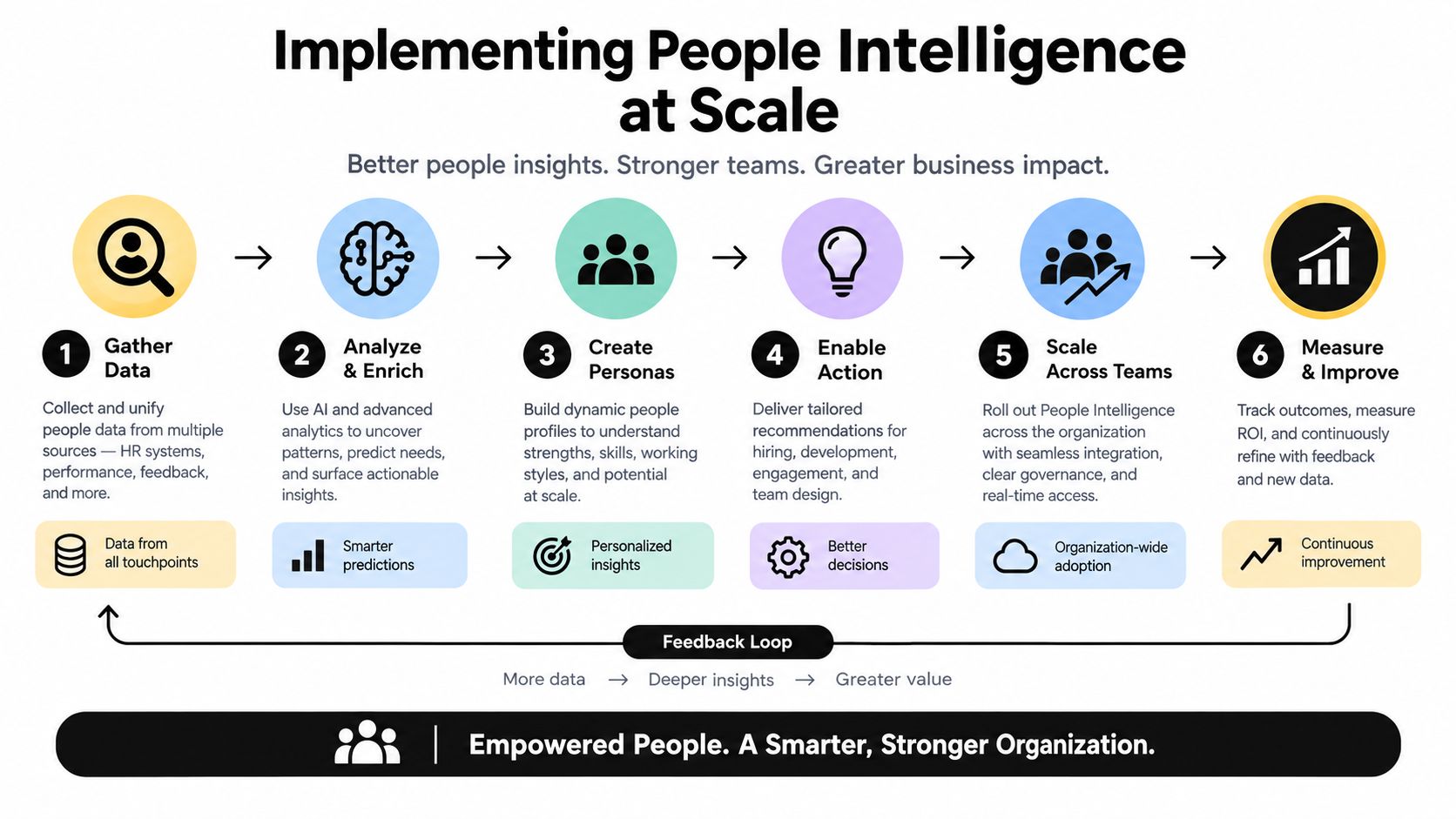
Behavioral data creates value only when it changes a decision. A practical implementation model moves from measurement to comparison, then from interpretation to action. Synopsix is one platform that applies this workflow through assessments, comparable profiles, business-language reports, simulations, compatibility analysis, and development plans.
Four stages from data to action
1. Assess candidates and employees in under 30 minutes. The first requirement is usable participation. A concise assessment gives hiring and talent teams a repeatable input without turning every decision into a lengthy evaluation process.
2. Generate comparable behavioral profiles. Comparison creates a common language. Leaders can examine how people approach decisions, communication, pressure, and collaboration without relying solely on informal impressions.
3. Translate psychometrics into business signals. HR leaders shouldn't have to decode technical terminology before making a staffing decision. Reports can surface risk indicators, fit recommendations, and role-specific insights in language managers can use.
4. Act through simulations, compatibility analysis, and development plans. The highest-value question is prospective: what may happen if this candidate joins the team, if this employee takes a promotion, or if responsibilities are reorganized? Testing those possibilities supports decisions before friction becomes expensive.
Organizations using Synopsix report 40% faster hiring decisions, 60% fewer mis-hires, and over 50,000 behavioral profiles generated, with claimed 98% assessment accuracy. These are reported platform outcomes, not universal benchmarks, and leaders should test them against their own baseline. The operational principle remains broadly useful: connect every assessment output to a defined decision, owner, and follow-up measure.
> Implementation test: If a profile doesn't change a hiring question, team assignment, manager conversation, or development action, it isn't yet people intelligence.
From Insight to Impact, A Real-World Scenario
Consider a mid-size technology company whose product development team repeatedly missed delivery commitments while turnover increased. Leadership initially treated the issue as an individual performance problem. A behavioral review revealed a different pattern: technical capability was strong, but team members had little shared awareness of communication preferences, decision-making styles, and risk tolerance.
The company mapped where those differences appeared in delivery work. Some employees wanted extensive context before committing. Others moved quickly and expected colleagues to resolve ambiguity as they went. Risk concerns surfaced late because the people most likely to identify them didn't have an explicit role in decision reviews.
Design the system around the friction
Leadership used compatibility analysis to identify predictable pressure points, redesigned roles around decision ownership, and introduced simulated collaboration exercises. The team then created operating agreements covering escalation, handoffs, challenge, and closure. The intervention didn't attempt to make everyone communicate in the same way. It made differences visible enough to coordinate.
Over the following six months, the organization reported improved delivery predictability, reduced interpersonal conflict, and higher engagement scores. These outcomes belong to the scenario, not a general guaranteed result. The important analytical point is that leaders changed the system rather than labeling employees as difficult or insufficiently committed.
The same logic applies outside technology. Organizations coordinating volunteers, distributed programs, or community operations may need both behavioral insight and practical workflow support. A resource on [volunteer management software](https://www.volunteerbadge.com/volunteer-management-software) can help with the operational side, while team analysis addresses how people coordinate within that structure.
The scenario demonstrates a useful sequence: identify interaction patterns, connect them to work consequences, assign explicit responsibilities, and measure whether behavior changes. Team dynamics and performance become manageable when leaders treat friction as data rather than as personality drama.
Building a Future-Ready Approach to Team Design
Future-ready team design won't be defined by collecting more personality labels. It will be defined by connecting behavioral evidence to the decisions that shape work: who joins a team, who leads it, how responsibilities are distributed, how disagreement is handled, and how development priorities are selected.
The evidence supports three priorities. First, assess interaction conditions, not just individual capability. Project Aristotle's findings place psychological safety and other team dynamics ahead of composition variables when leaders evaluate effectiveness. Second, build shared awareness so that differences in communication, decision-making, and risk tolerance become operating agreements. Gallup's findings show why awareness can matter more than the raw mix of strengths. Third, use contextualized measurement so that assessments relate to observable job demands rather than broad labels.
A practical agenda for CHROs
Hybrid and global teams make this discipline more important because fewer informal cues reveal who is disengaged, confused, or withholding a concern. Explicit operating agreements and behavior-based data can compensate for what leaders can't reliably observe in distributed work.
The strategic shift is simple but demanding. Stop treating team composition as the final answer. Treat it as an input to a larger system that includes psychological safety, role clarity, dependability, awareness, leadership behavior, and measurable work outcomes.
---
Synopsix turns scientifically validated behavioral assessments into practical guidance for hiring, team design, and talent development, including comparable profiles, role-specific insights, compatibility analysis, and development plans. Visit [Synopsix](https://synopsix.ai) to evaluate how people intelligence can help your organization make clearer decisions about team dynamics and performance.