Team Dynamics Assessment Guide for HR Leaders
By Synopsix · September 8, 2026 · 15 min read
A product team can have talented engineers, experienced marketers, and a capable manager, yet still miss deadlines, duplicate work, and avoid difficult decisions. HR often sees the symptoms first: complaints about collaboration, uneven workloads, regretted hires, or a manager who says the team “just doesn't click.” The harder question is what the team does when priorities change, information is incomplete, or pressure rises.
A team dynamics assessment gives HR a way to answer that question with evidence. It moves beyond a single cohesion score and examines interaction patterns, coordination, contribution balance, role clarity, decision behavior, trust, and adaptation over time. That shift matters for hybrid, cross-functional, and rapidly changing organizations, where informal signals are harder to observe.
This guide is for CHROs, people analytics professionals, talent leaders, hiring managers, and organizational development practitioners who need to diagnose team behavior responsibly. By the end, you'll have a practical way to choose a framework, run an assessment, interpret the findings, and connect them to hiring, development, leadership, and team design decisions.
Introduction Why Team Performance Is More Than Talent
A senior HR business partner notices a familiar pattern. A newly assembled team includes people with strong functional records, complementary expertise, and a respected leader. Yet projects stall at handoffs. Two people solve the same problem while another waits for context. Meetings feel agreeable, but decisions are revisited later in private conversations.
The organization's first reaction may be to ask whether the team needs more training or a different personality mix. Those questions can help, but they often skip the operating system that connects individual talent to collective performance. A group can contain high performers and still lack clear decision rights, reliable information flow, or a balanced distribution of effort.
That's why team dynamics assessment deserves a place in the HR toolkit. Traditional approaches have often relied on how team members describe their experience. A 2019 systematic review found that self-report surveys were the most common method for studying conflict, with 16 articles using surveys for that construct, and concluded that surveys remained the most widely used approach across multiple team-dynamics phases and constructs. ([Systematic review of team dynamics measurement](https://pmc.ncbi.nlm.nih.gov/articles/PMC6593277/))
Surveys remain useful, but they're only one lens. People may report strong alignment while avoiding disagreement, or rate trust positively while one person carries most of the coordination work. HR needs measures that connect perceptions with observable behavior and changing work conditions.
For practical guidance on setting expectations, clarifying responsibilities, and strengthening collaboration before problems become expensive, HR leaders can also consult [strong team building advice from Jelly Donut](https://jellydonutevents.com/building-a-strong-and-efficient-team/). The broader lesson is simple: teams perform better when their working agreements are made visible and revisited.
A strong assessment doesn't label a team as good or bad. It helps leaders identify where friction begins, how the team adapts, and which changes are most likely to improve execution.
What Team Dynamics Assessment Really Measures
A team dynamics assessment measures the team as a working system. It asks how members exchange information, coordinate responsibilities, make decisions, respond to uncertainty, and support one another when the work becomes difficult. Satisfaction matters, but it's only one part of the picture.
Think of an orchestra. Individual musicians may be highly skilled, but performance still depends on timing, listening, role awareness, and the conductor's ability to adjust the group. A team assessment examines those collective behaviors rather than asking whether each musician enjoys working with the others.
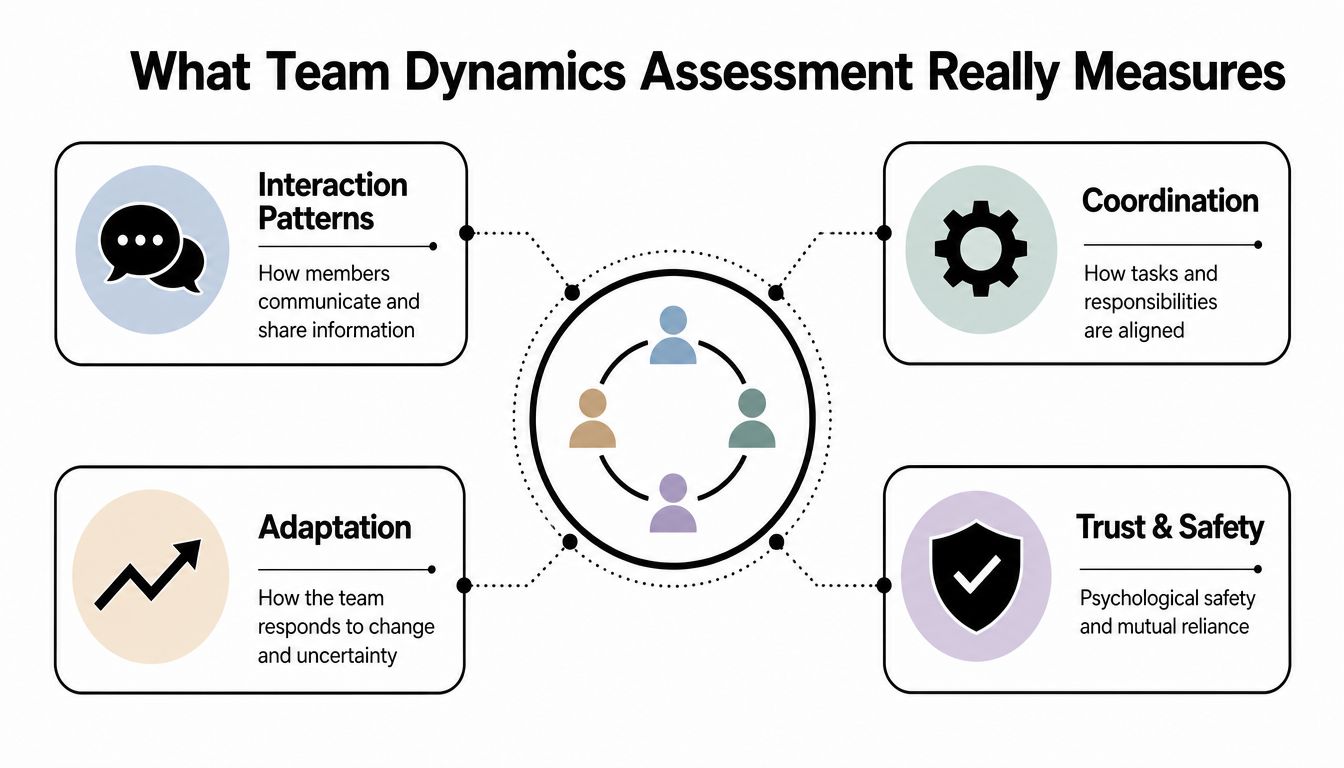
Four practical measurement areas
Interaction patterns show who shares information, who gets consulted, and whether disagreement enters the room early enough to improve decisions. Organizational network analysis can add structure to this view by examining relationships and communication patterns across a team, rather than treating each person as an isolated data point. [Learn more about organizational network analysis](https://synopsix.ai/blog/organizational-network-analysis).
Coordination covers handoffs, role clarity, prioritization, and follow-through. A team may communicate frequently but still coordinate poorly if responsibilities remain ambiguous or decisions lack an owner.
Adaptation captures how the group responds to new information, shifting goals, and pressure. A team that works well under stable conditions may struggle when a customer changes requirements or a key contributor becomes unavailable.
Trust and safety concern whether people can ask for help, challenge assumptions, admit uncertainty, and rely on colleagues to complete their commitments. This isn't the same as social closeness. A friendly team may still avoid difficult conversations.
Attitudes are signals, not the whole diagnosis
Self-report items can reveal confidence, perceived cohesion, and concerns that aren't visible to an observer. Behavioral measures add a different kind of evidence, such as who contributes, how decisions unfold, or whether tasks repeatedly return to the same person.
The field has also moved toward longitudinal and process-oriented assessment. The earlier review noted a shift from static snapshots toward measuring team dynamics over time, while a major review of team effectiveness described interaction sensors and computational modeling as emerging ways to capture cohesion and cognition as work unfolds. ([Review of team effectiveness research](https://psycnet.apa.org/record/2019-36626-001))
The practical implication is important: a team score taken once can describe a moment. A useful assessment helps explain the pattern behind that moment and whether the pattern is changing.
Comparing Common Frameworks and Metrics That Matter
No single framework answers every HR question. A psychological safety survey can identify whether people feel able to speak up, but it may not show who gets interrupted or where decisions slow down. A multi-rater instrument can reveal contribution differences, but it still needs context from the team's work environment.
The strongest choice depends on the decision you need to make. Start with the behavior or risk you want to understand, then select the lightest method that can capture it with enough validity.
| Framework Type | Core Metrics | Best For | Limitation to Watch | |---|---|---|---| | Team surveys | Cohesion, trust, psychological safety, conflict perceptions | Establishing a shared baseline and identifying perceived concerns | May reflect attitudes without showing actual behavior | | Peer assessments | Task cohesion, contribution patterns, behavioral manifestations | Understanding how members experience one another's work behaviors | Ratings can contain bias and may be influenced by relationships | | Structured observation | Handoffs, participation, decision routines, follow-through | Diagnosing meeting and workflow behavior in context | Requires trained observers and consistent criteria | | Multi-rater feedback | Contribution balance, coordination, reliability, interpersonal behavior | Comparing self-perception with colleague and manager observations | Results can become noisy without clear referents | | Interaction sensors | Communication flow, participation patterns, interaction timing | Studying dynamics as they unfold in real work | Privacy, consent, data quality, and interpretation require care | | Computational models | Dynamic patterns, relationship structures, emerging friction | Exploring complex or changing team systems | Models need strong validation and shouldn't replace human judgment |
Choose task behavior over pleasant impressions
Peer-assessed measures become more informative when they capture task cohesion, use referent-shift items, and assess behavioral manifestations. A meta-analysis found that these proximal, behavior-focused measures correlate more strongly with performance than measures focused only on social cohesion or attitudinal consensus. (Meta-analysis of team-dynamics measures)
That distinction changes the questions HR asks. Instead of “How well do you get along?” use prompts such as:
Workload distribution deserves equal attention. Research describes group dynamics as involving both cohesiveness and individual contribution levels, and large within-team differences in peer feedback or self-reported effort can signal imbalanced labor, lower trust, and weaker coordination. In intervention studies, third-party teamwork measures produced larger effects than self-reports, with d = 0.80 versus 0.38. ([Research on teamwork measurement and intervention effects](https://pmc.ncbi.nlm.nih.gov/articles/PMC12051087/))
Use surveys to learn what people perceive. Use structured observation and multi-rater methods to test what happens.
When and Why to Run a Team Dynamics Assessment
Timing determines whether an assessment becomes a preventive tool or a postmortem. HR shouldn't wait until conflict becomes formal, turnover rises, or a major project fails. The most useful assessments occur when a team's operating conditions are changing or when leaders need a clearer view of execution risk.
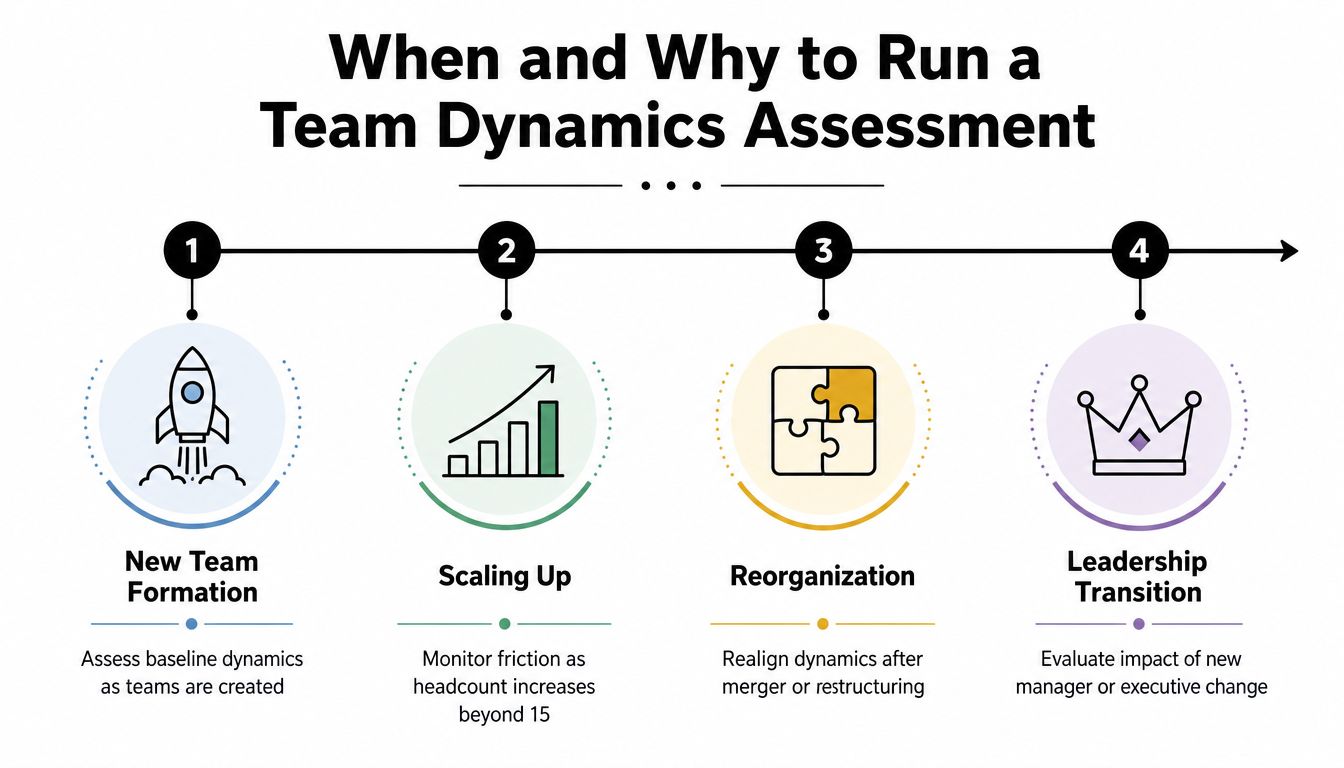
Proactive triggers
Run a baseline assessment when a new team forms. Early measurement can surface unclear roles, missing decision routines, and assumptions about communication before those issues harden into norms.
Scaling creates another trigger. As membership grows, informal coordination becomes less reliable, and leaders may need to examine whether information still reaches the right people. The provided process visual identifies scaling beyond 15 people as a milestone for monitoring friction. That threshold should be treated as a practical prompt, not a universal law, because complexity also depends on workflow, interdependence, and leadership structure.
Reorganizations and leadership transitions deserve focused attention. A merger can change identity, authority, and knowledge-sharing patterns. A new manager can improve clarity, or unintentionally centralize decisions and silence dissent.
Reactive triggers
Persistent conflict is obvious, but quieter signals matter too:
High cohesion alone won't solve these problems. A team can feel close and still lack role clarity, effective decision patterns, or the capacity to renew shared knowledge as conditions change. A recent review frames team dynamic capability as the team's higher-order ability to share, combine, and renew knowledge over time. ([Review of team dynamic capability](https://www.frontiersin.org/journals/psychology/articles/10.3389/fpsyg.2025.1615909/full))
Assess at meaningful milestones, not because a calendar says it's time. Reassessment makes sense after a major role change, restructuring, or intervention, provided the team understands how the information will be used.
How to Implement Assessment From Tools to Action Plans
Implementation succeeds when measurement follows the work instead of floating above it. An HR team can administer a polished survey and still produce little value if the instrument doesn't match the decision, the reference group is unclear, or leaders interpret scores without understanding the operating context.
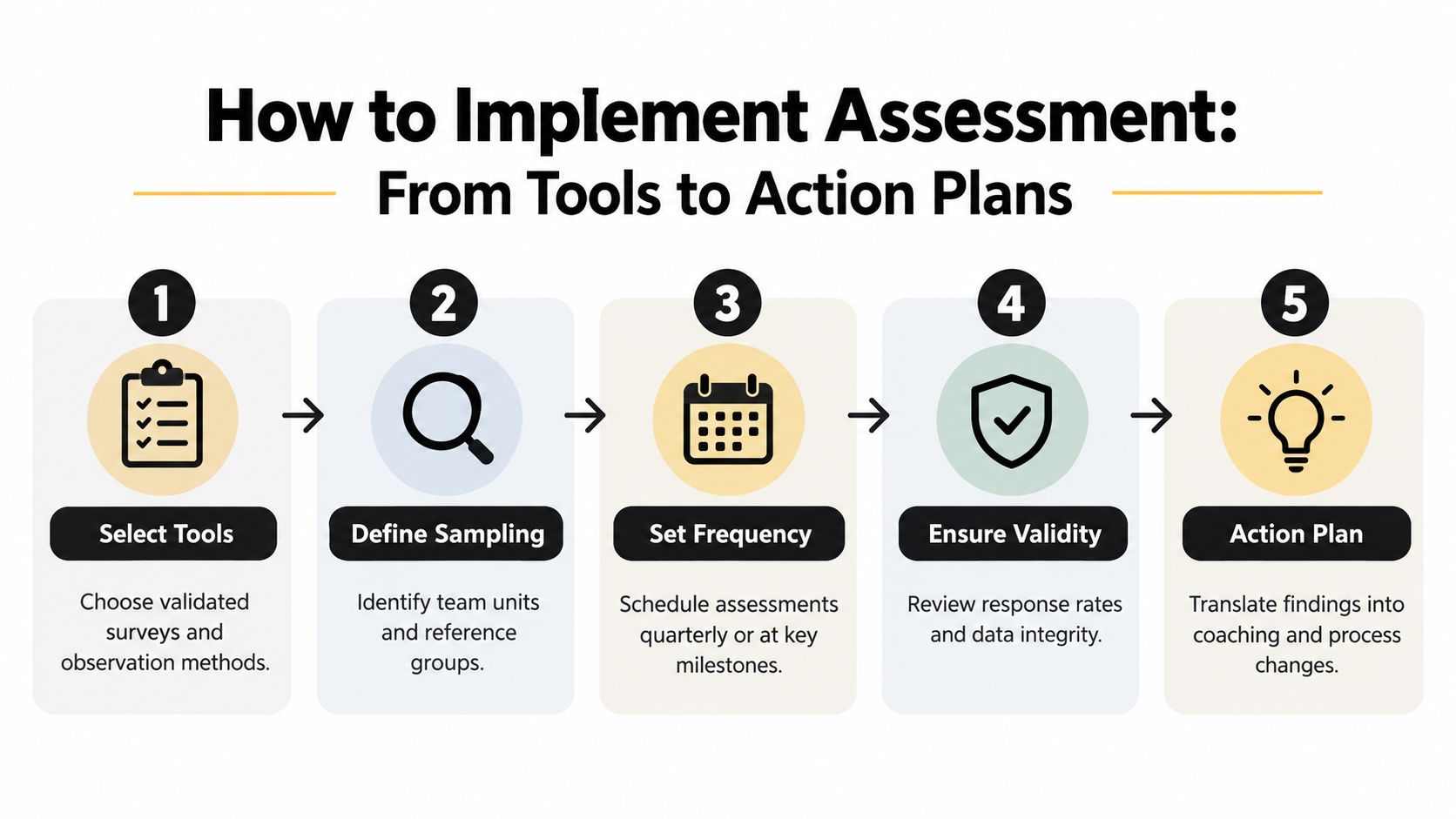
1. Select tools around a decision
Begin with a question that a leader can act on. “Is this team effective?” is too broad. “Why do product decisions stall between research and engineering?” is more useful.
Choose validated surveys for perceptions, structured observation for visible workflow behavior, and multi-rater instruments when contribution balance or coordination is central. Emerging sensors and computational models may help with interaction patterns, but they require explicit consent, careful governance, and disciplined interpretation.
Synopsix is one option for organizations that want behavioral profiles translated into business signals. Its platform supports assessments and profiles, intelligence reports, predictive simulations, and Human Interlink, which visualizes team complementarity and tension points. Explore [team dynamics software from Synopsix](https://synopsix.ai/blog/team-dynamics-software) alongside other tools, and judge each option against your use case.
2. Define the team and reference group
Decide who belongs in the assessment. A formal reporting line may not reflect the workflow, especially for matrixed teams. Include people who exchange information, make interdependent decisions, or depend on the team's output.
Define the reference group clearly in every question. “This team communicates well” is ambiguous if respondents are thinking about different subgroups. Referent-shift wording, such as “Members of this team share relevant information before decisions,” creates a more consistent target.
3. Set frequency without creating survey fatigue
Use a baseline when the team forms or enters a significant change. Follow up after an intervention or milestone, not after every minor fluctuation. Repeated measurement should answer whether behavior changed, not generate another dashboard.
4. Protect validity and context
Team behaviors need to be observed in the actual performance environment and mapped carefully to context. A remote meeting may conceal side conversations, asynchronous work, or language barriers. Validated remote teamwork assessment has also faced practical barriers involving language and video quality, so HR should check whether the data collection method works equally well for all participants.
Review response patterns, missing information, and discrepancies between self-report and external observation. A low score may reflect a real problem, a poorly worded item, a temporary project phase, or a subgroup's experience. Don't interpret it alone.
5. Convert findings into commitments
Translate the profile into a small set of actions with owners, timing, and observable evidence. If decision ownership is unclear, document who decides, who advises, and how dissent is recorded. If workload is uneven, review allocation and coordination responsibilities rather than telling the team to “collaborate better.”
Use the accompanying video as a discussion aid before leaders interpret results, especially when participants need a shared language for behavioral patterns.
<iframe width="100%" style="aspect-ratio: 16 / 9;" src="https://www.youtube.com/embed/uLGbAQVrKpE" frameborder="0" allow="autoplay; encrypted-media" allowfullscreen></iframe>
> Practical rule: A score is useful only when the team can connect it to a behavior, a business consequence, and a specific experiment.
Putting Insights to Work in Hiring Promotions and Development
Assessment creates value when it changes a talent decision or a team practice. A report that sits in a shared drive won't improve coordination, prevent a poor promotion, or help a new hire integrate.
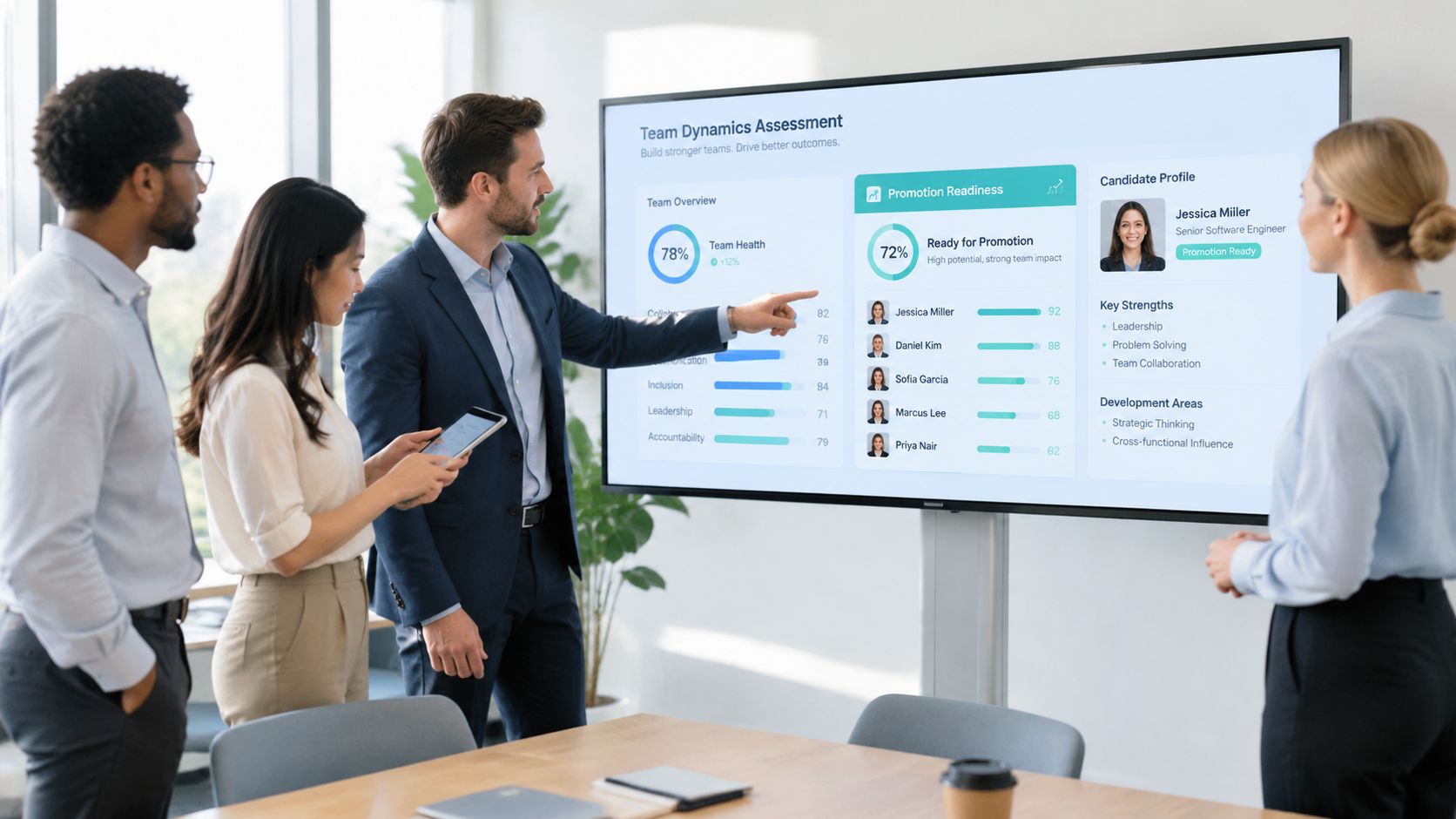
Hiring for complementarity
Hiring managers often evaluate candidates against a role description without examining the team's current behavioral pattern. A team dynamics assessment can reveal whether the group needs stronger challenge behavior, more reliable coordination, broader stakeholder communication, or a different decision style.
That doesn't mean hiring for personality similarity. It means identifying a behavioral gap and testing whether the candidate can fill it without creating a new risk. Synopsix describes predictive simulations that help leaders consider how a new hire may affect collaboration, friction points, and speed to impact. Used responsibly, that kind of scenario analysis can complement interviews and work samples rather than replace them.
Promotions and leadership readiness
A high-performing individual contributor may not yet demonstrate the behaviors required to distribute decisions, develop others, or manage conflict. Promotion assessment should therefore examine how the person affects the team, not only what the person delivers independently.
Look for evidence of shared ownership, clear delegation, constructive challenge, and adaptation under pressure. A manager who solves every problem personally may appear dependable while creating dependency around them.
For practical guidance on turning behavioral data into usable conclusions, HR practitioners can review [assessment interpretation guidance from Synopsix](https://synopsix.ai/blog/assessment-interpretation). The important discipline is to separate observed patterns from conclusions about character.
Development plans that change work
Development becomes more effective when it targets a team routine. If the assessment shows weak handoffs, the intervention might involve a decision template and a review of ownership at the end of each meeting. If the team avoids disagreement, leaders can introduce structured challenge rounds before committing to a plan.
Track whether the new routine changes behavior through follow-up observation, peer feedback, or another agreed measure. The business case comes from connecting those changes to practical outcomes, such as faster decisions, fewer escalations, clearer accountability, or more dependable execution. Avoid promising a precise return unless your organization has defined a credible baseline and follow-up method.
Avoiding Common Pitfalls and Making Results Stick
The most common mistake is treating team cohesion as a proxy for team performance. Cohesion can support collaboration, but it can also coexist with conformity, unclear roles, weak challenge behavior, or slow adaptation. A team that agrees quickly may be avoiding the information needed for a better decision.
Assessment quality also depends on fairness. Explain what data you're collecting, who can see individual responses, how results will be reported, and whether participation is voluntary or required. Protect confidentiality, minimize unnecessary data, and avoid using a developmental instrument as a hidden disciplinary tool.
Remote and cross-language environments require extra care. Language differences and poor video quality can distort observation and participation, so HR should offer accessible methods and avoid interpreting silence as agreement. Rater bias also deserves attention. Clear behavioral anchors, multiple perspectives, and trained observers can reduce the risk that one person's preference becomes the team's diagnosis.
Make the findings part of operating rhythm
Use assessment insights in retrospectives, one-to-ones, project kickoffs, and leadership reviews. Keep the conversation focused on behaviors the team can change:
Teams also need development options that match the identified behavior. HR leaders comparing [cost-effective leadership development options](https://redactai.io/blog/leadership-development-programs) can look for programs that reinforce assessment findings through practice, coaching, and follow-up rather than one-time inspiration.
Start with one team, define one business question, and combine perception with behavior. Then use what you learn to improve the method before scaling it. The aim isn't to produce a perfect score. It's to create a reliable system for seeing friction early, strengthening adaptation, and making better people decisions.
---
Synopsix helps HR leaders turn behavioral assessments into practical guidance for hiring, team design, predictive simulations, and talent development. Visit [Synopsix](https://synopsix.ai) to explore how your organization can connect team dynamics evidence with clearer decisions and targeted action plans.