Team Dynamics Software: Predict Workplace Behavior
By Synopsix · August 4, 2026 · 13 min read
Most advice about team dynamics software starts in the wrong place. It treats the category like a prettier personality test, then wonders why teams still miss deadlines, lose knowledge, or break down under pressure. The value shows up when software measures how work is distributed, how coordination holds up under load, and where resilience is fragile long before a manager notices the problem.
That shift matters because the field didn't begin with live behavioral telemetry. A 2019 systematic review in PLOS ONE found that the most common way to study team dynamics across constructs and development phases was still self-reported surveys [PLOS ONE review](https://pmc.ncbi.nlm.nih.gov/articles/PMC6593277/). That history explains why many tools still lean on check-ins and retrospective questionnaires, even though the business risk usually sits in the work beneath the survey response.
Why Most Team Dynamics Tools Miss the Mark
The market likes the language of fit, harmony, and communication style because it sounds low-risk. HR teams can explain it quickly, managers can absorb it without much effort, and candidates rarely object. A team can still fail in practice if one person holds all the context, one function becomes the bottleneck, or nobody can step in when a key employee leaves.
That is the measurement gap most platforms leave behind. They report whether people prefer similar working styles or seem compatible, but they often miss whether the team can carry work under pressure. Real team dynamics show up in how knowledge is distributed, how coordination holds up, and where the group becomes fragile before the manager sees the warning signs.
> Practical rule: if a vendor can only describe who “matches” whom, it is probably not measuring what breaks teams in production.
A team can look healthy and still be brittle. One person may handle the critical context, another may be the only one who can resolve a specific workflow, and the rest of the group may have little shared coverage. That kind of concentration creates knowledge islands, weak handoffs, and single points of failure. A practical team role assessment should expose those gaps, not just summarize personality overlap. [step-by-step productivity playbook](https://supercenter.app/blog/how-to-improve-team-productivity) may help leaders connect those findings to day-to-day execution, but the assessment itself has to show where the work is vulnerable.
Good team dynamics software needs to do more than map style alignment. It should show where knowledge sits, how work is shared, and whether the team still functions when one contributor is out. That is a different measurement problem, and it is the one that matters when leaders need results instead of a pleasant team report.
How Team Dynamics Software Actually Works
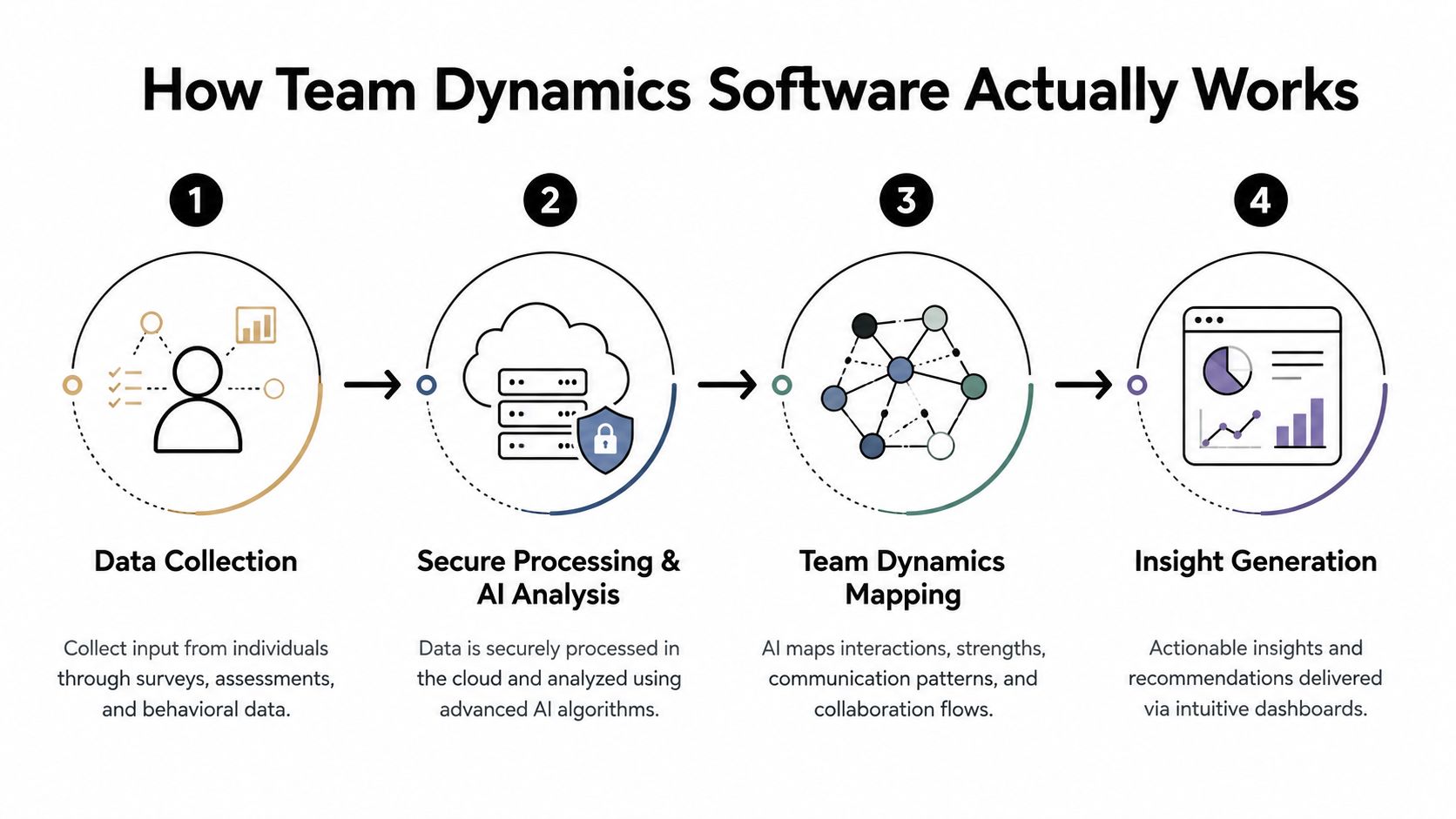
The architecture is more straightforward than many vendors make it sound. Individual data comes in, the platform normalizes it, then it rolls the signals up into a team-level distribution that leaders can compare. Psychometrics' Team Dynamics, for example, combines Work Personality Index results from 21 traits into team aggregate data, which is what lets managers see alignment, skew, and gaps instead of isolated assessment results [Psychometrics Team Dynamics](https://www.psychometrics.com/assessments/team-dynamics/).
A strong platform doesn't stop at assessments. It may also incorporate observation, communication behavior, or workflow signals. The 2020 Communication Analysis Tool, for instance, described a browser-based software solution that can capture team process dynamics from video/audio recordings or live observations, which matters because it measures actual interaction rather than memory-based reporting [CAT study](https://journals.sagepub.com/doi/10.1177/1046496420904126).
What the data pipeline should look like
A usable system usually follows four moves. First, people complete assessments or generate observable interaction data. Second, the platform aggregates those signals into a group profile. Third, analytics identify patterns such as imbalance, friction, or redundancy. Fourth, the output is translated into actions a manager can use without decoding psychometric jargon.
If you want a practical reference for turning assessment into action, the [team role assessment guide](https://synopsix.ai/blog/team-role-assessment) shows how role-level interpretation helps leaders move from raw behavioral data to team decisions. That's the difference between a report and a management tool.
For teams that also need operational discipline, a [step-by-step productivity playbook](https://supercenter.app/blog/how-to-improve-team-productivity) can complement the behavioral layer by connecting team insight to daily execution habits. The best platforms sit inside that larger operating system, not outside it.
> When a vendor says it “predicts team success,” ask what it does with the individual inputs, how it builds the team profile, and what actions the manager gets back.
The Four Core Capabilities That Drive Results
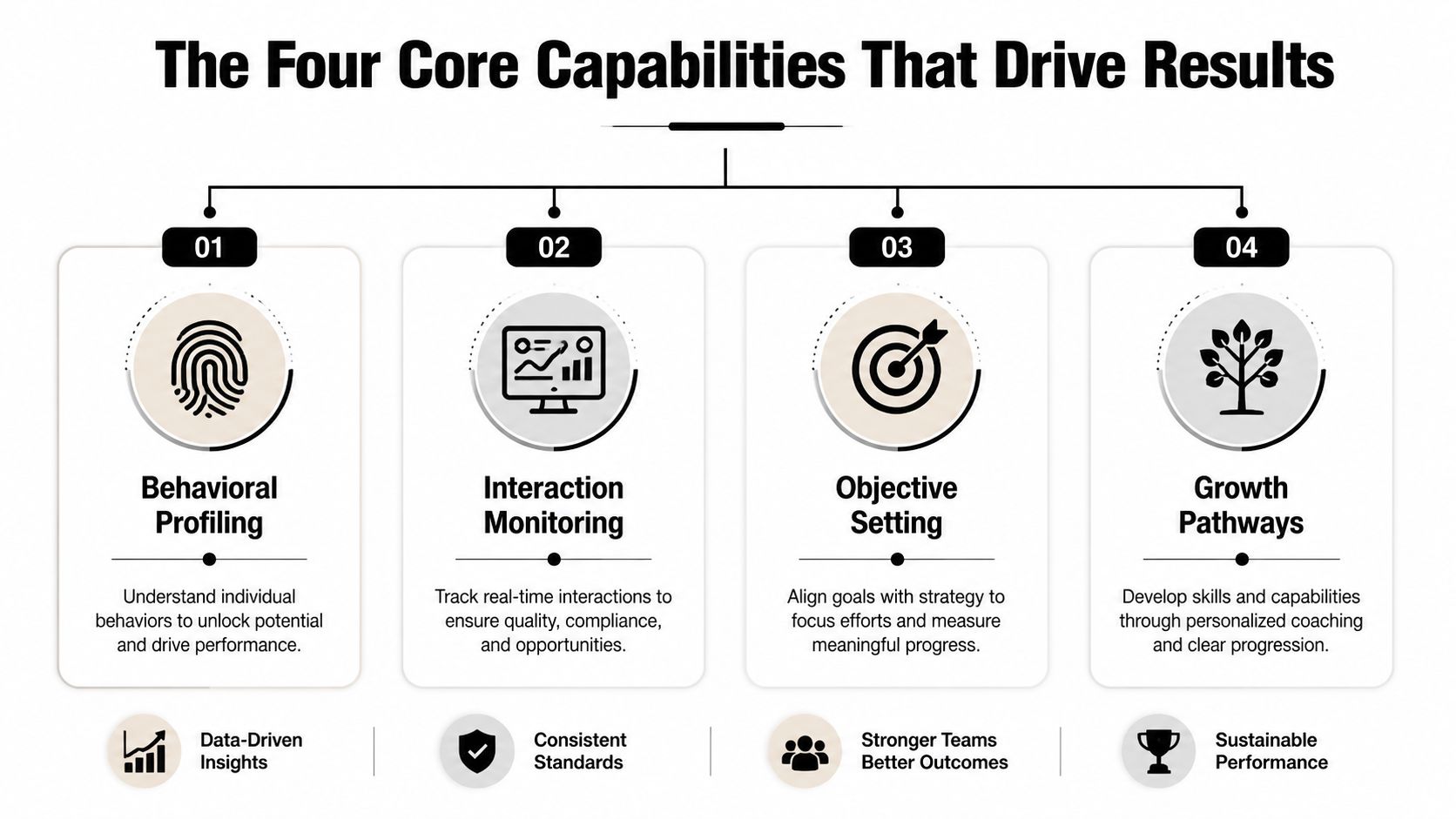
The useful platforms do four jobs well. If one of those jobs is weak, the whole system becomes a survey dashboard with better branding.
Behavioral profiling
This is the entry point. The platform gathers psychometric or behavioral inputs and turns them into comparable profiles. In practice, that means you can review a candidate, a new hire, or an existing employee against the demands of a role or team structure without relying only on a manager's intuition.
This capability matters most in hiring and internal mobility. It helps leaders see whether someone will thrive in a collaborative, ambiguous, or highly structured environment. It also keeps teams from overusing the same kind of person for every role.
Interaction monitoring
The product starts to move beyond static assessment. Communication research has identified 14 distinct categories of team communication measurement, which shows how specific the observable layer can get, from turn-taking to speaking time and responsiveness [Communication Monographs review](https://onlinelibrary.wiley.com/doi/10.1002/smr.1641). The point isn't to count every utterance. It's to see whether interaction patterns are balanced enough to support the work.
That capability is valuable in restructuring, leadership meetings, and teams with recurring coordination problems. It reveals who dominates, who disappears, and where the group stalls.
Objective setting
A strong platform ties behavioral insight to a real business outcome. If the only output is “this person is high on influence,” the software is incomplete. Managers need to know what objective the insight supports, such as reducing handoff friction, improving role clarity, or building a stronger bench for a critical function.
Growth pathways
The last piece is where the tool becomes a development system. Good reports translate team insight into coaching priorities, succession planning, and role-specific development. That's also where role-based intelligence matters. If you're evaluating a tool that handles hiring or internal development, [strategy for predictable software delivery](https://ritenrg.com/blog/building-high-performing-teams/) is a useful analogy, because it shows how teams improve when systems support repeatable execution instead of ad hoc heroics.
> Use case check: if a vendor can't explain how the insight changes a hiring call, a team redesign, or a coaching plan, it's not a decision system yet.
The newer platforms also need to measure resilience, not just compatibility. A design that looks elegant on paper can still fail if too much expertise sits in one head or one clique. That's where the category gets more useful and more honest.
Measuring ROI and Business Impact
The business case gets stronger when you stop treating this software as a “people experience” add-on and start treating it like decision support. Synopsix says organizations using it report 40% faster hiring decisions, 60% fewer mis-hires, over 50,000 profiles generated, and claimed 98% assessment accuracy. Those figures are vendor-reported, but they show the type of outcome leaders expect when behavioral data is connected to real workflow decisions.
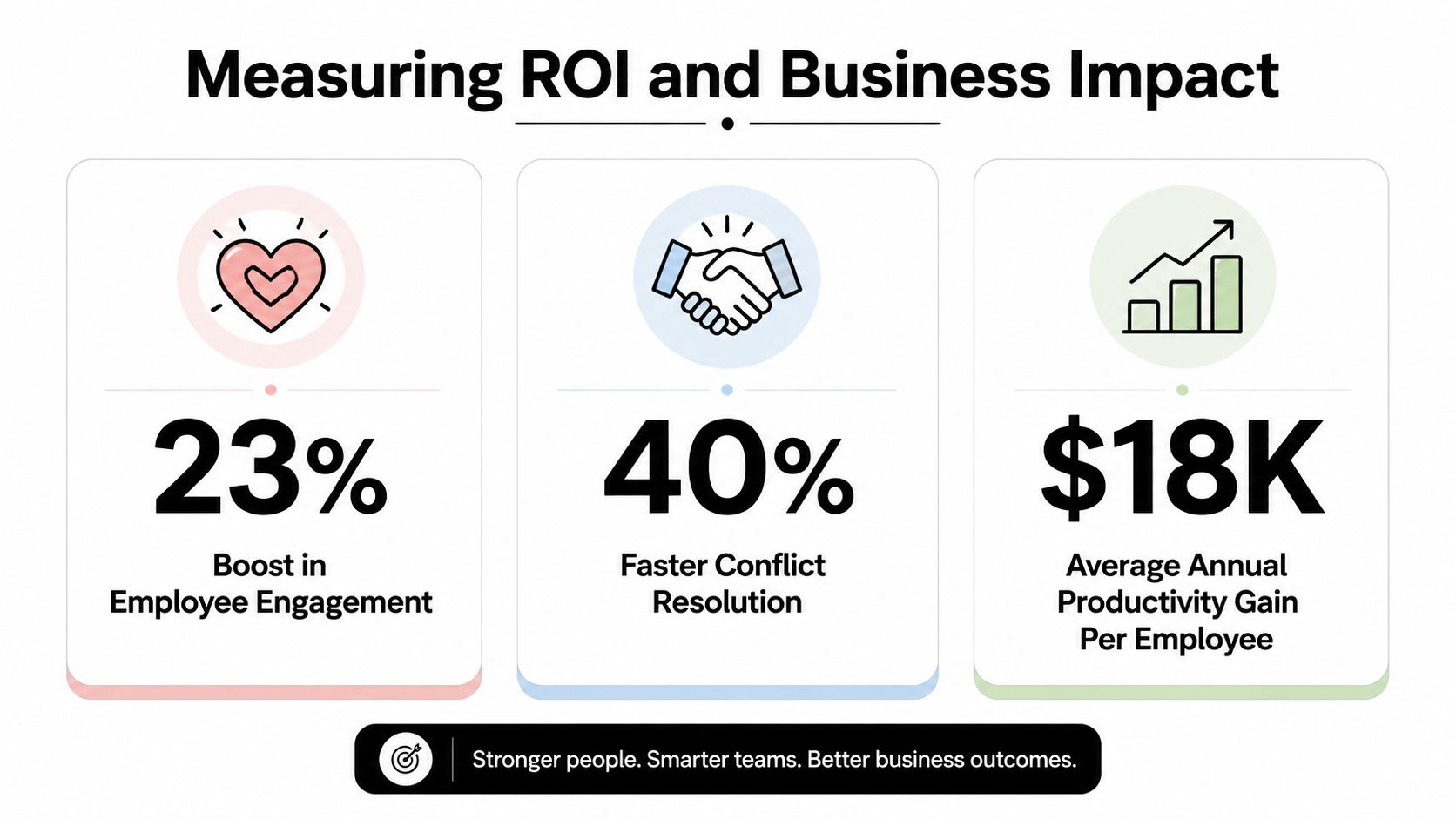
The stronger ROI argument usually has three layers. First, hiring gets faster because managers spend less time arguing over subjective fit. Second, mis-hires drop because the platform flags team mismatch earlier. Third, development budgets go further because coaching targets the behaviors that matter inside the team.
What to measure first
Start with baseline metrics before rollout. Track hiring cycle time, mis-hire rates, manager confidence in team decisions, and how long it takes a new hire to become useful. Then compare those numbers after assessments and team profiles are wired into the process.
The objection that behavioral data is “too soft” usually fades once executives see that the platform doesn't ask them to interpret personality theory. It gives them a fit recommendation, a risk indicator, or a distribution map they can use immediately. That's why tools like [HR performance prediction](https://synopsix.ai/blog/hr-performance-prediction) are relevant, they connect people signals to outcome-oriented management.
For people analytics teams, consistency is key. A manager's instinct varies by experience, bias, and context. A structured assessment workflow gives the organization one shared language for decision-making.
> If the output doesn't change a hiring choice, a restructuring decision, or a development plan, the ROI case will stay theoretical.
The market context also supports continued adoption. Archive Market Research projects the global team building software market will reach USD 242.8 million by 2033, growing at a 7.8% CAGR from 2023 to 2033 [Archive Market Research](https://www.archivemarketresearch.com/reports/team-building-software-35833). That's a projection, not a guarantee, but it shows the category is becoming a sustained part of the software stack.
Implementation Roadmap and Change Management
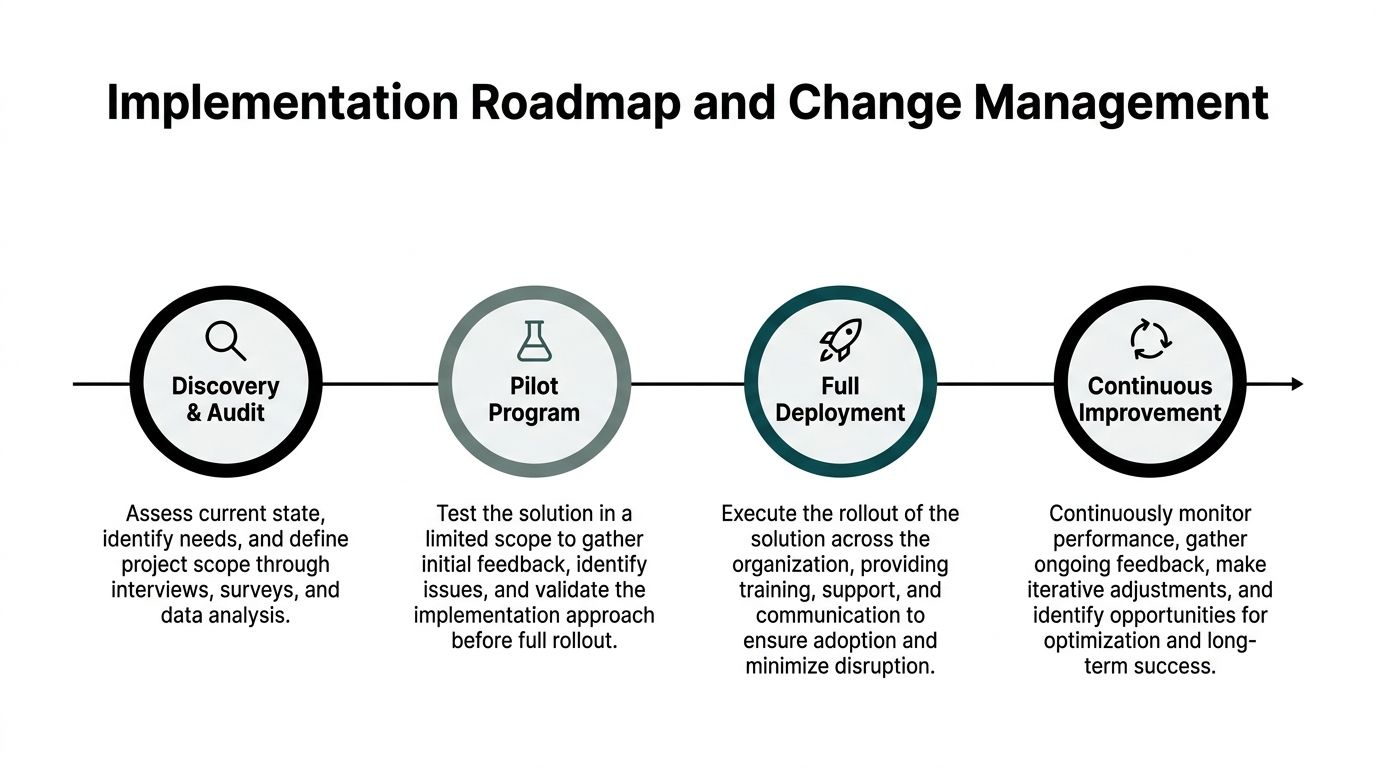
Most rollouts fail for ordinary reasons, not technical ones. Leaders skip stakeholder alignment, managers don't trust the outputs, and the vendor's report arrives in language nobody uses. A structured specs workflow helps prevent that. Slack's technical-spec template asks teams to define functional and non-functional requirements, scope, deadlines, standards, business goals, end-user impact, task ownership, budget, and release timeline, which is exactly the level of detail HR technology rollouts usually need [Slack technical specifications](https://slack.com/intl/en-in/templates/technical-specifications).
Start with the smallest defensible use case
Pick one decision with high value and clear ownership. Executive hiring, a leadership pipeline review, or a critical team restructure are better starting points than a broad enterprise launch. That gives you a visible win without forcing everyone to change at once.
Treat privacy and fairness as design work
Employees don't object to measurement just because it exists. They object when the rules are vague. Spell out what data is collected, who sees it, how it's used, and what it is not used for. If managers can't explain that clearly, the deployment isn't ready.
Build the rollout around adoption, not announcement
Run a pilot with managers who are open to using data in their decisions. Use their feedback to refine the reports, then expand to adjacent teams. A well-run pilot turns skepticism into a working reference case.
You can also use a broader HR tech lens to pressure-test the rollout. [People analytics solutions](https://synopsix.ai/blog/people-analytics-solutions) is a good comparison point because the same implementation discipline applies, data quality, business alignment, and manager usability all determine whether the tool sticks.
Change management is simple. Show people how the platform improves one decision they already have to make, then repeat that win in the next team. If it takes too much explanation, the product isn't yet fluent enough for the business.
Evaluating Vendors and Asking the Right Questions
The best vendor conversations are blunt. Ask what the platform measures, how it validates its outputs, and what a manager can do with the result in five minutes or less. If the answer stays abstract, move on.
| Evaluation Category | Key Questions | Red Flags | |---|---|---| | Assessment validity | What behavioral model is used, and how is it validated in practice? | The vendor hides behind buzzwords or can't explain the methodology | | Team-level insight | How do individual results become a team distribution or risk map? | You only get separate individual reports with no team synthesis | | Business reporting | Are reports written for managers, or only for analysts? | Heavy jargon, no role-specific guidance | | Integration | How does it fit with your HR stack and workflow? | Manual exports, weak implementation support | | Privacy and governance | Who can access results, and what controls exist? | Unclear permissions or vague data handling | | Outcomes | What measurable business changes have clients seen? | No examples of decision impact |
The right questions force clarity. Can the platform support role-specific reports for leadership, sales, or another critical function. Can it handle team redesign, not just hiring. Can it explain why one profile is a risk in one context and an asset in another.
That last point is where many tools fall short. They present compatibility as a fixed truth, when the actual issue is context. A person who's perfect for a startup turnaround may be a poor fit for a regulated operating environment.
For a broader comparison framework, [What does AI maturity look like for enterprises?](https://siliconprime.ai/services/ai-readiness-assessment) helps leaders think about readiness before buying another intelligent system. The same maturity question applies here, because the organization has to be ready to use the output, not just purchase it.
Synopsix fits this evaluation conversation as one option because it combines behavioral assessment, team-level insights, predictive simulations, and role-based reporting in a single workflow. That doesn't make it the right answer for every organization, but it does make it a useful benchmark for what a modern platform should explain clearly.
Real-World Applications Across the Employee Lifecycle
A recruiting team uses team dynamics data differently from an organizational development team, and that's exactly how it should be. In hiring, the value is in making the next interview round or offer decision more grounded. A candidate can have the right resume and still create friction in a team that already has too much of the same behavioral pattern.
In team design and restructuring, the question changes. Leaders need to know which skills are concentrated, which roles create dependency risk, and where coordination bottlenecks are likely to appear. That's where team-level insight matters more than individual fit.
Leadership development teams use the same data for a different purpose. They're trying to build coaching plans, succession pipelines, and a clearer view of how behavior shifts across roles. The point isn't to label someone. It's to make growth decisions easier to defend.
One practical pattern I've seen works well is this. Hiring managers use the profile to screen for likely friction, then coaches use the same insight to shape development after the hire lands. That keeps the system consistent from selection to onboarding to advancement.
Your Action Plan for Getting Started
CHROs should start by defining the business case, the decisions the platform will support, and the metrics that prove it's working. Talent acquisition teams should map where behavioral assessments fit into screening and finalist review. Hiring managers need a simple rule for how to use the profile without overreading it. People analytics teams should own integration, governance, and reporting quality.
A sensible 90-day plan looks like this. Use the first month for discovery and audit, the second for a pilot in one high-stakes workflow, and the third for manager feedback, reporting refinement, and scale planning. If the reports still feel academic by day 90, course correct before expanding.
The wrong move is buying software before the decision process is ready. The right move is building a small, repeatable workflow that makes better team decisions easier than guessing.
---
Synopsix turns scientifically validated behavioral assessments into practical guidance for hiring, team design, and talent development, which makes it directly relevant to the team dynamics software problem. If you want a platform that connects assessment, team insight, and decision support in one workflow, visit [Synopsix](https://synopsix.ai) and see how it can fit your team decisions.