Team Performance Improvement: A Practical Framework for HR
By Synopsix · September 15, 2026 · 15 min read
A CHRO can have a full calendar of people initiatives and still face a team that misses deadlines, repeats work, loses strong employees, and depends on senior leaders to resolve ordinary decisions. Engagement surveys, manager workshops, and new performance templates may all be active while team performance improvement remains invisible in the operating metrics that matter.
The answer isn't another disconnected program. It's a tighter loop: diagnose the behavioral and operating gap, assess the people and roles involved, choose a focused intervention, model likely outcomes, and verify the result against business KPIs before expanding the investment. That's the standard people-analytics teams should use when advising the business.
The Real Cost of Underperforming Teams
A 40-person product organization recently completed two training programs, launched a manager-coaching initiative, and refreshed its engagement survey. Twelve months later, delivery velocity was flat, regrettable attrition had risen, and the executive team wanted to know where the investment had gone.
That question exposes the difference between program activity and performance improvement. Attendance, completion rates, and survey participation can look healthy while the team still struggles to coordinate work. The P&L feels the consequences through three cost buckets.
The three costs leaders should size
Lost output appears first. People wait for decisions, duplicate analysis, reopen completed work, and compensate for unclear ownership. The team may look busy, but capacity is consumed by coordination drag and rework rather than valuable delivery.
Replacement cost follows. A poor hire can create recruiting effort, onboarding demands, manager time, and disruption for colleagues. Avoidable turnover creates a related burden, particularly when high performers leave because standards are inconsistent or the team keeps carrying unresolved dysfunction.
Opportunity cost is harder to see but often more strategic. Senior leaders spend time escalating routine decisions, mediating conflict, and repairing failed handoffs instead of building new capabilities, developing successors, or pursuing growth opportunities.
| Cost Bucket | Typical Driver | Indicative Annual Range | |---|---|---| | Lost output | Rework, delayed decisions, coordination drag | Qualitative exposure varies with team complexity and workload | | Replacement cost | Mis-hires, avoidable turnover, extended ramp-up | Qualitative exposure varies with role scarcity and replacement difficulty | | Opportunity cost | Executive firefighting and management escalation | Qualitative exposure varies with leadership involvement and strategic priorities |
The right starting point is a business-impact baseline, not a larger survey. A practical guide to [business impact assessment](https://synopsix.ai/blog/business-impact-assessment) can help connect people conditions to operational consequences without pretending that every cost can be isolated perfectly.
> Practical rule: If a people initiative can't be connected to output, quality, retention, decision speed, or customer results, it isn't yet a business case.
The working thesis is simple. Underperforming teams rarely need more activity for its own sake. They need a diagnostic-to-measurement loop that identifies the broken lever, matches the intervention to that lever, and tests whether the business improved.
Diagnose the Gap Before You Prescribe
Diagnosis is the step most HR teams skip. A leader reports missed commitments, HR recommends coaching, and the organization launches training before anyone establishes whether the problem is clarity, composition, execution, or leadership.
Start with a team-level evidence review. Don't rely on one survey or one manager's narrative. Use a simple 0 to 3 score for each signal, where 0 means the evidence shows a severe gap, 1 means inconsistent performance, 2 means the foundation is mostly working, and 3 means the signal is strong and repeatable.
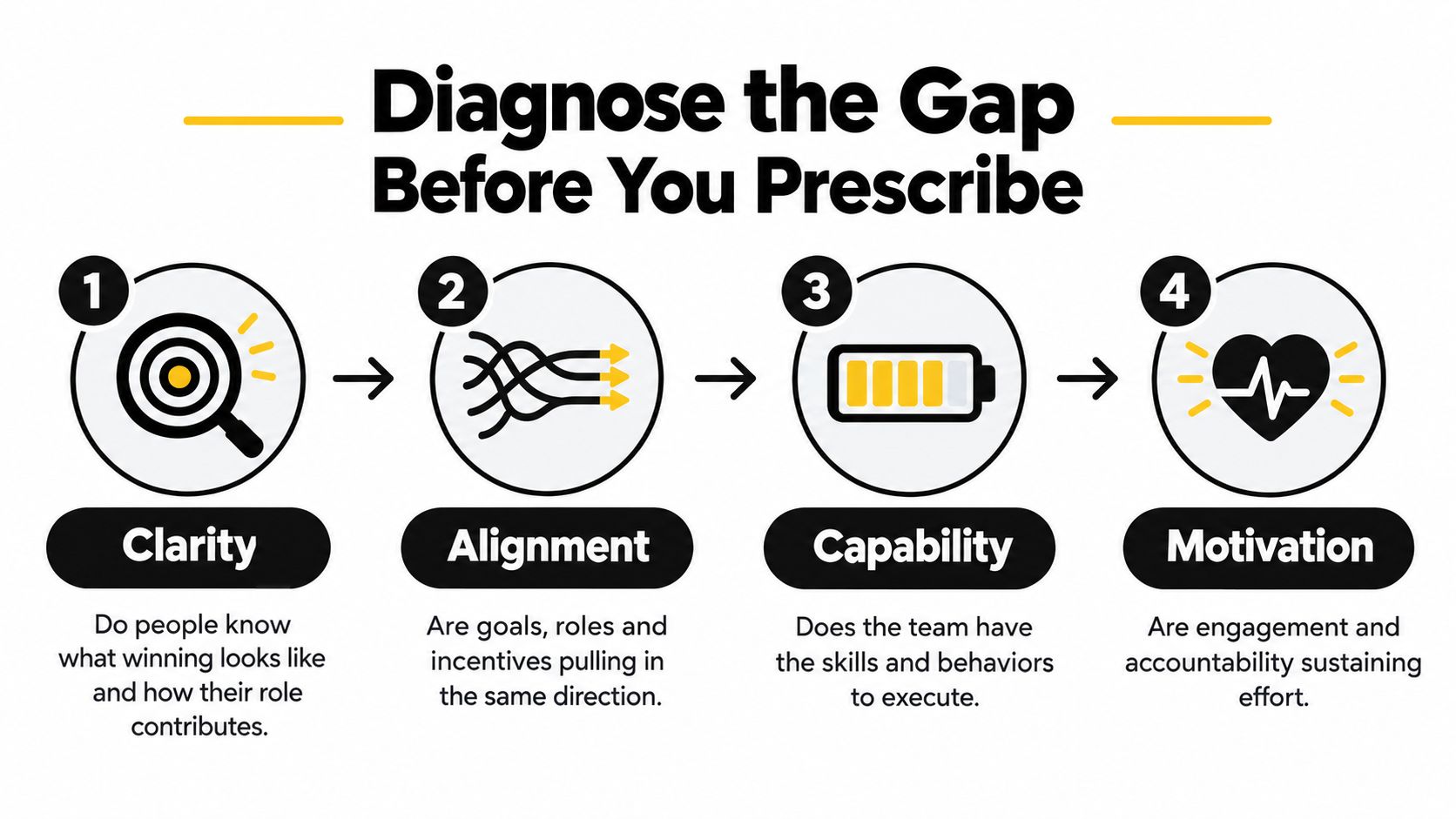
Score the four signals
Clarity asks whether people know what winning looks like and how their work contributes. Pull OKR cascades, role charters, priority documents, and examples of recent work. If team members can describe the company objective but can't explain their own decision rights or success measures, score clarity low.
Composition concerns the cognitive and behavioral mix required by the work. Review skills inventories, workload distribution, role coverage, and the demands of the operating model. Team composition evidence finds the strongest relationship with task and outcome performance for deep-level traits such as cognitive ability, while Big Five traits show smaller positive effects; mean agreeableness, emotional stability, and extraversion relate more strongly to attitudinal outcomes such as satisfaction than to raw performance, as summarized in this team composition evidence review.
Execution is visible in meeting audits, decision logs, handoff quality, cycle time, and rework. A team with capable people can still underperform when rituals are bloated, decisions aren't recorded, or feedback arrives too late. Planning also matters. A Bayesian meta-analysis of 33 independent samples covering 1,885 teams found a moderate positive association between team planning and performance, with ρ = .31, 95% CI [.20, .42], p < .001 (planning and team performance evidence).
Leadership covers direction, unblocking, coaching, and development. Examine skip-level notes, 360 themes, escalation patterns, and the manager's record of clarifying priorities. A manager who attends every meeting but doesn't remove constraints has an activity pattern, not necessarily a leadership solution.
| Signal | Evidence to Pull | Low Score Usually Means | |---|---|---| | Clarity | OKR cascades, role charters | People can't connect tasks to outcomes | | Composition | Skills inventory, workload distribution | Capability or fit is misaligned | | Execution | Meeting audits, decision logs, cycle time | Operating routines create friction | | Leadership | Skip-level notes, 360 themes | Direction, coaching, or escalation support is weak |
Don't average the scores into a flattering composite. The lowest signal should guide the next investigation. If clarity scores 1 and execution scores 2, rewriting goals and decision rights may outperform a general teamwork course. If composition scores 1, training may only mask a capacity or role-fit problem.
Run Assessments That Translate Into Decisions
Most organizations are good at collecting assessment data and poor at using it. A hiring committee receives a report full of trait scores, generic descriptors, and cautious language, then returns to interviews and intuition because the assessment doesn't answer the business question.
A decision-grade behavioral assessment needs three foundations. It should measure a validated construct, such as the Big Five, HEXACO, or a commercially licensed derivative. It should use a job-relevant norm group. Its output should translate psychometrics into observable behavior and role implications that a hiring manager can act on.
Match the method to the work
Use self-report when the role requires a broad profile of preferences, motivations, and likely work styles. Add multi-rater input when leadership behavior or collaboration patterns need external observation. Use situational assessments when the role contains dense judgment, customer pressure, trade-offs, or recurring interpersonal decisions.
The assessment method should follow the role's decision density and collaboration load. A back-office role with clearly defined individual deliverables may need a different evidence mix from a product leader who must align engineering, design, sales, and executives.
The output should answer four practical questions:
Those signals become useful only when tied to the role. “High influence” isn't a hiring conclusion. “Likely to push decisions forward, with a need for explicit collaboration norms in a consensus-heavy team” is a committee-ready hypothesis that can be tested in interviews and references.
For a practical approach to turning reports into usable business signals, use this guide to [assessment interpretation](https://synopsix.ai/blog/assessment-interpretation).
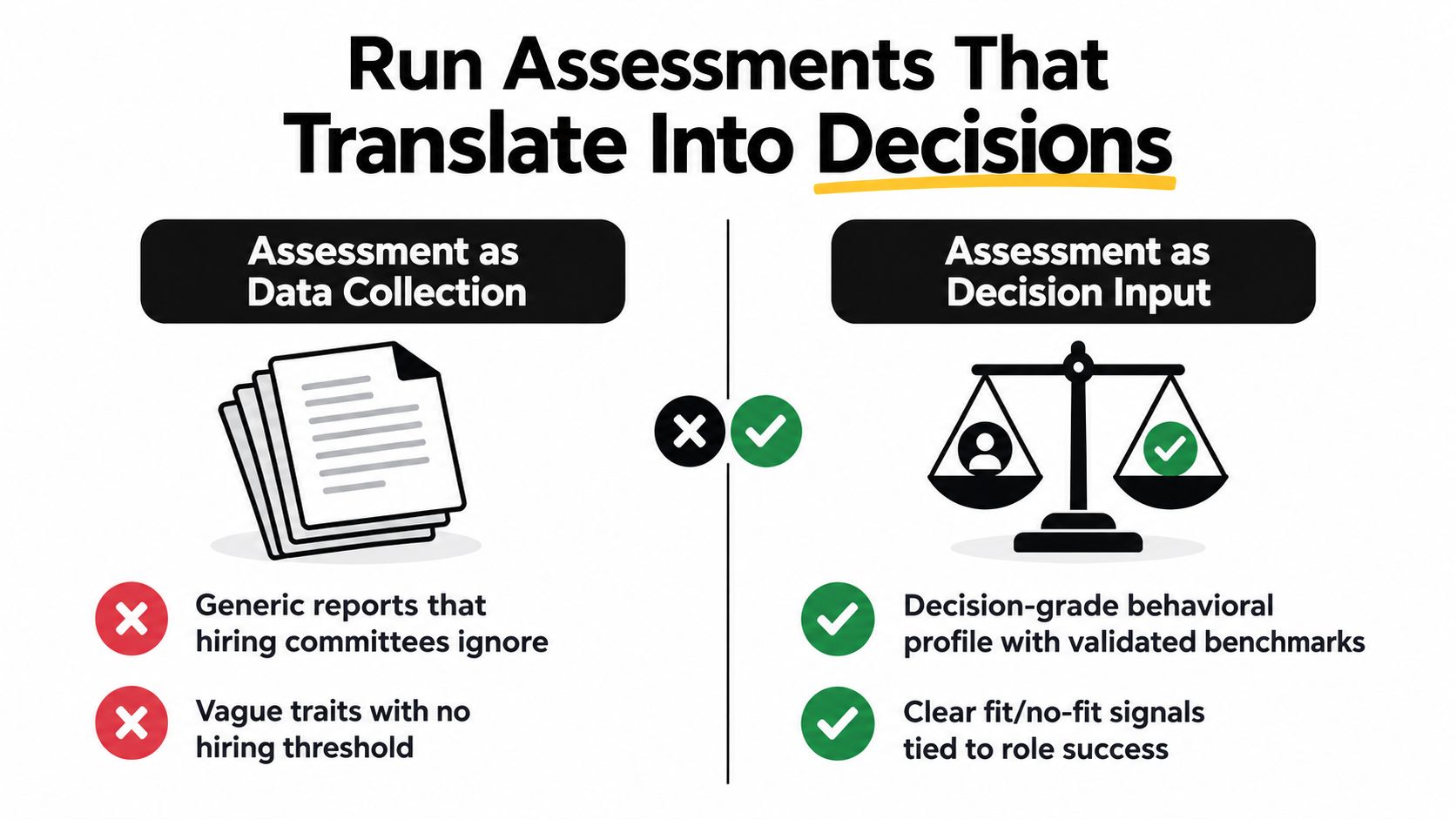
Keep the guardrails firm
Assessment data should have a clear privacy basis, controlled access, and a documented retention policy. Review potential adverse impact before using results in selection, promotion, or allocation decisions. No single assessment should determine a high-stakes people decision on its own.
Use assessments as one input alongside structured interviews, demonstrated work, references, performance evidence, and role requirements. The purpose isn't to label people. It's to create comparable evidence that helps leaders make better decisions about fit, development, and team complementarity.
Designing Hiring, Development, and Reallocation Interventions
Interventions are a lever set, not a checklist. The common executive mistake is to hire, launch training, redesign roles, and move people simultaneously, then discover that no one can explain which action changed the result.
Begin with the diagnosed failure mode. If the bottleneck is capability, develop or hire. If it is role fit, redesign. If it is load distribution, reallocate. Add a second lever only when the evidence shows that the first cannot work alone.
Choose the lever deliberately
External hiring makes sense when the team lacks a capability that can't be built quickly enough internally. The cost isn't limited to recruiting. Hiring consumes leadership attention, introduces integration risk, and can intensify an existing team problem if the role definition is weak.
Internal development fits a capability gap when the person has a credible foundation and the work can provide practice, feedback, and reinforcement. One-off training is a weak intervention by itself. A systematic review of controlled teamwork interventions found a significant large effect on team performance, Cohen's d = 0.919, 95% CI 0.65 to 1.19, Z = 6.72, p < 0.001, though the substantial heterogeneity, I² = 94.2, means design and context matter ([teamwork training evidence summary](https://www.cipd.org/globalassets/media/knowledge/knowledge-hub/evidence-reviews/2023-pdfs/8388-high-performing-teams-scientific-summary-may23.pdf)).
Role redesign is the right response when responsibilities, incentives, or decision rights conflict with the person's strengths. Redesign can mean narrowing ownership, changing interfaces, or pairing complementary capabilities. It shouldn't become a way to avoid a necessary performance decision.
Reallocation addresses uneven load. Review workload distribution, dependency patterns, and queue ownership before concluding that an individual lacks capability. A strong contributor overloaded by interruptions may need a different allocation, not another course.
| Lever | Best Evidence Signal | Time to Impact | Primary Risk | When to Skip | |---|---|---|---|---| | External hiring | Persistent capability gap | Depends on role and market | Mis-hire or poor integration | The role itself is unclear | | Internal development | Learnable behavior or skill gap | Depends on practice and reinforcement | Generic training with no transfer | The person lacks role fit | | Role redesign | Responsibilities conflict with strengths | Depends on operating changes | Shifting problems elsewhere | Core capability is absent | | Reallocation | Uneven workload or bottlenecks | Depends on dependency changes | Resentment or hidden overload | Work demand is structurally excessive |
For distributed managers, practical [remote team leadership training tips](https://www.latojobs.com/blog/leadership-training-programs) can complement the operating changes, but training shouldn't substitute for clear ownership, workable capacity, or decision rights.
Run one primary intervention first. Overlapping four changes burns political capital, weakens trust with the line, and destroys attribution.
Simulating Outcomes Before You Commit
Predictive simulation isn't a crystal ball. It's a pressure test for proposed team changes before they affect payroll, customer commitments, or promotion decisions.
Start by mapping validated behavioral profiles for the existing team. Then analyze complementarity across the work that matters. The model should look for coverage gaps and likely friction, not rank individuals. Two strong operators may both seek influence, challenge decisions quickly, and score lower on collaboration behaviors. On a customer-facing account, that combination could create avoidable conflict unless the team has explicit decision rights and a strong integrating role.
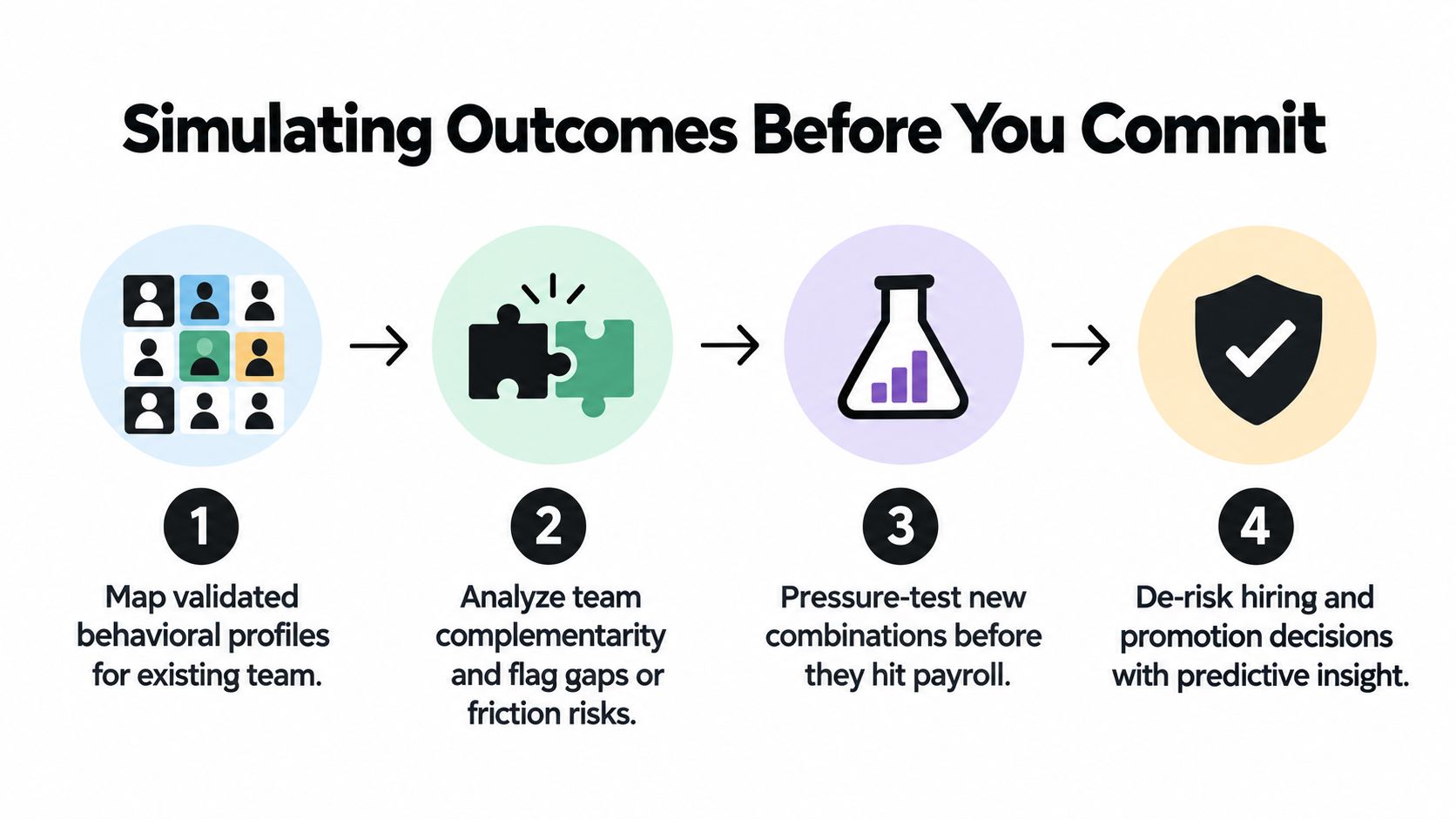
Compare scenarios, not personalities
A useful simulation compares the current team with two or three proposed configurations. Test each against operational measures such as cycle time, decision quality, and overload risk. The question isn't “who is the strongest person?” It's “which configuration best matches the demands, dependencies, and failure modes of this work?”
In one role-swap proposal, a senior individual contributor was due to move into a team-lead position while the existing lead moved toward an individual-contributor role. The simulation flagged collaboration friction between the proposed pair. Rather than approve the swap immediately, the organization created a mentoring bridge and clarified the interface between technical authority and people leadership.
That is the right use of predictive insight. It doesn't replace judgment. It surfaces a risk early enough for leaders to test, mitigate, or reject the change.
A practical [simulation and forecasting method](https://synopsix.ai/blog/simulation-forecasting-method) should make its assumptions visible. Clean role definitions, current profiles, accurate workload data, stable team membership, and clearly defined success metrics are essential inputs. If the source data is stale or the role is still changing, the model can only produce a more polished version of uncertainty.
A short visual explanation can help stakeholders understand the workflow:
<iframe width="100%" style="aspect-ratio: 16 / 9;" src="https://www.youtube.com/embed/N3In9FSNoZs" frameborder="0" allow="autoplay; encrypted-media" allowfullscreen></iframe>
Measuring Team Performance Improvement With KPIs and Cadence
Engagement is a useful diagnostic signal, but it isn't a sufficient outcome measure. Gallup's 2024 meta-analysis covered 183,806 teams and found that, compared with bottom-quartile engagement teams, top-quartile teams were 18% more productive in sales, 14% more productive in production records and evaluations, and 23% more profitable ([Gallup's high-performing team evidence](https://www.gallup.com/workplace/650156/science-of-high-performing-teams.aspx)). The practical lesson is clear: pair engagement with operating and financial outcomes.
Track leading and lagging indicators together. A leading indicator tells managers whether the mechanism is changing. A lagging indicator tells the business whether the change mattered.
Build the measurement set
Use a quarterly role-mapping audit to measure clarity of ownership. Ask who owns each critical outcome, where decisions sit, and which handoffs create ambiguity. Track execution friction through cycle time and rework rates, using consistent definitions before and after the intervention.
Pair those signals with lagging measures:
| Day | Leading Indicators | Lagging Indicators | Manager Conversation Focus | |---|---|---|---| | 30 | Baseline role ownership, cycle time, and rework | Establish current quality, throughput, retention, and business measures | “What does the baseline show, and which obstacle are we removing first?” | | 60 | Early movement in ownership clarity and execution friction | First directional movement in quality and throughput | “What changed in the work, not just in sentiment?” | | 90 | Repeatability of ownership and operating routines | Attribution review across quality, throughput, retention, and business outcomes | “Did this intervention create lift, require redesign, or need to stop?” |
At day 30, instrument the baseline and confirm definitions. At day 60, review whether the intervention is changing behavior in the workflow. At day 90, conduct attribution analysis before approving broader rollout.
Give managers words for the hard result
When data moves, managers should connect behavior to consequence: “Cycle time improved after we clarified decision ownership. Which part of that routine should become standard?”
When data doesn't move, the script must resist the reflex to add training: “The outcome hasn't changed. Is the barrier capability, capacity, decision rights, or leadership support? What will we remove or redesign before we prescribe another course?”
If sentiment improves while throughput and quality remain flat, say so plainly: “The team feels better, but the work hasn't improved yet. We'll keep the engagement signal, but the next decision will be based on execution evidence.”
Your Change-Management Checklist for Sustained Lift
CHROs should hand the operating sequence directly to people analytics, talent acquisition, organizational development, and HR business partners. The sequence protects attribution and prevents the line from experiencing people strategy as a series of disconnected experiments.
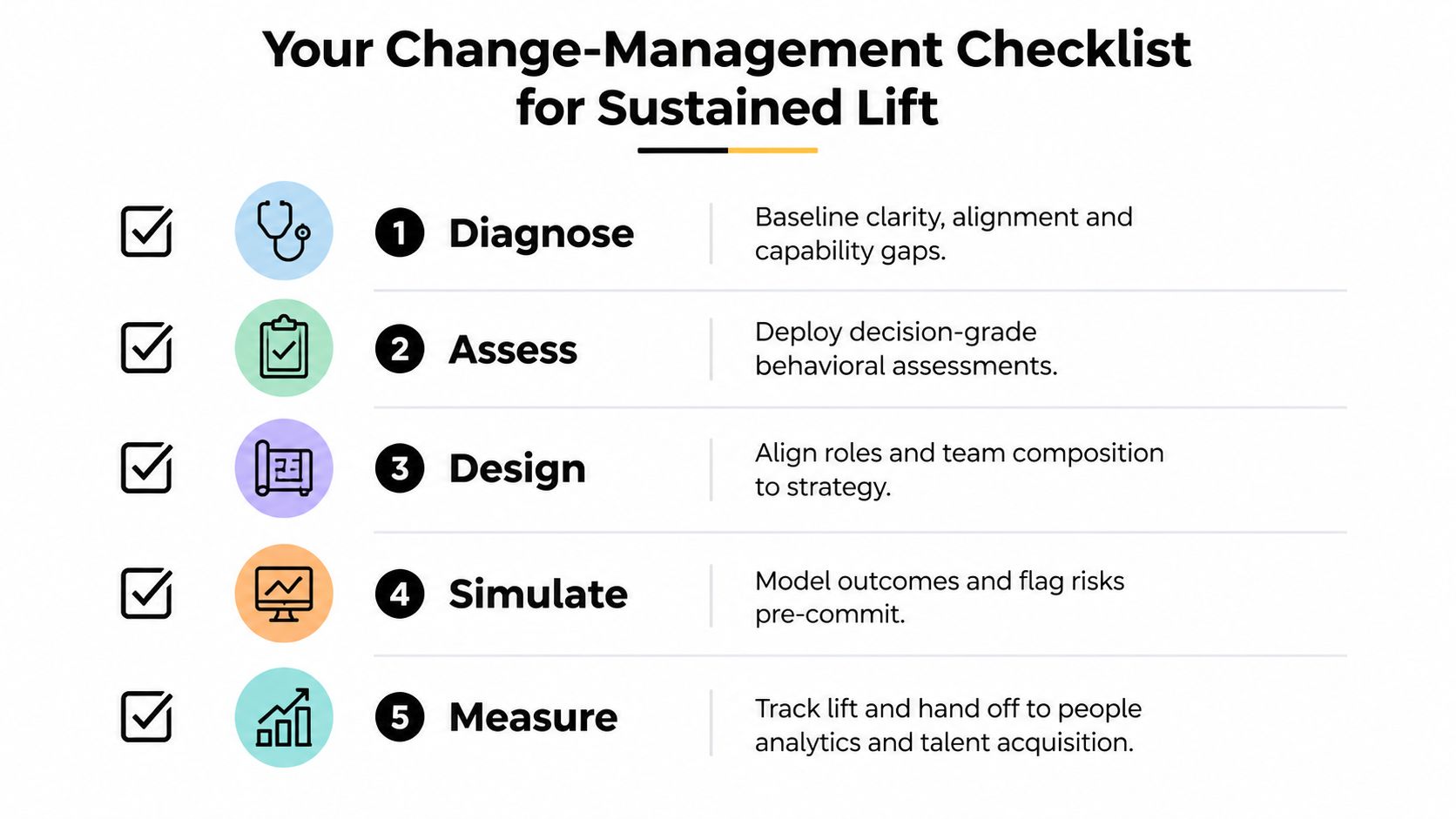
Use five gates
1. Diagnose: Baseline clarity, composition, execution, and leadership signals. Don't run an intervention until the lowest-scoring signal is supported by evidence. 2. Assess: Use decision-grade behavioral assessments where they add useful evidence. Treat the output as a team-fit and role-fit input, never as an automatic hire-or-no-hire trigger. 3. Design: Choose hiring, development, role redesign, or reallocation based on the failure mode. Stabilize role definitions before changing team composition. 4. Simulate: Model proposed combinations only after responsibilities, dependencies, and success measures are clear. Flag friction and overload risk before committing. 5. Measure: Review leading and lagging KPIs through day 90. Don't expand hiring or reallocation beyond one team until the evidence has been examined.
Cadence keeps the loop alive. Run weekly standups during the first month, biweekly business reviews through month three, and monthly KPI reviews with the executive sponsor. Each meeting should end with a decision, an owner, and the evidence required for the next gate.
A concise [Firacard guide for HR teams](https://firacard.com/blog/change-management-approach/) can support the broader change-management discipline, but the operating rule remains yours: budget follows demonstrated lift, not enthusiasm at launch.
Watch for predictable failure modes
Sustained lift comes from repeating the loop. Teams should diagnose again when priorities, membership, leadership, or task structure changes, then adjust the intervention and measurement plan accordingly.
---
Synopsix helps CHROs and people-analytics teams turn validated behavioral assessments into comparable profiles, business-language insights, predictive simulations, compatibility analysis, and development plans for hiring and team design. Visit [Synopsix](https://synopsix.ai) to evaluate how a tighter diagnose-to-measurement loop could improve your next team performance decision.