Team Profile Examples: 8 Frameworks That Work
By Synopsix · November 19, 2026 · 19 min read
Google's Project Aristotle studied teams across functions and locations and found that effective sales teams exceeded their targets by an average of 17%, while less effective teams could fall short by as much as 19%, a 36-percentage-point spread that individual talent doesn't explain, according to [Google's summary of the five dynamics of effective teams](https://business.google.com/us/think/future-of-marketing/five-dynamics-effective-team/). The strongest differentiator wasn't who sat on the team. It was how the team interacted, organized its work, and handled mistakes.
Most "team profile examples" circulating online stop at description. They list a name, a role, a set of skills, a few hobbies, maybe a behavioral label, and call it a profile. None of that answers the question a hiring manager has: will this group ship on time, will the new director clash with the existing leadership team, will accountability survive the reorg.
This list goes further. Each of the eight frameworks below is annotated with what it predicts about team behavior, where it breaks down as a hiring or team-design tool, and the moves that turn a static profile into a better people decision. Expect common risk indicators, adaptation guidance, and methods you can rerun next quarter.
1. Belbin Team Roles
A product team misses three release dates in a row. Nobody is lazy. The team has two strong idea generators, a persuasive coordinator, and a well-connected external scout, and nobody whose job is to close the last ten percent. That's the failure Belbin Team Roles was designed to surface.
Meredith Belbin developed the model from observational research on management teams at Henley Management College, grouping contributions into nine roles: Plant, Resource Investigator, Coordinator, Shaper, Monitor Evaluator, Teamworker, Implementer, Completer Finisher, and Specialist. The argument is that teams perform best when the mix covers all nine.
What it actually predicts
Role gaps produce predictable failures. A team without a Completer Finisher ships late. A team with no Monitor Evaluator commits to the first plausible plan. That's a forecast about output, not a description of personality.
The collective-intelligence work at MIT's Center for Collective Intelligence points the same direction. In studies with 699 participants assigned to groups of two to five, a group's collective-intelligence factor explained roughly 30% to 40% of performance variation, and collaboration processes predicted outcomes better than individual member skill, as reported in MIT's collective intelligence research. Interaction beats roster.
Where it breaks down
Belbin is self-report. People rate themselves as they'd like to be seen, and role preference shifts with workload and context. A Shaper during a crisis is often a Teamworker on a quiet Tuesday. Treat the nine roles as tendencies, never labels, and never hire a "Plant" as though the word were a skill.
> Practical rule: Collect observer ratings alongside self-ratings. Where a manager and a colleague disagree about someone's dominant role, that disagreement is the useful data.
Before you run it on a live team, read this breakdown of [how a team role assessment works](https://synopsix.ai/blog/team-role-assessment), including what it can and can't tell you.
2. DISC Team Profile
DISC is the most used and most misused team profile in the room. It maps observable behavior on four dimensions, Dominance, Influence, Steadiness, and Compliance. The model traces to psychologist William Moulton Marston's 1928 work on how people express emotion. A team DISC profile plots every member on the same grid, so leaders can see clusters of direct, people-oriented, patient, and detail-focused styles.
What it actually predicts
Communication and conflict patterns, mostly at handoff points. A handoff between a high-Influence account lead and a high-Compliance analyst fails predictably: the lead gives a verbal sketch, the analyst wants a written spec, and both walk away convinced the other was careless. Seeing that on one page turns an interpersonal grievance into a process fix.
A sales team I'd advise would use its DISC mix to settle one rule: lead handoffs go out in a fixed written template with a 24-hour window. The high-I members will never volunteer documentation, and the high-C members will never chase it verbally.
Where it breaks down
As a hiring predictor, it's weak, and the reason is structural. Structured interviews predict job performance at a mean validity of 0.42 against 0.19 for unstructured interviews, a gap that comes from standardization, not intuition, per this [synthesis of personnel-selection meta-analyses](https://gwern.net/doc/statistics/meta-analysis/2021-sackett.pdf).
So use DISC to decide how a team communicates after the hire. Use structured, role-specific interviews to decide who gets hired. "Is this candidate a high D?" is the wrong question. "Can this person run a stakeholder meeting where a high-S client needs slow decisions?" is the right one.
> The team map is a conversation tool. The moment it becomes a ranking, people start managing their profile instead of their work.
If you're choosing between versions, this guide to [the DISC assessment](https://synopsix.ai/blog/everything-disc-assessment) covers how the dimensions behave in practice.
3. Myers-Briggs Type Indicator Team Composition Report
MBTI is probably the most recognized personality instrument in the world and the least defensible as a screening tool. The team composition report aggregates individual results across four preference pairs: Extraversion or Introversion, Sensing or Intuition, Thinking or Feeling, and Judging or Perceiving. It builds on Carl Jung's theory of psychological types and was developed by Katharine Cook Briggs and Isabel Briggs Myers.
What it actually predicts
Meeting dynamics and decision style. A team weighted toward Judging preferences will lock the agenda and finish early; a team weighted toward Perceiving will leave with three open threads and no owner. A Thinking-dominant group will settle a dispute with data and skip the part where anyone feels heard, then wonder why the decision doesn't stick.
A product organization can use its type map to schedule a 20-minute options-only block before any decision meeting. The Intuitive members generate alternatives faster than the Sensing members can evaluate them, and without that block the meeting splits along the same fault line every week.
Where it breaks down
Type is a preference framework, not a performance measure. It belongs in meeting design and development conversations, not in a screening rubric. Combine it with validated predictive measures whenever a decision carries real cost.
There's a governance problem here that almost nobody discusses. Team profiles accumulate personal detail, and guidance on employee profiles already recommends standardized, searchable fields with employee-editable updates, as in [Slack's employee profile guidance](https://slack.com/intl/pt-br/blog/collaboration/employee-profile). Someone has to decide which fields are voluntary, who can view them, how they get corrected, and what happens when a role changes.
4. Predictive Index Team Map
The Predictive Index Team Map is the version of this exercise built for decisions rather than conversation. It plots members on dominance, extraversion, patience, and formality, adds cognitive ability measures, and compares the collective profile against the behavioral demands of a specific role. The instrument dates to the 1950s and industrial psychologist Arnold Daniels.
What it actually predicts
Job fit and coverage. Because roles are benchmarked from top performers, the map answers a question DISC can't: does this group's aggregate drive match what the work requires? A fast-paced sales floor needs dominance and extraversion. A compliance function needs formality and patience. A leadership team of seven high-dominance strategists will fight for the floor and leave the detailed work undone.
Where it breaks down
Fit in the current role is not evidence of fit in the next one. Research across 131 firms found that pre-promotion sales performance was negatively correlated with post-promotion managerial value added, and that doubling a worker's pre-promotion sales was associated with a 7.5% decline in manager value added, per this [study in the Quarterly Journal of Economics](https://academic.oup.com/qje/article/134/4/2085/5550760). A selection policy built on the best-predicted managers implied subordinate performance could improve by approximately 30%.
Trait data also has a ceiling. Conscientiousness shows an overall raw correlation of 0.17 with job performance across 104 independent estimates, with a 95% confidence interval of 0.15 to 0.19, and it adds incremental validity beyond cognitive ability, according to [the 2023 conscientiousness meta-analysis](https://psycnet.apa.org/record/2023-35344-001). Real signal, modest effect, never a verdict on its own.
5. Insights Discovery Team Wheel
Zoom's 2024 collaboration survey of 7,969 full-time knowledge workers across 16 countries found that 35% of leaders spend at least three hours a day on in-person meetings and email, as detailed in the [Zoom collaboration report](https://www.zoom.com/en/products/collaboration-tools/resources/collaboration-report/). Three daily hours in the wrong meeting format is the most expensive line item in most calendars.
The Insights Discovery team wheel exists to fix the format. It uses four color energies, Fiery Red, Sunshine Yellow, Earth Green, and Cool Blue, to describe preferences in energy, communication, and decision-making. The model is rooted in Jung's typology, was developed in Scotland, and is widely used by internal development teams and coaches.
What it actually predicts
Which interactions will get tense, and which decision rules prevent it. A team weighted toward Fiery Red alongside a team weighted toward Earth Green will deadlock on pace: one side wants the call made today, the other wants everyone consulted first. Naming that out loud in a workshop is a five-minute fix. Leaving it unnamed costs a quarter.
A cross-functional project team can use its wheel to set an explicit rule that Cool Blue owners get 48 hours to review before a decision closes, and Fiery Red owners may escalate past the review when a deadline is at risk.
Here's how the color model looks when a trained facilitator runs it with a real team.
<iframe width="100%" style="aspect-ratio: 16 / 9;" src="https://www.youtube.com/embed/mLg2OwbmjRA" frameborder="0" allow="autoplay; encrypted-media" allowfullscreen></iframe>
Where it breaks down
Color language is sticky and reductive. "She's such a red" is a label, and labels harden into excuses for behavior nobody has to change. Facilitator quality matters more than the instrument, so insist on accredited training and on outputs written as behavioral agreements rather than color descriptions.
6. CliftonStrengths Team Report
Atlassian's 2024 State of Teams survey found that 55% of knowledge workers find it difficult to track down information even though they know many people at their organization, according to the [Atlassian State of Teams report](https://www.atlassian.com/blog/state-of-teams-2024). Knowing people isn't the same as knowing what they're good at.
Gallup's CliftonStrengths Team Report closes part of that gap. It identifies each member's top five of thirty-four talent themes and shows how those themes distribute across strategic thinking, relationship building, execution, and influence. The approach grew out of decades of research led by Don Clifton and stays deliberately strengths-based rather than deficit-focused.
What it actually predicts
Coverage, and the routing of work. A team with no execution themes will agree on brilliant plans and produce nothing by Friday. A team with a thin relationship-building cluster will burn through stakeholders and wonder why every launch needs a rescue. The distribution, not any individual top-five, is the predictive part.
A customer experience team can use its strengths map to assign ownership explicitly: relationship-building themes own the key-account escalation path, and process-improvement themes own the onboarding redesign. That converts a report into a routing table.
Where it breaks down
A strengths map names what people do well and enjoy. It says nothing about whether the team has the right work in front of it. A team can be beautifully matched to its strengths and still miss the number because nobody owns the number. Pair strengths with explicit performance expectations and a named owner for each outcome.
7. Hogan Personality Inventory Team Profile
Most team profiles describe how people behave when things are going well. The Hogan model was built for the other condition. It separates bright-side personality, what you see under normal circumstances, from dark-side tendencies that surface under stress, fatigue, or threat. HPI team profiles aggregate seven scales, including Ambition, Sociability, and Prudence, to show how a group will likely operate and where it will crack.
What it actually predicts
Derailment risk under load, and it carries the clearest commercial stakes in this list. The best bosses increased subordinate output by more than 10% relative to the worst bosses, according to the [World Economic Forum's analysis of promotion research](https://www.weforum.org/stories/jobs-and-the-future-of-work/promotions-and-the-peter-principle), and management-practice variation tracks substantial differences in firm productivity across countries.
An executive search firm can use dark-side profiles to flag a COO candidate whose stress response is micromanagement, before the appointment is finalized, and then build a coaching clause into the offer and the first 90-day plan.
Where it breaks down
Sensitive data plus amateur interpretation equals damage. Dark-side results need certified interpretation and a feedback conversation, or they become a permanent accusation attached to someone's name. Stress behavior is also contextual: a derailment pattern appears under specific conditions, not everywhere and not always.
> For high-stakes roles: treat the team profile as a risk map for the pipeline, not a scorecard for the individual.
8. Lencioni Five Dysfunctions Team Assessment
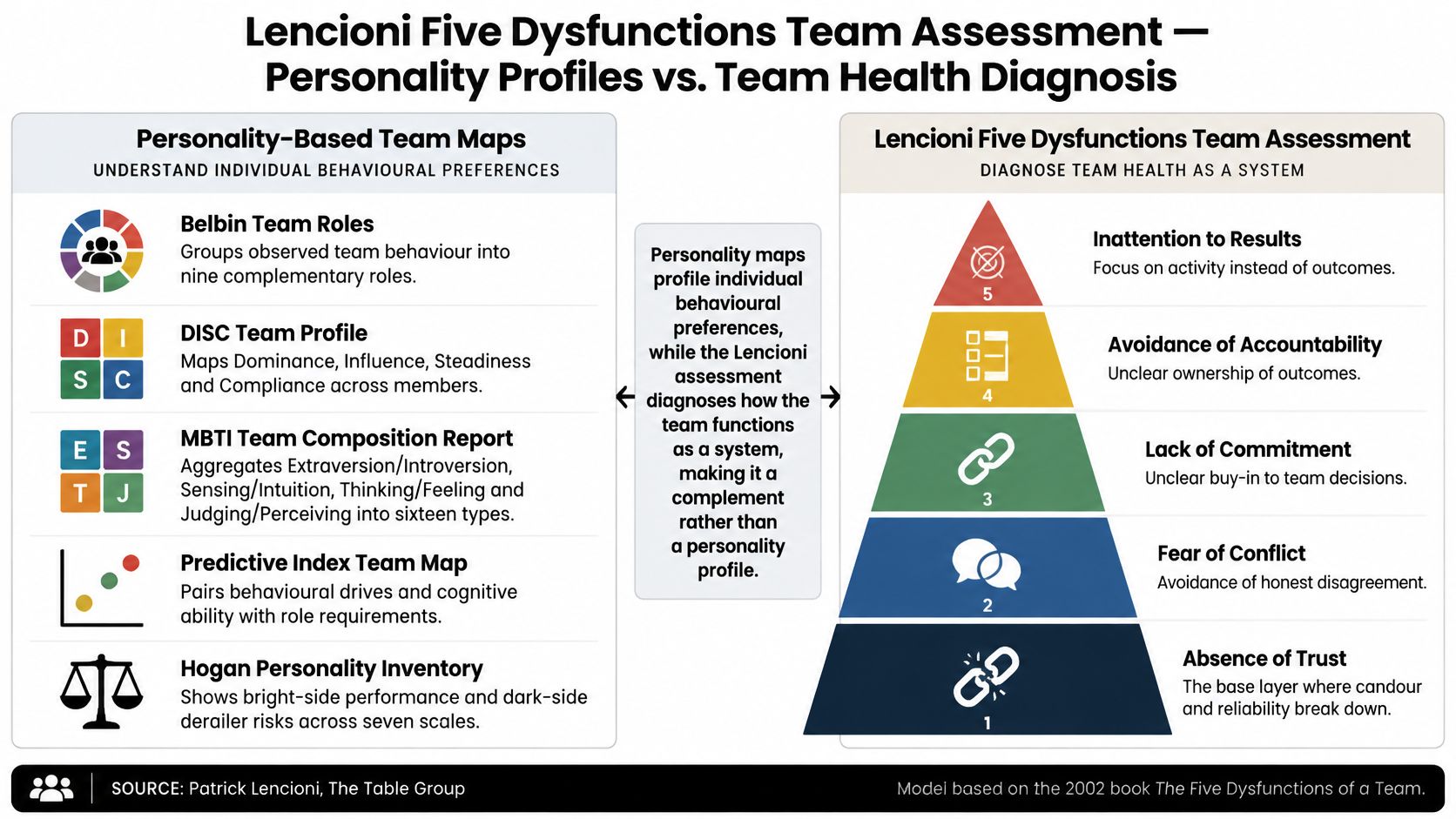
This is the odd one out, because it doesn't profile people at all. Based on Patrick Lencioni's 2002 book, the assessment measures the team as a system across five areas: absence of trust, fear of conflict, lack of commitment, avoidance of accountability, and inattention to results. Where the other frameworks tell you who is in the room, this one tells you whether the room works.
What it actually predicts
Where team process will fail before any individual does, and it responds to intervention. In a controlled six-week organizational experiment, teams given an individuation intervention focused on recognizing individual perspectives improved psychological-safety scores by 12% more than the control group, while a separate blocker-removal intervention produced a 6% relative improvement, as reported in [MIT Sloan Management Review's account of the experiment](https://sloanreview.mit.edu/article/proven-tactics-for-improving-teams-psychological-safety/).
A newly formed executive team can run the assessment before a strategy offsite and discover that several members don't believe the growth target is achievable and haven't said so. Better to spend the offsite on that disagreement than on the deck.
The comparison below shows the structural difference between personality-based maps and the five-dysfunctions pyramid.
Where it breaks down
It's a self-report snapshot, and it's only as honest as the room. Run responses anonymously and aggregate before you discuss, or the fear-of-conflict score is itself a product of fear of conflict. It also gives you no information about individual capability, so it complements personality profiles rather than replacing them.
For a structured way to run this with individual data alongside it, see this guide to a [team dynamics assessment](https://synopsix.ai/blog/team-dynamics-assessment). The trust layer underneath it is worth reading up on too, and [Ekipa's guide to workplace trust](https://ekipa.co/insights/blogs/why-trust-matters-in-the-workplace-tips-for-building-it-with-agile-practices-2/) covers how agile teams build it deliberately.
Team Profile Frameworks at a Glance
| Framework | Best For | Predictive Strength | Key Limitation | |---|---|---|---| | Belbin Team Roles | Identifying gaps and complementary contributions in a team | Highlights likely team blind spots; limited for predicting individual job performance | Self-perceptions may differ from observed behavior | | DISC Team Profile | Improving communication and understanding behavioral styles | Helps anticipate communication and conflict patterns; limited for cognitive ability or technical skill | Four categories can oversimplify behavior, and versions vary in rigor | | Myers-Briggs Type Indicator (MBTI) Team Composition Report | Building shared language around team preferences and work styles | Useful for discussing interaction preferences; not designed to predict job performance | Reliability concerns and risk of stereotyping | | Predictive Index Team Map | Matching behavioral drives and cognitive ability to role needs | Supports role-fit assessment when roles are carefully benchmarked | Requires meaningful role benchmarks and fair use of cognitive measures | | Insights Discovery Team Wheel | Team development, communication, and facilitated discussion | Can surface likely interaction and friction patterns; less suited to hiring decisions | Validation may be limited, and results depend on facilitation | | CliftonStrengths Team Report | Assigning work and planning development around team strengths | Shows strength coverage and gaps; does not measure overall performance or ability | Strengths-only focus may overlook weaknesses | | Hogan Personality Inventory Team Profile | Leadership development and identifying occupational or stress-related risks | Well-supported for occupational outcomes and derailment risk | Complex, sensitive results require qualified interpretation | | Lencioni Five Dysfunctions Team Assessment | Diagnosing team health and improving trust, accountability, and results | Describes team dynamics but is not strongly validated for prediction | Depends on candid participation and skilled facilitation |
From Static Profiles to Predictive People Decisions
Every framework above gets more useful the moment you pair it with role context and test it before the decision is final. Three habits separate teams that get value from profiles from teams that collect personality decks.
Match the framework to the decision. Hiring calls for structured, role-benchmarked behavioral evidence and an interview process that treats every candidate the same way. Team design calls for role mix, interaction maps, and written process rules. Development calls for preferences, strengths, and coaching, with the results kept private by default. Using a development instrument to screen candidates is the most common and most expensive mistake in this whole field.
Measure a baseline and a lift, not just a score. A team-based learning study of 107 medical students organized into 18 teams found an average Team Gain Score of 18.7 percentage points between individual readiness-test performance and team retest performance, with team results ranging from 13.6 to 24.0 points, per this [study in Academic Medicine](https://academic.oup.com/academicmedicine/article/95/6/872/8347171). The strongest team moved from 66.9% individually to 90.9% after discussion. Baseline admissions measures didn't separate the teams, which means the lift came from how the group worked together, not from who was in it. Capture that kind of before-and-after metric for your own teams and the profile stops being decoration.
Keep the profile alive. Guidance on candidate-facing team profiles recommends tying updates to role changes rather than relying only on calendar reviews, as [Dr John Sullivan's work on team profiles](https://drjohnsullivan.com/articles/team-profile-excite-candidates/) sets out. A stale profile misleads more confidently than no profile at all, because people trust it.
> A profile is a hypothesis about how a group will behave. A people decision made without testing that hypothesis is a guess with paperwork.
This is the gap that tools like Synopsix are built to close: assessments that read each person against the role rather than a generic template, simulations of a hire, promotion, or reorg before it happens, and a Human Interlink map of where a team will collaborate well and where it will create friction.
Start small. Pick one team that matters this quarter, map its current profile against the framework that matches the decision in front of you, and run a simulation before your next hire or reorg rather than after it.
---
Team profiles only change outcomes when the insight arrives before the decision. Synopsix turns validated behavioral assessments into comparable profiles, then lets you simulate a hire, a promotion, or a reorganization and see where friction and complementarity will show up in your actual team. Take the free assessment to see how your own profile reads against a role, then bring your next people decision into [Synopsix](https://synopsix.ai) and test it before it goes live.