Team Role Assessment: A Practical Guide to Smarter People
By Synopsix · July 31, 2026 · 15 min read
Popular advice treats team role assessment like a sorting exercise. Put the right mix of people in a room, label the roles, and performance will follow. That sounds tidy, but real teams do not work that way, especially when work is hybrid, cross-functional, and constantly shifting.
The stronger approach is more practical and less glamorous. Treat roles as behavioral tendencies in context, not permanent identity tags. That distinction matters because Belbin's framework itself defines a team role as “a tendency to behave, contribute and interrelate with others in a particular way” and separates the model into nine roles across action-oriented, people-oriented, and cerebral contributions ([Cambridge IFM on Belbin's team roles](https://www.ifm.eng.cam.ac.uk/research/dmg/tools-and-techniques/belbins-team-roles/)).
Why Team Role Balance Is Not a Silver Bullet
Balanced teams can help, but balance is not a shortcut to effectiveness. A role map tells you how people tend to contribute, not whether the team will execute well under real pressure. That is where most public guidance gets too confident, because the evidence base is more nuanced than the “build the perfect mix” story suggests.
Context changes the value of a role
A 2024 scientific review found that team-role balance is still being studied as a predictor of effectiveness, but the evidence is uneven and context-dependent rather than universal. The same review also pointed to a medical-student study where perceived role balance had only partial links to team effectiveness, which is exactly the kind of result that should make leaders cautious about static team formulas ([MDPI review on team roles and effectiveness](https://www.mdpi.com/2673-8104/3/3/36)).
That fits what I've seen in practice. A team can look balanced on paper and still struggle if the work is ambiguous, the manager is unclear, or the members rotate in and out of projects every few weeks. In those settings, the key question is not, “Do we have all nine roles?” It is, “Which behaviors show up when the team is under load, and which ones disappear?”
> Practical rule: Use role data to understand likely contributions, then verify those contributions against the work the team actually has to deliver.
Hybrid work makes static role maps weaker
Hybrid and project-based work create role drift. One person may switch from idea generation to execution, then to coordination, all in the same quarter. Recent team-science guidance emphasizes mission clarity, task distribution, inclusion, and breadth of perspectives, not just classic labels like Plant or Coordinator ([Penn State CTSI team science assessment toolkit](https://ctsi.psu.edu/services/toolkits/team-science/assessment)).
That matters because a team-role assessment can mislead if you treat it like a personality verdict. Belbin's own methodology combines self-perception with observer input, and the practical output is strongest when you read it as a team-context tendency, not a fixed trait. If you freeze people into one role, you miss variance across situations and you overstate confidence in traits that were only weakly observed.
The useful mindset is narrower and more defensible. Role data helps you see what people are likely to do, what they avoid, and where collaboration may fray. It does not replace management judgment, and it definitely does not replace evidence from actual team outcomes.
Choosing or Designing the Right Assessment
The quality of the assessment sets the ceiling for the decision. If the method is thin, the discussion will be thin too, and many organizations end up buying a role label and asking it to cover hiring, development, succession, and team design at the same time.
Start with a multi-method design
The first filter is simple. Do not rely on self-report alone if you want a defensible team role assessment. Belbin's methodology combines a self-perception inventory with observer assessments and job profiling, and Belbin North America describes the standard report as a multi-rater profile built from self-ratings plus four to six observers who judge workplace behavior ([Belbin North America guide](https://belbinnorthamerica.com/wp-content/uploads/2025/07/A-Guide-to-Belbin-Team-Roles-IE7-Version.pdf)).
That design choice matters because self-assessment is vulnerable to blind spots. Colleagues see how someone behaves in meetings, under deadline pressure, or when the work gets messy. The strongest read comes from triangulating those views and then interpreting the combined profile as a tendency, not a label.
Belbin also notes that peer-rater instruments may require at least eight positive adjectives to produce a reliable role indication, which is a useful reminder that weak signal data should not be overread. If the observed evidence is thin, the output should be treated with caution.
Check the structure, not just the brand name
Established frameworks can be useful because they are explicit about what they measure. Belbin's classic operational format uses seven sections with ten points distributed per section, and the model describes nine team roles that span action-oriented, people-oriented, and cerebral contributions ([Belbin North America guide](https://belbinnorthamerica.com/wp-content/uploads/2025/07/A-Guide-to-Belbin-Team-Roles-IE7-Version.pdf)). That structure gives you something concrete to evaluate, especially if you are comparing tools.
A sound tool should answer a simple question. Is it measuring what people are likely to do in a team, or is it pretending to diagnose who they are? If the vendor cannot explain how observer data is used, how role variance is handled, or how results should be interpreted in context, the tool is too blunt for high-stakes use.
For a broader view of assessment design, the [psychometric evaluation overview](https://www.myculture.ai/blog/what-are-psychometric-assessments) is a useful companion resource because it places team role assessment in the wider family of behavioral measurement rather than treating it like a stand-alone gimmick.
Tool selection also comes down to workflow. Teams that are comparing options often need a practical reference point, and a guide to [psychometric assessment tools](https://synopsix.ai/blog/psychometric-assessment-tools) can help frame the trade-offs between administration, interpretation, and how easily the output can be used in real hiring and development decisions.
One practical option many teams consider is a platform that combines assessment, profile generation, and business-facing interpretation. Synopsix is one example in that category, but the same selection logic applies to any vendor, the method has to support evidence-based decisions, not just interesting labels.
A decent test is whether the output can be used to explain behavior in a team meeting without jargon. If it cannot, the assessment is probably too abstract to drive decisions.
<iframe width="100%" style="aspect-ratio: 16 / 9;" src="https://www.youtube.com/embed/D6qm7bOKF6A" frameborder="0" allow="autoplay; encrypted-media" allowfullscreen></iframe>
Running Assessments with Candidates and Incumbents
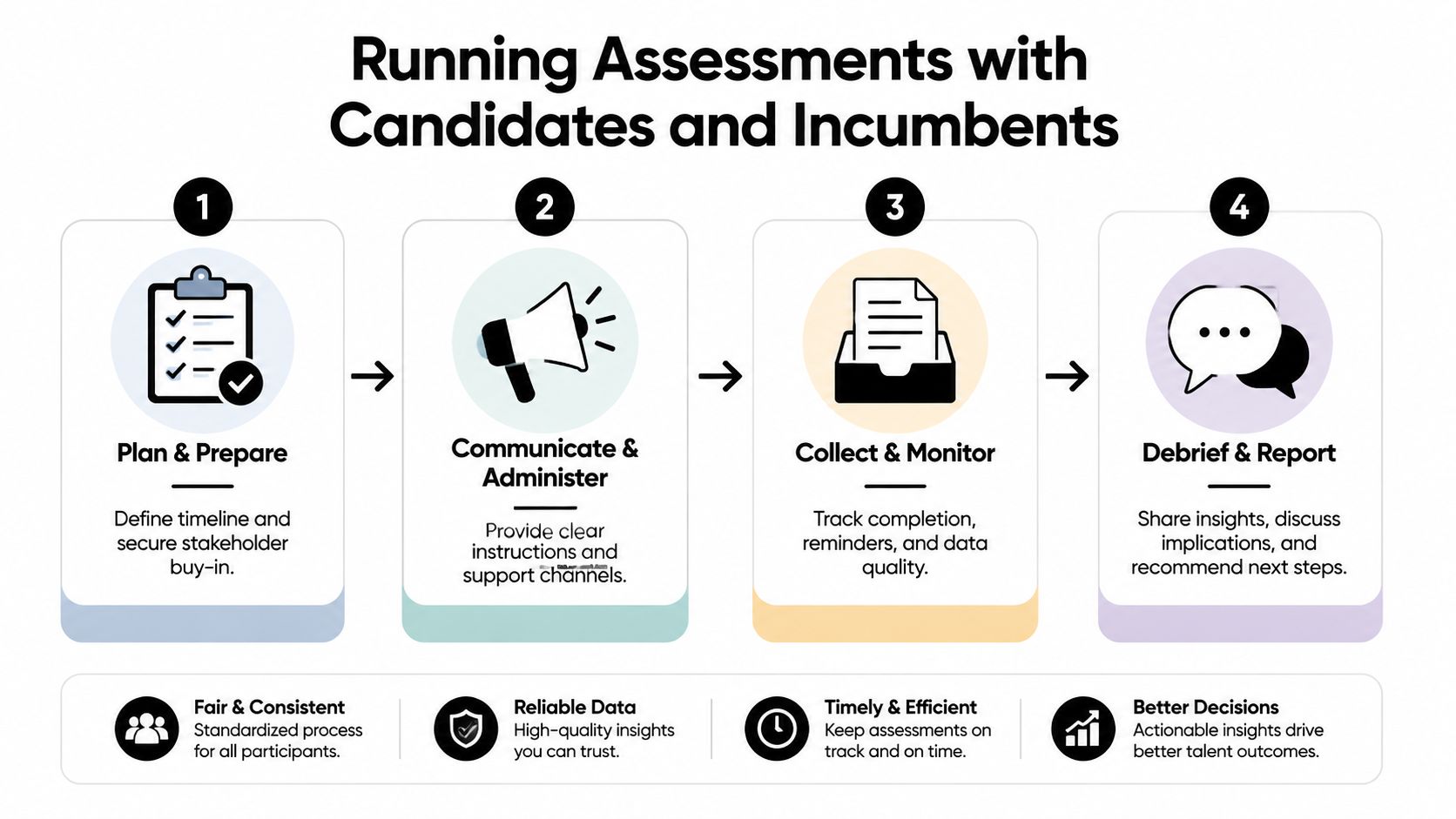
Implementation gets messy fast because candidates and incumbents need slightly different handling. Candidates need fairness and consistency. Incumbents need context, trust, and enough psychological safety to answer truthfully. If you do not plan for both, data quality slips before the first report is even generated.
Build the process around the data you need
Start by deciding what decision the assessment will inform. For candidates, that usually means role fit, collaboration style, and likely friction points in the target team. For incumbents, the focus is usually development, role rotation, and whether the current structure still matches the work.
Observer selection is the part many teams underthink. Belbin North America's multi-rater approach uses four to six observers who see the person at work, which is a practical reminder to choose raters who observe behavior rather than people who know the employee by title ([Belbin North America guide](https://belbinnorthamerica.com/wp-content/uploads/2025/07/A-Guide-to-Belbin-Team-Roles-IE7-Version.pdf)). In hybrid teams, that may mean combining a manager, a peer, and someone from another function, not just whoever is easiest to email.
> Practical rule: If the observers do not see the work, they should not shape the role read.
Keep the rollout fair and low-friction
For candidates, communicate what the assessment will and will not do. If the organization is using the data for hiring, say so. If it is only one input among several, say that too. Silence creates suspicion, especially when a tool looks behavioral but gets used as a hidden gate.
For incumbents, the biggest risk is assessment fatigue. People accept the process faster when it is tied to visible business problems, like unclear ownership, duplicated effort, or recurring conflict. That is why a well-run rollout should include a debrief and a short written summary in business language, not just a score profile.
If your organization already runs employee assessment programs, the operational discipline should be familiar. The same principles apply here, consistency, clarity, and a clean feedback loop. A useful complement is the [assessment for employees](https://synopsix.ai/blog/assessment-for-employees) perspective, which aligns the process with real workplace decisions instead of treating it as a one-time test.
Another practical challenge is role overlap. One person often covers multiple functions in a project team, and a rigid reading will miss that. The better approach is to capture the dominant tendency, note secondary behaviors, and document where the context forces someone to stretch.
Run the process with explicit expectations, calm communication, and enough admin discipline to keep the data trustworthy. That is what keeps a role assessment from turning into a morale problem.
Translating Psychometrics into Business Signals
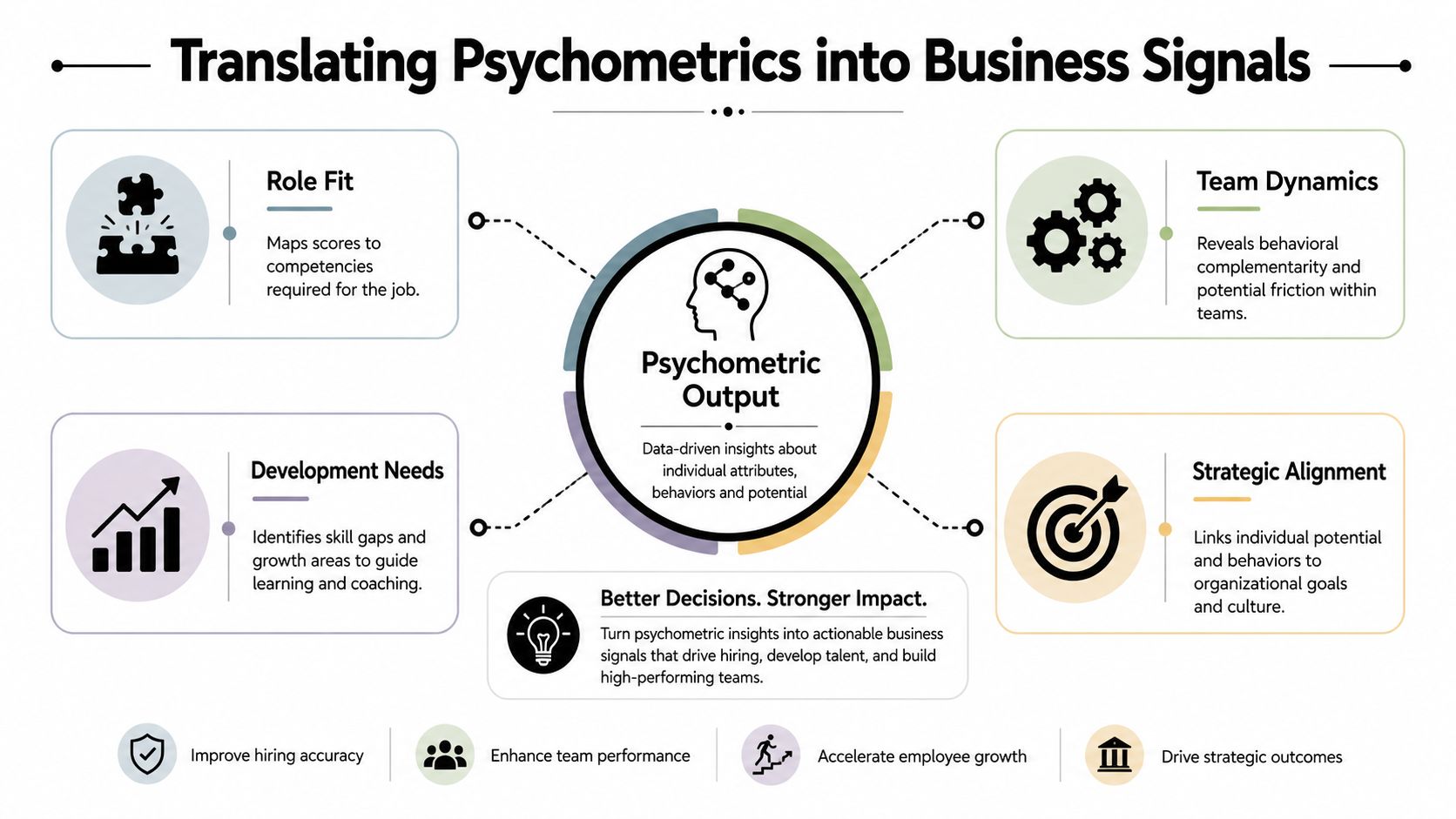
Raw scores do not help managers. Business signals do. The interpretation job is to turn behavioral data into decisions about fit, risk, and development, without pretending that one profile explains everything.
Map the score to a decision
A useful report answers four questions in plain language. Where is this person likely to add value, where might they slow the team down, what kind of environment helps them perform, and what should the manager watch for? That framing is far more actionable than a long list of traits.
Many assessments fail because they describe a behavior and stop there. The manager is left to translate the result alone, which is a poor use of the data and a weak basis for action. A better report says, in effect, “This candidate may contribute strongly in structured execution, but the team will need clear ownership and a manager who avoids constant reprioritization.” That is business language, and it is what leaders can act on.
Avoid the static-box trap
The newest team-science thinking is moving away from simplistic role typing. Recent research suggests roles are expressed through combinations of behaviors that shift with context, and a 2025 paper on the “team role kaleidoscope” shows how the same role can map to different interaction patterns in practice ([MDPI review on team roles and effectiveness](https://www.mdpi.com/2673-8104/3/3/36)). That is exactly why a single score should never be read as destiny.
A role can fit one project and fail in another. A person who looks like a strong Coordinator in a stable environment may struggle in a fast-moving product squad where decisions are decentralized. A cerebral contributor may be invaluable in planning but less visible in a sprint-heavy delivery cycle.
The interpretation should surface that tension instead of hiding it. If a person's profile suggests strong interpersonal support but weaker challenge behavior, that does not mean they are a bad hire. It means the manager should know how the team handles disagreement before making the offer.
A good companion resource for this kind of translation is the [assessment interpretation guide](https://synopsix.ai/blog/assessment-interpretation), especially when you need to convert behavioral data into a concise manager brief.
Use the language decision-makers already use
A practical report should talk about fit recommendations, risk indicators, and development priorities. It should also make clear what would change the recommendation. For example, if a role depends on fast independent judgment, the report should say whether the candidate needs structure, coaching, or a narrower scope to succeed.
The right output does not just say “good fit” or “bad fit.” It tells the hiring manager what the person will need, what the team will need, and what friction is most likely to appear. That is the difference between psychometrics as reporting and psychometrics as decision support.
For teams that need a broader definitions check before they interpret results, the [psychometric evaluation overview](https://www.myculture.ai/blog/what-are-psychometric-assessments) can help anchor the language around what the instrument is measuring.
Using Assessment Outputs in Hiring and Development
Assessment data earns its keep when it affects real decisions. Hiring, promotion, and development all need different guardrails, but the underlying discipline is the same. Pair the role inventory with evidence from team performance, then check whether the person's behavior is helping outcomes or just matching a preferred style.
| Decision Context | Assessment Focus | Key Guardrails | |---|---|---| | Hiring | Likely contribution in the target team, collaboration style, adaptation to the role | Use with structured interviews and job evidence, not as a standalone filter | | Promotion | Readiness for broader team influence, not just current performance | Test how the person behaves under stretch conditions and increased ambiguity | | Development | Behavior shifts needed for the next assignment | Tie feedback to visible workplace situations, not abstract labels |
Use role data inside a broader performance loop
Assessment literature recommends a continuous cycle, define goals, monitor progress regularly, review formally, then reward or reset priorities. Weekly or bi-weekly check-ins are common ways to keep the data current, and that matters because role composition and collaboration patterns change over time ([Primalogik on team performance assessment](https://primalogik.com/blog/team-performance-assessment/)).
That same source notes a 55-item Team STEPPS Assessment covering team foundations, functioning, performance, skills, leadership, climate, and identity, which makes it a useful complement when role balance alone is not enough ([Primalogik on team performance assessment](https://primalogik.com/blog/team-performance-assessment/)). I would use that kind of team-performance lens when the question is not just who someone is, but how the group is working.
Keep business signals attached to the profile
Do not evaluate role scores in a vacuum. Link them to goal attainment, psychological safety, and delivery quality. Otherwise, the team can look balanced while missing deadlines, suppressing disagreement, or shipping weak work.
This is the point where talent-management discipline matters. A [Salesmotion guide to talent management](https://salesmotion.io/blog/strategic-talent-management-strategy) is a useful reference if you want to connect assessment outputs to broader workforce planning and succession logic rather than treating them as isolated HR artifacts.
The strongest use case is development. If a manager knows someone tends to stabilize a team but avoids challenge, the development plan should not say “be more assertive” and leave it there. It should identify the situations where that behavior matters, the meeting format where it shows up, and the support the manager needs to provide.
Use assessments to sharpen, not freeze, talent decisions
A good assessment process can support external hiring, internal promotion, and leadership pipeline planning. A weak one becomes a label factory. The difference is whether you keep testing the profile against actual outcomes and revise the interpretation when the evidence changes.
Measuring Success and Avoiding Common Pitfalls
A team role assessment program succeeds when managers make better decisions, not when everyone finishes the questionnaire. One organization I worked with had strong completion rates and almost no change in how managers assigned work. The profiles looked polished, but the team still had recurring handoff problems because no one linked the role data to delivery outcomes.
Measure the effect, not just the rollout
The first sign of success is decision quality. Are hiring managers asking sharper questions? Are development plans more specific? Are team leads assigning work with less guesswork? Those are better indicators than simple participation counts.
Annual-only review cycles are another common failure point. By the time a yearly conversation happens, the team may already have shifted, especially in hybrid or project-based environments where roles rotate quickly. That is why regular check-ins matter, because they catch friction while it is still manageable.
A practical bias check is worth building in too. If a quieter specialist is consistently overlooked because they do not self-promote, the assessment process should not amplify that bias. The [remote team evaluation bias insights](https://pebb.io/articles/how-to-avoid-bias-in-remote-team-evaluations) article is a useful companion when you are trying to keep distributed-team judgments grounded in observed behavior rather than visibility alone.
Watch for the common failure modes
The biggest pitfall is over-interpreting one questionnaire as a complete role map. That creates false confidence in weakly observed traits and misses how the person behaves across contexts. Another failure mode is using role scores without reviewing the team's actual results, which can leave execution problems untouched.
A second risk is marginalizing specialists who contribute in understated ways. In distributed teams, the loudest voice often gets treated as the clearest signal, even when the most critical work is being done by someone else. Good assessments should reduce that distortion, not bake it in.
> A role profile is useful only if it leads to better allocation, better feedback, or better hiring. If none of those change, the process is decorative.
Course-correct when the evidence changes
Role composition does change. A person who was a stabilizer on one project may become a challenger on another. If the current data no longer matches the team's experience, update the read instead of defending the old profile.
That is the test in hybrid work. The organization has to know when someone is covering multiple roles, when a team needs explicit role rotation, and when a static role model is creating blind spots in hiring and design. If your process cannot handle that complexity, it is too simple for the work.
---
If you're building a more defensible way to assess people, Synopsix turns behavioral data into clear signals for hiring, team design, and development. Visit [Synopsix](https://synopsix.ai) to see how assessment results can move from profiles to practical decisions without the usual interpretation burden.