Understanding Team Dynamics: A Practical Guide
By Synopsix · September 28, 2026 · 15 min read
A product team can hit every delivery date and still be getting weaker. The same people attend polished planning meetings, dashboards stay green, and difficult decisions keep moving to the next call. Meanwhile, one senior contributor absorbs ambiguity, quieter members stop challenging assumptions, and everyone spends more time searching for context than solving the problem.
That pattern isn't a morale mystery. It's a team dynamics problem, and understanding team dynamics means treating it as something observable, diagnosable, and changeable. The practical question isn't whether a team feels good. It's whether people share information, challenge decisions, coordinate ownership, and recover from mistakes quickly enough to do reliable work.
What Team Dynamics Means
Team dynamics are the repeatable patterns through which people influence one another through roles, norms, communication, conflict, power, accountability, and trust. Diagnose them in observable terms: who speaks first, whose concerns receive follow-up, how decisions are revisited, and what happens after someone admits an error.
The distinction from culture matters. Culture describes shared meaning and expectations across a wider organization, while dynamics describe how a particular group behaves during daily work. Engagement measures an individual's affective relationship with work. A highly engaged employee can still work in a team where information is hoarded or disagreement is punished.
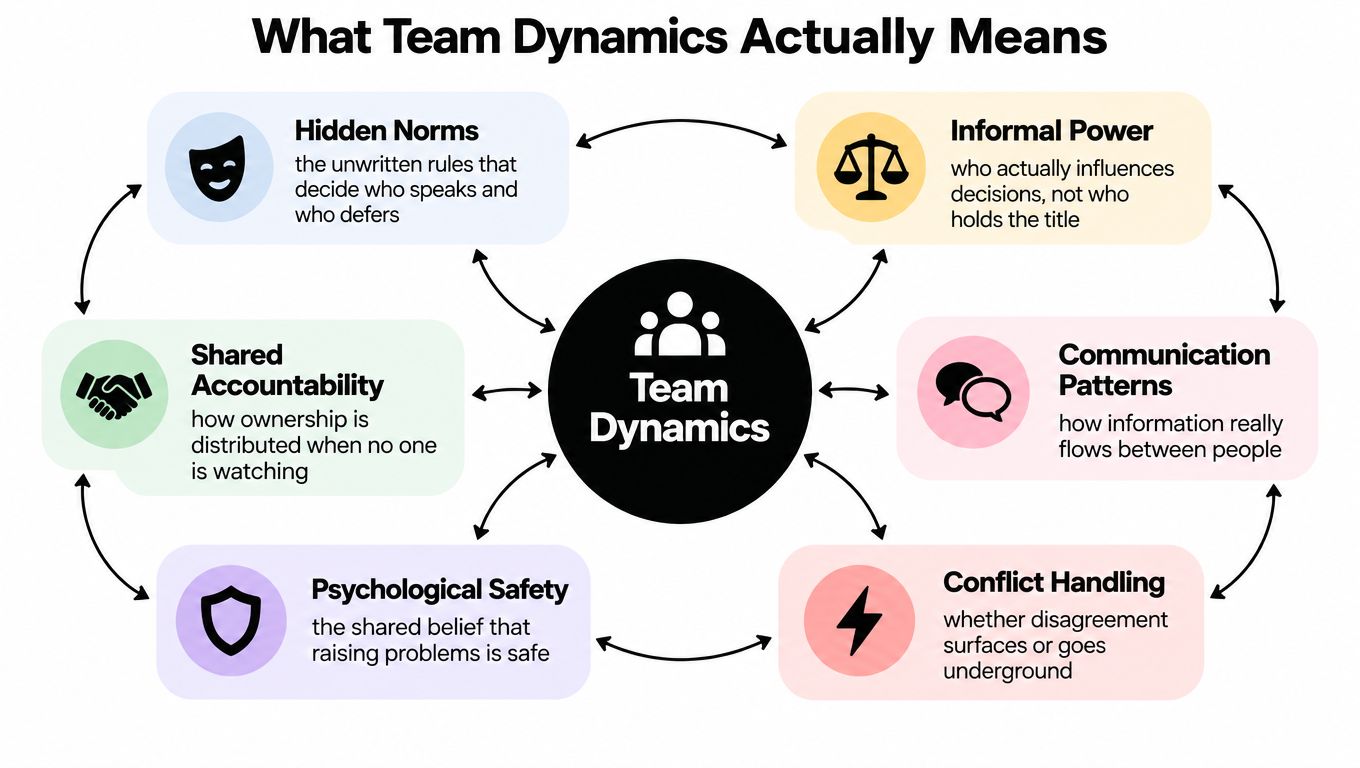
The operating system beneath the output
A team operates through inputs and feedback loops. Inputs include goals, people, incentives, workload, decision rights, and information. The loops determine whether a mistake becomes a lesson, a debate produces a better decision, or a missed handoff creates recurring rework. If the loops stay unchanged, the same failure modes tend to return.
Psychological safety is one measurable component. It is the shared belief that interpersonal risk taking is safe. Assess it by asking whether mistakes are held against people, members can request help, and concerns can be raised without punishment. Research links stronger psychological safety with team learning, information sharing, speaking up, experimentation, and performance, rather than comfort alone ([research on psychological safety as a dynamic team construct](https://www.nature.com/articles/s41599-024-04037-7)).
Use a practical diagnostic cycle: name the driver, measure the behavior, intervene at the system level, then measure again. For example, track decision rework after clarifying ownership, or monitor unresolved handoffs after changing communication norms. Guidance on [ways to boost collaboration with Contesimal](https://contesimal.ai/blog/qualities-of-an-effective-team/) and [what team cohesion means in practice](https://synopsix.ai/blog/what-is-team-cohesion) can support that work, but neither replaces observation of the team's own operating patterns. AI can organize survey comments and identify recurring language. It cannot yet determine whether silence reflects agreement, fear, or a deliberate decision.
The Drivers That Shape How a Team Behaves
Start with the drivers people can observe, not abstract labels. A senior engineer who resolves ambiguous requirements without announcement may become the team's de facto product manager. The problem isn't that the engineer is helpful. The problem is that the team has allowed informal ownership to replace explicit role design.
| Driver | Observable Signal | Risk When Out of Balance | |---|---|---| | Roles | The same person resolves recurring ambiguity | Hidden dependency and overload | | Norms | People know what is safe to say | Silence around emerging risks | | Communication | Context reaches the right person at the right time | Search overhead and duplicated work | | Conflict | Disagreement is visible and bounded | Avoidance, escalation, or personal friction | | Diversity | Different perspectives enter decisions | Conformity or fragmented debate | | Psychological safety | Members can admit uncertainty and raise concerns | Late risk discovery and defensive behavior |
Roles and informal power
Titles rarely explain influence. Watch who frames the problem, who gets consulted before a meeting, and whose objections cause the group to pause. If one person repeatedly carries unresolved decisions, write down the decision owner and the people who provide input. A role map often exposes the gap faster than a general conversation about accountability.
Norms and communication
A sales team may repeat a “no surprises” rule so often that people stop reporting weak pipeline signals. A product squad that defaults to chat may move quickly while losing the context that a difficult design conversation requires. Diagnose the channel, not just the volume. Ask where decisions are recorded, where uncertainty is discussed, and how a new member would find the reasoning behind a choice.
Conflict and diversity
A design and engineering pair that never disagrees may be highly aligned, or they may be avoiding the discussion that would reveal fragmented user flows. Team climate research finds that psychological safety relates positively to performance, while agreement about that safety strengthens the relationship. Mixed perceptions can hide subgroups where some people speak and others remain silent (research on team climate strength and conflict).
Cognitive diversity only helps when dissent is usable. A team can contain different thinking styles and still reward the fastest, most senior voice. Give disagreement a defined place in the process, such as pre-mortems, written alternatives, or explicit challenge rounds. Since the drivers interact, fixing communication alone won't resolve unclear decision rights, and hiring for diversity won't repair a punitive response to bad news.
How to Diagnose Your Team Today
A useful diagnosis combines the story people tell, the behavior you observe, and the operational signals the team produces. Structured one-to-one interviews surface hidden norms and recurring frustrations. Direct observation shows whether the meeting behavior matches the stated values. Surveys and telemetry add scale, but they don't replace judgment.
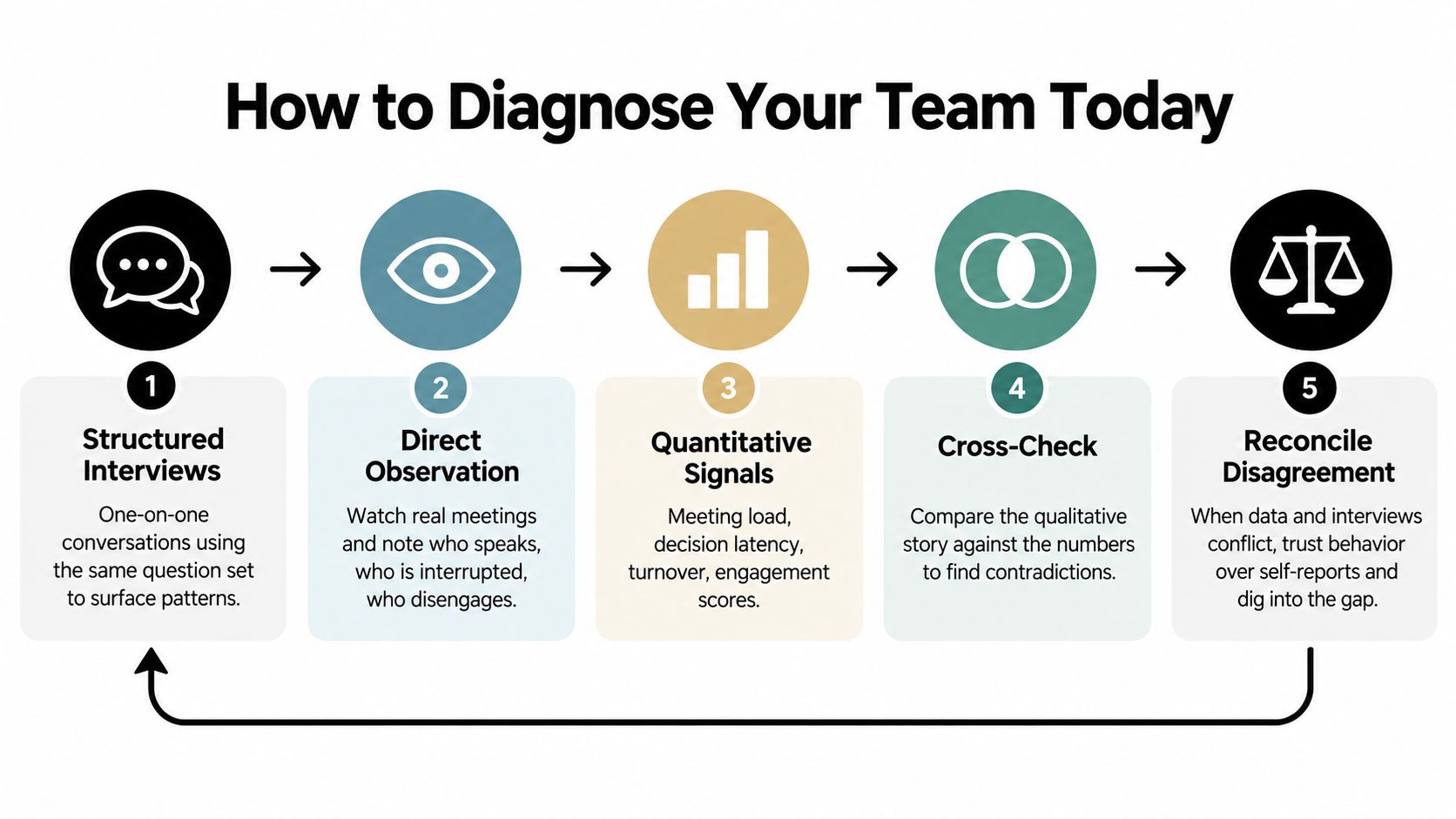
Triangulate instead of averaging
Use the same interview questions with each participant. Ask where decisions stall, which topics stay unspoken, who gets pulled into urgent work, and what happens after a mistake. Then observe real meetings and record who speaks, who interrupts, who gets interrupted, who receives questions, and whose suggestions become actions.
Add a short pulse covering safety, conflict, clarity, and ownership. You can also inspect meeting load, decision latency, rework, and handoff failures. A simple rule helps: if two of the three signal types point in the same direction, treat the driver as real.
Disagreement between signals is valuable. If engagement scores are high but observation shows avoidance, don't use the survey as reassurance. Treat the ceiling of the survey as data, then investigate whether people interpret “engaged” as committed to the mission while remaining unwilling to challenge colleagues.
A 10-day diagnostic sprint
Don't diagnose everything. A narrow, evidence-backed finding creates more movement than a broad statement that the team needs better communication.
Behavioral Assessments and Predictive Tools
Use diagnostic tools in ascending order of effort. Begin with structured interviews and observation because they reveal how the team explains its own behavior. A validated multi-rater process adds a second perspective, especially when a leader's intended behavior differs from the experience of direct reports.
Personality and cognitive measures can help identify preferences, role-fit risks, and likely friction points. The Big Five can describe individual tendencies, while a short situational judgment exercise can show how someone approaches a realistic trade-off. Neither instrument should be treated as a direct forecast of team performance.
Team simulations reveal something different. An in-basket exercise, survival exercise, or incident tabletop places people under constraints and makes decision patterns visible. It can show whether the group shares information, defers to status, or abandons decision rights when pressure rises. For a broader overview of [team dynamics assessment methods](https://synopsix.ai/blog/team-dynamics-assessment), compare the instrument to the decision you need to make rather than selecting a test because it's familiar.
| Tool | Time Cost | What It Reveals | Where It Falls Short | |---|---|---|---| | Structured interviews | Low | Hidden norms and lived friction | Self-report and selective memory | | Meeting observation | Low to moderate | Participation, interruption, and influence patterns | One meeting may not represent the whole system | | 360 feedback | Moderate | Gaps between intended and received behavior | Ratings can reflect politics or limited exposure | | Personality and cognitive measures | Moderate | Preferences, reasoning style, and role-fit risks | Individual traits don't explain context | | Team simulation | High | Behavior under pressure and shared decision patterns | Scenarios can differ from operational reality |
AI-assisted analysis has a useful but bounded role. It can synthesize open-ended 360 comments, group recurring themes, and flag changes in language across meetings. It currently can't reliably predict sustained behavior without ground truth, context, and a clear connection between observed behavior and later outcomes.
Sequence the work accordingly: run the cheapest credible instrument first, then add heavier tools only where the initial evidence remains incomplete.
A Short Case Study in Diagnosing and Fixing Friction
A 14-person product squad saw cycle time creep upward despite stable headcount and stable tooling. The team didn't lack effort. Members were working harder inside a decision system that made challenge risky and ownership unclear.
Structured one-to-ones exposed two unspoken norms about who could challenge technical decisions. A 360 process on the lead revealed a gap between the behavior the lead believed they were modeling and the behavior colleagues experienced. A short simulation then showed that decision rights collapsed during cross-functional incidents, when the team most needed clarity.
> Diagnostic principle: Don't launch a culture campaign when the evidence points to a feedback habit and a decision-rights problem.
The intervention used three targeted moves. Planning sessions changed how feedback was solicited, with explicit requests for dissent before commitment. The team documented a decision-rights matrix so participants could distinguish the accountable owner from contributors and approvers. A recurring retrospective focused on specific decisions, including what information was available, who influenced the outcome, and what the team would change next time.
The team tracked cycle time, meeting load, and psychological safety scores before and after the intervention. Cycle time fell, meeting load declined, and the safety measure improved. Those are the signals that moved. The case didn't show that every team metric improved, and that distinction matters. A targeted intervention should produce movement in the indicators connected to the diagnosis, not a convenient story about universal improvement.
The broader lesson is methodological. Interviews found the hidden norm, multi-rater feedback located the leadership gap, and simulation exposed the pressure failure. No single instrument would have shown the complete operating pattern.
Interventions That Change Behavior
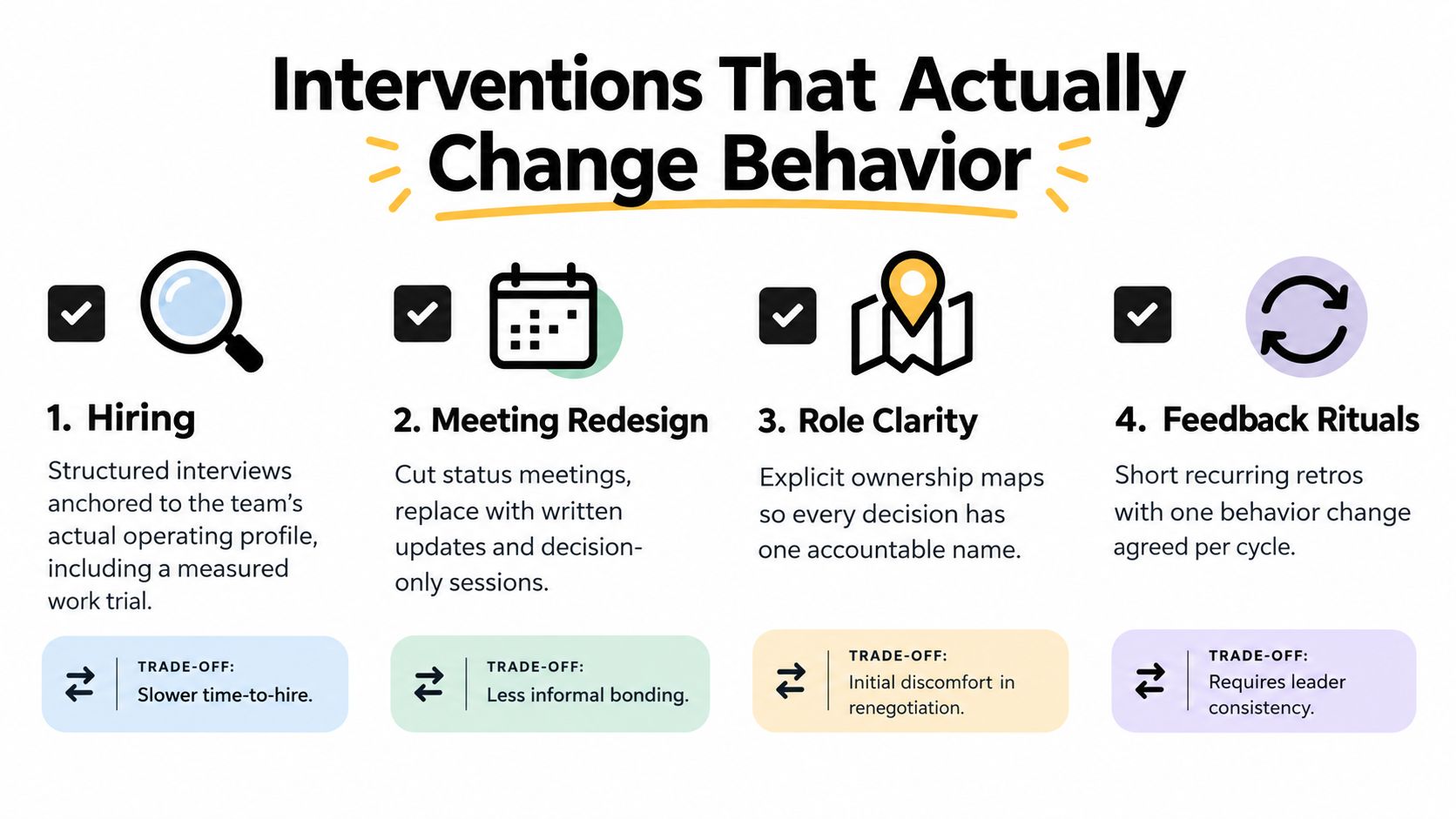
Interventions change team dynamics when they alter a repeated behavior or structural condition. Announcing an aspiration creates activity, not operating change.
Four intervention points
Hiring should use structured interviews tied to the team's operating profile, alongside a measured view of cognitive-style diversity. The trade-off is real: hiring for close fit can narrow the team and reinforce existing habits. Assess complementarity rather than cultural similarity, then track early performance and retention against the role's requirements.
Teaming design should match size and composition to the work. Distributed collaboration can widen access to talent, while co-location may support work that depends on rapid, context-rich coordination. Neither arrangement resolves unclear ownership. Define when people need synchronous contact, when written updates suffice, and whether decision latency changes after the redesign.
Simulations let teams rehearse a specific failure mode, such as an incident with competing priorities or a handoff involving incomplete information. The benefit is behavioral visibility. Rehearsed scenarios can also hide novel failures, so vary the constraints and review assumptions after each exercise. Measure response time, escalation quality, or handoff errors rather than relying on participant enthusiasm.
Development plans need one or two observable behaviors at both individual and team level. “Communicate better” is shelf-ware. “Invite challenge before closing a decision, then record the response” can be observed, coached, and reviewed through decision records.
For teams that need facilitated practice, these [actionable team collaboration exercises for 2026](https://chronosoneescaperooms.com/team-building-challenges/) can help when each exercise is tied to a defined behavior and follow-up measure.
Open-door policies, mission statements, and off-site retreats often create activity without changing operating metrics on their own. Leaders reinforce new behavior through planning, staffing, decisions, and performance conversations. AI can summarize patterns in meeting and decision data, but it cannot yet establish trust, interpret every political signal, or replace facilitated practice.
<iframe width="100%" style="aspect-ratio: 16 / 9;" src="https://www.youtube.com/embed/J_cd-CCpfJU" frameborder="0" allow="autoplay; encrypted-media" allowfullscreen></iframe>
Metrics for Tracking Real Impact
A team scorecard should be small enough to use and specific enough to challenge a convenient narrative. Start with a baseline, then track the delta after the intervention. The point isn't to collect every available measure. Too many indicators bury the signal.
Use five practical indicators:
Review the meeting snapshot weekly, pull decision latency monthly, and review the full pulse and retention picture quarterly. Meeting health and decision latency are leading indicators. Retention is a lagging indicator, so don't wait for it to deteriorate before acting. A practical guide to [team-building effectiveness](https://synopsix.ai/blog/team-building-effectiveness) can help connect activities to measurable operating outcomes.
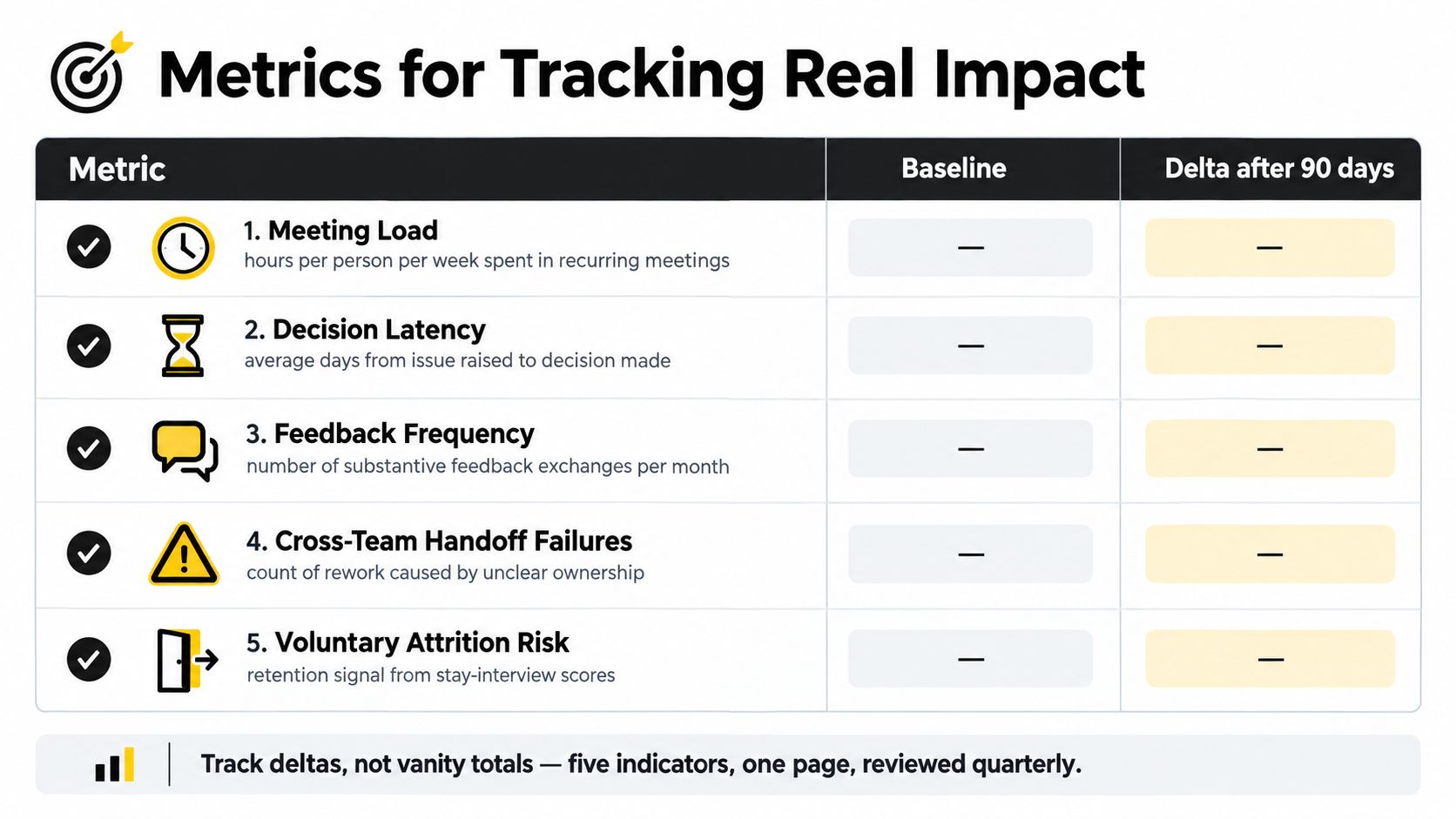
A 90-day window should show a pattern, not a single heroic week. Compare the baseline with early behavioral changes, then check whether the improvement persists across ordinary workload and a period of pressure. If only one measure moves while the linked behavior remains unchanged, assume noise until further observation confirms it.
Common Misconceptions to Clear Up
A team can look healthy in a survey and still avoid the conversation that matters. Test explanations against observable behavior, decision records, and operating metrics.
| Common Belief | Evidence-Based Reality | Quick Diagnostic | |---|---|---| | Personality tests predict team performance | They describe individual tendencies, while context and interaction patterns shape team behavior | Compare assessment themes with observed decisions | | High-performing teams skip conflict | Strong teams surface disagreement and resolve it before commitment | Review whether difficult decisions are challenged | | Psychological safety means comfort | It means people can take interpersonal risks without punishment | Ask who can say “I don't know” or raise bad news | | More diverse teams automatically outperform | Diversity helps when norms make dissent usable and participation equitable | Track whose ideas enter final decisions | | AI tools can diagnose dynamics reliably today | AI can summarize transcripts and flag patterns, but lacks ground truth and context | Check every flag against observed behavior |
Assessment results support role design, but they cannot reveal power differences, unspoken norms, or how a leader responds under deadline pressure. A retreat may improve connection while leaving decision rights and challenge behavior unchanged. Check whether the intervention changes a metric such as decision latency, the share of decisions challenged before commitment, or follow-through on assigned actions.
Psychological safety also shifts with workload, leadership behavior, and recent consequences for speaking up. Monitor it as a time-varying operating condition, as the research cited earlier shows. A positive pulse result is a baseline, not proof that people will raise bad news in the next high-pressure meeting.
AI warrants the same discipline. A [Deloitte analysis of AI value and team structure](https://www.deloitte.com/us/en/insights/topics/talent/ai-roi-and-team-structure.html) describes stronger AI value where teams are larger, diverse in skills, and highly collaborative across functions. A systematic review still finds uncertainty about whether AI operates as a shared resource, an autonomous team member, or an individually used tool. AI can summarize transcripts and identify recurring interruptions or unanswered questions, but a practitioner must verify the pattern against context, power, and outcomes. It may improve task execution without improving coordination or trust.
Group decisions can also produce different behavior from individual decisions. In a [study of team decisions in a public goods game](https://www.ifo.de/DocDL/cesifo1_wp4406.pdf), teams contributed more and punished less than individuals, regardless of the team decision rule. Diagnose behavior at the level where work occurs, then test whether the intervention changes collaboration, challenge, and delivery.
Synopsix turns behavioral assessments into guidance for hiring, team design, simulations, and development planning. Visit [Synopsix](https://synopsix.ai) to examine team complementarity, influence, and friction before a people decision.