Validated Assessment Tools: A Hiring Guide
By Synopsix · August 1, 2026 · 18 min read
You're probably looking at two vendor decks that both say validated, both have slick charts, and both promise better hiring decisions. That's where most HR teams get stuck, not because they don't care about evidence, but because the evidence sounds similar until you know what to ask for. The core question isn't whether a tool has been validated once, it's validated for whom, in what context, and against which outcome.
A good people decision tool should do more than look scientific. It should show that it works for your roles, your candidates, your language, your workflow, and your decision point. The science behind that is practical, not academic, and the best way to use it is to treat validation as a buying discipline, not a marketing label.
Why Most HR Leaders Struggle To Tell A Validated Tool From A Polished One
A CHRO gets two proposals on a Monday morning. One vendor has a polished deck with glossy candidate screenshots, polished language about fairness, and a long list of features. The other has fewer visuals but more detail about sample groups, scores, and how the assessment behaves in real hiring conditions. Both say they're scientifically backed, and both can sound convincing in a procurement meeting.
That's where the confusion starts. A well-designed interface can hide weak evidence, and a plain presentation can carry stronger proof. The problem isn't that HR leaders lack judgment, it's that validation evidence is easy to blur together unless you know which layer matters for which decision.
The buying mistake most teams make
Most buyers start with the label validated assessment tools and treat it like a pass or fail stamp. In reality, validation is a fit question. The most important question is whether the tool is supported by evidence in the exact population, language, and outcome you care about, not just whether it has some research behind it.
That matters because selection decisions ripple downstream into hiring, promotion, and development. A tool that looks rigorous can still be the wrong instrument for your workforce if it was built for a different role family or a different level of literacy. The buyer who asks the right context questions usually gets a more honest answer than the buyer who only asks whether the tool is validated.
> Practical rule: if a vendor answers “yes” to validation but can't tell you for whom and for what outcome, you still don't know enough to buy.
For a plain-language framing of the psychology behind those claims, the internal overview on [validity in psychology](https://synopsix.ai/blog/validity-in-psychology) is a useful companion. It helps separate the language of measurement from the language of marketing.
The most useful mental model is simple. Validation is not a trophy, it's an evidence chain. Once you think that way, every vendor conversation changes.
What Validated Assessment Tools Actually Mean
The everyday meaning of validated is checked against a standard. In assessment, that standard is evidence, not opinion. A tool earns the label only when the seller can show it measures what it claims to measure and does so consistently enough to support a real hiring or development decision.
Start with the two basic tests
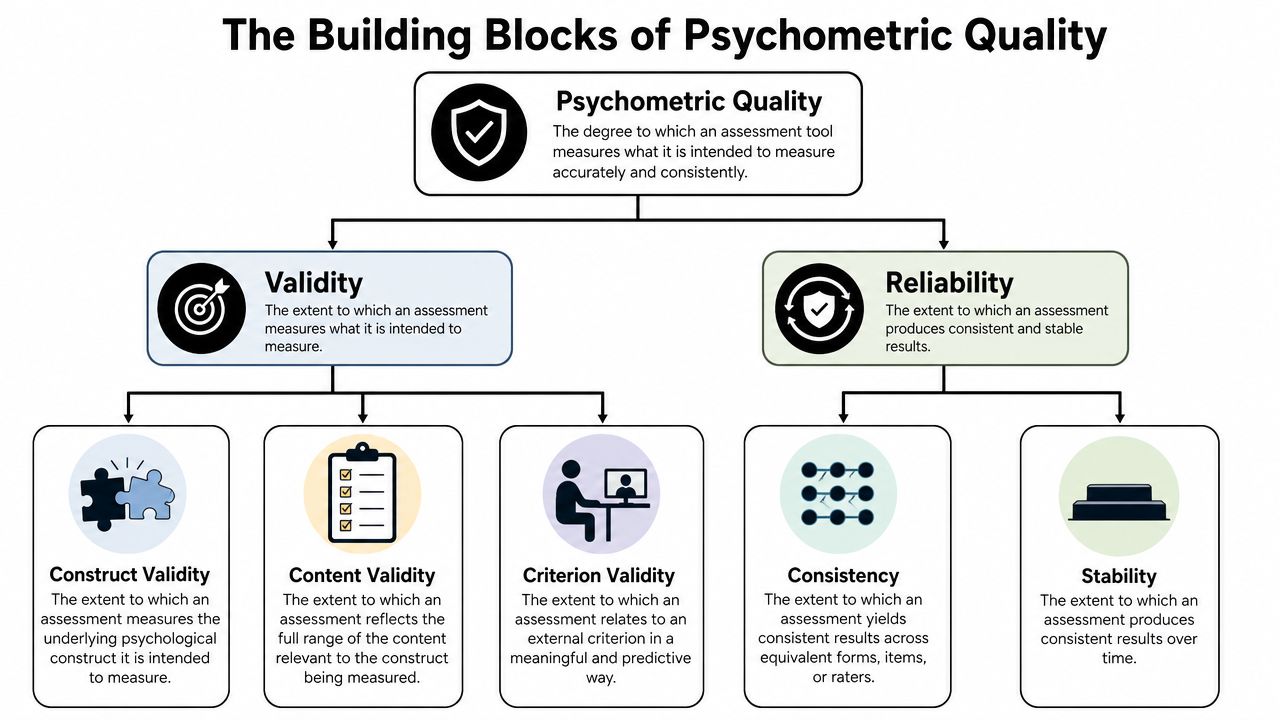
Reliability asks whether the tool gives consistent results. Validity asks whether it measures the thing you care about. A stopwatch can be reliable without being valid for performance appraisal, because it measures time well but not leadership potential. A medical analogy works here, a device can be calibrated and still be the wrong device for the job.
In assessment science, reliability is commonly examined with the intraclass correlation coefficient, and values above .75 are generally considered good, while values at or below .5 indicate poor reliability, with Kappa recommended for categorical measures ([PMC10425717](https://pmc.ncbi.nlm.nih.gov/articles/PMC10425717/)). That's the kind of evidence serious vendors should be able to discuss without hand-waving.
Why standards matter more than marketing language
A validated tool also needs evidence that it is reliable, current, sufficient, and authentic, with the evidence supporting a reasonable judgment for the intended decision context ([ACT Validation and Moderation Guide](https://www.education.act.gov.au/__data/assets/pdf_file/0007/801619/Validation-And-ModerationGuideForDevelopingAssessmentTools.pdf)). That's a stricter bar than “our customers like it.” It means the validation process should be treated like a quality-review cycle, with revisions to the tool, the administration process, or the scoring rules when the evidence says a change is needed.
A practical way to think about it is this. Reliability tells you the tool isn't random. Validity tells you the tool is relevant. Together, they tell you the number on the dashboard deserves attention.
For readers who want a deeper psychology lens, [evidence based practice Australian psychology](https://practiceready.com.au/blog/evidence-based-practice-psychology) offers a helpful bridge between theory and applied decision-making. The logic is the same in hiring, if you can't show the evidence chain, you're trusting a claim, not a tool.
<iframe width="100%" style="aspect-ratio: 16 / 9;" src="https://www.youtube.com/embed/mz0KOklTgt8" frameborder="0" allow="autoplay; encrypted-media" allowfullscreen></iframe>
The Building Blocks of Psychometric Quality
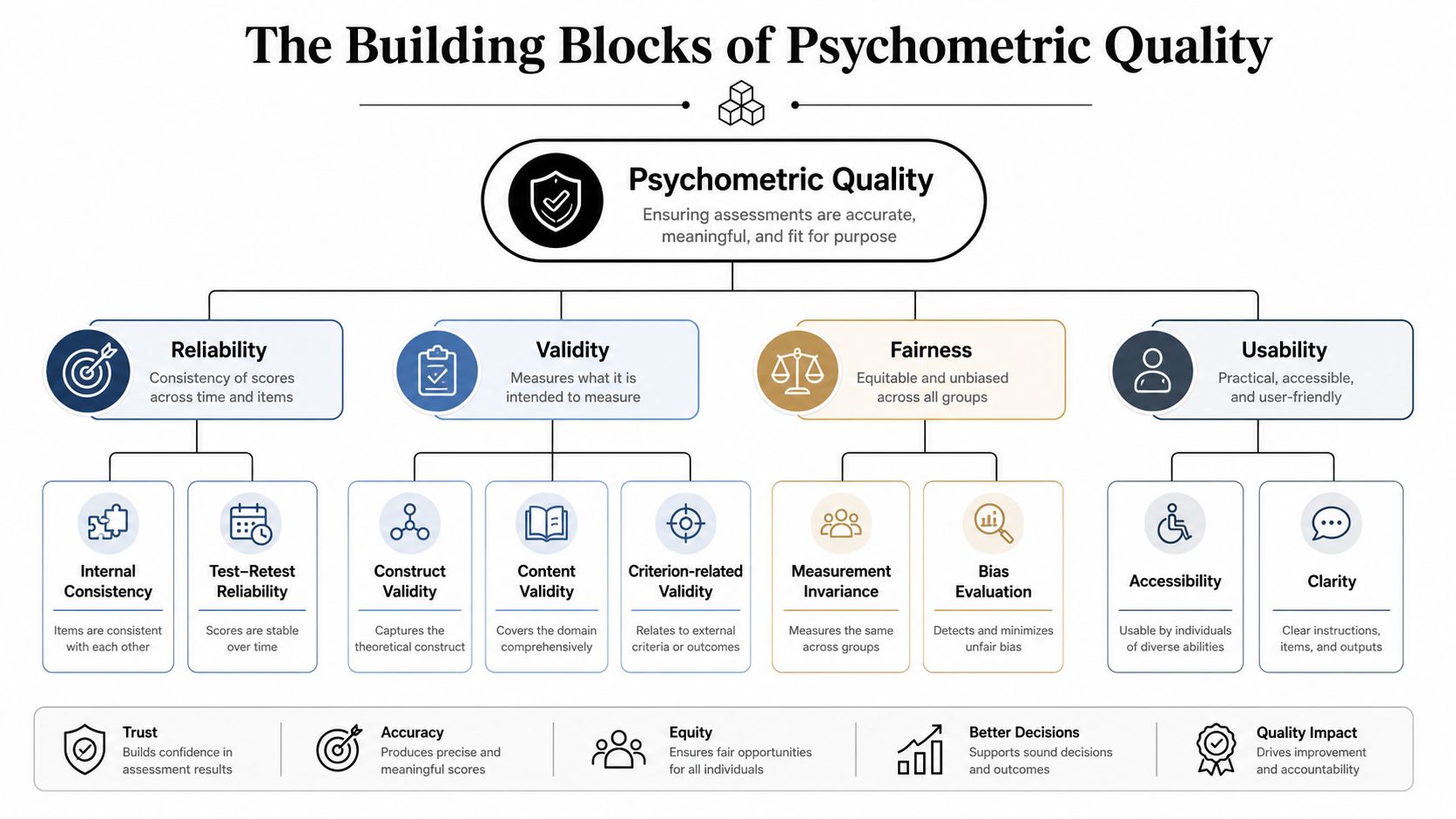
A vendor deck can make an assessment look precise while leaving the real questions unanswered. The faster way to read it is to separate the claim into parts. Some claims are about what the tool measures, some are about how consistently it measures, and some are about whether the items and scoring fit the job. Once you can name the category, you can ask for the matching evidence instead of accepting a vague promise.
Validity types in workplace language
Construct validity is about the underlying trait, such as cognitive ability or communication skill. If a vendor says its test measures problem-solving, that is a construct claim. A well-designed cognitive ability test fits here because it aims to capture a mental capability rather than a narrow work sample.
Content validity asks whether the items reflect the actual content of the role. A structured interview can fit here when the questions map tightly to job competencies and the scoring rubric is tied to what success looks like in the role. If the job is customer support and the interview never asks about conflict handling, the content is incomplete.
Criterion validity checks whether the assessment relates to a real outcome, such as job performance, retention, or simulation results. A job-fit simulation belongs here. If the work sample predicts who handles the work best, that is the point. The U.S. Office of Personnel Management's evidence table shows why this matters, since general cognitive ability alone had a validity coefficient of .51, work sample tests .54, and structured interviews .51. When combined with cognitive ability, work samples and structured interviews both reached .63, a 24% increase, and integrity/honesty tests rose from .41 to .65, a 27% gain ([OPM assessment strategy](https://www.opm.gov/policy-data-oversight/assessment-and-selection/assessment-strategy/)).
> The lesson is not that one method wins. The lesson is that validated selection systems are usually batteries, not single instruments.
A simple way to keep the ideas straight is to ask three questions in order. What trait is the tool supposed to measure, does the content match the job, and does the score line up with a real outcome? The internal note on [what is test reliability](https://synopsix.ai/blog/what-is-test-reliability) is a useful companion here, because a measure can only support a decision if it performs consistently enough to trust the signal.
What item quality looks like under the hood
Good tools also use item analysis to catch weak questions. That means looking at the proportion answering correctly, distractor patterns, and point-biserial correlations, where a negative or near-zero value is a warning sign that low performers are just as likely as high performers to answer correctly. The broader psychometrics literature treats those checks as part of routine item review, including work such as [PMC10425717](https://pmc.ncbi.nlm.nih.gov/articles/PMC10425717/). This is how tools improve over time, by dropping flawed items and keeping the ones that separate signal from noise.
If communication is part of the role architecture, [Synopsix's communication skill assessment guide](https://intonetic.com/communication-skill-assessment/) is a practical example of how a narrow skill domain can be measured without pretending that all roles need the same evidence. The logic matters for HR buyers because the right tool is not the one with the most polished brochure, it is the one with evidence that fits the specific decision you are making.
The key point is simple. Validity is not one thing. It is a stack of related checks, and each check answers a different buying question.
A Checklist for Evaluating Vendor Validation Claims
A vendor can sound rigorous and still leave out the one thing you need to know. Use the questions below to separate real validation evidence from well-packaged confidence. If the answer stays at the level of “we have clients” or “the tool is science-based,” you're not getting enough to make a hiring decision.
Questions that surface whether the evidence fits your use case
| Question to Ask the Vendor | What Strong Evidence Looks Like | | --- | --- | | Which population was used for validation? | A clearly described sample that resembles your candidates, roles, and geography | | What outcome was the tool validated against? | A real criterion such as job performance, work sample results, or retention | | How current is the evidence? | Recent validation work or a clear plan to revalidate after product or workforce changes | | Are reliability metrics reported for this version? | Version-specific reliability evidence, not a generic brochure claim | | Are item statistics available? | Evidence of item analysis, including weak items that were revised or removed | | Was the tool checked locally in a similar setting? | Validation in a comparable workforce, not just in the original norm group | | Are fairness or subgroup checks reported? | A transparent review of subgroup performance and calibration differences | | Has the scoring model been updated? | A documented review cycle with revisions when evidence changed |
Red flags that should slow the purchase
A vendor who cites an old study for a new product version should trigger questions. So should a tool that says it is validated but won't specify the outcome, the sample, or the administration conditions. Another warning sign is a deck that skips the local workforce entirely and relies only on a broad norm group.
For people teams buying across regions, translation and localization matter too. A useful companion is the [2026 HR compliance translation guide](https://translators-usa.com/employee-handbook-translation-the-hr-guide-to-multilingual-compliance-2026/), because a tool that reads well in one market can fail when language and policy expectations change.
One more question belongs in every procurement meeting. Ask whether the tool has been revalidated after material changes to scoring, delivery, or role context. If not, you may be evaluating an old claim dressed up as a current product.
Fairness, Adverse Impact, and the Validated For Whom Question
A tool can be technically sound and still fail a fairness review in your workforce. Legal and ethical review sits on top of psychometric review, because HR is not only asking whether the assessment measures something well, but whether it does so fairly for the people who will take it. If one subgroup is screened out more often than another, the next question is whether the assessment fits the population, the language, and the outcome being used.
Why the question has to be narrower than “is it validated”
A better buying question is, validated for whom, in what language, with what literacy level, and against which outcome? That wording pushes the vendor to show evidence in the exact setting where the tool will be used. A test can perform well in one context and mislead in another, especially when education levels, language familiarity, or cultural norms differ.
Review evidence in low-resource and special-population contexts shows that validation is uneven across languages, educational levels, and local populations ([PMC4310476](https://pmc.ncbi.nlm.nih.gov/articles/PMC4310476/)). That does not make the tools useless. It means buyers should not assume portability without checking whether the evidence travels with the product.
What fairness review looks like in practice
A technical fairness review should include discrimination and calibration. Discrimination asks whether the tool separates higher-risk or higher-fit cases from lower ones, while calibration asks whether the same risk level produces comparable outcome rates across subgroups ([equivant risk assessment guidance](https://equivant-supervision.com/validating-risk-need-assessment-tools-what-you-need-to-know/)). If those patterns shift by population, the tool may not be stable enough for confident use in your setting.
That is why vendors should be able to discuss subgroup checks without retreating into slogans. If they cannot explain what they tested, who was included, and what happened after localization, the “validated” claim is incomplete.
For multilingual programs, the [2026 HR compliance translation guide](https://translators-usa.com/employee-handbook-translation-the-hr-guide-to-multilingual-compliance-2026/) is a practical reminder that language is not a cosmetic issue. It can change how instructions are understood, how candidates respond, and whether the same construct is being measured.
A translated assessment is only fair if the meaning survives the translation. That is where local review, not just vendor reassurance, matters.
For teams that want a concise way to think about interpretation discipline, the internal guide on [assessment interpretation](https://synopsix.ai/blog/assessment-interpretation) is useful because it keeps the focus on what a score can and cannot support in real hiring decisions.
> If the tool only works for one slice of your workforce, it is not a universal solution. It is a local instrument.
Implementation and Change Management That Actually Sticks
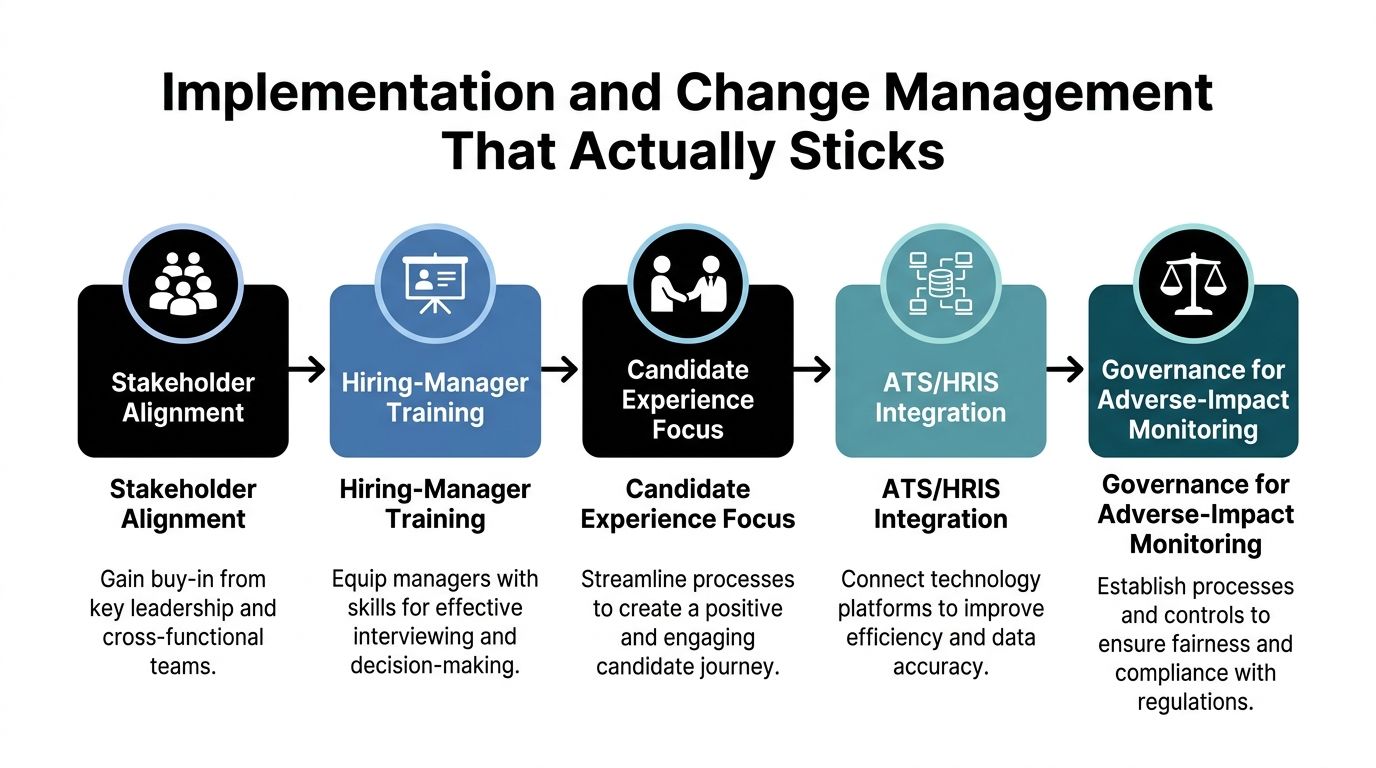
The best assessment tool can still fail if managers don't use it correctly. That's why rollout matters as much as validation evidence. People teams need a plan for training, governance, candidate communication, and system integration before they ask hiring managers to trust a new score.
The rollout sequence that avoids common failure modes
Start with stakeholder alignment. Recruiting, HR, legal, business leaders, and the hiring managers who will use the tool need to agree on what decision the tool supports. If they don't agree on the use case, they'll treat the score like a shortcut instead of a decision aid.
Hiring-manager training has to be more than a slide deck. Managers need to know what the assessment does, what it doesn't do, and when a result should trigger follow-up rather than an automatic decision. Skipped training is one of the fastest ways to turn a useful tool into a bad habit.
Then make the candidate experience deliberate. Candidates need clear instructions, a realistic time expectation, and a process that doesn't feel like a black box. If the assessment feels arbitrary, your employer brand pays the price.
> Practical rule: never roll out a new assessment before you know who will read the dashboard, who will act on it, and who will review the edge cases.
For teams that want a concise way to think about interpretation discipline, the internal guide on [assessment interpretation](https://synopsix.ai/blog/assessment-interpretation) is a useful reference.
Build governance before the rollout gets busy
Integration with ATS and HRIS should reduce manual work, not create duplicate entry. Once the system is live, governance has to monitor adverse impact, usage patterns, and whether managers are over-relying on one score. A single number should support judgment, not replace it.
Synopsix fits naturally in this category as one example of a people-intelligence platform that turns assessment data into role and development guidance, but the broader point is bigger than any one product. The right implementation design lets people use evidence without turning hiring into a spreadsheet exercise.
The teams that stick with a rollout usually do three things well. They pilot first, calibrate based on feedback, and expand only when the process is stable. That discipline matters more than speed.
Measuring ROI and KPIs Without Falling for Vanity Metrics
A new assessment often looks successful on paper before anyone checks the baseline. If you do not measure the starting point, you cannot tell whether the change came from the tool itself, from a shift in hiring volume, from manager behavior, or from plain timing. The question is not whether the dashboard looks busy. The question is whether the numbers line up with the validation claim that justified buying the tool in the first place.
Start with the decision the assessment is supposed to improve. If the vendor says the tool should help screen faster, then speed matters. If the claim is better prediction of performance, then the KPI has to sit in performance, retention, or another outcome record that reflects actual work. A self-reported satisfaction score can be useful, but it cannot carry the whole argument if the buying case was built on job performance.
Choose metrics that reflect decision quality
Time-to-hire matters when the tool reduces friction in screening. Quality-of-hire matters when the assessment better predicts on-the-job performance. Mis-hire rate matters when the organization wants to know whether it is avoiding costly fit mistakes. Internal mobility and manager satisfaction show whether the tool helps move people into the right roles and whether managers trust the process enough to use it.
Pair each KPI with the record that can support it. A faster process should show up in ATS timestamps. Better prediction should appear in performance or retention data, not only in survey feedback. If the outcome lives in one system and the claim is about another, the evaluation should follow the claim, not the easiest spreadsheet to pull.
Example KPIs for Validated Assessment Rollouts
| KPI | Why It Matters | Typical Data Source | | --- | --- | --- | | Time-to-hire | Shows whether the process is faster or more efficient | ATS timestamps | | Quality-of-hire | Indicates whether selected candidates perform better | Performance review data | | Mis-hire rate | Reveals whether the process avoids poor fit decisions | HR case reviews, turnover records | | Internal mobility | Shows whether assessments support role movement | HRIS talent movement data | | Manager satisfaction | Captures adoption and trust in the process | Survey feedback from hiring managers |
The evidence summarized by the [OPM assessment strategy](https://www.opm.gov/policy-data-oversight/assessment-and-selection/assessment-strategy/) is a useful reminder that single methods often show only moderate predictive validity, while combining tools can improve accuracy. That is why ROI should be measured against the full decision system, not against the novelty of one assessment on its own.
If you are comparing tools, keep the comparison honest. Use the same role family, the same funnel stage, and the same definition of success. Otherwise you are measuring noise and calling it progress. A pre/post comparison can be useful, but only when the before and after conditions are close enough to make the signal believable.
Next Steps and a 30-60-90 Plan for Adoption
The cleanest way to move from interest to action is to work in phases. That keeps the team from trying to buy, validate, train, and govern everything at once. It also gives you a simple story for leadership, one that ties science to execution.
Days 1 to 30 inventory and gap analysis
Start by inventorying every assessment currently used in hiring, promotion, or development. Document what each tool claims to measure, who uses it, and where the evidence is thin. If a tool lacks clear validation for the current population or outcome, put that gap in writing.
Days 31 to 60 vendor review and pilot
Run the vendor checklist against your top contenders. Pick two candidates for a pilot if possible, and compare them on sample fit, reliability evidence, fairness review, and how well they integrate into your process. The goal is not to buy quickly, it's to identify which tool belongs in your context.
Days 61 to 90 measurement and rollout
Set baselines, launch a calibrated rollout, and brief leadership on what the assessment will and won't tell them. Then monitor the KPIs that matter most to the validation claim you bought. If the evidence and the outcome don't line up, pause and adjust before scaling further.
Before you buy, ask yourself four questions. Is the tool validated for my workforce? Does the evidence match the outcome I care about? Do we have a plan to monitor fairness and usage? Can we explain the decision to candidates and managers in plain language? If any answer is fuzzy, the purchase is premature.
Synopsix helps teams turn assessment results into role-fit and development guidance, so if you're building a more evidence-based hiring process, visit [Synopsix](https://synopsix.ai) and see how validated behavioral data can move from scores to action.