Validity in Psychology: Mastering Talent Decisions
By Synopsix · July 2, 2026 · 19 min read
You're probably sitting on at least one hiring decision that still bothers you.
The candidate looked exceptional. Strong resume. Sharp interview presence. Good references. Everyone in the panel felt confident. Then the person started, and within months the cracks showed. Execution slipped. Team friction rose. The role demanded judgment under pressure, and the new hire brought polish instead.
That kind of miss usually gets blamed on chemistry, timing, or “one of those things.” In reality, it's often a prediction problem. You used signals that felt persuasive, but those signals didn't predict the outcome that mattered.
That's where validity in psychology becomes a business issue, not an academic one. If you lead HR, talent, or people analytics, validity is the difference between an assessment process that sounds scientific and one that helps you make smarter people decisions.
predict-human-behavior-synopsix-smarter-people-decisions
Why That Great Hire Was a Great Mistake
A hiring process can feel rigorous and still fail. Structured interviews, scorecards, polished debriefs, and enthusiastic consensus can all coexist with a bad outcome. The reason is simple. A process can be orderly without being predictive.
Most executives first hear validity defined as “does the test measure what it claims to measure?” That's useful, but it's too thin for applied talent decisions. Recent research argues that the canonical definition of validity, “measuring what is purported to measure,” is epistemically insufficient for applied fields, because validity has to extend into a network of theoretical and observational terms that can predict future relationships ([Frontiers in Psychology](https://www.frontiersin.org/journals/psychology/articles/10.3389/fpsyg.2019.00532/full)).
Why textbook definitions fall short at work
In business, you're rarely hiring for a trait in isolation. You're hiring for future behavior in context.
A sales leader role isn't just “high extraversion.” It may require commercial judgment, resilience after rejection, political navigation, and the ability to coach underperformers without losing the room. A customer success manager role isn't “agreeable.” It may require calm under strain, prioritization, and the willingness to hold a boundary with demanding clients.
That's why validity matters beyond labels. It asks whether your process can connect:
If any link in that chain is weak, your hiring confidence is inflated.
> The practical question isn't “Did the assessment produce a score?” It's “Did the score help us predict what this person will do when the job gets real?”
The expensive comfort of confidence
Interviewers often overweight charisma, narrative fluency, and similarity to past success stories. Those signals are memorable. They're also vulnerable to bias.
A candidate may communicate like a high performer without operating like one. Another may look average in conversation but excel in the actual demands of the role. Validity helps separate impression from evidence.
For HR leaders, that changes the standard you should apply to any hiring method. Don't ask whether the process feels sound. Ask whether it has a credible claim to prediction. If it doesn't, you're still making a bet. It's just a better-dressed bet.
What a better question sounds like
When teams learn to think in terms of validity, the conversation changes fast. Instead of asking, “Did everyone like the candidate?” they ask:
| Common hiring question | Better validity question | |---|---| | Did they interview well? | Did the interview capture behaviors tied to success in this role? | | Do they seem like a leader? | What evidence shows the process measured leadership and not confidence? | | Would they fit the team? | What observable patterns suggest this person will work effectively in this environment? |
That shift is small in language and huge in consequence. It's how talent leaders move from opinion-heavy hiring to evidence-based prediction.
The Difference Between Consistent and Correct
A lot of assessment vendors talk about consistency. That matters. But consistency alone won't save you from a bad decision.
A bathroom scale can be consistent every morning and still be wrong. If it adds the same error each time, it's reliable. It isn't valid. The same problem shows up in hiring. An assessment can produce stable scores across candidates and still fail to predict job performance.
The target analogy that clears this up
Think about two archers.
The first puts every arrow in the same spot, but all of them land far from the bullseye. That's reliability without validity.
The second puts arrows tightly in the bullseye. That's reliability plus validity.
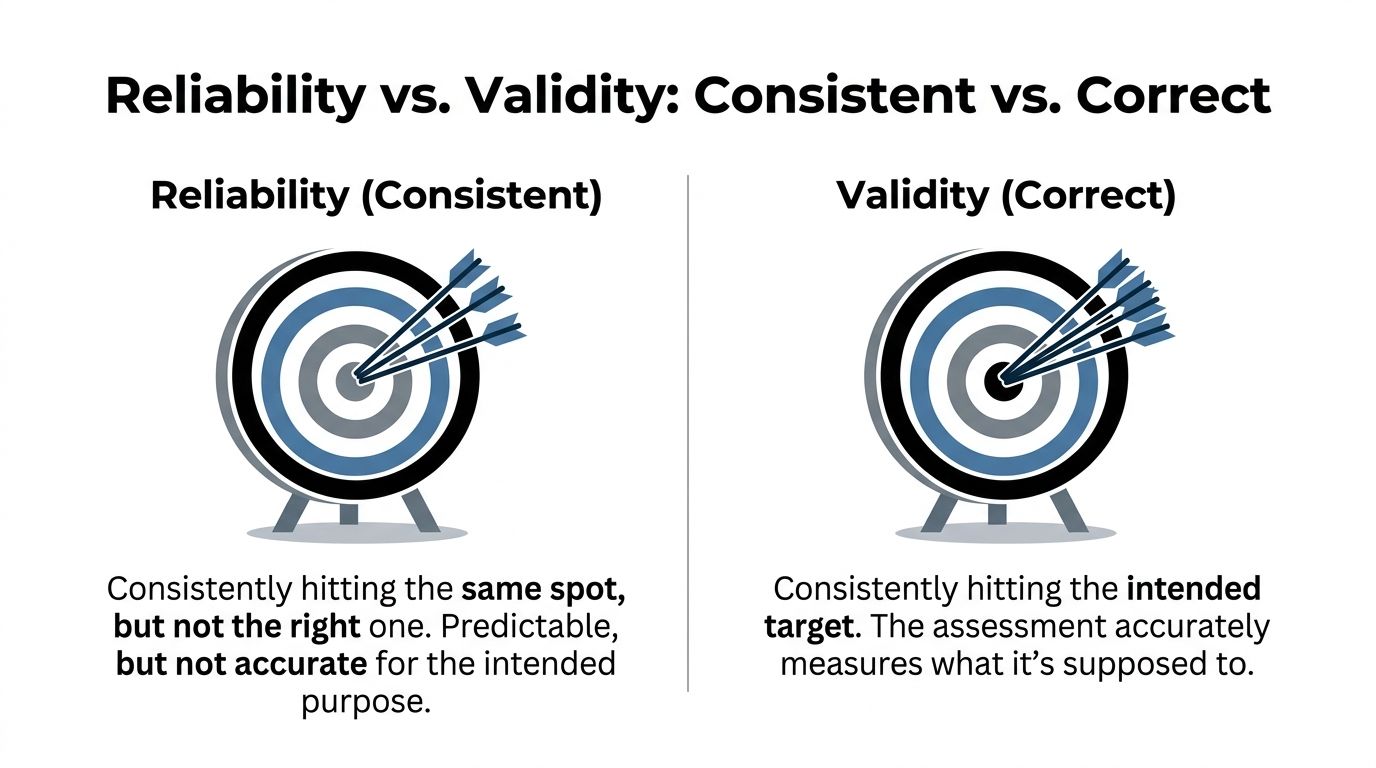
A hiring tool that produces repeatable scores is useful only if those scores are also aimed at the right target. If the tool consistently measures test-taking comfort, verbal polish, or familiarity with corporate language instead of the capability required for the role, your process is stable but misdirected.
Why leaders get fooled by consistency
Consistency is easy to market. It sounds scientific. It gives leaders a sense of control.
But reliability answers one question: Will the tool produce similar results under similar conditions? Validity answers the question that executives prioritize: Are those results correct for the purpose we're using them for?
That's why reliability is necessary but not sufficient. If you want a deeper explanation of the consistency side of the equation, this overview of [test reliability in hiring assessments](https://synopsix.ai/blog/what-is-test-reliability) is a useful companion.
> Practical rule: Never approve an assessment for hiring because it is “consistent.” Approve it only if that consistency supports an accurate, job-relevant conclusion.
A side-by-side business view
| Concept | What it means | Hiring risk if used alone | |---|---|---| | Reliability | The tool gives consistent results | You may repeatedly make the same wrong call | | Validity | The tool measures the right thing for the intended purpose | Without reliability, results may be unstable | | Both together | The tool is consistent and correct | Stronger basis for high-stakes decisions |
A structured interview illustrates this well. If every interviewer asks the same questions in the same order and scores answers the same way, the process is more reliable. But if those questions don't reflect the demands of the role, the interview still lacks validity.
That's the trap. Many organizations improve process discipline and assume they've improved decision quality. Sometimes they have. Sometimes they've just made an invalid process more repeatable.
A Taxonomy of Truth What Validity Really Means
A hiring assessment earns trust the same way any business forecast does. It needs more than a polished interface, a stable score, or a confident vendor pitch. It needs evidence that the signal you are buying maps to the decision you need to make.
That is the practical meaning of validity.
For HR leaders, validity is not an academic label. It is the answer to a costly question. If we use this assessment to screen, shortlist, or select talent, are we basing that decision on evidence that reflects the job and predicts useful outcomes?
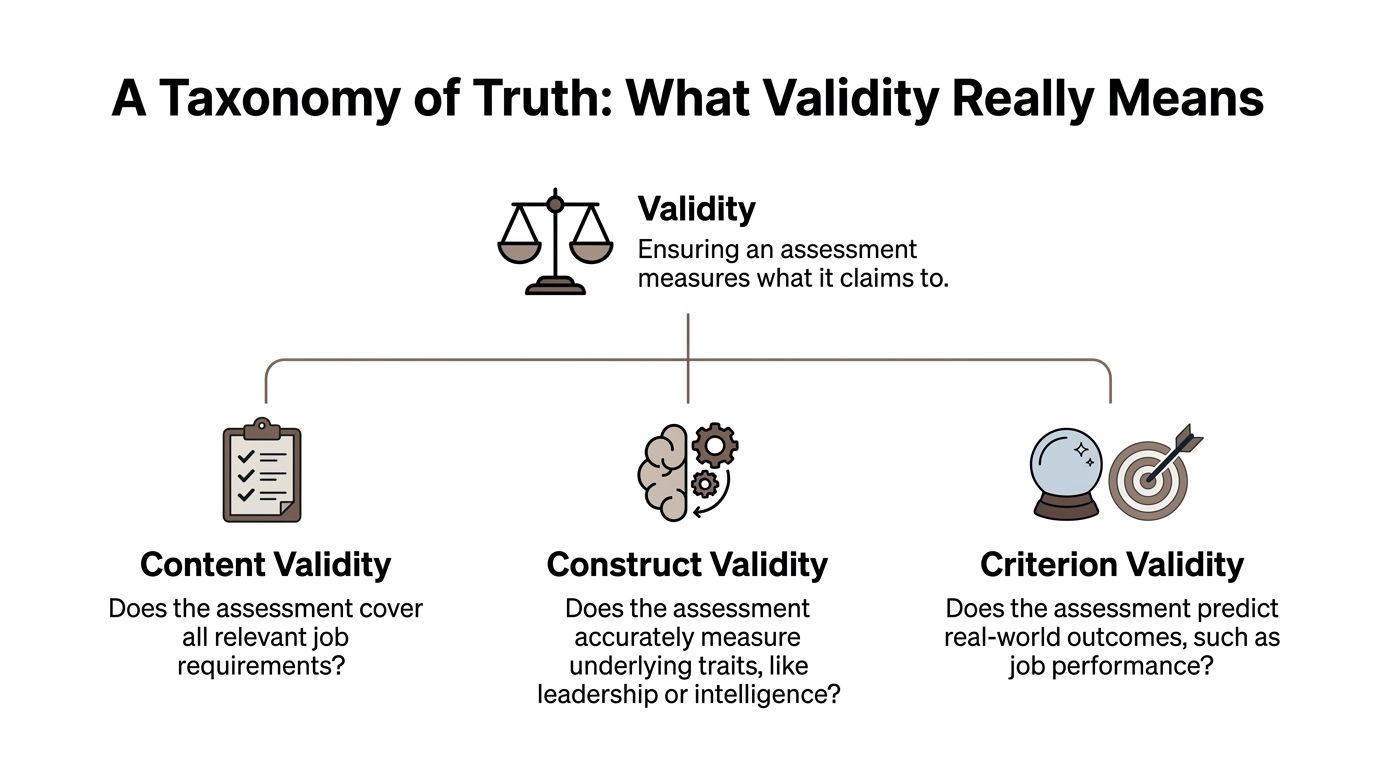
The cleanest way to answer that question is to treat validity as a set of evidence, not a single stamp of approval. In hiring, three forms matter most: content validity, criterion validity, and construct validity.
Content validity and job coverage
Content validity asks whether the assessment samples the work that matters in the role.
An exam works as a useful analogy. If a finance course teaches forecasting, decision-making, and risk tradeoffs, but the final tests only memorized definitions, the score says little about who can do the job of finance. Hiring assessments face the same problem. If a role depends on judgment, stakeholder communication, and prioritization under pressure, a tool that measures only broad personality tendencies leaves large parts of the job untested.
This is why serious job analysis matters. You start by mapping the role itself. What tasks define success? Which decisions show up repeatedly? What knowledge, skills, and behaviors separate strong performance from average performance?
Then you build or choose assessments that match that map.
A work sample often performs well here because the connection is visible. Ask a product marketer to critique a launch memo. Ask a sales manager to coach a struggling rep. Ask a people leader to respond to a conflict scenario. Those exercises tend to carry stronger business credibility because leaders can see how the exercise relates to day-one demands. For teams comparing methods, this guide to [psychometric testing for hiring decisions](https://synopsix.ai/blog/what-is-psychometric-testing) helps clarify where broader assessments fit and where job simulations fit better.
Criterion validity and business payoff
Criterion validity asks a harder question. Do assessment scores connect to outcomes your organization cares about?
This is the validity evidence executives usually want first because it speaks the language of ROI. If higher scores are associated with stronger sales results, lower turnover, faster ramp time, better manager ratings, or fewer quality defects, the assessment is doing more than sounding scientific. It is showing practical value in the talent system.
Two versions matter in business settings. Predictive validity looks forward. Candidates take the assessment, and later performance is compared with earlier scores. Concurrent validity looks at people already in role and tests whether stronger performers score differently from weaker performers.
Neither approach is perfect on its own. Predictive studies take time. Concurrent studies can be distorted by past selection filters or uneven development opportunities. But together they help answer the question an executive team should ask before scaling any assessment. Does this tool improve decisions in practical settings, or does it only describe people in interesting language?
Construct validity and the trait underneath
Construct validity examines whether the assessment is measuring the psychological quality it claims to measure.
Many assessment conversations become slippery. Vendors use labels such as “grit,” “learning agility,” “strategic thinking,” or “leadership potential” because those labels sound relevant. The hard part is proving that the score reflects that construct rather than something adjacent, narrower, or easier to fake.
A leadership score, for example, might capture verbal confidence more than leadership judgment. A resilience score might reflect general optimism. A strategic thinking score might mostly reward abstract vocabulary. If the construct is fuzzy, the business decision built on it becomes fuzzy too.
Good construct evidence usually comes from a pattern, not one claim. The measure should relate to similar traits in expected ways, stay distinct from unrelated traits, and fit a clear theory of job performance. If your team needs a plainer vocabulary for discussing these concepts across HR, talent, and business leaders, the [language of assessment strategies](https://www.orangeneurosciences.ca/guide/language-of-assessment) is a useful reference.
A practical screen for vendors and internal teams
Use three questions before you put any assessment into a high-stakes hiring process:
A strong assessment does not need to be perfect. It does need to be defensible.
That distinction matters in board-level terms. Validity is what turns psychometric theory into a decision asset. Without it, an assessment is just another polished input in the hiring process. With it, the tool has a credible case for improving talent quality, reducing selection error, and supporting better business results.
Hidden Threats That Invalidate Your Assessments
Even a well-designed assessment can fail in practice. The failure often doesn't come from the test itself. It comes from the conditions around it.
An executive team may buy a strong instrument, run it on the wrong population, interpret scores out of context, or combine it with an interview process that reintroduces noise and bias. At that point, the organization blames the assessment when the deeper issue is misuse.
Where validity breaks down quietly
Some threats are obvious. Others are subtle enough that teams miss them for years.
A process can look polished and still be compromised by one of these issues.
The mistake leaders make about face validity
Many people hear “face validity” and dismiss it as cosmetic. That's a mistake.
Recent editorial work argues that, while often treated as superficial, face validity is an essential component because it helps ensure a measure is understandable and relevant to the population using it, including clinical and developmental settings ([Hogrefe editorial discussion of face validity](https://econtent.hogrefe.com/doi/10.1027/1015-5759/a000777)). In hiring, that matters because candidates don't take assessments in a vacuum. They interpret them.
If a senior engineer gets a test that feels disconnected from the role, they may disengage. If a frontline supervisor sees language that doesn't match the job, responses may reflect confusion rather than capability. Candidate understanding affects data quality.
> If candidates can't see how an assessment relates to the role, you may be measuring frustration, skepticism, or interpretation skill instead of the intended trait.
For leaders who want a better vocabulary for these issues, Orange Neurosciences offers a helpful guide to the [language of assessment strategies](https://www.orangeneurosciences.ca/guide/language-of-assessment). It's a good reference for sorting out terms that vendors often blur together.
Red flags worth noticing
Watch closely when a provider:
| Red flag | Why it matters | |---|---| | Says the tool is “validated” but won't specify for whom | Validity depends on use and context | | Equates candidate engagement with scientific rigor | A pleasant experience isn't proof | | Avoids discussing threats, limitations, or tradeoffs | Serious validation work always has boundaries |
The strongest vendors don't pretend their tools are universal. They can explain where the evidence is strongest, where caution is needed, and how interpretation should change by role.
Putting Validity to Work in Your Talent Strategy
A hiring team approves an assessment because the demo is polished, the dashboard is clean, and the vendor says it predicts success. Six months later, performance is uneven, turnover is up, and leaders are arguing about whether the tool works. That is the moment validity stops sounding academic and starts looking like a capital allocation problem.
Validity matters because every assessment makes a business claim. It is claiming that a score gathered today helps you make a better talent decision tomorrow. For a CHRO or talent leader, the job is not to run the psychometric analysis personally. The job is to require evidence that matches the decision at stake.
Questions that separate science from sales
When a vendor says an assessment is valid, ask them to get specific. “Validated” on its own does not tell you enough to approve use in hiring, promotion, or succession planning.
Use questions like these:
1. What business outcome is this tool meant to predict? “Better hiring” is too broad to evaluate. A useful answer names outcomes tied to the role, such as sales performance, error reduction, quota attainment, customer satisfaction, or speed to proficiency.
2. What kind of evidence supports that claim? You want to hear whether the case rests on content evidence, criterion-related evidence, construct evidence, or a combination. Different decisions call for different forms of proof.
3. Who was studied? Evidence from graduate students, a general population sample, or a different job family may not transfer well to your hiring context. Validation is context-sensitive.
4. How do you know the assessment is measuring the intended construct? Vendors should explain their technical work in plain language when addressing this question. For an executive audience, the practical question is simple: does the score reflect the capability you care about, or is it partly picking up something else, such as reading load, test familiarity, or reaction to the format?
5. What are the limits of the tool? Serious providers can tell you where the evidence is strong, where it is weaker, and how the tool should and should not be used.
A good vendor conversation should feel less like a pitch and more like due diligence before an acquisition. You are not buying a feature. You are buying a prediction.
Match the method to the decision
The common mistake in talent strategy is not using assessments. It is using a method that does not fit the decision.
A personality inventory can support coaching or team discussion, yet offer limited value as a stand-alone gatekeeper for high-stakes selection. A structured interview can add useful signal if questions are tied to real job demands and scoring is standardized. A simulation or role-based exercise often costs more, but for many jobs it gives hiring teams a closer look at how candidates perform.
That is why method choice should follow job requirements, not vendor popularity. If the role requires a person to diagnose client needs, handle ambiguity, and make tradeoffs under pressure, your process should sample those demands directly. For teams considering hands-on evaluation, this guide to [work sample testing in hiring](https://synopsix.ai/blog/work-sample-testing) shows why work samples often create a tighter link between assessment content and job performance.
Using multiple methods can improve decision quality too. The point is not to pile on tests. The point is to combine signals that answer different questions clearly.
Build an internal standard, not a string of one-off purchases
Many organizations buy assessment tools the way departments buy software. Sales adopts one. Operations chooses another. Leadership development adds a third because a manager had a good experience with it elsewhere. Over time, the company ends up with overlapping tools, inconsistent standards, and no shared rule for what counts as acceptable evidence.
A stronger approach is governance.
Create one internal standard for how your organization evaluates talent measurement tools. It does not need to read like a journal article. It does need to answer the same core questions every time:
That discipline is where scientific rigor turns into ROI. It lowers the odds that your organization pays for tools that look advanced but add little predictive value. It also gives leaders a shared language for saying yes, no, or not yet.
A useful walkthrough sits below.
<iframe width="100%" style="aspect-ratio: 16 / 9;" src="https://www.youtube.com/embed/HzKlQLL41wo" frameborder="0" allow="autoplay; encrypted-media" allowfullscreen></iframe>
What good looks like inside the business
A valid talent strategy improves prediction and stays honest about uncertainty.
Leaders should be able to explain why a tool belongs in the process, what decision it informs, what evidence supports its use, and how its results will be weighed alongside interviews, experience, and work history. That is the bridge between psychometric theory and business execution. Validity stops being abstract and starts becoming a standard for better talent bets.
Your Evidence-Based Hiring Checklist
Most hiring systems drift toward convenience. Managers use the interview styles they like. Recruiters rely on signals that move fast. Vendors promise clarity in a dashboard. Without a validity standard, the process becomes a collection of habits.
That's risky because hiring is a causal claim. Your process is saying, “If we use this method, we will identify better future performers.” Internal validity refers to the extent a causal relationship can be established between an intervention such as a hiring assessment and an outcome like job performance by controlling for confounding factors, so the observed effect is due to the assessment ([Appinio on internal validity](https://www.appinio.com/en/blog/market-research/internal-validity)).
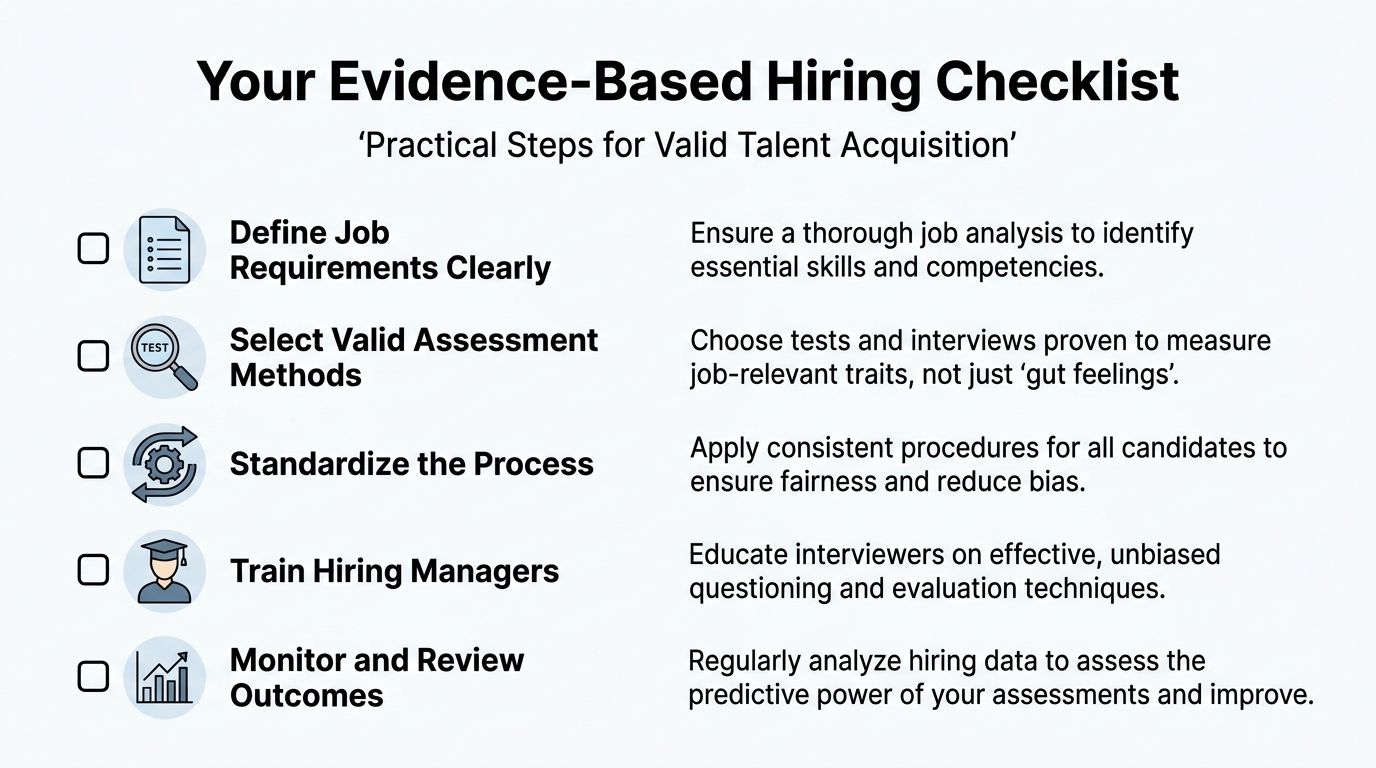
Use this before you approve any hiring method
Audit the process after hiring
Don't stop at selection. The actual test starts later.
Ask:
| Checklist question | Why it matters | |---|---| | Did the assessment signal match later performance? | This is the practical test of prediction | | Did managers use results consistently? | A good tool can fail under weak implementation | | Were there role, team, or subgroup patterns? | Validity can vary by context | | What seemed persuasive but added little value? | Remove decorative steps |
> The best hiring teams treat every process like a hypothesis. They test it against outcomes, refine it, and resist falling in love with their own methods.
Validity in psychology isn't optional if your decisions affect revenue, leadership quality, team cohesion, or execution risk. It's part of the operating system for serious talent strategy. Teams that ignore it still make decisions. They just make them with less signal and more confidence than the evidence deserves.
---
If you want a more practical way to turn assessment science into hiring and talent decisions, [Synopsix](https://synopsix.ai) helps teams translate validated behavioral data into clear, business-ready guidance. It's built for leaders who want less psychometric jargon and more usable signal in hiring, team design, and development.