10 Ways to Improve Organizational Performance in 2026
By Synopsix · October 15, 2026 · 21 min read
A team can miss its targets quarter after quarter while every process appears sound on paper. The hiring process is documented, performance reviews are scheduled, and managers have dashboards full of activity data. Yet the results remain stubbornly average because the gap sits in people decisions: who gets hired, who gets promoted, how teams are formed, and how managers coach.
The most useful ways to improve organizational performance connect those decisions to evidence and business outcomes. They don't treat employee behavior as a fixed mystery or reduce performance to a single score. Instead, they give leaders better methods for assessing capability, anticipating risk, building teams, setting direction, and developing talent.
This guide presents ten practical approaches. Each one includes implementation steps, a KPI that shows whether the approach is working, and a trade-off leaders should watch before scaling it.
1. Use Scientifically Validated Behavioral Assessments in Hiring and Promotion
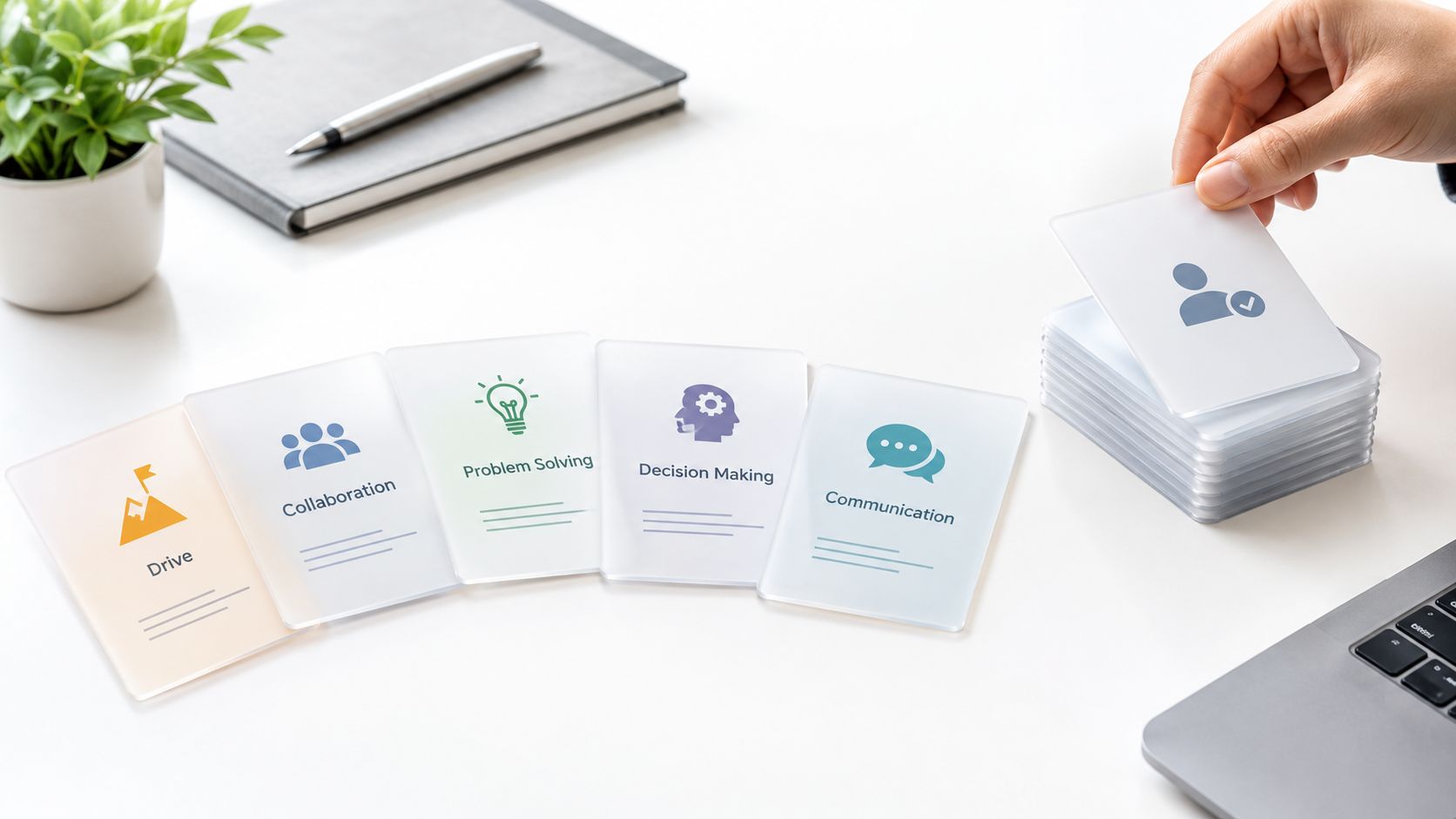
Gut feel is fast, familiar, and difficult to audit. It also makes different candidates look better or worse depending on the interviewer, the comparison group, and the latest memorable conversation. Scientifically validated behavioral assessments give hiring and promotion teams a common basis for evaluating traits such as drive, collaboration, judgment, and decision-making style against the actual demands of a role.
The evidence supports a disciplined approach. A meta-analysis of personality measures examined 494 studies, with 97 independent samples and a combined sample of 13,521 people. Predictive validity reached 0.38 when researchers used job analysis to select relevant traits, compared with 0.29 in confirmatory studies and 0.12 in exploratory studies, as reported in the [meta-analysis of personality measures](https://onlinelibrary.wiley.com/doi/abs/10.1111/j.1744-6570.1991.tb00696.x).
Put the assessment inside a broader decision
Start by documenting the behaviors that distinguish success in the role. Select an assessment with published reliability and validity evidence for comparable job types, then use the results alongside a structured interview and a relevant work sample. Synopsix's Assessments & Profiles product is designed to generate comparable behavioral profiles, helping teams evaluate candidates against consistent benchmarks.
Track post-hire performance by assessment dimension, not just whether a candidate was hired. Review promotion outcomes, early performance, retention, and manager evaluations. The trade-off is precision versus overconfidence. An assessment can improve consistency without becoming a standalone pass or fail gate.
Explain what the assessment measures, how results will be used, and who can access them. Monitor selection outcomes across demographic groups. The [EEOC interpretation of the Uniform Guidelines](https://www.eeoc.gov/laws/guidance/questions-and-answers-clarify-and-provide-common-interpretation-uniform-guidelines) states that employers generally need validity evidence when a selection procedure adversely affects a racial, sex, or ethnic group.
2. Predict Human Behavior to Make Smarter People Decisions
A hiring decision rarely fails because leaders lacked information after the fact. It fails because they didn't test the decision before making it. Predictive people analytics can combine behavioral data, assessment results, role requirements, and historical outcomes to form a view of how an individual or team may perform, adapt, collaborate, or create friction.
That makes predictive modeling useful for high-consequence decisions such as a leadership appointment, a team restructure, or a promotion into a role with new demands. Synopsix's Predictive Simulations are designed to anticipate friction and risk before those decisions become expensive organizational problems.
Turn predictions into testable hypotheses
Use the model to surface questions, not to label people permanently. If a simulation identifies a potential collaboration risk, ask the manager and employee about decision rights, communication preferences, workload, and prior experience. A prediction is more useful when it leads to a specific intervention, such as clarifying ownership or adding a mentoring relationship.
Measure prediction calibration, meaning how often identified risks and strengths correspond with observed outcomes. Compare predicted and actual outcomes after a defined review period. Also record whether managers acted on the insight and whether the intervention changed the result.
> Practical rule: Treat every prediction as a hypothesis that needs human context and later validation.
Attrition-risk modeling can help prioritize stay conversations, but it creates a clear trade-off between early intervention and employee privacy. Document how predictions influence decisions, restrict access to sensitive data, and audit models for bias. Predictive tools should make decisions more explainable, not turn employees into opaque risk scores.
A useful implementation sequence is simple:
The KPI is forecast accuracy paired with intervention quality, not the number of alerts generated.
<iframe width="100%" style="aspect-ratio: 16 / 9;" src="https://www.youtube.com/embed/wEwGBIr_RIw" frameborder="0" allow="autoplay; encrypted-media" allowfullscreen></iframe>
3. Adopt Structured Behavioral Interviewing
Unstructured interviews reward conversational chemistry. Structured behavioral interviews reward relevant evidence. Every candidate receives comparable, job-related questions, and interviewers score the answers against predefined criteria instead of relying on a general impression.
The distinction matters. A meta-analysis of interview format and structure found that structured interviews produced mean validity coefficients approximately twice as high as unstructured interviews, according to the [review of structured interviews](https://www.cambridge.org/core/journals/industrial-and-organizational-psychology/article/structured-interviews-moving-beyond-mean-validity/7CB1F7C86CB0D15328B3F07AD5F964E2). Structure doesn't mean making the conversation cold. It means making the evidence comparable.
Build questions from the work
For each competency, write three to five questions that ask candidates to describe a real situation, their task, the action they took, and the result. Use the same core questions for every candidate. Interviewers can probe for detail, but they shouldn't replace job-related questions with improvised prompts.
Create a scorecard before interviews begin. Have interviewers score independently before the debrief so the most senior voice doesn't anchor the group. The [interview scorecard template from Nexus IT Group](https://nexusitgroup.com/interview-scorecard-template/) can help teams formalize this process.
The primary KPI is the relationship between interview scores and post-hire performance. Review which questions separate strong and weak outcomes, then retire questions that produce attractive stories but little predictive value.
The trade-off is speed. Structured interviews require preparation, interviewer training, and consistent scoring. They can feel slower than an informal conversation, especially for senior hires. That cost is justified when the role is difficult to replace or when inconsistent hiring decisions create downstream performance problems.
Pair the interview with a work sample or behavioral assessment. The interview captures demonstrated experience and reasoning. Other methods capture different signals. No single method should carry the entire decision.
4. Design Balanced, Complementary Teams
A high-performing team isn't just a collection of high-performing individuals. People need complementary capabilities, clear responsibilities, and working norms that prevent predictable friction. A team packed with initiators may generate ideas but struggle to finish them. A team dominated by cautious reviewers may avoid mistakes while delaying decisions.
Start with the current team, not the vacancy. Map strengths, role coverage, decision styles, collaboration patterns, and critical-function redundancy. Synopsix's Human Interlink is designed to visualize team complementarity and tension points, while role-based frameworks such as Meredith Belbin's team roles can help leaders discuss how people contribute as implementers, coordinators, or monitor-evaluators.
Design around the work system
Use the map to identify the capability gap an open role must fill. Don't hire a second version of the strongest person because that profile feels familiar. Assign responsibilities according to strengths, but maintain redundancy for critical functions so one departure doesn't create a single point of failure.
Set team norms after reviewing the composition. A team with mixed working styles may need written decision records, rotating meeting facilitation, explicit response expectations, and separate time for debate and execution. Revisit the design when the team enters a new phase, such as a product launch, restructuring, or international expansion.
Measure team delivery quality, using indicators such as milestone reliability, rework, decision cycle time, and stakeholder satisfaction. The trade-off is that complementarity can reduce immediate comfort. A balanced team may include people who challenge one another, which can feel less harmonious than hiring for similarity. The leader's job is to convert that difference into productive disagreement through clear decision rules.
> A team map is useful only when it changes a decision, such as whom to hire, how to allocate work, or which norm to establish.

5. Build Psychological Safety in Teams
Employees can't help leaders solve problems they feel unable to mention. Psychological safety gives team members permission to raise concerns, admit mistakes, ask questions, and challenge a decision without fear of humiliation or punishment.
The practice is behavioral, not ceremonial. Leaders build it by asking for dissent before decisions are final, acknowledging uncertainty, and thanking people who surface risks. A policy that says “speak up” won't work if the person who speaks up gets ignored or blamed.
Make learning visible
Run retrospectives that examine systems, handoffs, incentives, and process design rather than searching for one person to blame. In healthcare, blameless post-incident reviews can encourage reporting of near-misses and help teams correct hazards before they become more serious. In any industry, the same logic applies to customer complaints, security incidents, missed deadlines, and quality failures.
Track perceived psychological safety alongside problem-detection behavior. Use short pulse surveys, then compare responses with the number and quality of risks raised, near-misses reported, and corrective actions completed. A rise in reported issues may indicate greater trust rather than worse performance, so leaders must interpret the metric with care.
The trade-off is accountability. Psychological safety doesn't mean removing standards or consequences. It means separating honest reporting and learning from reckless or harmful conduct. Leaders should make that distinction explicit.
For practical guidance on the broader conditions that help teams work well, see [qualities of effective teams](https://synopsix.ai/blog/qualities-of-effective-teams). Then choose one behavior for managers to demonstrate in every meeting, such as asking, “What are we missing?” or inviting the most skeptical view before closing a decision.

6. Strengthen Manager Effectiveness and Engagement
Managers translate strategy into daily work. They set expectations, remove obstacles, coach performance, recognize contribution, and decide which priorities receive attention. When managers perform those jobs inconsistently, an organization can have strong strategy and weak execution at the same time.
Gallup estimates that managers account for at least 70% of the variance in employee-engagement scores, and employees whose managers hold regular meetings are nearly three times as likely to be engaged as employees who don't have those meetings, according to [Gallup's manager research](https://www.gallup.com/workplace/236570/employees-lot-managers.aspx).
Install a manager operating system
Before promoting someone, assess management readiness separately from individual performance. Give new managers training before or immediately after the transition. Then standardize a small set of behaviors:
The KPI should be team engagement combined with regrettable attrition and delivery outcomes. A manager who raises survey scores while missing commitments may need a different intervention. A manager who delivers results through exhaustion and avoidable turnover also isn't succeeding.
The trade-off is managerial capacity. Adding meetings, surveys, and training can overload managers unless leaders remove low-value reporting and clarify which conversations matter most. Treat manager effectiveness as a capability system, not a motivational campaign.
7. Set Clear Goals with OKRs and Goal-Setting Theory
Employees often look busy because leaders have given them too many competing priorities. Clear goals reduce that ambiguity by defining the outcome, the level of ambition, and the evidence that will show progress. OKRs provide a practical format: an objective describes the direction, while key results define measurable outcomes.
Use the method to align organizational, team, and individual work. A marketing team objective might focus on improving qualified demand, while its key results measure conversion quality, pipeline contribution, and customer fit. The key results shouldn't read like a task list. “Publish six campaigns” describes activity. “Increase qualified opportunities from the target segment” describes an outcome.
Limit the work in progress
Give each team a small number of objectives for the cycle. Review progress weekly, but don't turn the check-in into a status ritual. Ask three operational questions: What changed, what is blocked, and which priority must be reduced if a new request enters?
Track key-result progress together with strategic delivery and priority changes. If teams hit their OKRs while customers see no improvement, the measures are wrong. If teams continually miss because leaders add work mid-cycle, the issue may be prioritization rather than effort.
The trade-off is transparency versus pressure. Visible goals can improve coordination, but they can also encourage sandbagging or local optimization when leaders tie every result directly to compensation. Separate learning goals from commitments where appropriate, and evaluate outcomes fairly at the end of the cycle.
Use a framework comparison before rollout. [SMART vs OKR vs GROW](https://fluidwave.com/blog/goal-setting-frameworks) helps teams choose a method based on the type of work, the required cadence, and the level of uncertainty.

8. Replace Annual Reviews with Continuous Feedback
An annual review asks a manager to reconstruct months of performance from memory, then compress that history into a rating. Continuous feedback moves the conversation closer to the work. Managers discuss what happened, what matters next, and which support the employee needs before a small problem becomes a pattern.
Adobe's Check-In approach replaced its annual review process with ongoing conversations and quarterly feedback. Deloitte announced in 2015 that it would scrap annual performance ratings in favor of more frequent feedback, as described in its performance-management case material.
Separate coaching from judgment
Keep check-ins short and specific. Discuss one or two priorities, name the behavior or result, and agree on the next action. Separate development conversations from compensation decisions when possible so employees can discuss weaknesses without assuming every admission will immediately affect pay.
A practical cadence includes:
Track feedback frequency, employee-reported usefulness, and subsequent performance movement. Frequency alone isn't success. Managers can hold many low-quality conversations that create administrative work without improving behavior.
The trade-off is managerial discipline. Continuous feedback exposes weak coaching habits because managers can no longer hide behind an annual form. Give them examples, practice, and a simple record of agreed actions. For question prompts that keep conversations concrete, use [employee performance review questions](https://synopsix.ai/blog/employee-performance-review-questions).
9. Personalize Development Plans Using the 70-20-10 Model
A course catalogue isn't a development strategy. Employees build capability through the work they do, the feedback they receive, and the relationships that shape their judgment. The 70-20-10 model, associated with Michael Lombardo and Robert Eichinger at the Center for Creative Leadership, uses that principle to balance challenging assignments, relationships and feedback, and formal learning.
Treat the proportions as a planning guide, not a universal law. A technical certification may require substantial formal instruction. A new leader may learn more through a difficult project and regular coaching. The plan should reflect the capability gap and the context of the role.
Convert insight into practice
Start with two or three development priorities tied to business needs. Then connect each priority to an experience, a relationship, and a learning resource. A manager working on delegation might lead a cross-functional project, receive observation from an experienced leader, and complete a focused course on workload planning.
Review the plan quarterly. Track capability evidence, such as successful completion of a stretch assignment, improved stakeholder feedback, internal mobility, or stronger performance in the target behavior. Course completion is an input, not proof of development.
The trade-off is opportunity cost. Stretch work can improve capability, but it can also overload employees or expose customers to avoidable mistakes. Define the decision rights, support, and guardrails before assigning the work. Managers also need time and incentives to coach, otherwise the development plan becomes an employee's private administrative burden.
Use behavioral profiles to target development rather than assigning generic training. Synopsix's development planning approach translates assessment insights into specific actions for employees and leaders. A practical starting point is this [talent development plan template](https://synopsix.ai/blog/talent-development-plan-template).
10. Build Evidence-Based Leadership Succession Pipelines
Succession planning is often treated as an annual talent-review exercise, then ignored until a critical leader leaves. A stronger pipeline identifies the capabilities each important role requires, assesses readiness against evidence, and gives potential successors opportunities to demonstrate those capabilities before promotion.
Past individual performance isn't enough. A strong salesperson may not be ready to lead a sales organization. A technical expert may need significant support before managing people. The Peter Principle, described in Laurence J. Peter and Raymond Hull's 1969 book, captures the risk of promoting people beyond the level at which they have demonstrated competence.
Test readiness before the vacancy
Define role-specific competencies before naming candidates. Use performance history, behavioral assessment data, structured interviews, stakeholder evidence, and relevant simulations. Synopsix's Intelligence Reports for leadership roles are designed to support leadership selection and readiness decisions.
Create clear readiness categories such as ready now, ready with targeted development, and longer-term potential. Require evidence for each rating. Then give successors stretch assignments, mentoring, and exposure to decisions that resemble the target role.
Measure succession coverage and successor performance after appointment. Also track whether critical roles have credible alternatives and whether development actions close the identified gaps. The trade-off is transparency versus retention risk. Telling someone they are not ready can trigger frustration, but hiding the assessment leaves the organization vulnerable and denies the employee a clear development path.
Review succession slates annually with HR and senior leaders together, then revisit them when strategy or role requirements change. A pipeline should remain connected to the future work of the organization, not merely reproduce today's leadership profile.
10-Point Comparison of Organizational Performance Strategies
| Strategy | 🔄 Implementation complexity | ⚡ Resource requirements | 📊 Expected outcomes | 💡 Ideal use cases | ⭐ Key advantages | |---|---:|---:|---|---|---| | Use Scientifically Validated Behavioral Assessments in Hiring and Promotion | Moderate, selection, validation, vendor integration, HR training | Moderate, assessment licenses, admin time, interpretation expertise | Improved hire quality; reduced bias; more consistent decisions | High-volume hiring, promotion decisions, roles needing objective fit | Standardized, validated predictors of performance; defensible decisions | | Predict Human Behavior to Make Smarter People Decisions | High, modeling, data pipelines, ongoing auditing | High, analytics, data integration, data scientists, governance | Probabilistic forecasts of fit/risk; fewer mis-hires; proactive retention | Leadership appointments, succession risk, workforce planning scenarios | Enables scenario testing and early risk identification | | Adopt Structured Behavioral Interviewing | Moderate, question design, scorer calibration, interviewer training | Low–Moderate, templates, interviewer time, training sessions | More reliable interview scores; reduced bias; clearer hiring rationale | Any role where past behavior predicts success; complements assessments | Consistent, comparable interviews with audit trails | | Design Balanced, Complementary Teams | Moderate, team mapping, role-alignment, visualization | Moderate, team assessments, analytics tools, leader time | Better collaboration, fewer conflicts, faster adaptation | New team formation, restructuring, cross-functional projects | Optimizes team composition for complementary strengths | | Build Psychological Safety in Teams | High, cultural change, leader modeling, sustained practices | Low–Moderate, leader development, facilitation, pulse surveys | Increased learning, innovation, early problem detection, retention | R&D, high-risk operations, innovation teams | Enables candid communication and faster issue surfacing | | Strengthen Manager Effectiveness and Engagement | Moderate, programs for selection, training, feedback loops | Moderate–High, coaching, measurement tools, training resources | Higher engagement, productivity, lower turnover, consistent experience | Organizations scaling managers or improving team outcomes | Managers drive major variance in engagement and performance | | Set Clear Goals with OKRs and Goal-Setting Theory | Moderate, goal design, alignment, cadence governance | Low–Moderate, planning time, OKR tooling, regular check-ins | Greater alignment, focus, measurable progress toward strategy | Strategy execution, scaling organizations, cross-team alignment | Aligns effort to priorities and supports transparent accountability | | Replace Annual Reviews with Continuous Feedback | Moderate, process redesign, manager discipline, tooling | Moderate, manager time, lightweight systems, training | Faster course correction, improved development, less recency bias | Performance improvement initiatives, development-focused cultures | Timely, actionable feedback that strengthens manager-employee relationships | | Personalize Development Plans Using the 70-20-10 Model | Moderate, tailoring plans, matching experiences and mentors | Moderate, stretch assignments, mentoring, learning resources | Targeted capability growth, better internal mobility and retention | High-potential development, role transitions, succession prep | Emphasizes experiential learning tied to business needs | | Build Evidence-Based Leadership Succession Pipelines | High, competency models, readiness assessment, governance | High, executive sponsorship, assessments, development programs | Reduced mis-promotions, stronger bench, continuity for critical roles | Critical-role succession planning, enterprise continuity | Data-driven readiness rankings and targeted development paths |
Turning These Approaches Into a Practical Performance Plan
Ten approaches can create energy, but adopting all ten at once usually creates another performance problem: too many initiatives competing for the same managers' attention. Start with the most costly people decision this quarter. That might be a recent mis-hire, repeated conflict inside a delivery team, unclear accountability after a restructure, or a leadership role with no credible successor.
Choose one or two approaches that directly address that decision. If hiring quality is the problem, begin with role analysis, a validated assessment, and a structured interview. If execution is weak inside an existing team, start with manager operating routines, clearer goals, and a review of team composition. If a key role is exposed, build a succession slate before adding another general leadership course.
Give every intervention an owner and a measure
Assign one executive owner, one operational owner, and one KPI. Keep the KPI close to the decision:
Don't use activity as a substitute for impact. The number of assessments completed, meetings held, or courses attended shows adoption. It doesn't show whether the organization made better decisions.
Measurement also needs legitimacy. Deloitte's 2025 Global Human Capital Trends survey covered nearly 10,000 leaders across 93 countries and found that 75% of organizations rated their ability to accurately evaluate the value created by individual workers as ineffective. The same research reported that 61% of managers and 72% of workers didn't trust their performance-management process, as documented in [Deloitte's 2025 performance-management findings](https://www.deloitte.com/us/en/insights/topics/talent/human-capital-trends/2025/employee-performance-management-optimization-effective-strategy.html). More dashboards won't fix metrics employees see as unfair, invasive, or disconnected from value.
Remove work before adding a program
Every new practice needs implementation capacity. Before launching a new assessment, OKR cycle, or feedback cadence, decide which report, meeting, approval, or low-value task will stop. In a separate 2025 performance-management study, almost half of organizations said productivity could rise by at least 10% if performance management were optimized, yet only 39% said their process effectively delivered clear goals, regular feedback, fair ratings, and links to rewards. The findings are summarized in [WTW's performance-management research](https://www.wtwco.com/en-gb/news/2025/10/organizations-can-achieve-greater-productivity-and-employee-engagement-with-improved-performance-man).
This subtraction step protects adoption. Managers can't coach well if every strategic priority becomes another team task. Employees can't learn from a stretch assignment if their workload leaves no time to reflect, practice, or receive feedback.
Review the first intervention after a full operating cycle. Keep it, redesign it, or stop it based on evidence. Then add the next practice only when the organization can explain what changed, which outcome improved, and what trade-off remains unresolved.
Synopsix can support this operating model by connecting behavioral assessments with comparable profiles, predictive simulations, Human Interlink team analysis, and development planning. The platform is most useful when leaders use those signals to make a specific hiring, team, development, or succession decision, then measure the result rather than treating people intelligence as another reporting layer.
Lasting improvement comes from consistent execution of a few well-chosen practices. Better organizational performance isn't produced by collecting more data or launching more initiatives. It comes from making clearer people decisions, giving managers usable systems, protecting trust, and learning quickly from the outcomes.
---
Synopsix turns scientifically validated behavioral assessments into practical guidance for hiring, team design, predictive simulations, and talent development. Use it to connect people decisions with role requirements, team dynamics, and development actions, then visit [Synopsix](https://synopsix.ai) to explore how the platform can support your performance plan.