What Is Competency Assessment? a Guide for Smarter Decisions
By Synopsix · June 29, 2026 · 16 min read
You're probably dealing with one of these situations right now. A manager wants to fast-track a candidate because the resume is pristine. A high performer is up for promotion because they've delivered strong individual results. A team is under strain, and nobody can quite explain why two capable people keep creating friction.
On paper, all three decisions can look rational.
In practice, they often fail for the same reason. Most organizations still confuse visible capability with real competency. They verify credentials, experience, and task knowledge, then assume behavior will take care of itself. It won't. People don't work in a vacuum. They work under pressure, with ambiguity, across personalities, and inside power structures that expose strengths and weaknesses fast.
That's where competency assessment matters. Done well, it gives leaders a more defensible way to judge not only whether someone can perform, but how they're likely to perform when the role gets real.
The High Cost of Guesswork in Talent Decisions
A bad hire rarely looks bad on day one. The person interviews well, says the right things, and often has credible experience. The problem shows up later. Deadlines slip. Stakeholders lose confidence. The new leader can't calibrate their style to the team. A technically strong manager creates avoidable turnover because they don't know how to influence, coach, or absorb pressure.
That's why competency assessment matters more than a resume screen or an unstructured interview. It's a business process for reducing guesswork in hiring, promotion, succession, and team design. Instead of relying on intuition and credentials alone, leaders can evaluate the behaviors, judgment patterns, and applied capabilities that shape performance.
For CHROs, this isn't a niche topic. The global competency assessment market reached $4.8 billion in 2025 and is projected to grow to $9.2 billion by 2033, at an 8.2% CAGR, according to [Dataintelo's competency assessment market report](https://dataintelo.com/report/competency-assessment-market). That growth reflects a practical shift. More organizations want tools that turn psychometric data into business signals leaders can use.
What guesswork usually looks like
A detailed look at the [cost of a bad hire](https://synopsix.ai/blog/cost-of-a-bad-hire) makes the downstream impact obvious. The cost isn't just replacement. It's stalled work, credibility loss, manager time, and avoidable friction inside critical teams.
> Practical rule: If your process can explain why someone looked qualified but still failed, you're doing postmortems. If it can predict that risk earlier, you're doing competency assessment.
The point isn't to remove human judgment. It's to give human judgment better evidence.
Decoding Competency Beyond the Resume
Ask ten leaders what competency means and most will describe skills. That's incomplete. Skills matter, but they're only the visible layer. Competency is broader. It includes the knowledge, skills, patterns of behavior, and underlying drivers that determine how someone applies what they know in a work setting.
A useful way to think about it is the iceberg model. The top is what a resume shows. The larger mass below the surface determines whether the visible strengths hold up in real work.
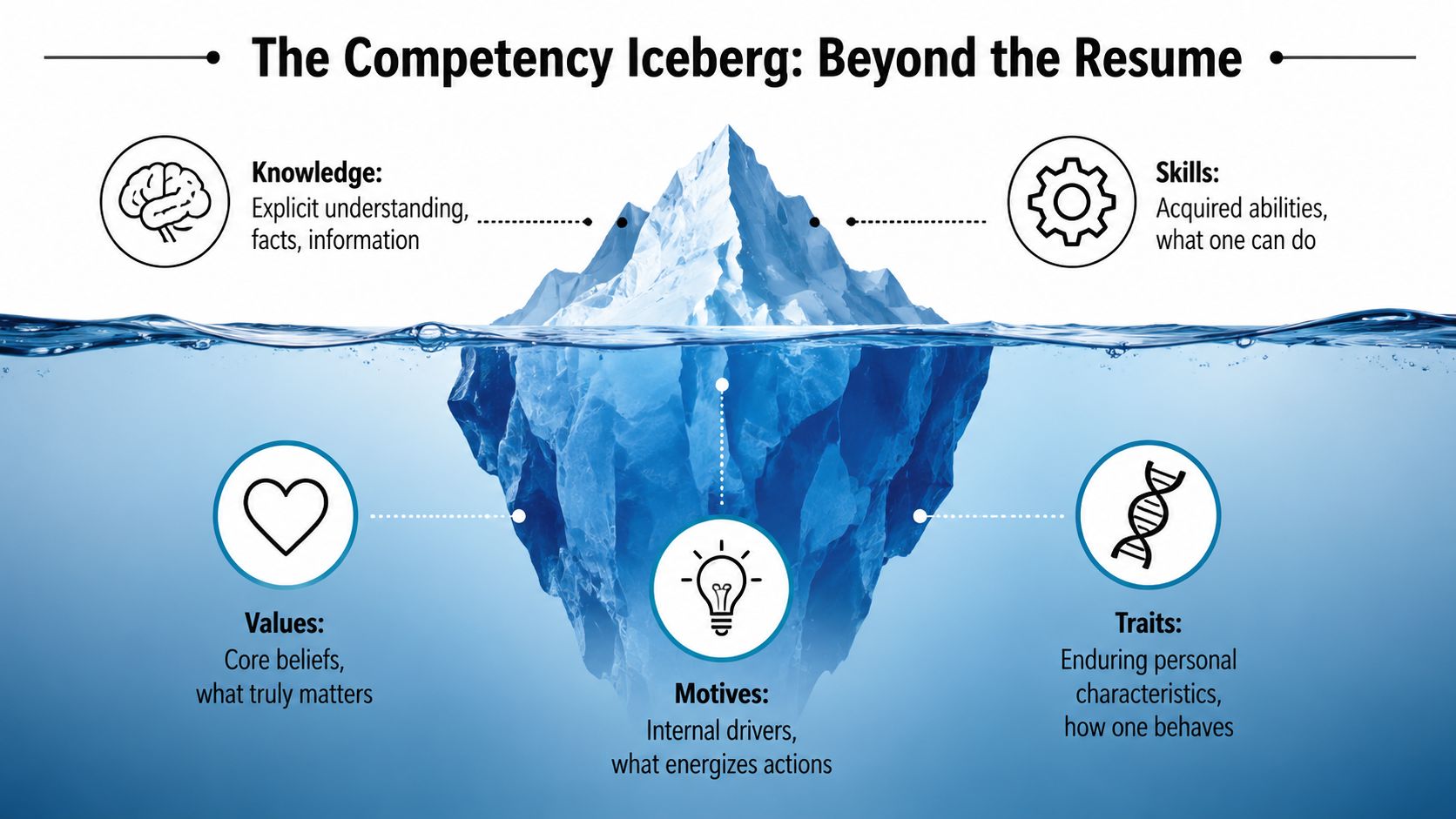
What sits above and below the waterline
Above the surface, most organizations evaluate:
Below the surface, the better assessments try to capture:
That's why what is competency assessment is the wrong question if it leads only to testing tasks. A better question is this: what evidence do we have that this person can apply capability consistently, in context, with other people, when the stakes rise?
Why global standards moved in this direction
The shift away from credentials alone didn't happen by accident. The [Program for the International Assessment of Adult Competencies, or PIAAC](https://nces.ed.gov/surveys/piaac/), helped establish a broader benchmark by assessing key cognitive and workplace skills through how adults apply them in real-world contexts. That matters because it reframed assessment around applied competence, not just academic attainment.
For HR leaders, that distinction is operational. A degree may signal exposure. A certification may signal study. Neither automatically tells you how someone prioritizes, collaborates, adapts, or handles complexity when the work environment changes.
A strong [competency mapping approach](https://synopsix.ai/blog/what-is-competency-mapping) helps convert that broader view into role-specific criteria. It links the role to the behaviors that produce results, not just the qualifications that look impressive in a shortlist.
> Competency isn't a synonym for experience. It's evidence that a person can translate capability into effective action in the conditions the role actually demands.
What good definitions avoid
Weak definitions create weak systems. In practice, I'd avoid any framework that treats competency as one of these:
| Mistaken view | Why it fails | |---|---| | Tenure equals competence | Time served doesn't show quality of application | | Credentials equal readiness | Formal achievement rarely captures interpersonal execution | | One test equals the whole person | A single score can miss context, trade-offs, and role fit |
Competency assessment works when it moves past static qualifications and examines how performance is likely to show up on the job.
Moving Beyond Task Proficiency to Behavioral Insight
Most talent systems still over-reward proof of task proficiency. Can the candidate write the code, close the sale, build the model, run the plant, present to the board? Those are valid questions. They're also incomplete.
The failure point is usually behavioral application. A person may know exactly what to do and still apply that capability poorly when priorities collide, feedback lands badly, or collaboration gets tense. This is the gap many organizations miss. They assess whether someone can do the task, then make a leap of faith about how that person will operate under real conditions.
The hidden difference between can do and will do well
A useful line from the ATD discussion of competency assessment is the distinction between task proficiency and behavioral application. The same source notes a risk for bias when assessments focus on demonstrating skills without validating how those skills are applied across diverse conditions, which can inflate scores without predicting actual job performance.
That's exactly what many polished hiring processes do. They create confidence without creating foresight.
A software engineer may complete a technical exercise flawlessly, then struggle in the role because they escalate poorly, shut down under ambiguity, or create drag in cross-functional work. A sales leader may know pipeline mechanics but damage trust through control-heavy behavior. A finance director may be analytically strong but fail when executive communication requires judgment, brevity, and political awareness.
> The practical question isn't “Can they do it?” It's “How do they do it when the environment stops being ideal?”
Where traditional assessment methods break down
Three patterns show up often:
1. Technical screens dominate the decision Teams assume skill proof is enough for role fit.
2. Interviews reward confidence signals Charisma, fluency, and executive presence can mask weak behavioral range.
3. Reference checks come too late By then, the organization is usually looking for confirmation, not disconfirming evidence.
For hiring teams rebuilding around more applied criteria, resources on skills-based hiring can help [revolutionize your engineering hiring](https://www.tekrecruiter.com/post/what-is-skills-based-hiring), especially when technical requirements are clear but behavioral demands are still underdefined.
What better assessment looks like
A stronger process probes for behavior in context:
This is the point at which competency assessment becomes strategically useful. It stops being a checklist and starts becoming a prediction tool for smarter people decisions.
Key Types of Competency Assessments
Not all competency assessments answer the same question. That's where many talent processes become muddled. Leaders combine interviews, tests, and references without being clear on what each method is supposed to predict.
At the technical end, a competency assessment is a structured evaluation of Knowledge, Skills, and Abilities against role-based requirements using observable indicators and defined proficiency levels, as described in [Peak Technical's explanation of technical competency frameworks](https://peaktechnical.com/technical-competency-framework-engineering/). That gives you a solid base for job relevance. It doesn't remove the need for behavioral assessment, but it does anchor the process in the work itself.
What each method is good at
Some methods are best for proving capability. Others are better for surfacing judgment, consistency, and interaction style.
Common assessment methods include:
For teams comparing approaches across education and workforce settings, it's useful to look at practical examples such as [Kenya's CBE assessments](https://keybaki.com/assessments), which illustrate how competency-based evaluation can be structured around demonstrated capability rather than passive recall.
Comparison of Competency Assessment Methods
| Assessment Method | Best For Assessing | Predictive Validity | Candidate Experience | Scalability | |---|---|---|---|---| | Behavioral interview | Past behavior, judgment, communication | Moderate when structured, low when unstructured | Familiar and conversational | Moderate | | Work sample test | Role-specific execution | High for clearly defined tasks | Usually positive if relevant and time-bound | Moderate | | Simulation | Decision-making under pressure, prioritization, stakeholder handling | High when built around role realities | Strong if realistic, poor if overly complex | Lower than interviews at first, improves with standardization | | 360-degree feedback | Leadership style, collaboration patterns, development needs | Strong for development context | Mixed, depends on trust and culture | Moderate | | Psychometric assessment | Behavioral tendencies, motivators, interpersonal patterns | Useful when validated and combined with other data | Efficient if concise and clearly explained | High |
What works and what doesn't
What works is stacking methods by decision purpose. For example, a sales manager search might combine a structured interview, a role-play, and a validated behavioral assessment. A senior engineer role might rely on a work sample plus collaboration-focused interviewing. A leadership promotion decision may require multi-rater feedback and evidence of sustained behavioral patterns, not just individual output.
What doesn't work is treating one instrument as a silver bullet.
> Decision guide: Use work samples to verify capability, use structured interviews to probe applied behavior, and use validated assessments to understand patterns that won't show up in a resume.
That combination produces a more complete picture than any single score.
Designing a Valid and Defensible Assessment Framework
A competency framework becomes useful only when leaders can explain why each competency matters, how it shows up in behavior, and how it will be assessed consistently. Without that discipline, frameworks turn into word clouds. You get attractive labels like “leadership,” “agility,” or “strategic thinking” with no operational definition behind them.
The more robust models follow a sequence. [Research published in PMC](https://pmc.ncbi.nlm.nih.gov/articles/PMC8713730/) describes competency assessment development as a multi-step process that starts with identifying purpose, then specifying the competencies required for practice, and defining distinct proficiency levels such as novice through expert to produce actionable benchmark data.
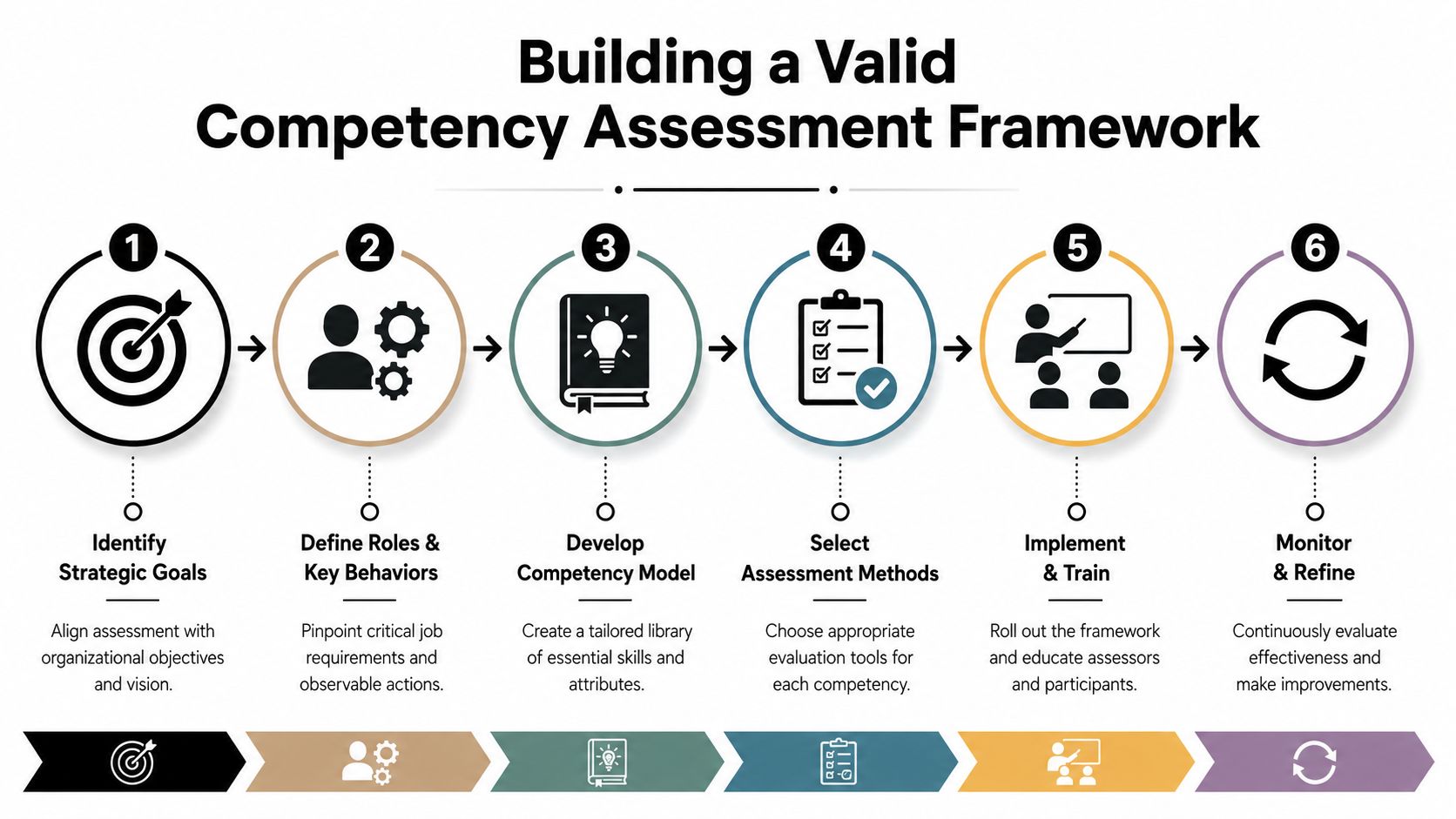
A practical build sequence
In applied organizational work, the cleanest sequence looks like this:
1. Start with business risk and role outcomes Don't begin with generic competencies. Begin with what the role must deliver and where failure becomes expensive.
2. Define observable behavior “Influence” isn't enough. Spell out what influence looks like in meetings, decision cycles, and conflict.
3. Set proficiency levels Competency-based frameworks typically use 3 to 5 levels for each competency, with observable behavioral indicators at each level, as outlined by [SkillPanel's overview of competency-based assessment](https://skillpanel.com/blog/competency-based-assessment/).
4. Choose methods that match the competency If a competency shows up in live stakeholder trade-offs, a multiple-choice test won't capture it well.
What defensibility actually requires
Leaders often say they want a valid framework when what they mean is a framework that feels organized. Validity is stricter than that. The framework must connect role requirements, assessment methods, and interpretation logic in a way that is consistent and fair.
A few essential elements help:
If you're refining this process, understanding [test reliability in practical terms](https://synopsix.ai/blog/what-is-test-reliability) helps leadership teams ask better questions about consistency before they use assessment outputs in hiring or promotion.
> A defensible competency framework doesn't promise perfect certainty. It creates a repeatable logic for making better decisions with less bias and less improvisation.
A simple example of proficiency design
Take a competency like stakeholder management.
| Proficiency level | Behavioral signal | |---|---| | Early | Responds to stakeholder requests clearly and on time | | Proficient | Aligns priorities across stakeholders with differing needs | | Advanced | Anticipates tension, reframes trade-offs, and preserves trust under pressure |
That's the difference between a framework people can use and one they ignore.
Putting Competency Data to Work Across the Talent Lifecycle
Many organizations still treat competency assessment as a hiring tool. That leaves most of its value on the table. The same data that improves selection can also sharpen development, succession planning, and team design.
A useful way to think about it is this. The assessment isn't the product. The product is a better decision at multiple moments across the employee lifecycle.
Hiring with less false confidence
A shortlist often includes several people who can do the job technically. The hard part is separating who is likely to sustain performance from who merely presents well.
In a hiring context, competency data helps teams compare candidates on shared criteria. Not just “strong communicator” or “good culture fit,” but concrete signals like tolerance for ambiguity, collaborative range, decision style, and likely pressure response. That matters in specialized searches too. Firms working on [AI engineer placement](https://www.ayautomate.com/services/engineer-placement) often face this exact issue. Technical capability is necessary, but team fit and execution behavior determine whether placement turns into performance.
Development that is specific enough to change behavior
Most development plans fail because they're too vague. “Improve executive presence” doesn't tell a leader what to do differently next week. A useful competency profile does.
For example:
That kind of specificity turns development from aspiration into action.
Here's a short demonstration that captures how assessment data can move from profile to operational decision:
<iframe width="100%" style="aspect-ratio: 16 / 9;" src="https://www.youtube.com/embed/z7vTJAmOGZ8" frameborder="0" allow="autoplay; encrypted-media" allowfullscreen></iframe>
Succession and team design
Succession planning usually breaks when readiness is inferred from visibility or loyalty. The leader who gets the nod is often the one the executive team knows best, not the one whose behavioral profile best fits the future role.
Competency data helps correct that. It allows organizations to ask sharper questions:
> Strong talent systems don't collect assessment data for a filing cabinet. They use it to place people where their strengths can hold under pressure and where their risks can be managed in advance.
Used this way, competency assessment becomes part of the organization's operating system, not a one-time hiring event.
From Assessment to Smarter People Decisions
The most useful answer to what is competency assessment isn't academic. It's practical. It's a disciplined way to improve judgment about people before the consequences get expensive.
The strongest systems don't stop at checking whether someone can perform a task. They examine how performance is likely to show up in real work. Under pressure. Across relationships. In moments where ambiguity, ego, conflict, and pace test the person behind the resume.
That's also why leaders should be careful with isolated scores. For high-stakes decisions, [research on competence assessment validity](https://pmc.ncbi.nlm.nih.gov/articles/PMC10368597/) cautions that standardized measures shouldn't be interpreted in isolation because they often don't satisfy reliability requirements on their own. Overall competence matters more than any single narrow measure.
What this means for CHROs
If your process still relies mainly on resumes, manager instinct, and loosely structured interviews, you're not assessing competency in the full sense. You're screening for plausibility.
A stronger approach does three things:
That shift is no longer optional for organizations that want better hiring, cleaner promotions, and stronger leadership pipelines. The companies that make smarter people decisions won't be the ones with the longest interview loops. They'll be the ones with the clearest evidence about how people work.
---
If you want a more practical way to turn behavioral assessment into hiring, team design, and development decisions, [Synopsix](https://synopsix.ai) helps translate psychometrics into clear business guidance leaders can act on.