What Is Evidence Based Practice? a Practical HR Guide
By Synopsix · November 3, 2026 · 14 min read
Evidence-based practice means making a decision by combining the best available evidence with professional expertise, stakeholder values and the specific context in which the decision will be applied.
If your hiring team uses a scientifically developed assessment, does that automatically make its decisions evidence-based? Not if nobody checks what the assessment predicts, whether it fits the role, or what happens after hiring.
For HR leaders, the practical question isn't “What is evidence based practice?” It's how to make a people decision that you can explain, test and improve without pretending you can predict someone's future with certainty.
What Evidence Based Practice Means in Plain Terms
A pilot doesn't fly by reading the flight manual alone. They combine the manual with instrument readings, their experience and passengers' needs, while responding to actual conditions. HR practitioners need the same discipline: published knowledge matters, but so does what's happening in your organization.
Evidence-based practice isn't mechanical obedience to research. It means weighing different kinds of information and making the reasoning visible. The [CIPD guide to an evidence-based profession](https://www.cipd.org/en/knowledge/guides/evidence-based-profession/) identifies scientific research, organizational information, professional expertise and stakeholder perspectives as complementary sources.
The four inputs to evidence based practice
| Input | What It Contributes | Typical Weakness | |---|---|---| | Research evidence | Published studies, validated tests and systematic reviews | May not match your role, population or context | | Internal organizational data | Your own hiring, performance and retention records | Small samples and hidden bias in past decisions | | Professional expertise | Practitioner judgment built from experience and observation | Can drift into habit, intuition or familiarity | | Stakeholder values | Candidate, employee and leader priorities, concerns and fairness expectations | Can conflict with predictive accuracy and needs explicit trade-offs |
The approach grew from evidence-based medicine, a term Gordon Guyatt used in 1991 and the Evidence-Based Medicine Working Group popularized in 1992, as described in this [BMJ historical account](https://www.bmj.com/content/348/bmj.g371). The principle transfers to people decisions: replace unquestioned tradition with deliberate appraisal, without discarding professional judgment.
> Self-check: Think about your last hiring or promotion decision. Which input carried the most weight, and which input did you ignore?
How the Evidence Hierarchy Ranks Your Sources
A strong hiring decision can still rest on weak evidence. The hierarchy works like a pilot's preflight check: every item matters, but some warnings carry more weight than others. Once you have gathered the four inputs, rank the research evidence by design strength before you decide how much it should influence the choice.
Evidence hierarchy from strongest to weakest
| Evidence Level | HR Example | Strength | Caution | |---|---|---|---| | Systematic reviews and meta-analyses | Pooled validity studies of a selection method across many samples | Strongest average estimate across settings when included studies are sound | Averages can hide subgroup or role differences | | Randomized controlled trials | Randomly assigned pilot of a new interview process against the current one | Strong evidence of cause and effect | Costly and rarely feasible at full scale | | Cohort and comparison studies | Tracking higher-scoring versus lower-scoring hires over two years | Useful when trials are impossible | Other factors, such as role mix, may explain differences | | Case studies and internal audits | A team's retention change after a process update | Good for local learning and monitoring | Cannot prove the change caused the result | | Expert opinion and anecdote | A manager says an interview method always spots strong hires | Starting point for questions | Lowest weight; test before relying on it |
Study design determines how much confidence an explanation deserves. Randomized controlled trials help distinguish an intervention's effect from coincidence, bias and confounding. Systematic reviews and meta-analyses bring findings together to improve precision and reduce random error.
The ranking still requires critical reading. A review built from weak studies stays weak even after the results are pooled. Random assignment also cannot rescue an unreliable performance measure, such as a supervisor rating that changes with each manager's personal standard.
Adjust strength for relevance
Suppose you are selecting frontline sales staff, but an assessment's validation sample consists of graduate engineers. Even a carefully designed study leaves questions about differences in work demands, applicants and definitions of success. Lower its weight until you can justify transferring its conclusions.
Your internal audit sits at the other end of the trade-off. It may fit the role closely yet remain weak on causation. Better retention after a hiring change could reflect improved pay, a different manager or easier market conditions, so use that audit to investigate rather than declare victory.
Give a vendor's accuracy claim the same scrutiny. Ask what was predicted, how the prediction was tested and whether results came from candidates outside the sample used to develop the model. Then name the metric that will show whether the decision worked before you roll the method out.
> Start with the strongest design available, then check whether its population, role and measures fit your decision.
How to Run the Six-Step Evidence Cycle
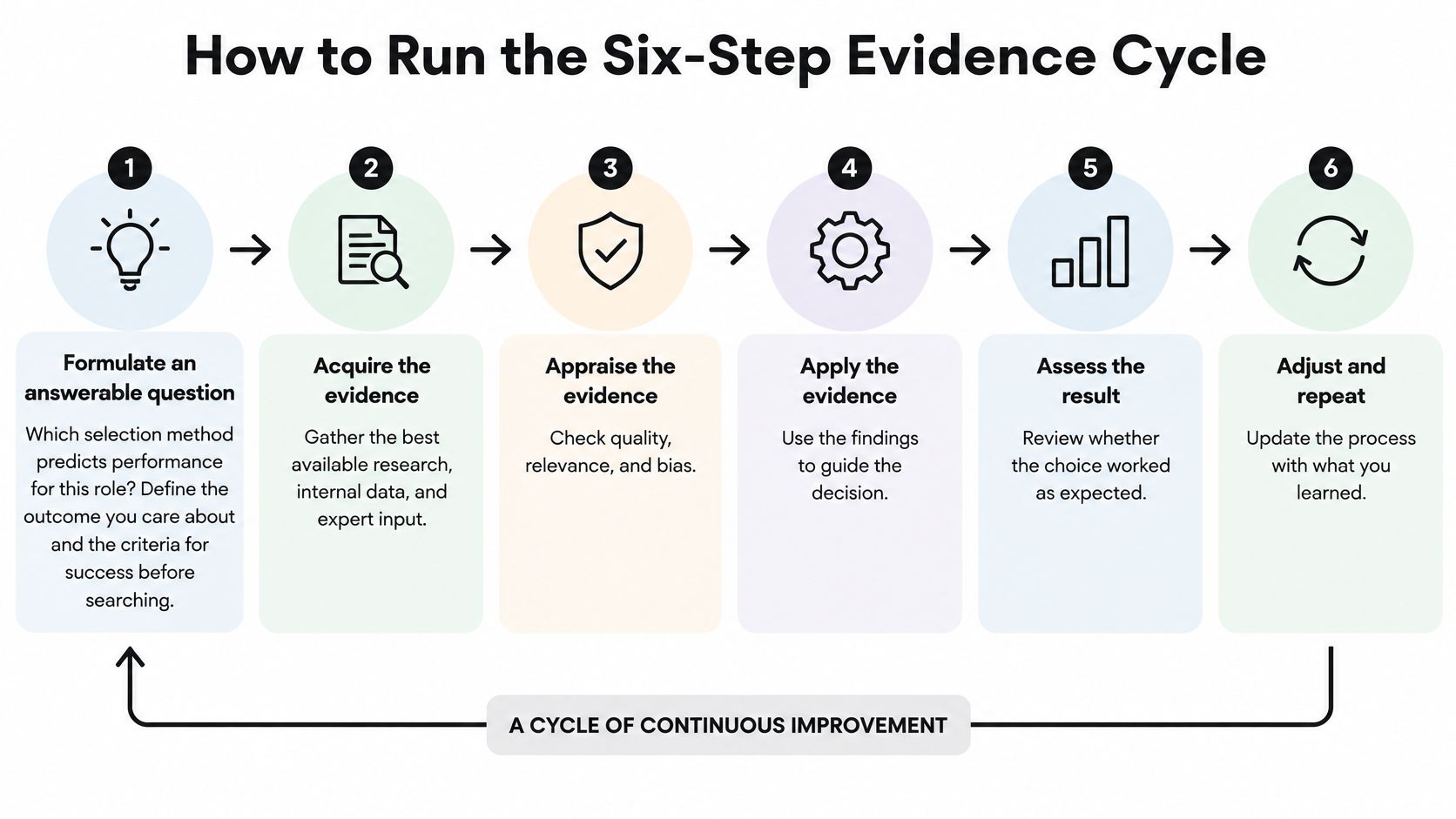
The [CIPD evidence-based practice factsheet](https://www.cipd.org/en/knowledge/factsheets/evidence-based-practice-factsheet/) describes a decision discipline built around asking, acquiring, appraising, aggregating, applying and assessing. Treat these as checkpoints, not a paperwork exercise.
The cycle is continuous because implementation gives you new information.
Turn a question into a testable decision
1. Formulate an answerable question. Ask which selection method predicts performance for a defined role, then specify what successful performance means before searching. A common slip is starting with a preferred tool and looking only for evidence that supports buying it.
2. Acquire relevant evidence. Gather published validation studies, technical manuals, internal performance records and practitioner observations, recording each source and sample. Don't accept a vendor claim without identifying the criterion behind it, such as sales output, supervisor ratings or training completion.
3. Appraise validity and applicability. Check sample size, population, measurement reliability and how performance was assessed. Treating a correlation as causal proof is a common mistake: a relationship can support prediction without showing that changing the predictor changes performance.
4. Aggregate the findings. Compare where sources agree and where they conflict, rather than choosing the most appealing result. Don't average away a meaningful difference, such as an assessment predicting training success but not sustained job performance.
5. Apply through a controlled pilot. Use a bounded hiring process with predefined success criteria, a cost estimate, an owner and an adverse-impact check before rollout. Skipping the baseline leaves you unable to distinguish improvement from ordinary fluctuation.
6. Assess and revise. Compare outcomes with the baseline and a credible comparison group, checking both results and whether managers followed the intended process. The mistake here is defending the original choice when local outcomes contradict its assumptions.
Keep a usable decision record
Create a one-page decision record with the question, evidence considered, limitations, stakeholder concerns, success criteria, pilot design and review date. Name who can authorize changes and what result would trigger a pause.
Keep the record short enough for a hiring manager to use. Its purpose is to preserve the reasoning, including rejected alternatives, so a new recruiter doesn't have to reconstruct why the process exists.
How to Check an Assessment Is Valid Before Using It
The [U.S. Equal Employment Opportunity Commission guidance](https://www.eeoc.gov/laws/guidance/employment-tests-and-selection-procedures) says employers must ensure selection procedures are properly validated for the positions and purposes in which they're used.
That means checking the intended interpretation, not merely whether a test has a scientific-looking report. Criterion-related validation examines relationships with job performance; content validation examines whether tasks represent important work; construct validation examines whether a measure captures a job-relevant psychological attribute.
Check the proposed use
1. Request role-relevant evidence. For a sales assessment, look for evidence linked to comparable sales work, not a general statement about workplace behavior.
2. Identify the validation strategy. A realistic customer-objection exercise might support a content-based argument. A claim that its score predicts later sales performance needs evidence of that relationship.
3. Check transferability. Establish whether the evidence comes from your organization or another setting, then document why the work, applicants and conditions are sufficiently comparable.
4. Inspect the performance criterion. For an architectural role, define a deliverable before designing a work sample. A resource such as [BIM project handover explained by HireArchitects](https://hirearchitects.com/bim-modeling/) can help frame the work discussion, but it doesn't itself validate a selection procedure.
5. Interpret probability, not certainty. The [American Psychological Association's job-performance overview](https://www.apa.org/topics/healthy-workplaces/job-performance) reports that general cognitive ability and conscientiousness together can account for approximately 20% to 30% of variance in job performance. That describes relationships across samples, not a guarantee about an individual.
A separate distinction matters: consistent measurement doesn't automatically establish a useful interpretation. Use this explanation of [assessment validity and reliability](https://synopsix.ai/blog/assessment-validity-and-reliability) to distinguish repeatable scores from evidence that supports the decision.
> Go or no-go question: Can we explain why this score supports this decision for this role, using a meaningful measure of success?
Evidence Based Decisions in Hiring and Promotion
Say a sales team relies on conversational interviews. Interviewers ask different questions, write uneven notes and defend candidates who feel persuasive, leaving the panel without comparable evidence.
A panel can look professional while still using an inconsistent process.

The [personnel-selection literature summary](https://en.wikipedia.org/wiki/Personnel_selection) reports corrected validity of about 0.63 for structured interviews, compared with 0.20 for unstructured interviews, and approximately 0.64 for consensus-rated structured board interviews. These are correlation estimates, not percentages of correct hiring decisions.
Change the mechanics
The team keeps the role and candidates but introduces standardized prompts about prospecting, objection handling and account follow-through. Interviewers score independently against behavioral anchors informed by job requirements and checked against examples from strong performers, then discuss evidence rather than impressions.
For remote healthcare administration roles, a role-scoping resource such as MedicalVirtual's [Hire Medical Virtual Assistants](https://medicalvirtual.com/assistants/) can help frame the staffing discussion. Recruiters must still define and assess the actual scheduling, communication and confidentiality tasks.
Use the same discipline when [reducing hiring bias](https://synopsix.ai/blog/how-to-reduce-hiring-bias): comparable questions and documented ratings make judgments easier to examine.
For additional context on people decisions, consider the accompanying video.
<iframe width="100%" style="aspect-ratio: 16 / 9;" src="https://www.youtube.com/embed/Dt6sefbuMXs" frameborder="0" allow="autoplay; encrypted-media" allowfullscreen></iframe>
In a promotion scenario, internal records reveal inconsistent manager ratings. The team combines job-relevant predictor evidence, observations of conscientious follow-through, leaders' fairness priorities and the practical limits of a small candidate pool.
It chooses a common leadership exercise and calibrated scoring, while retaining judgment about candidates' opportunities to demonstrate leadership. The process mechanics matter more than the tool's category: calling something an interview or assessment doesn't establish how well it's used.
Where Evidence Based Practice Falls Short
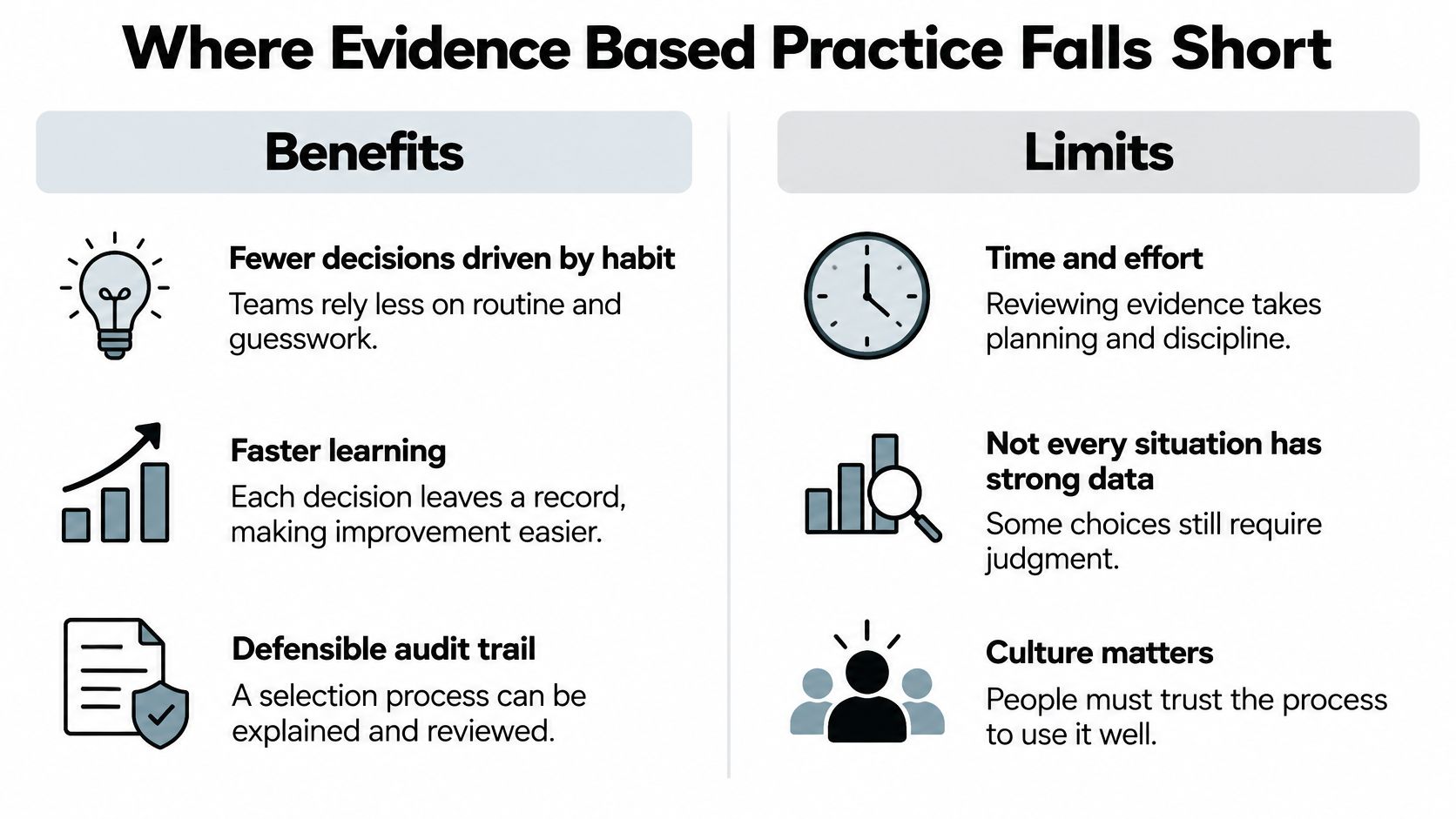
Evidence-based practice gives teams a way to challenge habit. When managers must name the evidence behind a preference, they can separate an observable job requirement from familiarity with a candidate.
A decision record also supports faster organizational learning and a defensible audit trail. It lets reviewers examine what decision-makers knew, which alternatives they considered and why they acted.
Strong-looking estimates can mislead
A [2021 reassessment of personnel-selection validity estimates](https://experts.umn.edu/en/publications/revisiting-meta-analytic-estimates-of-validity-in-personnel-selec/) found that commonly used range-restriction corrections could overcorrect, reducing mean validity estimates for many procedures by approximately 0.10 to 0.20 points, although structured interviews remained top-ranked. A useful ranking doesn't make every published effect size dependable.
Selection leaders should examine the assumptions behind corrected estimates, not repeat the largest number in a vendor presentation. A smaller, credible estimate is more useful than an impressive figure whose interpretation doesn't survive scrutiny.
The benefits and limits need to be considered together.
Knowing isn't implementing
A [2025 implementation study and discussion of adoption barriers](https://pmc.ncbi.nlm.nih.gov/articles/PMC11987419/pdf/12912_2025_Article_3059.pdf) identified insufficient staffing and time as obstacles, with multifaceted strategies explaining only 27% of variance in implementation intentions. Its discussion also identifies limited skills, insufficient training and difficult technology as practical barriers.
No dashboard removes the need to give managers time, usable instructions and support. Make the trade-offs explicit:
Invest most heavily in recurring, high-volume or high-cost decisions. A documented judgment may be proportionate for a low-risk, one-off choice, but it doesn't excuse ignoring legal duties or foreseeable harm.
Metrics That Show Whether Decisions Work
Adoption isn't effectiveness. A [systematic review of 129 experimentally tested implementation studies](https://pubmed-d.ncbi.nlm.nih.gov/39350295/) reported positive change in adoption and implementation outcomes in roughly three-quarters of studies, compared with approximately 54% of effectiveness outcomes and 58% of maintenance outcomes.
For HR, that distinction means a completed scorecard isn't proof of better hiring. Build a logic model connecting the evidence to manager behavior and then to a business outcome, and establish the baseline before rollout.
Metrics to track evidence based people decisions
| Metric | What It Shows | How to Calculate | |---|---|---| | Prediction accuracy | Whether scores match later performance | Correlation between the selection score and later performance rating | | Quality of hire | Performance of new hires against defined criteria | Average standardized performance score against agreed role criteria | | Time to productivity | How quickly a new hire reaches agreed output | Days from start date to agreed output level | | First-year turnover | Early attrition after a selection decision | Hires leaving within their first year divided by hires with a complete first-year observation window | | Adverse impact ratio | Differences in selection outcomes across groups | Each group's selection rate divided by the highest group's rate | | Manager adoption | Whether managers use the process as designed | Share of decisions with documented criteria and scores | | Cost of mis-hires | Financial impact of errors | Replacement, ramp-up and lost output costs per failed hire |
Use a review rhythm
For adverse-impact monitoring, the four-fifths rule treats a selection-rate ratio below 0.80 as a signal to investigate, not a complete legal judgment. Check sample sizes, practical significance and the applicable legal context rather than treating a threshold as automatic clearance.
Compare a pilot with a credible comparison group, and schedule a maintenance review at twelve months rather than stopping after the first quarter. These are recommended review intervals, not guarantees of sufficient evidence.
For ongoing employee feedback, [moving beyond annual surveys with Pebb](https://pebb.io/glossary/how-to-measure-employee-engagement) offers a complementary measurement perspective. Connect feedback with operational results through [people analytics in HR](https://synopsix.ai/blog/people-analytics-in-hr), without treating engagement as a substitute for performance.
Check process fidelity monthly and outcomes quarterly. Change criteria when credible evidence supports the change, documenting why rather than adjusting them to make results look better.
Choose and Frame Your First Evidence Based Decision
Choose a recurring hiring decision for a clearly defined role, not your entire talent system. Write down the business problem, the outcome you want to improve and who owns the decision.
List the evidence inputs you already have and name the missing input. Then set the baseline, success measures and comparison approach before changing the process.
Make the first action concrete
If you're considering a behavioral assessment, obtain the role-relevant validation study and inspect the criterion behind its accuracy claim. Don't confuse matching evidence with predicting every future behavior.
At Synopsix, our average evidence-match accuracy is 87%. That measure shouldn't be read as a promise of hiring success or as a substitute for validating an intended use.
Keep the scale decision explicit: Did the pilot improve the outcome you measured, without creating an adverse-impact problem? If the answer is unclear, investigate rather than expanding by default.
---
Synopsix offers executive reports written in plain business language, backed by the same evidence as a financial decision, to help leaders connect behavioral assessments with practical people decisions. Visit [Synopsix](https://synopsix.ai) to explore how that approach could support a clearly defined hiring, promotion or team-design decision.