What Is Leadership Assessment and How It Actually Works
By Synopsix · September 18, 2026 · 17 min read
A leadership assessment is a structured evaluation of behaviors, traits, and decision patterns against role-relevant criteria, used to predict leadership performance and identify development needs. Assessment-center methods have shown a corrected correlation of .28 with supervisory performance ratings, with a 95% confidence interval of .24 to .32.
The popular advice is to find a personality test, add a 360-degree survey, and treat the resulting profile as a reliable picture of leadership potential. That approach confuses description with prediction. A profile can tell you how someone describes their preferences or how colleagues currently experience them, yet still say little about how they'll behave when priorities collide, authority is unclear, or the organization changes direction.
The more useful question is not, “What kind of leader is this person?” It's, “What evidence indicates how this person will perform in this role, under these conditions, and what can development change?”
What Leadership Assessment Actually Measures
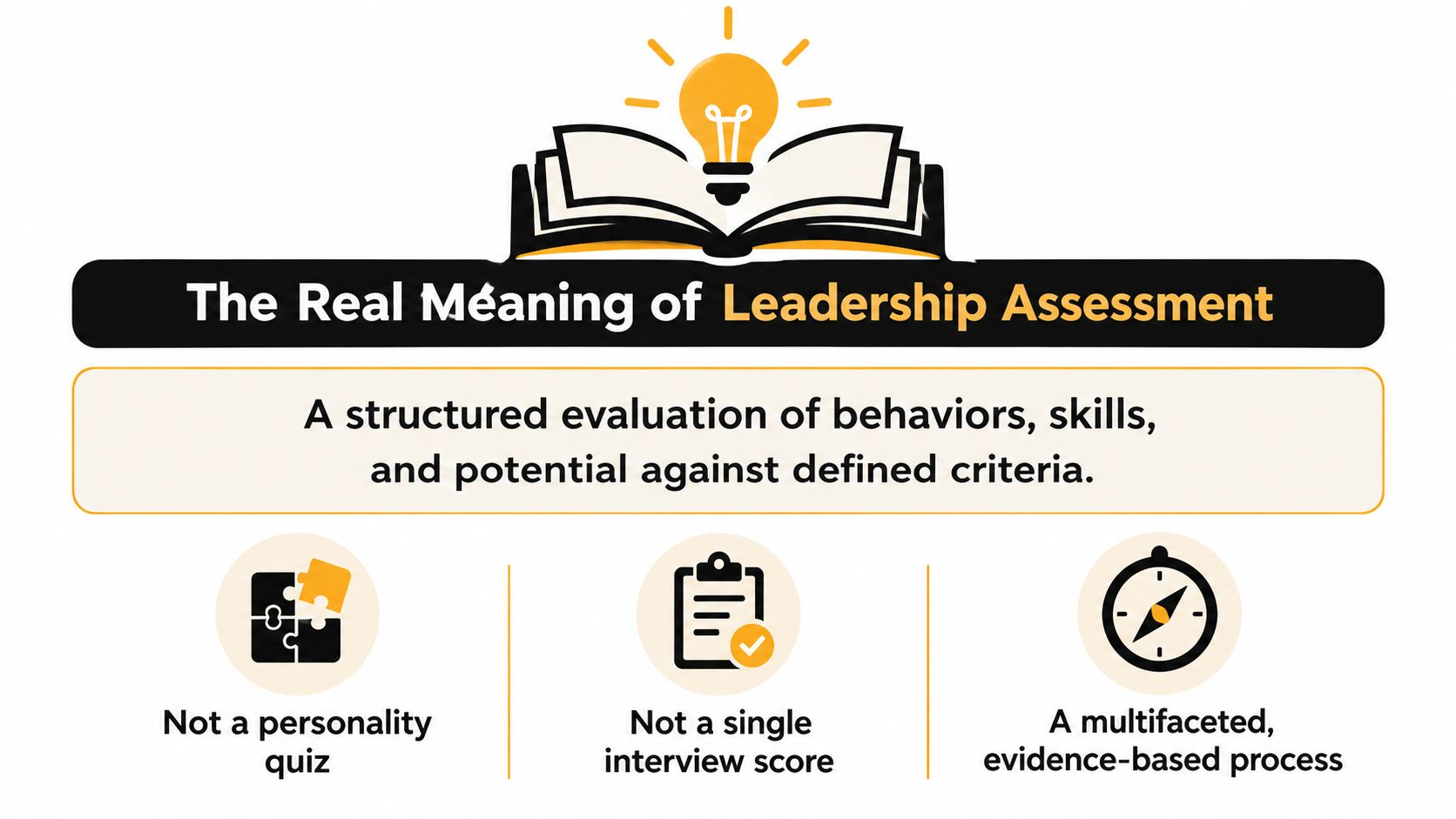
Leadership assessment is not a personality quiz with a more serious label. It is a structured evaluation of behaviors, traits, and decision patterns measured against criteria that matter for a specific leadership role. Its practical purposes include predicting performance, informing hiring or promotion decisions, and identifying development needs.
The key distinction is between description and prediction. Descriptive profiling summarizes how someone appears on paper, such as being outgoing, analytical, or comfortable with risk. Predictive assessment examines whether those characteristics, observed behaviors, and role evidence connect with outcomes the organization values. A chief executive may need strategic judgment under ambiguity, while a frontline manager may depend more on coaching, planning, and consistent execution. A score has no fixed meaning outside the job and conditions in which it will be used.
Four questions every CHRO should ask
A sound assessment should answer four questions:
1. What is being measured? Are the dimensions linked to actual tasks, decisions, and interpersonal demands? 2. Which method provides the evidence? Does the method observe behavior, ask about past behavior, collect others' perceptions, or infer tendencies from self-report? 3. How predictive is the evidence? Has the assessment been tested against later performance or another relevant outcome? 4. What decision will follow? Will the results guide selection, development, succession, coaching, or role redesign?
These questions turn an assessment from a report into a small validity study. Each method is one lens, not a complete picture. Job analysis defines what matters, methods supply different kinds of evidence, and later outcomes show whether the interpretation holds.
The field is strongest when the evidence sources fit the role and are interpreted together. It weakens when an attractive report replaces job analysis and labels become conclusions. Assessment can predict meaningful aspects of leadership, but the signal is moderate, constructs may overlap, and high-stakes decisions require several evidence sources plus reinforcement after the decision.
How the Field Evolved From Military Selection to Modern Practice
Leadership assessment has deep roots in military selection. During World War II, standardized approaches to identifying leadership potential were formalized through military personnel selection, including methods associated with the Office of Strategic Services. These efforts used multiple assessors and situational exercises rather than relying only on patronage, credentials, or an interviewer's intuition. The historical account in [the PubMed review of leadership research](https://pubmed.ncbi.nlm.nih.gov/34487621/) describes how the field later expanded beyond narrow trait screening.
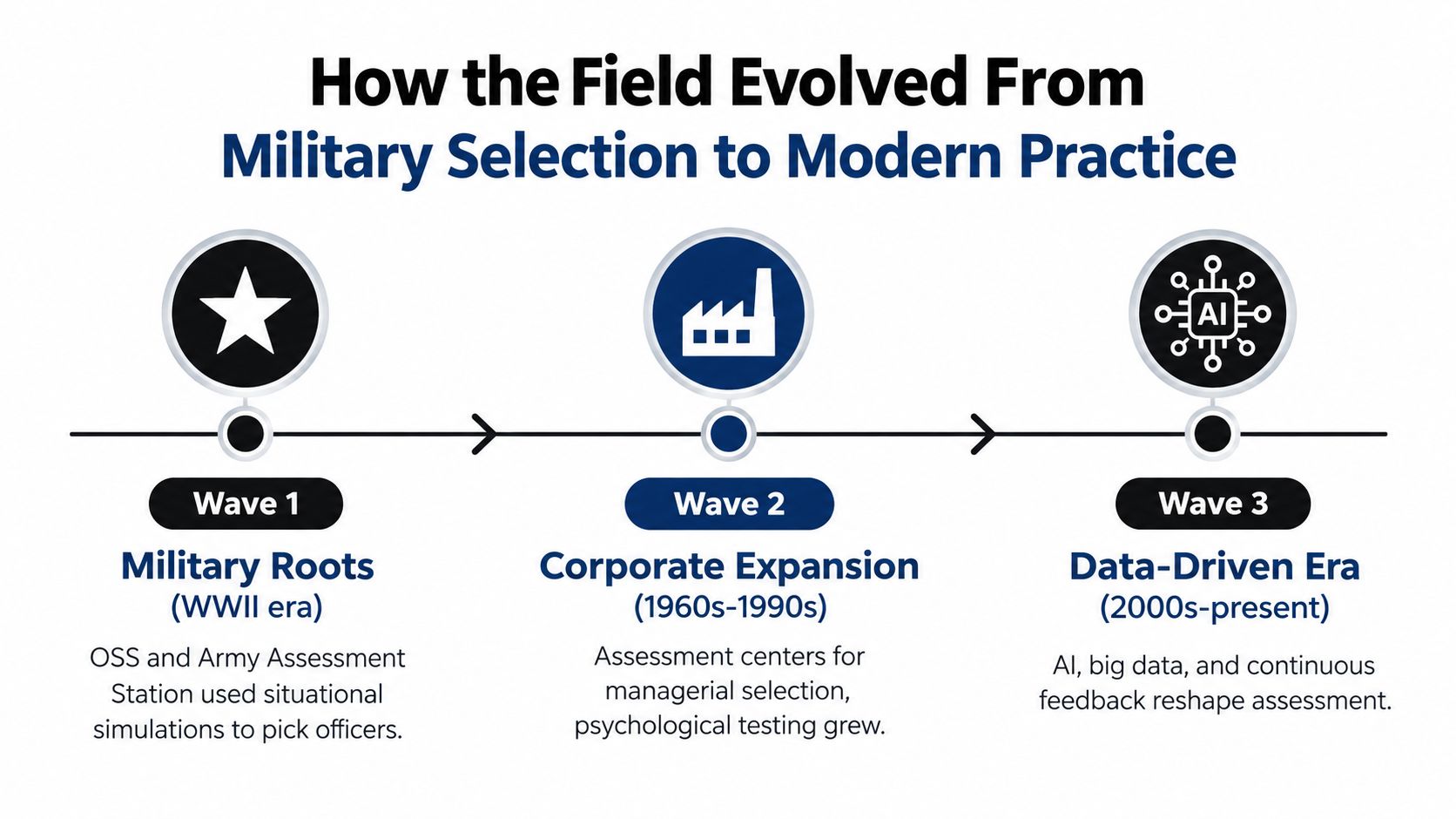
Three waves changed the question
After World War II, leadership research moved through three broad waves:
Each wave corrected a limitation in the previous one, but each also introduced new risks. Trait approaches can overgeneralize. Behavioral approaches can assume that a behavior works everywhere. Self-report instruments can capture self-perception more readily than observable conduct. Multisource feedback adds perspective, yet it can also reflect politics, visibility, and the quality of a leader's relationships.
The modern practice is therefore an integration problem. Psychometrics, structured interviews, work samples, simulations, and feedback systems can complement one another. The historical lesson isn't that one method replaced another. It's that leadership becomes more assessable when organizations define the role clearly and collect different kinds of evidence about relevant behavior.
A current danger is regression toward convenience. Surveys are easy to distribute and summarize, so organizations can mistake a large volume of responses for a strong measurement system. More data doesn't automatically mean better evidence. A modern assessment should preserve the field's original insight, leadership potential is best examined through multiple observations in relevant situations.
Main Assessment Methods and What Each One Actually Measures
Every method samples a different part of the leadership criterion space. The table below uses qualitative reliability descriptions rather than invented numeric ranges, because reliability depends on the instrument, sample, administration, and role.
| Method | Target Construct | Reliability Range | Key Blind Spot | |---|---|---|---| | Personality inventories, such as Big Five or HEXACO | Stable tendencies, motives, and possible derailers | Depends on the validated instrument and scale | May not show how a person adapts behavior to a specific team or crisis | | Cognitive ability tests, such as Watson-Glaser or Raven's matrices | Reasoning, learning, problem solving, and judgment capacity | Depends on the test and administration conditions | Measures thinking capacity, not relationship quality or demonstrated leadership behavior | | Structured behavioral interviews | Past behavior, judgment, and role-relevant experience | Stronger when questions, scoring anchors, and interviewer training are standardized | Candidates may give polished examples that don't fully represent typical conduct | | Situational judgment tests | Responses to realistic leadership scenarios | Depends on scenario quality, scoring, and criterion linkage | Can measure applied judgment without observing sustained execution | | Multisource or 360-degree feedback | How colleagues, managers, and direct reports perceive current behavior | Depends on rater selection, aggregation, and response quality | Perceptions can reflect visibility, politics, role context, or limited observation | | Assessment-center exercises, including in-basket tasks and role plays | Observable behavior across standardized exercises | Depends on assessor training, exercise design, and scoring consistency | Exercise effects can blur distinct competencies | | Work-sample simulations | Performance in tasks that resemble the target role | Depends on fidelity, scoring, and validation against later outcomes | Resource demands can limit scale, and one simulation can't represent every challenge |
A personality inventory can clarify tendencies such as conscientiousness, openness, or risk orientation. It can't establish that someone will coach effectively during a difficult performance conversation. A cognitive test can provide information about reasoning, but it won't reveal whether a leader listens well or earns trust.
Structured interviews sit closer to behavior because they ask candidates to describe what they did, why they acted, and what happened. Situational judgment tests move the evidence toward applied decision making by presenting realistic dilemmas. Assessment centers and work samples go further still, because observers can examine conduct in simulated tasks.
The principle is triangulation. No single method captures stable traits, reasoning, judgment, interpersonal behavior, context, and future adaptability at once. Combining methods should be deliberate, not additive for its own sake. Each additional tool should answer a question that the existing evidence leaves unresolved.
How Well Leadership Assessment Predicts Real Outcomes
Predictive validity asks whether assessment results relate to later performance. Operational validity asks whether that relationship survives real organizational conditions, including different roles, raters, and business environments. Utility asks whether the information improves a decision enough to justify its cost, time, risk, and candidate experience.
The strongest verified evidence here concerns assessment centers. A meta-analysis covering 26 studies, 27 validity coefficients, and a total sample of 5,850 reported a corrected correlation of .28 between overall assessment ratings and supervisory performance ratings, with a 95% confidence interval of .24 to .32, as reported in [the Wiley study](https://onlinelibrary.wiley.com/doi/abs/10.1111/j.1468-2389.2007.00399.x). Later work summarizes broader criterion-related validity estimates for overall assessment-center ratings in the range of .27 to .47, as documented in [this Cambridge assessment-center article](https://www.cambridge.org/core/services/aop-cambridge-core/content/view/F4B99906869787BFF29362382B8DABB8/S1754942624000014a.pdf/inclusive_leadership_as_a_valid_assessment_center_dimension.pdf).
| Assessment Method | Meta-Analytic r with Performance | Best Use Case | Key Caveat | |---|---:|---|---| | Assessment-center ratings | .28, with broader summaries ranging from .27 to .47 | Ranking candidates and identifying development priorities | The relationship is useful but not decisive on its own | | Leadership work-sample test | .33 for subordinate-rated Consideration in one study | Observing role-relevant behavior | Other predicted dimensions were not significant | | Structured interviews | Predictive relationships vary by dimension and criterion | Selection and promotion decisions | Different interview dimensions predict different outcomes | | 360-degree feedback | No single verified coefficient is provided here | Development and feedback quality | Current perceptions don't automatically establish future readiness |
A leadership work-sample study followed 127 managers for more than 6 months and found a correlation of 0.33 between test performance and subordinate-rated Consideration, with a 95% confidence interval of 0.06 to 0.56. The supervisor-rated relationship was 0.22, with a confidence interval crossing zero, and the test didn't significantly predict Influencing others or Planning, according to [the criterion-related validity study](https://onlinelibrary.wiley.com/doi/full/10.1111/sjop.12954).
That pattern is instructive. A valid tool may predict one behavior and fail to predict another. For a CHRO, a moderate relationship supports ranking, diagnosis, and informed development. It doesn't justify treating an assessment score as a verdict. Use multiple hurdles, monitor outcomes after decisions, and expect incremental validity to plateau when new methods repeat information already captured.
Treating Assessment as a Validity Study Rather Than a Test Battery
A vendor score report is an output. A validity dossier is an argument supported by evidence. Before an assessment reaches a candidate slate, the organization should be able to explain why each construct belongs in the role model, how each score is calculated, and which later outcome the score is expected to predict.
Start with the job, not the instrument
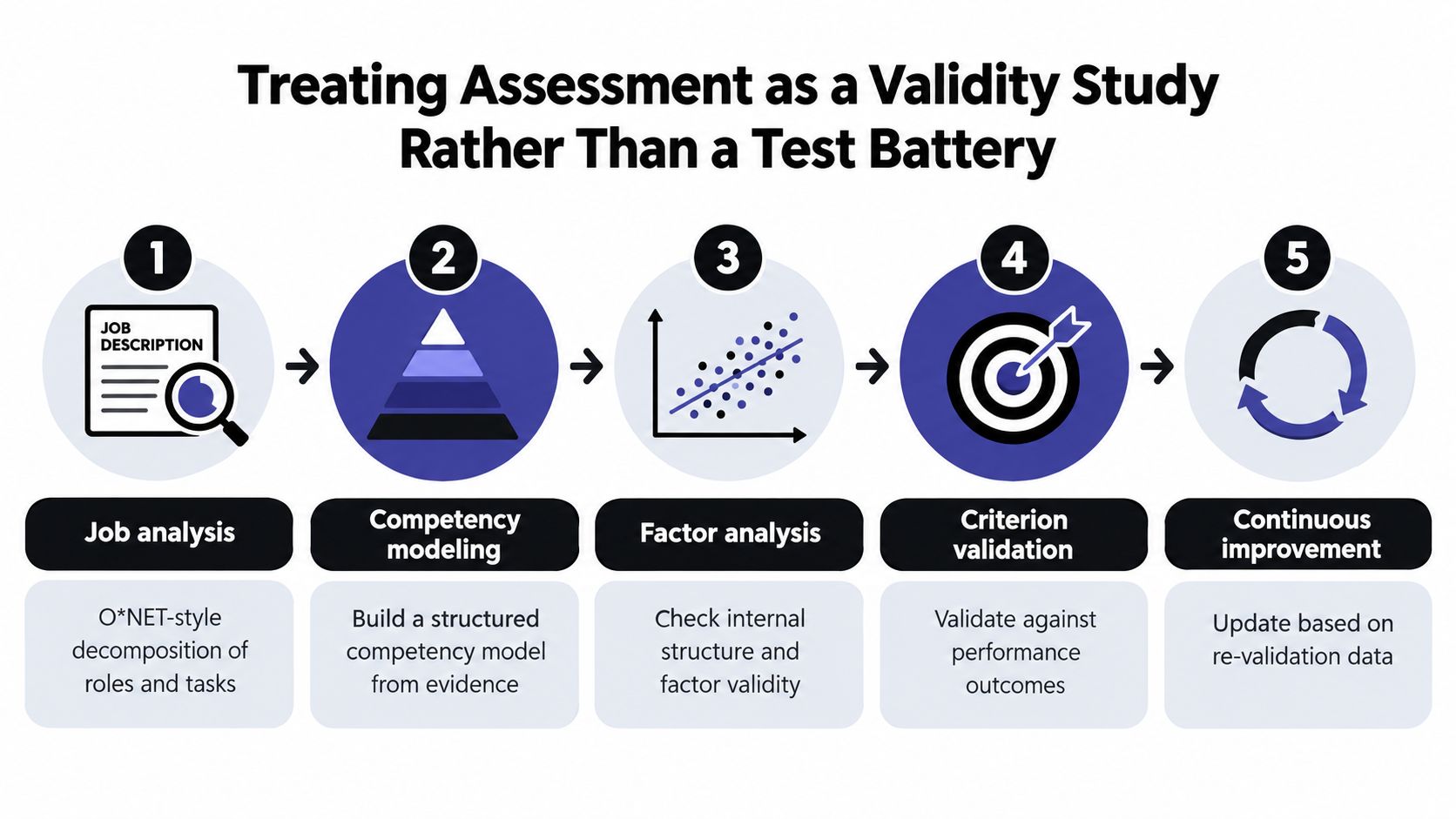
Begin with job analysis. Break the leadership role into tasks, decisions, relationships, constraints, and consequences. An O*NET-style decomposition can help organize the work, but internal subject-matter interviews, critical incidents, and observation should connect the model to the actual role.
Then define the KSAOs, knowledge, skills, abilities, and other characteristics, that the job requires. A competency label such as “strategic leadership” is too broad until it becomes observable. It might involve reallocating resources when evidence changes, communicating trade-offs, or coordinating decisions across functions.
Test the measurement model
Use exploratory factor analysis when the structure is uncertain and you need to examine which items cluster together. Use confirmatory factor analysis when you have a specified model and need to test whether the observed data supports it. Don't treat a good-looking factor label as proof that the construct is distinct.
Reliability also needs more than one number. Request internal-consistency estimates such as alpha or omega with confidence intervals, evidence of inter-rater agreement for observed exercises, and test-retest stability when the construct should remain relatively stable. [This practical guide to validating leadership assessments](https://beefed.ai/en/validating-leadership-assessments-psychometrics) emphasizes job analysis, internal-structure checks, reliability estimates, and criterion validation against later outcomes.
Criterion validation completes the chain. Choose proximal criteria, such as supervisor ratings of relevant behavior, and distal criteria, such as objective business outcomes, while checking for criterion contamination. Run concurrent studies when immediate evidence is necessary, but prioritize predictive studies when the assessment will guide future hiring or succession. Compare incremental validity against a structured interview baseline, rather than celebrating a correlation in isolation.
> Buyer standard: Ask for the role analysis, construct definitions, scoring rules, reliability evidence, fairness analyses, validation sample, criterion definitions, and revalidation plan before accepting a polished report.
For a deeper treatment of measurement quality, see [assessment validity and reliability](https://synopsix.ai/blog/assessment-validity-and-reliability). A serious buyer should receive evidence that the tool measures the intended constructs and predicts outcomes relevant to the decision, not merely an attractive set of behavioral descriptions.
Using Leadership Assessment for Hiring and Development
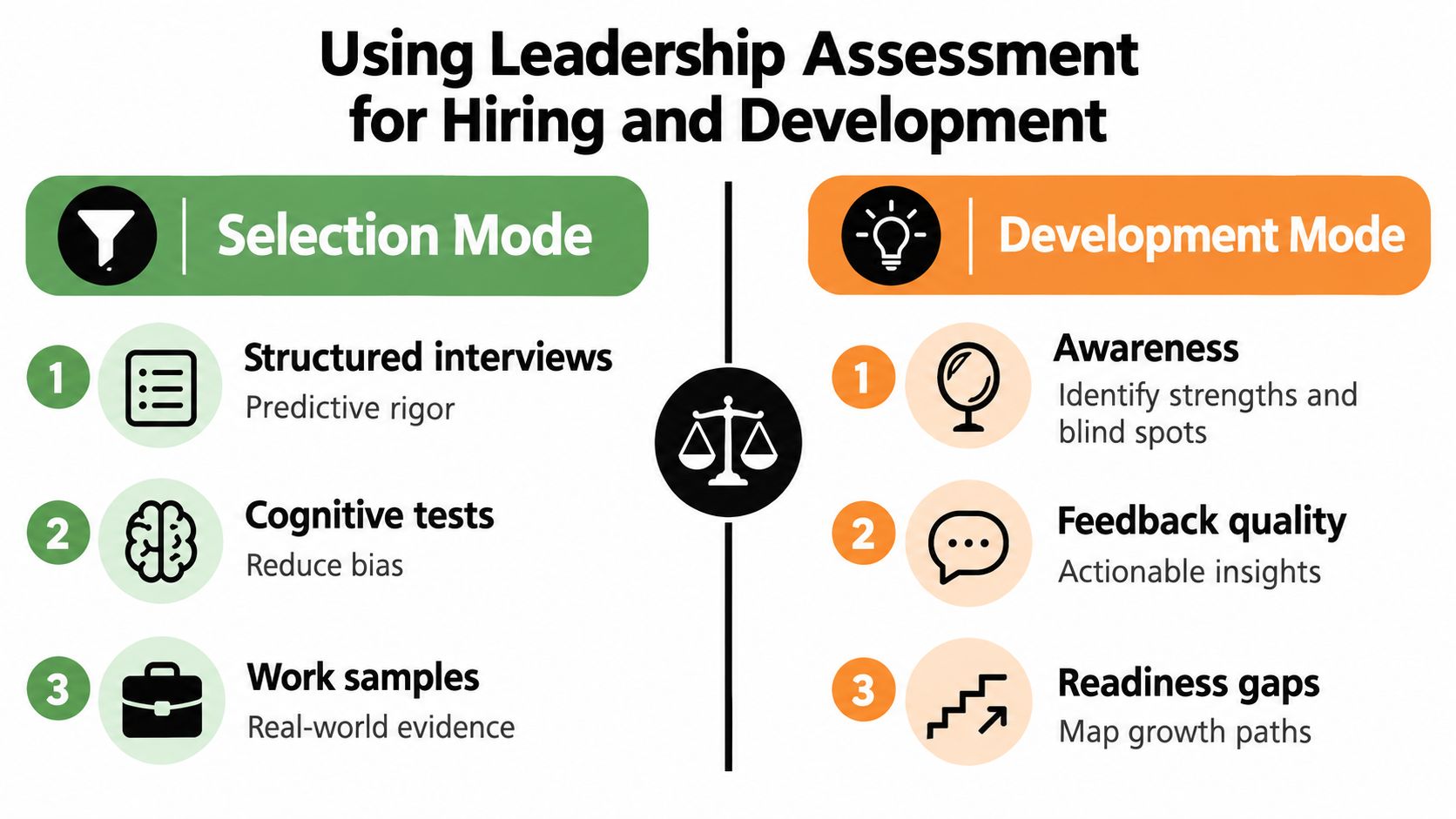
Selection and development use the same instruments for different purposes. Selection asks whether the evidence supports a comparative decision between candidates. Development asks what a person can understand, practice, and improve. Confusing those purposes turns a useful feedback tool into an unjustified promotion gate.
Selection mode
A hiring funnel should move from broad evidence to direct observation:
1. Structured situational interview: Ask every candidate comparable, role-linked questions and score responses against behavioral anchors. 2. Work sample or assessment-center exercise: Give finalists a realistic task, such as prioritizing competing requests, coaching a team member, or responding to a strategic change. 3. Personality and cognitive measures: Use these as supporting evidence about tendencies and reasoning, not as the sole basis for rejection. 4. Decision review: Examine the full evidence set, document the rationale, and monitor fairness at each hurdle.
The assessment should test whether the candidate can perform the next role, not only whether they have performed the current one successfully. A high-performing functional expert may need different capabilities when the job expands from individual delivery to enterprise influence.
Development mode
Development starts with feedback and interpretation. A 360-degree report can reveal a gap between self-perception and how colleagues experience a leader. An assessment-center debrief can make that gap concrete by showing what happened during a role play or prioritization exercise.
Translate findings into an Individual Development Plan with a small number of observable behaviors, practice opportunities, coaching support, and follow-up evidence. Personality results can help explain a recurring pattern, while simulations can provide a rehearsal environment for changing it. Succession planning should combine current performance, development progress, and evidence of readiness for future demands.
| Decision mode | Primary question | Strong evidence | Metrics to report | |---|---|---|---| | Selection | Who is most likely to perform in this role? | Structured interview, work sample, simulation, validated supporting measures | Quality of hire, later performance, fairness, candidate experience | | Development | What should this leader practice next? | 360 feedback, assessment-center feedback, coaching, role-based simulations | Behavior change, readiness movement, retention, well-being, manager observations |
A board or CEO will eventually ask whether the person can scale with the strategy. That question requires future-role evidence, not just a current-role profile. [Leadership readiness assessment](https://synopsix.ai/blog/leadership-readiness-assessment) can be considered within that broader design, provided the organization validates the readiness criteria against the role it intends to fill.
Where Leadership Assessments Fall Short
The central weakness is often construct validity, whether the assessment clearly measures the leadership concepts it claims to measure. Commercial inventories can use scientific-sounding labels while relying heavily on self-report items that don't map cleanly to role behavior. A person may endorse decisiveness, empathy, or strategic thinking without demonstrating those qualities when the situation becomes difficult.
Assessment centers aren't immune. A thesis study comparing assessment-center ratings with 360-degree feedback found low convergent and discriminant validity across four leadership competencies. Ratings within exercises were especially correlated, while ratings across methods were low, suggesting that exercise format can blur whether separate competencies are distinct, as reported in [the Western Kentucky University thesis](https://digitalcommons.wku.edu/theses/404/).
An independent review also highlights recurring concerns about weak construct validity in leadership scales, including work examining the Multifactor Leadership Questionnaire, as described in the PLOS One review. These findings don't make assessment useless. They impose design constraints.
| Method | Predictive Validity (r) | Faking Risk | Adverse Impact Risk | Best Used For | |---|---:|---|---|---| | Self-report personality survey | Varies by instrument and criterion | Higher when stakes are visible | Must be audited by subgroup and use case | Reflection and supporting evidence | | 360-degree feedback | Depends on raters, aggregation, and criterion | Social desirability and political distortion can occur | Depends on rater access and organizational context | Development and feedback conversations | | Structured interview | Varies by dimension and criterion | Candidates can rehearse examples | Interviewer bias and inconsistent scoring require controls | Selection with standardized protocols | | Situational judgment test | Depends on scenario quality and scoring | Responses can be optimized | Must be checked across relevant groups | Contextual judgment evidence | | Work sample or simulation | Depends on fidelity and validation | Lower than self-report when behavior is observed | Access, accommodation, and exercise design matter | Demonstrated role behavior |
The business context adds another blind spot. [DDI's 2025 Global Leadership Forecast findings](https://www.harvardbusiness.org/wp-content/uploads/2025/07/HBI_2025-Global-Leadership-Development-Study_Research-Findings_May25.pdf) report that high-potential individual contributors intending to leave rose from 13% in 2020 to 21% in 2024. The same source describes worsening trust and burnout among leaders. Those facts raise a practical question: can a conventional survey capture overload, resilience, and retention risk, or does it mostly record visible competencies under ordinary conditions?
More items and more raters won't automatically solve that problem. Treat assessment as one input in a monitored decision system, never as a tiebreaker that overrides job evidence, context, and observed behavior.
Choosing Tools and Measuring ROI Without the Hype
Vendor selection should begin with evidence, not a dashboard demonstration. Ask how the assessment was linked to the target job, which criteria were used, how reliability was estimated, and whether the vendor has examined fairness across the populations who will take it. Request transparent scoring rules, sample reports, administration requirements, accommodations, data controls, and a plan for reviewing outcomes after deployment.
A practical buying screen
Use these questions before signing:
A personality archetype can be engaging, but it isn't a substitute for role-behavior evidence. Assessment centers and situational judgment tests may offer more direct evidence of decisions in context, while self-report tools can remain useful for reflection and hypothesis generation.
For practical comparison criteria, review [leadership assessment tools](https://synopsix.ai/blog/leadership-assessment-tools). Synopsix is one option that combines behavioral assessments with comparable profiles, business-oriented reports, predictive simulations, compatibility analysis, and development planning. Its role in a governance system should still be judged by job linkage, validation evidence, fairness monitoring, and internal outcomes.
Measure value and exposure together
Build the ROI case around outcomes your organization can observe:
Buy when a validated external method solves a recurring problem and your team lacks the scale to build it. Build when the role is highly specialized and you can collect enough internal evidence for validation. Blend when a vendor supplies the measurement infrastructure but your organization supplies job analysis, criteria, governance, and follow-up.
Revalidate on a defined cadence, including every two to three years when that interval fits the role, workforce, and evidence available. The responsible question isn't whether an assessment sounds scientific. It's whether the tool improves a specific people decision, under your conditions, without creating an unmeasured fairness or well-being cost.
---
Synopsix helps HR teams translate scientifically validated behavioral assessments into role-specific signals for hiring, leadership development, team design, and succession decisions. Visit [Synopsix](https://synopsix.ai) to explore comparable behavioral profiles, predictive simulations, compatibility analysis, and development guidance that connect assessment evidence to action.