What Is Leadership Potential and How to Spot It
By Synopsix · September 27, 2026 · 17 min read
Leadership potential is a multidimensional, forward-looking estimate of whether someone can grow into broader leadership responsibility, measured across analytical skills, learning agility, drive, and emergent leadership rather than judged from current performance alone. Research treats it as a predictor of future leadership effectiveness, not as a single personality trait or a reward for being well liked.
That definition challenges the most popular advice about spotting future leaders. Many organizations still equate potential with a strong performance review, a recent promotion, confidence in meetings, or a manager's instinct that someone “has it.” Those signals may matter, but none answers the central question: Can this person's capabilities and behaviors scale when the work becomes more ambiguous, politically complex, and consequential?
The answer requires more than intuition. It requires repeated observation, several forms of evidence, and a fair way to distinguish current delivery from future capacity. It also requires humility, because any assessment of potential is a probability estimate, not a guarantee.
Why Leadership Potential Is Not the Same as Past Performance
Leadership potential isn't just past performance with a more flattering label. Performance describes what someone has delivered within a particular role, team, manager relationship, and level of complexity. Potential estimates how that person may perform when the context changes and responsibility expands. The two can overlap, but they answer different questions.
A useful analogy is running. Someone's current mile time tells you something about their present fitness, but it doesn't establish how they'll handle a marathon next year. Both involve running, yet the longer event demands pacing, endurance, adaptation, and a different approach to setbacks. In the same way, an excellent individual contributor may struggle with delegation, competing priorities, or influence across functions when promoted.
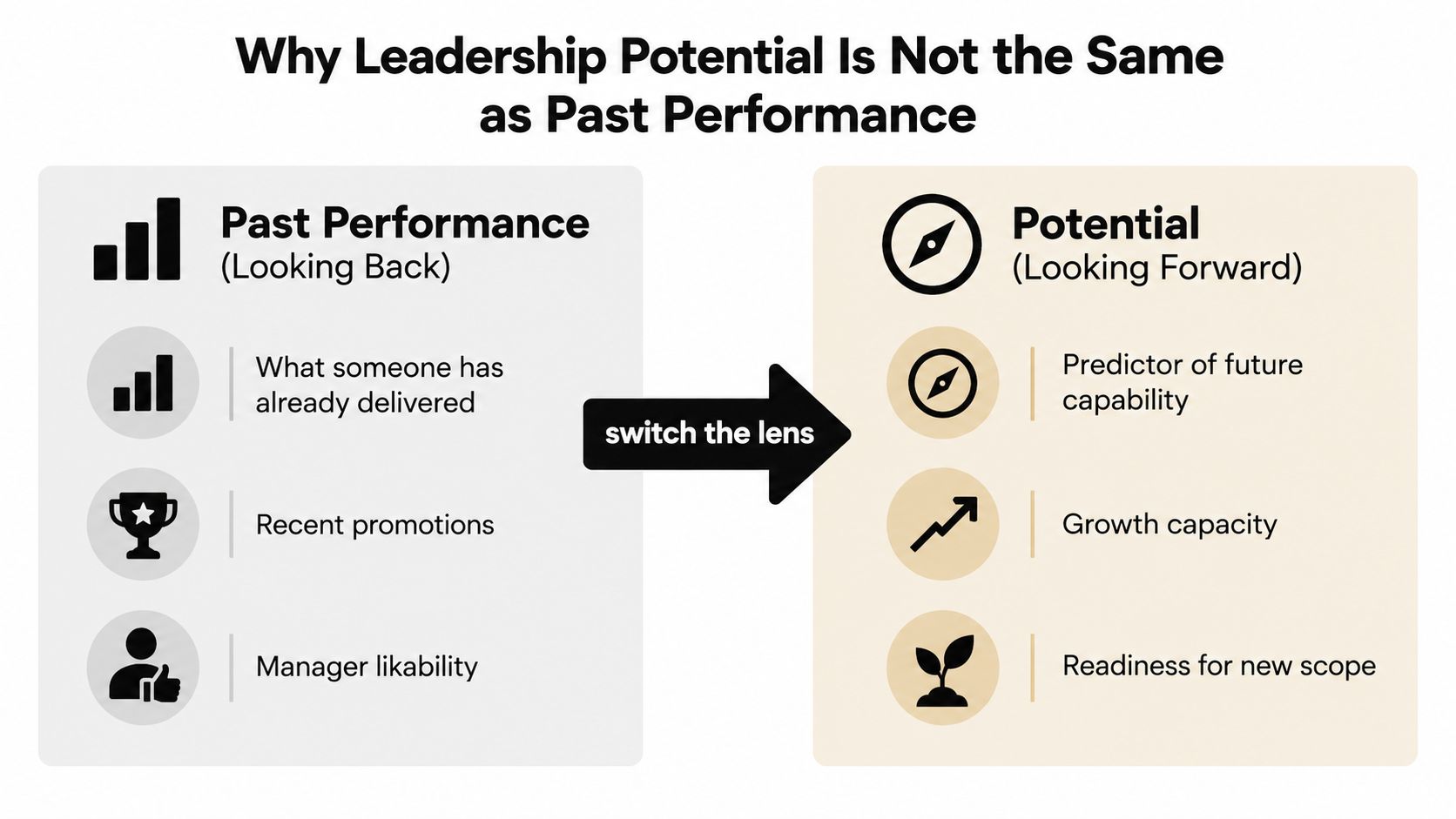
The lens HR teams need to switch
Current performance is often easier to observe than future capacity. A manager can point to sales results, project delivery, quality ratings, or visible ownership. Those records are useful, but they usually describe the employee's success within an established operating system. Leadership potential asks what happens when the system itself becomes unclear.
Research defines potential referentially, meaning a person has potential when measured attributes predict future growth in leadership effectiveness over time. That's why a longitudinal view matters. One manager rating or one successful project can't show whether a person learns from changing conditions, sustains effort, solves unfamiliar problems, or attracts cooperation without formal authority. The leadership-potential literature recommends evaluating multiple predictors rather than relying on past performance alone ([Wiley's research on leadership potential](https://onlinelibrary.wiley.com/doi/10.1002/hrm.21473)).
> Practical rule: Treat performance as evidence of current contribution, and potential as a testable hypothesis about future scope.
A strong talent review therefore separates two ratings. The first asks, “How effectively is this person performing in the current role?” The second asks, “Which behaviors suggest they could become effective at a broader level?” That separation prevents organizations from promoting the most visible high performers by default and overlooking people whose capabilities have not yet been displayed in a formal leadership role.
The Four Dimensions of Leadership Potential Explained
A widely cited model developed from the 1986–2010 literature organizes leadership potential into four predictor quadrants: analytical skills, learning agility, drive, and emergent leadership ([the four-quadrant leadership-potential model](https://onlinelibrary.wiley.com/doi/abs/10.1002/hrm.21473)). These dimensions are distinct, although they can reinforce one another. They shouldn't be reduced to a single “leadership score.”
Take a mid-level analyst assigned to a new cross-functional project. The project has incomplete information, stakeholders with competing priorities, and no established playbook.
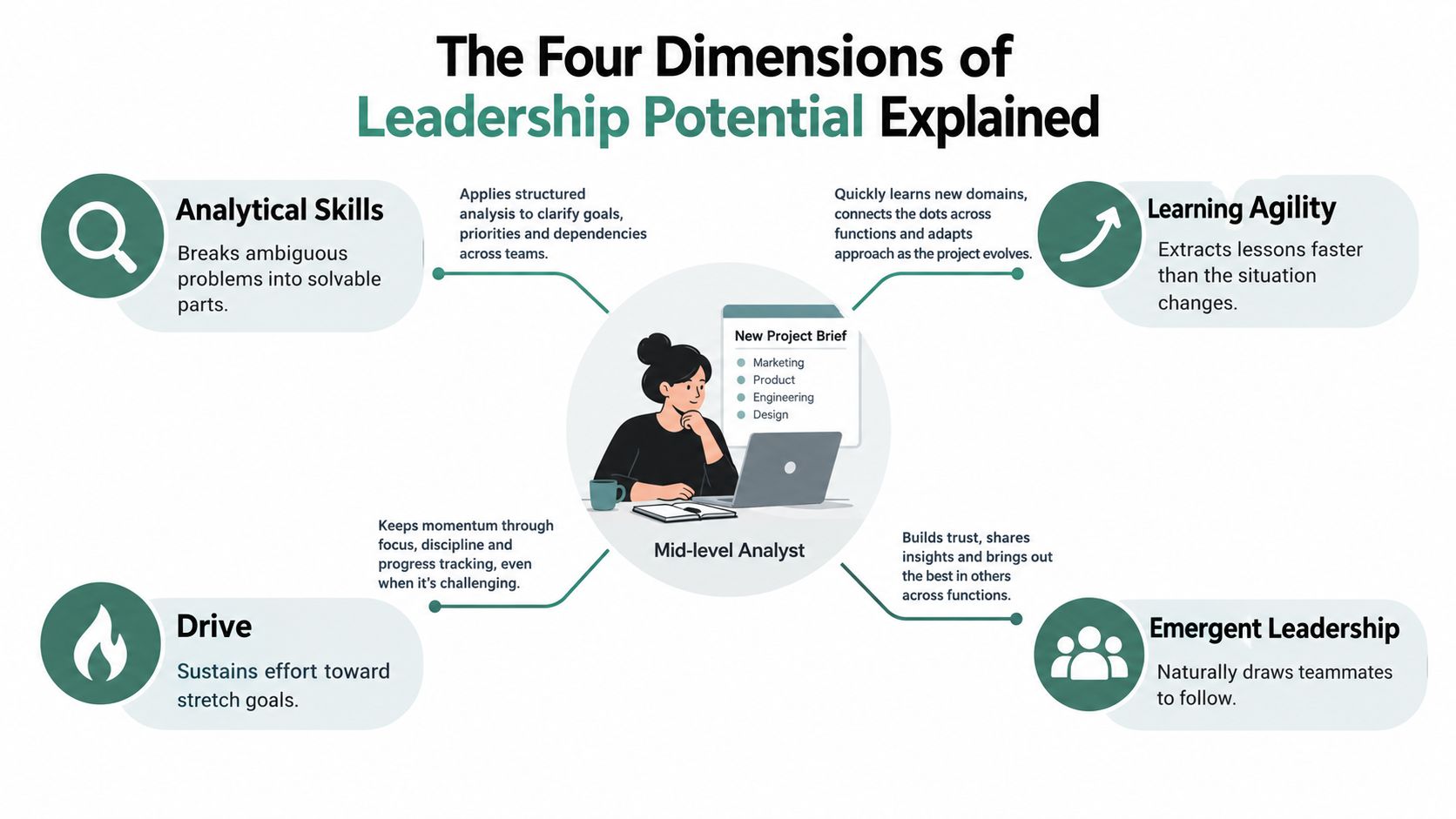
Analytical skills
The analyst breaks an ambiguous problem into solvable parts. They identify what is known, test assumptions, compare trade-offs, and connect the immediate project to broader business priorities. Analytical skills include intellectual curiosity, strategic insight, decision making, and problem solving.
This dimension isn't the same as knowing the most technical detail. A future leader needs to frame the right problem and help others reason through it, especially when the available information is incomplete.
Learning agility
The analyst notices that the first approach isn't working, asks for feedback, and changes course without becoming defensive. Learning agility includes willingness to learn, emotional intelligence, and adaptability. It becomes visible when someone extracts useful lessons from an unfamiliar situation and applies them to the next decision.
A person can be highly agile while still developing confidence in group settings. That distinction matters. The analyst may learn quickly but hesitate to speak first in a meeting.
Drive
Drive shows up in sustained effort, not a burst of enthusiasm. The analyst keeps stakeholders aligned, follows through on difficult tasks, and continues working toward the project's goal when progress slows. The model links drive with results orientation, perseverance, and dedication.
Drive also needs interpretation. Working long hours alone isn't proof of leadership potential. The stronger signal is purposeful persistence combined with judgment about where effort creates value.
Emergent leadership
Emergent leadership concerns whether others begin to rely on, trust, and follow the person, even without a formal title. The analyst may clarify a confusing decision, invite quieter colleagues into the discussion, and help the group move forward. This quadrant includes motivation to lead, self-promotion, and stakeholder sensitivity.
The analyst might score high on learning agility and drive but show only modest emergent leadership at first. That isn't an automatic disqualification. A development assignment, coaching, or a different team context may reveal whether influence can grow.
For practical guidance on the decision behaviors that help people handle uncertainty and competing priorities, HR teams can [browse leadership decision making](https://path-source.com/category/leadership-decision-making/) alongside a structured potential framework.
<iframe width="100%" style="aspect-ratio: 16 / 9;" src="https://www.youtube.com/embed/5B2smS8lspI" frameborder="0" allow="autoplay; encrypted-media" allowfullscreen></iframe>
These dimensions compound rather than operate as a simple average. Analytical ability without learning agility can produce clever but rigid decisions. Drive without stakeholder sensitivity can create forceful execution that damages trust. Emergent influence without sound judgment can create followership without direction. A useful assessment looks at the pattern and the role context, not only at a combined score.
Two Real Examples That Show Potential in Action
Consider a senior account manager whose performance ratings are consistently strong. They retain important clients, deliver reliable forecasts, and receive favorable feedback from their manager. When the organization gives them responsibility for a regional profit-and-loss area, the work changes. They now need to make trade-offs across sales, service, staffing, and finance, while influencing leaders who don't report to them.
The account manager keeps applying the habits that made them successful before. They solve customer issues personally, protect their own accounts, and prioritize immediate relationship repair over broader resource decisions. The results aren't disastrous, but the person struggles to scale. Strong performance in a defined client portfolio didn't prove readiness for enterprise-level complexity.
Now consider a quiet data analyst with less visible recognition. During a stretch assignment, the analyst coordinates a working group after the formal project lead becomes unavailable. They learn a new planning process quickly, ask specialists for input, persist through conflicting requirements, and summarize decisions so others can act. Colleagues begin bringing problems to them, even though they aren't the most outspoken person in the room.
The analyst's earlier reviews may have emphasized accuracy and task completion, missing the emerging evidence of influence. The stretch assignment creates a better observation window for learning agility, drive, and emergent leadership.
These examples don't prove that one employee will become a better leader than the other. They show why time horizon and context change the evidence. Tenure, visibility, and recent ratings can help identify people worth examining, but they can't replace a deliberate assessment of how someone handles broader scope.
Assessment Methods That Predict Future Leaders
Charisma and a strong performance record can make someone look ready for promotion. Neither, by itself, predicts how that person will learn, influence others, handle complexity, or sustain effort across a changing role. Assessment works better when several methods observe different parts of the four-dimensional construct over time, then relate the evidence to the demands of the target role.
What each method can reveal
Behavioral inventories examine patterns in communication, influence, responses to pressure, and workplace preferences. The Predictive Index, HPI, and OPQ belong to this family, although quality depends on the instrument, its administration, and its validation evidence. Organizations use behavioral assessments in hiring, onboarding, coaching, and succession planning. One provider describes online completion in under 8 minutes with instant visual insights ([Thomas behavioral assessments](https://www.thomas.co/assessments/behavioral-assessments-tests)). These tools indicate likely behavior. They do not deliver a complete leadership verdict.
Cognitive ability tests examine reasoning, problem solving, and the capacity to work through complexity. They matter when leaders must diagnose unfamiliar problems or decide with incomplete information. Cognitive results still need behavioral and interpersonal evidence. Strong reasoning does not show whether a person can build trust, learn from others, or sustain effort when progress is slow.
Structured interviews give candidates comparable questions linked to the four dimensions and the role's success factors. Interviewers score evidence from specific situations instead of rewarding fluency, confidence, or personal similarity. DDI classifies interview-based assessments as medium validity for hiring and selection, while emphasizing standardization and trained interviewers ([DDI leadership assessment types](https://www.ddi.com/blog/leadership-assessment-types)).
Simulations provide a controlled observation window. An in-basket exercise can test prioritization, while a role-play may reveal listening, judgment, and sensitivity to stakeholders. Group exercises show whether a candidate adds useful structure without taking over. A rubric matters because observers can otherwise disagree about what good leadership looked like.
The evidence favors combining methods. Integrity-test research found an overall corrected mean validity of .43, with a 95% confidence interval of .32 to .52, for predicting workplace deviance across industries and countries over a 50-year span ([meta-analysis of integrity tests](https://journals.sagepub.com/doi/10.1177/18344909231171729)). A technical summary of the Predictive Index reports significant results in 94% of nearly 350 criterion-validity studies conducted since 1992 ([Predictive Index technical summary](https://clearrock.com/wp-content/uploads/2022/03/Science-Behind-the-PI-Technical-Summary-1.pdf)). These findings support structured behavioral measurement. They do not support treating one instrument as a universal promotion filter.
| Method | Validity (r) | Cost/Time | Bias Risk | Best Used For | |---|---|---|---|---| | Behavioral inventory | Varies by instrument and validation study | Usually low time burden and scalable | Response style and interpretation bias | Behavioral patterns, coaching, succession | | Cognitive ability test | Varies by test and role | Moderate administration burden | Adverse-impact risk if used without safeguards | Complex problem solving and reasoning | | Structured interview | Medium validity for hiring and selection (DDI) | Moderate time and trained interviewer effort | Lower when standardized, higher when improvised | Dimension-based evidence and motivation | | Simulation | Role and exercise dependent | Higher preparation and participant time | Observer inconsistency without rubrics | Applied judgment, influence, prioritization |
Teams building a broader competency model can use this [competency-based assessments guide](https://hiredbyskill.com/blog/competency-based-assessments) to connect observable behaviors with role requirements. HR leaders can also compare [leadership assessment tools](https://synopsix.ai/blog/leadership-assessment-tools), then check each instrument for appropriate reliability, validity, accessibility, and fairness evidence.
The best combination depends on the decision. For an emerging first-line manager, a behavioral inventory, structured interview, and practical role-play can provide a balanced view. For a senior director, add a complex business simulation and stakeholder evidence, since the role requires broader systems thinking and influence. Manager recommendations can supply context, but they should not be the sole assessment method. Growth potential becomes more credible when evidence accumulates across methods, situations, and time.
Bias and Fatigue Risks That Distort Potential Judgments
A talent-review grid can make a judgment look precise while hiding the cues behind it. Charisma, familiarity, confidence, and similarity to the nominator may shape a rating as strongly as evidence of future capacity.
Research has found a gendered double standard: evaluators valued “leadership potential” more for male candidates, while female candidates were favored when they showed leadership performance rather than potential ([research on leadership-potential measurement issues](https://research.vu.nl/en/publications/unravelling-leadership-potential-conceptual-and-measurement-issue/)). This issue arises because potential is meant to identify capacity before someone has received the opportunity to prove it in a leadership role.
Where judgment becomes especially vulnerable
A confident self-promoter may be read as showing emergent leadership. A thoughtful employee who builds influence without fanfare may receive less credit, even when their behavior better matches the role. Managers can also favor people who share their communication style or career history. These shortcuts measure familiarity, not necessarily future performance.
Decision fatigue adds another source of inconsistency. Managers often make repeated talent judgments while handling operational pressure, shifting priorities, and employee change fatigue. Recent HR reporting identifies leader and manager development as a top 2025 priority. Separate survey reporting finds that 73% of HR leaders report employee change fatigue and 55% say current HR technology doesn't meet evolving business needs. These conditions can make rushed or inconsistent nominations more likely, although they do not prove that every nomination is biased.
A fair process places structure around human judgment. Reviewers should score observable evidence before discussing reputation, use comparable prompts, and involve multiple assessors. They should also separate current performance from potential evidence, record the behavior supporting each rating, and examine outcomes across demographic groups. Teams can apply guidance on [reducing hiring bias](https://synopsix.ai/blog/how-to-reduce-hiring-bias) to strengthen similar safeguards in promotion and succession decisions.
Fairness does not remove professional judgment. It gives judgment a defined role after relevant evidence has been collected and compared.
A Four-Step Playbook for Building Leadership Pipelines
A workable pipeline doesn't require an elaborate annual event. It needs a repeatable sequence that gives HR teams useful evidence without asking managers to become assessment specialists.
1. Assess
Start with the population that matters for the business decision, such as experienced individual contributors, current managers, or succession candidates. Use validated cognitive and behavioral measures, then connect the results to analytical skills, learning agility, drive, and emergent leadership.
Create a simple evidence record for each person:
Technology can automate administration, scoring, and report generation. It can't decide whether a particular behavior matters more for a regional operations role than for a research leadership role.
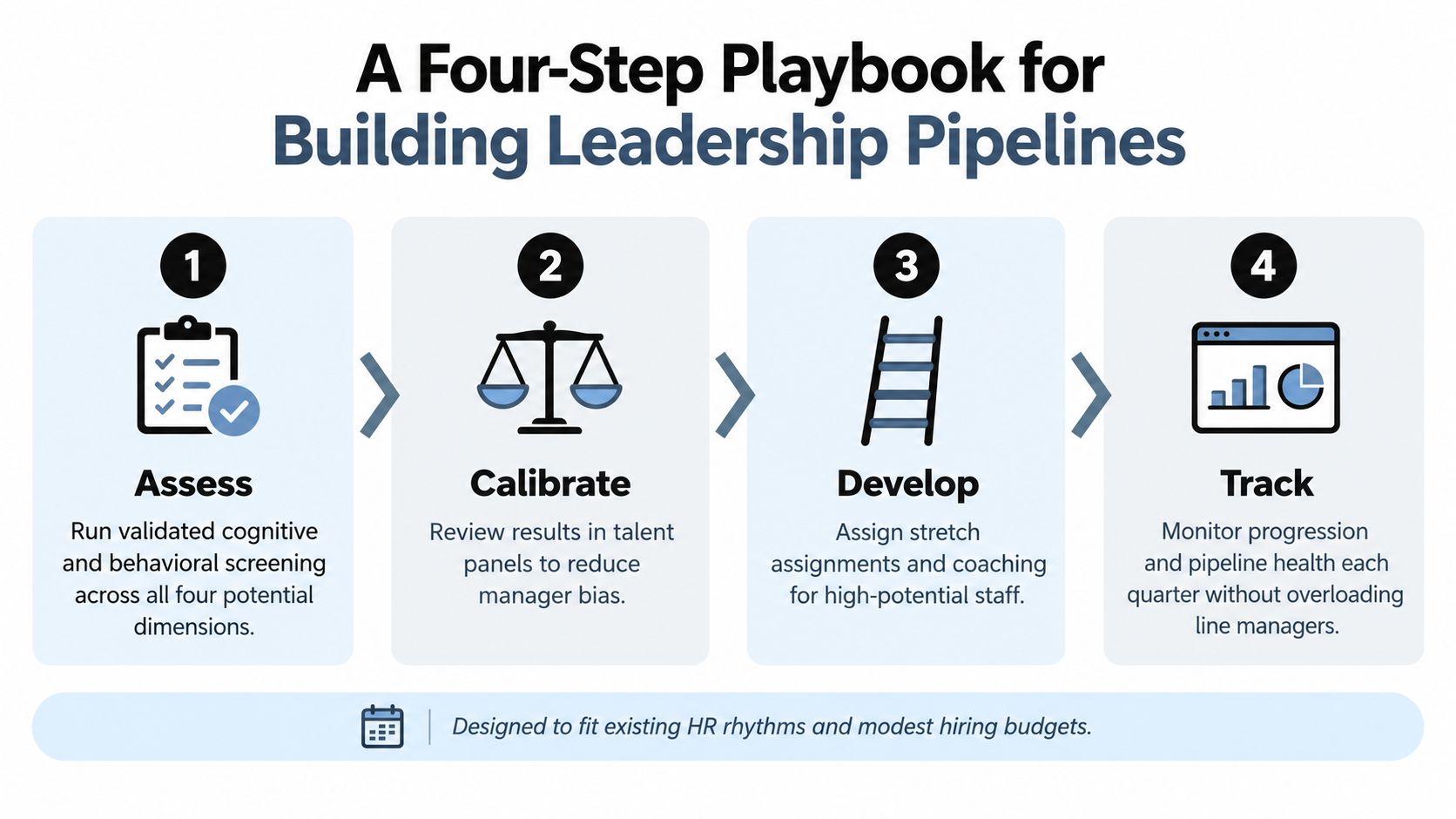
2. Profile
Don't turn assessment results into a pass-or-fail label. Translate them into a readiness profile that identifies strengths, growth edges, and the conditions in which the person is most likely to thrive.
For example, a candidate may show strong analytical skills and learning agility, with a development need around stakeholder influence. The appropriate conclusion isn't “not leadership material.” It's “ready for a cross-functional assignment with explicit practice in influence and decision communication.”
A talent-panel rubric should include the evidence source, the behavior observed, the dimension it informs, confidence in the conclusion, and the next question to test. This structure helps reviewers distinguish what they know from what they're inferring.
3. Simulate
Before promotion, give candidates a realistic leadership problem. Ask them to prioritize competing requests, conduct a difficult conversation, or lead a group toward a decision. Use trained observers and a common scoring guide.
The simulation should resemble the target role without becoming a theatrical performance. A quiet candidate can demonstrate leadership through diagnosis, listening, and synthesis. A charismatic candidate must still show judgment, adaptability, and follow-through.
4. Act
Connect the profile to a development plan, stretch assignment, coaching objective, or succession decision. Define what new evidence would confirm or challenge the initial hypothesis.
Human judgment remains essential when selecting assignments and interpreting context. Software can compare profiles, flag missing evidence, and track development actions, but leaders still need to explain decisions and give employees useful feedback.
Treat reassessment as part of the pipeline rather than an administrative afterthought. Leadership potential becomes clearer when people encounter new scope and the organization observes how they respond.
A Practical Checklist for HR Leaders
The most useful checklist separates what HR teams should start, stop, and continue doing. Each action should connect to the four dimensions, not to a vague impression of executive presence.
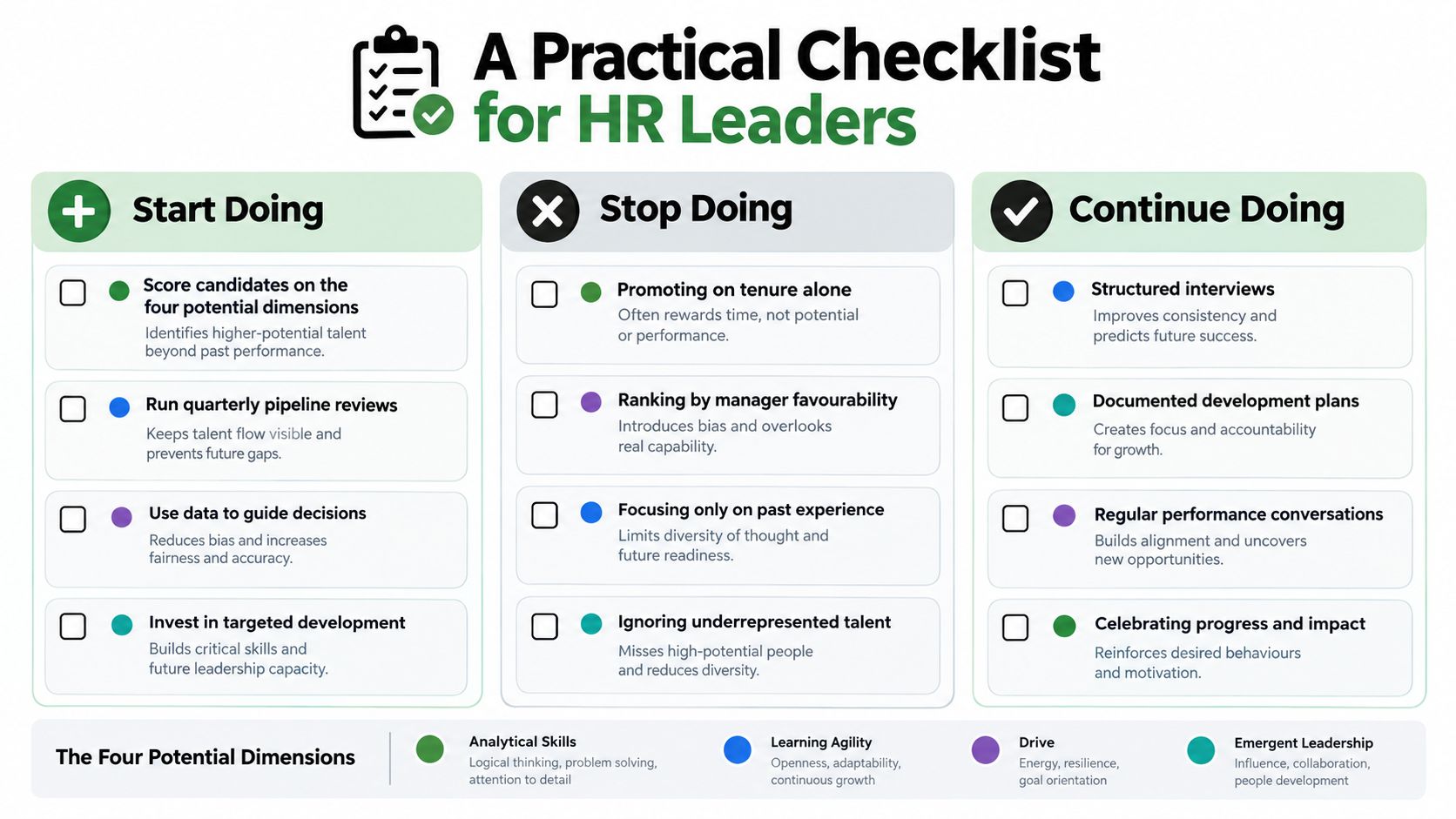
Start doing
Stop doing
Continue doing
Sequence the work so managers can absorb it. A smaller, well-run review with clear evidence is more useful than a large process that creates fatigue and produces vague labels.
Common Questions About Leadership Potential Answered
How often should potential be reassessed?
Use an annual formal review as a practical operating rhythm, supplemented by short evidence checks after meaningful projects, role changes, or major stretch assignments. The research basis supports repeated observation because potential concerns growth in leadership effectiveness over time. The exact cadence remains a practitioner choice, so organizations should match it to business cycles and the frequency of role changes.
How does potential differ from performance?
Performance is current effectiveness in a defined context. Potential is a forward-looking estimate of how a person may handle broader responsibility. High performers may have strong potential, but the relationship isn't automatic. A person can deliver excellent individual work without wanting, or yet being ready, to lead through delegation, ambiguity, and competing stakeholder needs.
How should HR communicate a potential rating?
Don't announce a label without a development path. A manager can say: “Your current work shows strong analytical judgment and persistence. We also see an opportunity to test your stakeholder influence through a cross-functional assignment. We'll review what you learn from that experience, and we'd like your view of the situations in which you feel most ready to lead.”
That script frames potential as developmental and revisable, not as entitlement or a permanent verdict. Share the evidence, name the opportunity, invite self-assessment, and explain how future observations will inform the next conversation.
---
Synopsix helps HR teams turn behavioral assessments into comparable profiles, leadership signals, simulations, and development plans, including analysis of how a person leads and the contexts where they may thrive or struggle. To build a more evidence-based leadership pipeline, visit [Synopsix](https://synopsix.ai) and explore how assessment data can support fairer talent decisions.