What Is Organizational Design: A Guide for 2026
By Synopsix · July 22, 2026 · 16 min read
Your company can be growing fast and still feel stuck. Teams miss decisions because nobody knows who owns them, managers keep rebuilding the same workflows in slightly different ways, and the org chart that looked sensible six months ago already feels too rigid for the work in front of you. That's usually the point where leaders start asking what organizational design really is, and why structure alone hasn't fixed the friction.
At its best, organizational design is the discipline of shaping how work gets done so strategy turns into execution. That means deciding how structure, decision rights, processes, people practices, technology, metrics, and culture fit together, not just drawing cleaner boxes and lines. The companies that get this right don't just organize headcount, they shape human behavior so the business can move faster with less waste and less confusion.
Beyond the Org Chart
A growth-stage company often notices the problem before it can name it. Sales keeps escalating issues to the same two leaders, product launches slip because handoffs aren't clear, and high performers are spending too much time translating across functions instead of doing the work they were hired to do. The org chart still looks tidy on paper, but the business is carrying hidden coordination costs.
That's why organizational design is better understood as the company's operating system. It connects strategy to execution by deciding where authority sits, how information moves, what behaviors get rewarded, and which roles need to work tightly together. McKinsey's global survey of redesigns found that successful redesigns were strongly associated with alignment, inclusiveness, and good planning, and that companies targeting at least two structural, two process, and two people-related changes saw the strongest correlation with success, which is a useful reminder that structure alone rarely solves execution problems. [McKinsey's global redesign survey](https://www.mckinsey.com/~/media/McKinsey/Business%20Functions/Organization/Our%20Insights/The%20secrets%20of%20successful%20organizational%20redesigns%20McKinsey%20Global%20Survey%20results/The%20secrets%20of%20successful%20organizational%20redesigns%20McKinsey%20Global%20Survey%20results.pdf)
> Practical rule: if a redesign only changes reporting lines, it usually exports the same problems into a new shape.
A useful way to think about the question what is organizational design is to compare it with the work of job architecture and role definition. If you're building out levels, job families, and career paths, [this guide to job architecture design](https://synopsix.ai/blog/job-architecture-design) gives a good adjacent view of how structure and role clarity reinforce each other. Organizational design goes broader, because it has to account for the way people coordinate once those roles exist.
The hidden test is simple. If a new structure makes it easier for managers to decide, for employees to know what good looks like, and for teams to hand work off without constant escalation, then the design is helping. If it creates more meetings, more ambiguity, and more workaround behavior, it's not a design problem solved, it's a design problem disguised.
The Core Elements of Organizational Design
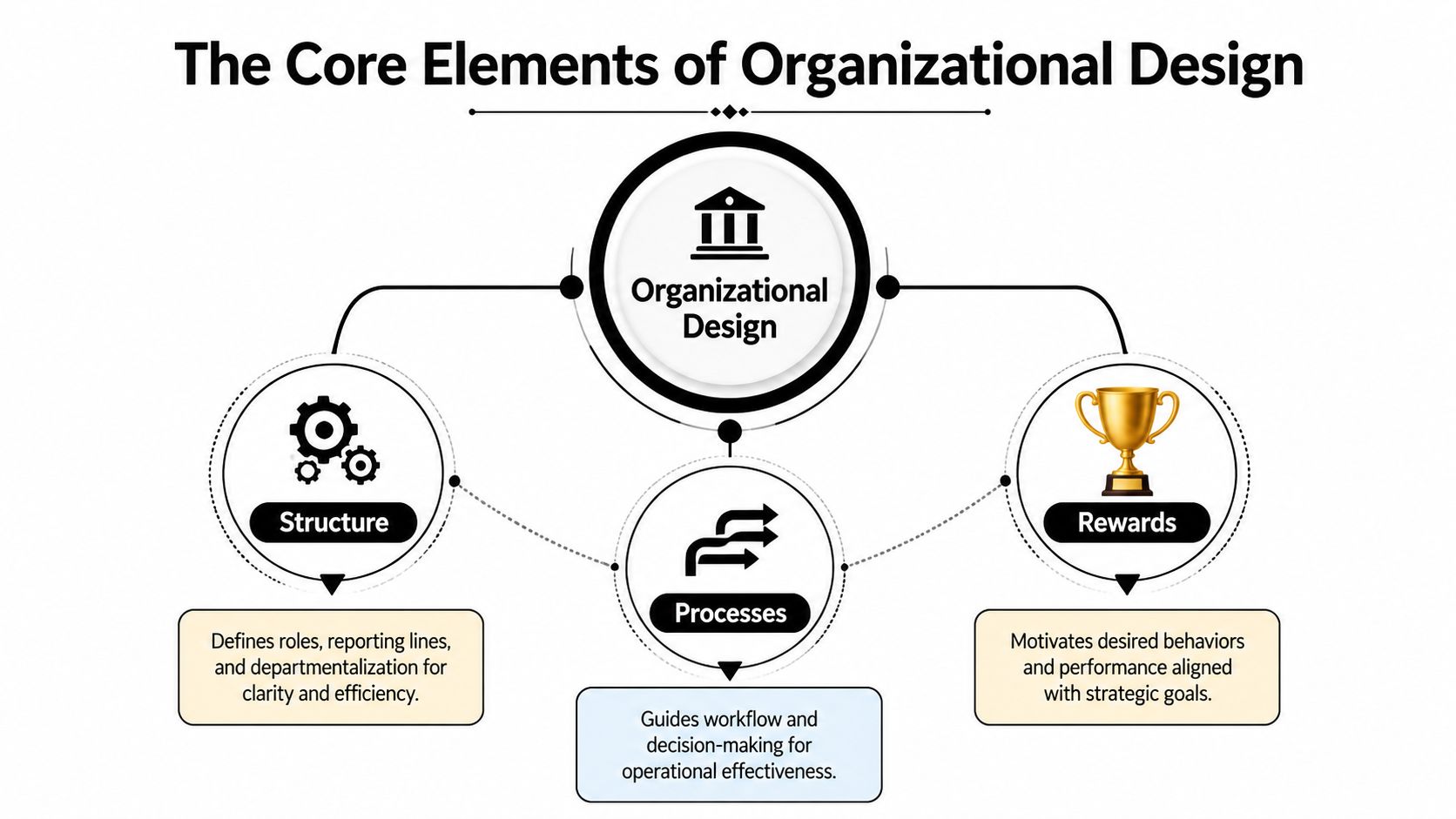
Think of organizational design as a business operating system with interconnected parts. The system only works when the components reinforce each other, because a strong structure with weak processes or misaligned incentives still produces friction. Deloitte frames this as a deliberately configured system of structure, decision rights, processes, people practices, technology, metrics, and culture, and its framework spans eight dimensions, including spans/layers, decision forums and rights, value-stream cadences, role charters, platform/data architecture, KPIs/incentives, and leadership behaviors. [Deloitte's organization design framework](https://umbrex.com/resources/frameworks/organization-frameworks/deloitte-organization-design-framework-eight-dimensions/)
Structure sets the bones
Structure defines how work is grouped, where accountability lives, and how many layers sit between the frontline and senior leadership. It includes reporting lines, spans of control, and whether teams are organized by function, product, geography, or customer segment. A clean structure reduces ambiguity, but only if the roles inside it are properly differentiated.
Processes keep the work moving
Processes are the workflows, handoffs, decision paths, and information flows that let the structure function. A team can have the right boxes on paper and still fail because approvals are too slow, meetings are too frequent, or data lives in too many places. For remote and hybrid teams, [Cubicle By Design's best practices for remote teams](https://cubiclebydesign.com/best-practices-for-remote-teams/) is a useful reminder that collaboration norms have to be engineered, not assumed.
Rewards shape behavior
Rewards cover incentives, recognition, and performance management. Leaders often get the design wrong in this area because the business asks for collaboration while rewarding individual heroics, or asks for speed while punishing experimentation. If rewards don't match the operating model, employees will optimize for whatever the system measures, not what the strategy says it wants.
People make the design real
People are the most important part of the system, because structures don't execute strategy, people do. Skills, mindsets, decision habits, and leadership behaviors determine whether the design is energizing or exhausting. BCG's work on organization design explicitly includes structural elements, roles and responsibilities, individual talent, and enabling mechanisms like decision-making processes and talent management, which is the right lens because a role only works when the person in it can handle the collaboration, pace, and ambiguity that role requires. [BCG on a new approach to organization design](https://www.bcg.com/publications/2016/people-organization-new-approach-organization-design)
The most common failure pattern is simple. Leaders redesign structure, but they leave the decision rights fuzzy, the workflows unchanged, and the people decisions untouched. That's when the new organization looks modern but still behaves like the old one.
Why Organizational Design Is a Strategic Superpower
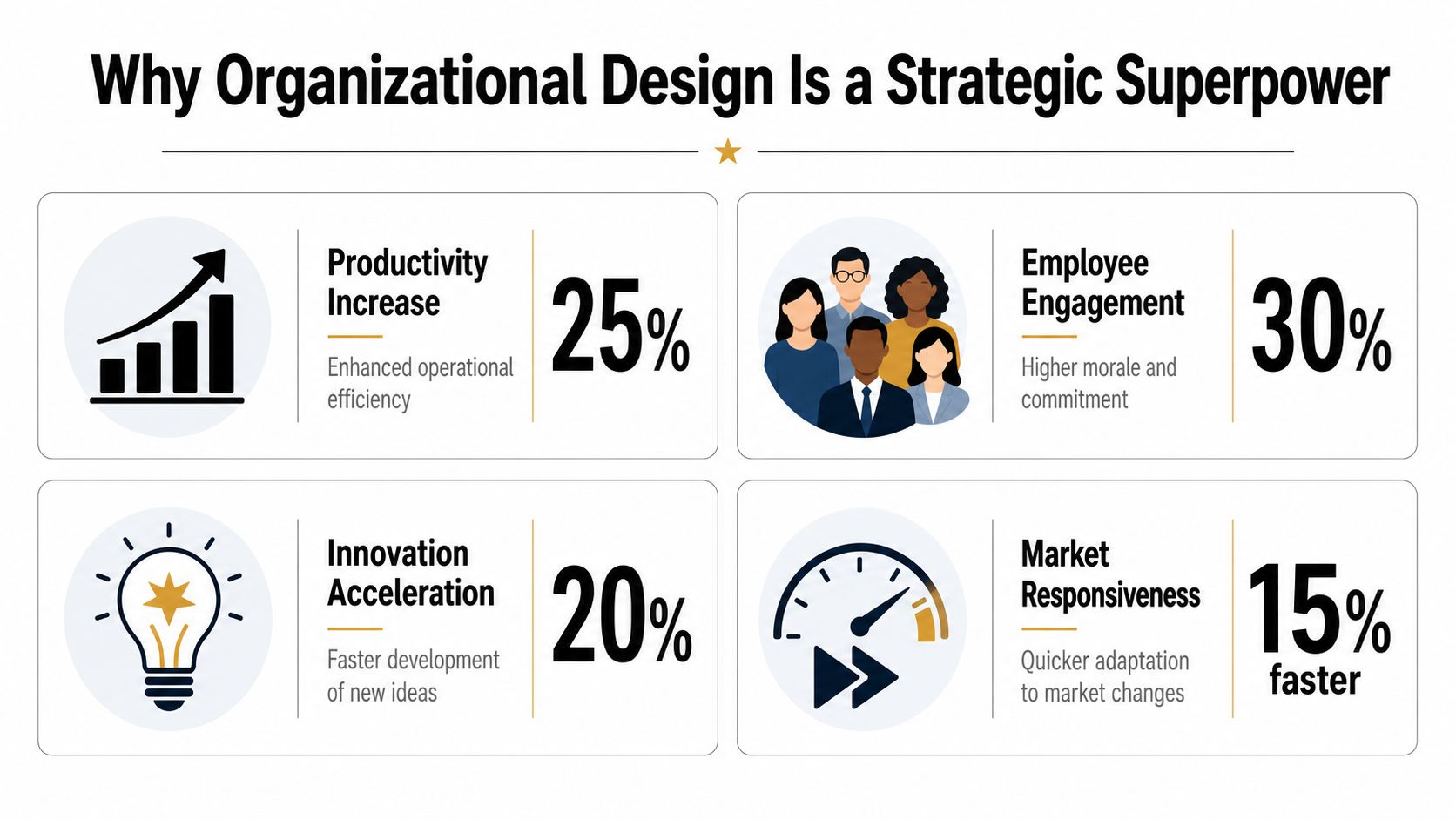
A well-designed organization does more than keep work moving. It shapes where decisions get made, how quickly teams respond, and how much coordination the business can absorb before progress slows. For a CHRO, that makes organizational design a performance system, not a charting exercise. BCG found that companies with the right design choices were more likely to become top performers, with faster growth and higher profits than peers, and that six specific design factors distinguished stronger performers from weaker ones. [BCG on performance through organization design](https://www.bcg.com/publications/2017/people-boosting-performance-through-organization-design)
Design choices show up in performance
The strategic value of organization design is that it turns business intent into day-to-day behavior. If the business wants faster execution, the design has to shorten decision paths. If it wants better customer responsiveness, authority has to sit closer to the market. If it wants clearer accountability, responsibility has to be visible instead of spread across too many shared roles.
That link matters because leaders rarely approve redesign work just to tidy up structure. They approve it when the case is tied to execution, when the trade-offs are clear, and when the model shows how coordination will improve without creating new layers of friction. That is the standard I use with leadership teams. The question is never whether a design looks cleaner on paper. The question is whether it will help the organization make better decisions and execute with less rework.
Top performers are designed, not accidental
The strongest organizations treat design as an operating choice, not a one-time cleanup. They use it to decide where attention goes, how talent is deployed, and who has authority to act without waiting for escalation. In complex businesses, that matters because one bottleneck can slow several functions at once.
> The best designs make trade-offs visible. They do not promise every team autonomy, speed, and zero conflict at the same time.
That trade-off logic is just as relevant in smaller settings. [streamlining small business operations](https://www.leavewizard.com/business-process-optimization/) shows the same principle in a simpler environment, where clearer roles and cleaner process flows reduce friction quickly. The scale changes, but the logic does not. Organizations that make decisions with less rework, less escalation, and less confusion usually outperform those that keep reorganizing to manage symptoms.
Design is a predictor of behavior
Organizational design extends beyond mere structure. It gives leaders a way to predict how people will behave inside a given system, which is the part many redesigns miss. If a role gives someone authority without clarity, they will hesitate or improvise. If a team is asked to collaborate but rewarded for individual output, it will protect its own scorecard. If a manager carries too many decisions, the work slows because the system has asked one person to absorb too much complexity.
That is why good design is tied to talent strategy. Roles, reporting lines, decision rights, and enabling mechanisms all shape whether people can deliver the strategy or only work around it. A model that fits the business on paper but does not fit the way people make decisions will create predictable resistance, extra coordination, and slower execution. The strongest organizations design for the behavior they need, then staff and manage against that model.
A Practical Approach to Organizational Redesign
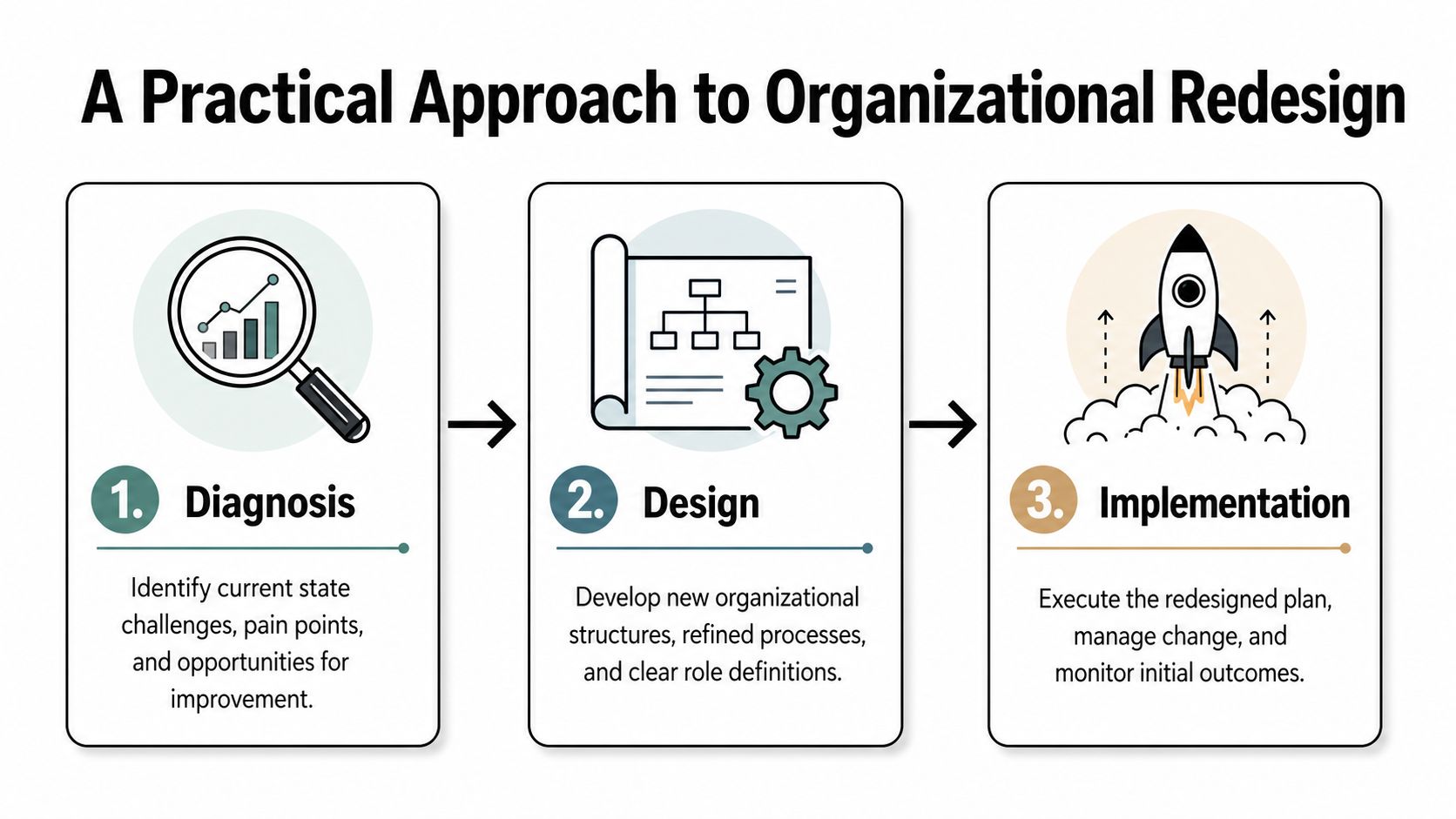
A redesign starts with a live business problem, not a new org chart. A CHRO and executive team should first ask where the current model is creating delay, confusion, or avoidable rework, because each symptom points to a different design choice. If decisions are too slow, customer handoffs are breaking, managers are overloaded, or growth is stalling because ownership is unclear, the structure needs to respond to that reality.
The work should begin with diagnosis. Leaders need hard data, but they also need to hear where work stalls, where people are improvising to keep things moving, and where responsibilities overlap in practice. [Synopsix's restructuring guide](https://synopsix.ai/blog/restructuring-the-organization) fits that mindset because it starts with how the organization functions before anyone changes reporting lines or team boundaries.
Design the target model with trade-offs in view
Strong redesign work compares several options before settling on one. A team may centralize expertise, push accountability into business units, build shared services, or organize around value streams and cross-functional teams. Each path changes speed, control, talent deployment, and manager load, so the design choice has to fit the performance problem, not just the preference of the senior team.
Decision rights need to be explicit. If a leader wants a matrix, the business needs clear rules for who decides, how conflicts get resolved, and how performance will be judged. Without that clarity, the model adds coordination work instead of reducing it.
A practical redesign also means comparing the operational effects of different structures, not just the reporting lines. Some organizations need tighter control because the business is exposed to risk or requires consistent standards. Others need faster local decisions because the market changes too quickly for central review. The right answer depends on where the business is trying to win.
Implementation lives or dies on communication
A redesign fails quickly when managers hear about it in a slide deck and then have to explain it to their teams without preparation. Employees need the logic behind the change, the sequence of events, and the practical impact on their work. They also need to understand what will remain stable, because uncertainty spreads faster than formal messages.
Communication has to be specific enough for people to act on it. That means explaining which decisions move, which ones stay put, how handoffs will change, and what leaders expect from managers in the first weeks of the shift. For smaller firms, [streamlining small business operations](https://www.leavewizard.com/business-process-optimization/) shows the same principle in a simpler setting, clearer process flow lowers friction and helps the team absorb change without losing momentum.
The same logic applies in larger organizations. Phasing matters, and manager readiness matters just as much. If the people expected to carry the change do not understand the new operating model, the redesign will exist on paper while the old habits keep running the business.
Measure before you declare victory
Success measures should be defined before launch, not after the fact. Leaders should track whether decisions are getting faster, role clarity is improving, workflows are cleaner, and unnecessary friction is falling. Those indicators show whether the redesign is changing how the organization works, which is the ultimate test.
The strongest redesigns also include review cycles and feedback loops. That lets leaders see where the new model is helping and where people are still working around it. A structure is only useful if it keeps fitting the business as the business changes.
Predicting Behavior The Missing Link in Design
A design can look elegant and still fail if the people inside it behave in ways the structure didn't anticipate. That is the missing link in most organizational redesigns, because leaders often focus on where the boxes go and not on how individuals will act once those boxes are filled. In practice, the primary question is whether the design predicts useful behavior, not whether it looks orderly on a slide.
Behavior determines whether the role works
The same role can succeed in one team and stall in another if the behavioral fit is wrong. Personality, adaptability, and learning capacity influence whether someone can operate in a role that demands ambiguity, collaboration, or rapid change. A 30-year integrative review in Frontiers in Psychology found that conscientiousness is the strongest personality predictor of job performance across occupations, but it also highlighted an important point, traits alone are insufficient, and assessments should be used as one component within a multilayered evaluation system. [Frontiers in Psychology review](https://www.frontiersin.org/journals/psychology/articles/10.3389/fpsyg.2026.1766680/full)
That matters for organizational design because a role definition isn't complete until leaders know what kind of person can thrive in it. If a redesigned team depends on tight coordination, then hiring and placement decisions need to reflect that reality. If a new operating model requires strong independent judgment, then the organization needs people who can handle that autonomy without constant supervision.
People intelligence lowers redesign risk
Behavioral assessments and workforce analytics help leaders make better design bets before the reorganization goes live. They don't replace managerial judgment, but they make hidden assumptions visible. In a redesign, that can mean spotting where a high-visibility role is likely to overwhelm a manager, where two strong individual contributors may clash in a shared account, or where a new leader will need support before taking on a broader span.
> A good design is predictive. It tells you not just where people sit, but how they're likely to work together once they get there.
That's the reason people intelligence belongs inside organizational design conversations, not after them. [Synopsix's predictive analytics in HR](https://synopsix.ai/blog/predictive-analytics-in-hr) fits naturally into this logic because the design problem is partly a forecasting problem. Leaders are always asking who can succeed in which role, under what conditions, and with what kind of team around them.
The modern design question is behavioral
The old question was, “How should we organize reporting lines?” The better question is, “What behavior do we need this structure to produce, and how do we know the people in it can produce it?” That shift changes hiring, succession planning, team composition, and leadership development. It also keeps organizations from treating the redesign as complete when the chart is approved.
The strongest modern designs make the behavioral logic explicit. They use assessments, team analysis, and role-specific expectations to reduce surprises after launch. That's not a softer form of org design, it's a sharper one.
Common Pitfalls and How to Avoid Them
A redesign can look finished on paper while the business is still running the old way. Leaders update titles, announce the new structure, and expect behavior to change on its own. It rarely does. Real change depends on routines, manager capability, decision rights, and the informal habits people use to get work done. Without that follow-through, confusion lingers, adoption slows, and teams invent workarounds that bypass the new model.
Don't design for the org chart alone
Formal reporting lines matter, but they do not describe how work really moves. If leaders ignore informal networks, culture, and collaboration patterns, the chart may be tidy while execution stays messy. People keep using the old channels if those channels are faster, clearer, or more trusted than the new ones.
The practical fix is to map how decisions and information already flow before finalizing the structure. Then design around the existing coordination network, not only the hierarchy that appears on the slide. That helps reduce friction, protect speed, and avoid creating a structure people have to work around in order to perform.
Don't ignore hybrid reality
A structure built for a fully co-located workforce can fail once teams are split across locations. A [Hybrid workplace research summary](https://www.loebleadership.com/insights/organization-design-for-the-human-centered-workplace) reported that workplace research projected that by 2025 only 40% of organizations would have successfully adapted to hybrid work, and 77% of employers reported difficulty maintaining company culture in those settings. That points to a clear design issue. Informal alignment, shared norms, and collaboration mechanisms matter more when people are not in the same room.
For CHROs, the trade-off is straightforward. Hybrid design can widen access to talent and improve flexibility, but it also raises the bar for role clarity, meeting discipline, and manager consistency. If those elements are weak, the formal structure absorbs the pressure and the culture starts to fragment.
Avoid the fake finish line
A redesign is not complete when the new org chart gets approved. It is complete when people work differently and managers can see the new logic in day-to-day decisions. If leadership treats the chart as the finish line, the organization often lands in a holding pattern where everyone waits for clarity that never arrives.
The better test is operational. Review role clarity, workflow quality, and decision speed after launch, then change the design where friction remains. That keeps the redesign tied to performance rather than presentation.
Three practical safeguards help leaders avoid the most common traps:
The organizations that benefit most from design treat it as a living system. They keep watching how people behave, where decisions stall, and where the model no longer fits the strategy. That is the difference between a redesign that looks polished and one that improves performance.
If your leadership team is trying to connect structure, role clarity, and people decisions in a way that strengthens execution, explore how [Synopsix](https://synopsix.ai) can help you turn behavioral insight into better hiring, stronger teams, and more confident organizational design choices.