What Is Pre Employment Assessment
By Synopsix · September 17, 2026 · 16 min read
A pre-employment assessment is any structured, evidence-based tool used before hiring to predict job performance, fit, or retention. Cognitive tests and structured interviews each show corrected validity around r = .51, while years of experience alone shows only about r = .06 in relation to later job performance.
You're probably asking because a familiar hiring process has stopped feeling reliable. Two candidates submit polished resumes, answer interview questions smoothly, and provide credible references, yet the team still can't tell who will learn faster, handle pressure better, or deliver consistently after the first few months. That gap is exactly where a well-designed pre-employment assessment belongs.
The important question isn't whether a test looks advanced. It's whether the signal is job-related, predictive, fair, and understandable to candidates and decision-makers. This guide separates tools that add evidence from practices that merely create the appearance of rigor, while keeping compliance and candidate experience in view.
A Hiring Decision You Can Actually Defend
Sara, a customer success hiring manager, is staring at two finalists. Both candidates have polished resumes, glowing references, and the kind of confident interview presence that makes a hiring panel nod along. One seems more experienced. The other explains complex customer situations with unusual clarity. Sara still can't tell who will ramp faster, stay calm during escalation calls, or remain effective after the novelty of the role wears off.
That uncertainty is common because each traditional hiring input answers a different, incomplete question. A resume describes what a candidate says they've done. An interview often rewards articulation, confidence, and rapport. A reference call confirms how someone was viewed in a previous setting. None of these, by itself, gives Sara a standardized demonstration of how the finalist would handle a realistic customer problem.

The missing instrument
A structured pre-employment assessment can give Sara comparable evidence before she makes an offer. She might ask both candidates to prioritize a set of customer escalations, draft a response to an upset account, or explain the reasoning behind a difficult decision. If the task has consistent instructions and a defined scoring rubric, the hiring team can compare performance against the demands of the role rather than relying only on impressions.
That doesn't mean an assessment should replace every other selection method. It means the team adds a measured signal to a decision that otherwise depends heavily on claims and conversation. The strongest design combines relevant evidence, rather than treating one score as an automatic verdict.
> Practical rule: Assess the behavior the role requires, not a trait that simply sounds impressive in a vendor brochure.
Sara's defensible decision would rest on a clear chain: the role requires calm prioritization and written judgment, the assessment measures those capabilities, the scoring criteria are applied consistently, and the final decision considers the result alongside other job-related evidence. The rest of the process should test three questions: Does the signal predict success? Is it fair? Does the candidate experience justify asking for it?
What Pre-Employment Assessment Really Means
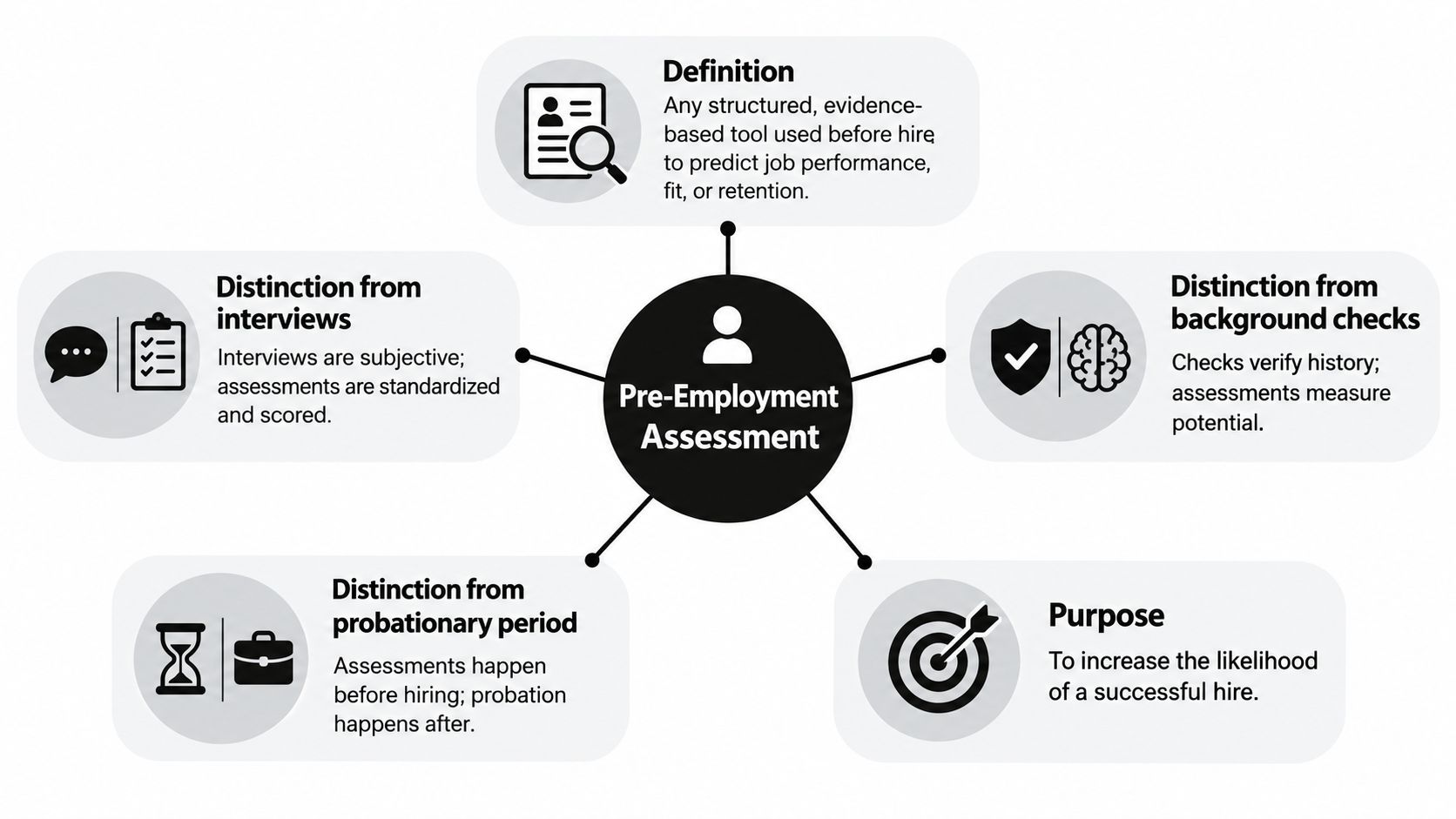
A pre-employment assessment is a structured, evidence-based tool administered before the hire to estimate job performance, fit, or retention. “Structured” means candidates receive comparable instructions and face a consistent scoring process. “Evidence-based” means the organization can explain why the measured capability relates to success in that particular role.
That definition separates assessments from several nearby practices:
Four familiar assessment families
Think of the main categories as different instruments for observing readiness:
1. Cognitive ability tests are like a treadmill stress test for the reasoning muscle a role demands. They can examine problem-solving, learning, and information processing. 2. Personality and behavioral inventories resemble a weather map. They describe the working climate a candidate tends to bring, such as preferences around structure, pace, communication, or decision-making. 3. Situational judgment tests, or SJTs, act like flight simulators. They present role-shaped dilemmas and ask candidates to choose or rank responses. 4. Work samples and skills tests are dress rehearsals. Candidates perform a slice of the actual work, such as analyzing data, writing a customer response, or completing a technical task.
The name of the assessment matters less than the evidence behind the score. A personality inventory can be useful when its constructs connect to the job and its interpretation is disciplined. A skills test can be weak when it tests obscure knowledge that employees won't use. Teams exploring a broader skills-first approach may also benefit from this practical resource on [building elite teams with skills-based hiring](https://www.tekrecruiter.com/post/what-is-skills-based-hiring).
<iframe width="100%" style="aspect-ratio: 16 / 9;" src="https://www.youtube.com/embed/pd3efYFri6o" frameborder="0" allow="autoplay; encrypted-media" allowfullscreen></iframe>
A good assessment produces a signal that can be compared, interpreted, and connected to a job criterion. A polished interface, gamified format, or automated recommendation doesn't create that connection on its own.
The Four Main Types and How They Differ
The four families differ in what they observe and how close they come to the work itself. Cognitive tests examine general reasoning capacity. Behavioral inventories examine tendencies and preferences. SJTs observe judgment in realistic scenarios. Work samples ask candidates to perform tasks that resemble the job.
The strongest evidence in the verified research supports cognitive tests and structured interviews at approximately r = .51, while a major meta-analysis reported a validity of 0.54 for work-sample tests, described as the highest validity for an individual selection method in that analysis ([work-sample and structured interview evidence](https://www.pin.com/blog/structured-interviews-guide/)). These coefficients are averaged, statistically corrected estimates, not simple raw correlations. Corrections account for artifacts such as measurement error and range restriction, which helps researchers compare selection methods more fairly ([how validity coefficients are interpreted](https://www.pitchnhire.com/interview-statistics)).
| Assessment Family | What It Measures | Typical Validity (r) | Best Fit Roles | |---|---|---:|---| | Cognitive ability | Reasoning, learning, and problem-solving | About .51 | Entry-level, graduate, analytical, and changing-work roles | | Structured interview | Job-related competencies through consistent questions and rubrics | About .51 | Broadly applicable across job families | | Situational judgment test | Decision-making in realistic work scenarios | Qualitatively useful when closely job-linked | Customer-facing, supervisory, and service roles | | Work sample or skills test | Direct performance of role-specific tasks | 0.54 in one major meta-analysis | Technical, craft, analytical, and practical work |
Matching the method to the role
Cognitive testing is most useful when employees must learn unfamiliar material or solve problems that change over time. A structured interview works across many roles because it can probe the competencies that matter in context, provided interviewers use the same questions and scoring logic.
An SJT is particularly useful when judgment, prioritization, and interpersonal choices matter. A customer support candidate might choose how to respond when a high-value account demands an exception, revealing practical decision-making that a resume won't show. Teams can explore the design and interpretation of these exercises in this guide to [situational judgment tests](https://synopsix.ai/blog/situational-judgment-tests).
Work samples are closest to the job, but closeness alone doesn't guarantee quality. A task must represent meaningful work, use consistent instructions, and have scoring criteria that distinguish strong from weak performance. Combining methods usually gives a fuller picture than asking one tool to carry the entire decision.
Why Some Assessments Predict Better Than Others
Validity answers a simple question: Does this assessment predict the outcome you care about? That outcome might be job performance, learning speed, or retention. Reliability asks a different question: Does the assessment produce consistent results when the same capability is measured under comparable conditions?
A reliable tool can still be invalid. A scale that consistently adds weight is reliable, but it isn't valid if you're trying to measure a person's height. In hiring, a beautifully consistent score has limited value if it measures trivia, familiarity with test-taking, or an abstract preference unrelated to the work.
Read the hierarchy correctly
The strongest verified comparison places general mental ability tests near r = .51, structured interviews near r = .51, and unstructured interviews near r = .38 ([canonical selection-method meta-analysis](https://www.tandfonline.com/doi/full/10.1080/09585190903363821)). The same evidence found that combining a cognitive test with a structured interview reached a multiple validity of approximately .63, showing why complementary signals can improve prediction.
| Selection Method | Validity (r with Job Performance) | Strength | |---|---:|---| | Cognitive ability test | About .51 | Strong general predictor | | Structured interview | About .51 | Strong when standardized and scored | | Cognitive test plus structured interview | About .63 multiple validity | Stronger combined prediction | | Unstructured interview | About .38 | Weaker and more dependent on interviewer judgment | | Years of prehire experience | .06 | Weak proxy when used alone |
The experience finding deserves attention. A meta-analysis of prehire experience measures found corrected correlations of .06 with job performance, .11 with training performance, and .00 with turnover ([meta-analysis of prehire experience](https://onlinelibrary.wiley.com/doi/10.1111/peps.12335)). Experience can still matter when it reflects relevant tasks, environments, or demonstrated accomplishments. The point is that years alone shouldn't be treated as proof of future success.
A resume screen or informal conversation may remain useful as an early filter, but gut feel shouldn't become the final scoring system. Higher-validity predictors give a hiring manager a clearer explanation when a hiring committee, HR business partner, or rejected candidate asks why one finalist advanced.
For a deeper explanation of how consistency and prediction work together, see this resource on [assessment validity and reliability](https://synopsix.ai/blog/assessment-validity-and-reliability). Leaders who need to connect hiring evidence with broader workforce decisions can also explore [HR risk analytics for executives](https://paradigmie.com/post/predictive-hr-analytics).
Business Benefits That Show Up on the Dashboard
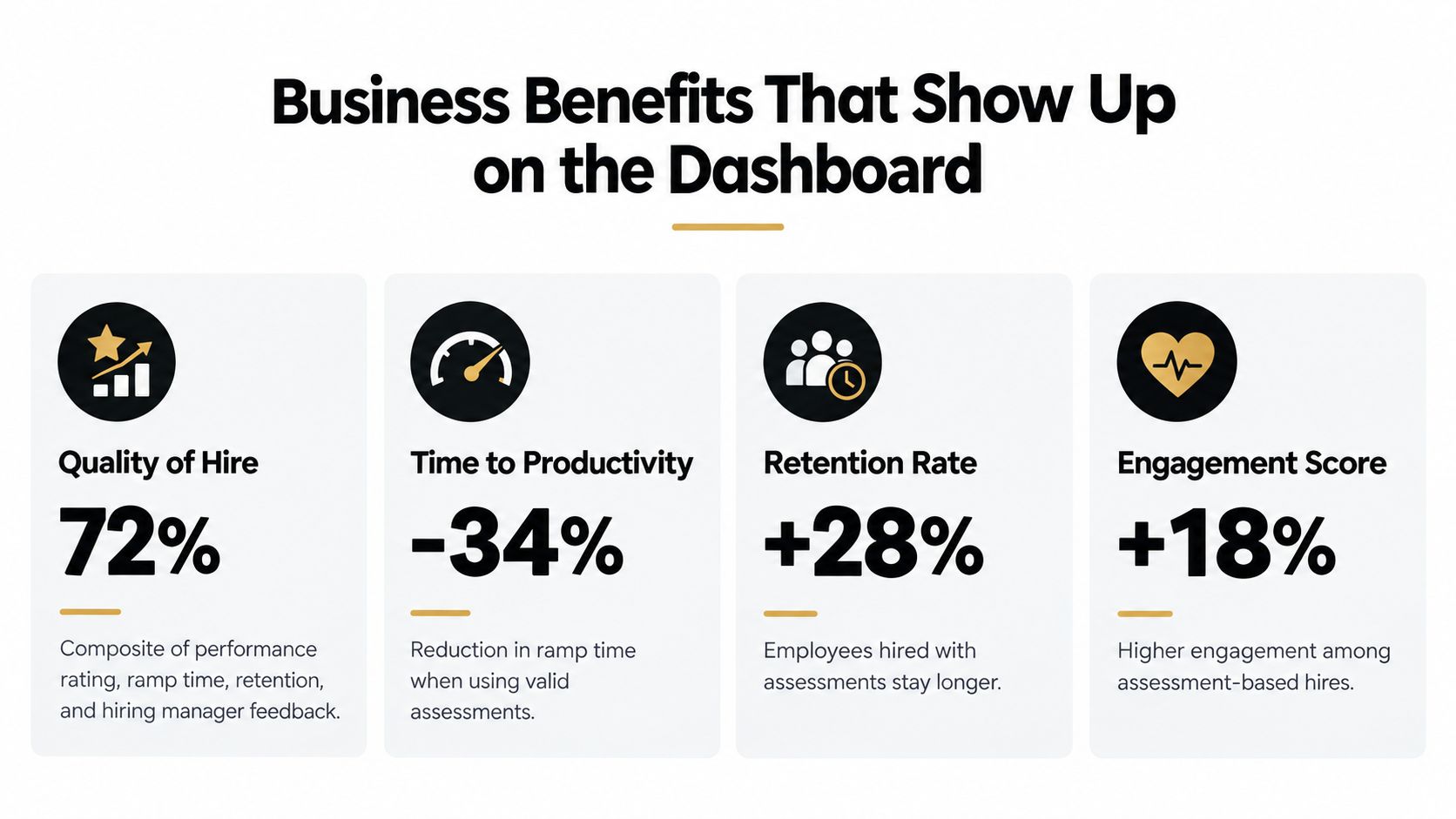
Assessment quality matters because executives don't manage abstract validity coefficients. They manage quality of hire, productivity, retention, hiring speed, and manager confidence.
Quality of hire is best treated as a composite rather than a single number. A people-analytics team might combine early performance ratings, ramp time, retention, and hiring manager satisfaction into one view. That score becomes more useful when the organization can trace which selection signals preceded strong outcomes.
Convert evidence into operating metrics
A structured assessment can improve decision quality by moving the team toward job-relevant evidence. A work sample may tell a hiring manager more about writing or analysis than another conversation about past responsibilities. A cognitive measure may help distinguish candidates who can learn a changing process from candidates who merely match the resume keywords.
The dashboard should answer questions such as:
Measure the variance you're currently absorbing
The business case isn't “tests save time.” A poorly chosen assessment can add friction, create false confidence, and push away qualified applicants. A well-designed program reduces avoidable variance by giving interviewers a common frame of reference.
That changes the ROI question. Instead of asking whether the organization can afford another hiring step, leaders should ask how much uncertainty the current process carries into workforce planning, quarterly reviews, and team capacity assumptions. The answer should come from tracked outcomes, not from attractive dashboards or vendor promises.
Fairness, Compliance, and the Candidate Experience
A valid assessment isn't automatically fair. A test can predict performance and still produce different selection rates across groups, creating legal and ethical concerns. Under U.S. employment law, adverse impact refers to a neutral selection practice that disproportionately screens out a protected group, even without discriminatory intent.
The EEOC's four-fifths rule is commonly used as a practical monitoring threshold. Teams should also remember that passing a ratio check doesn't prove that a process is fair, job-related, or appropriate. Cognitive tests can have strong predictive value and still require careful validation, accessibility review, accommodation processes, and monitoring.
Build the control system before launch
A defensible program should connect the assessment to documented job requirements. Content validation can examine whether the items represent actual work. Cut-score studies can test whether a pass point reflects the level needed for competent performance. Differential item functioning analysis can identify items that behave differently for comparable candidates from different groups.
International hiring adds a privacy layer. Teams need clear rules for consent, data access, retention periods, security, and the handling of automated scoring under applicable data-protection laws. Candidates should know what information the organization collects, why it collects it, how long it keeps it, and whether a person reviews an automated recommendation.
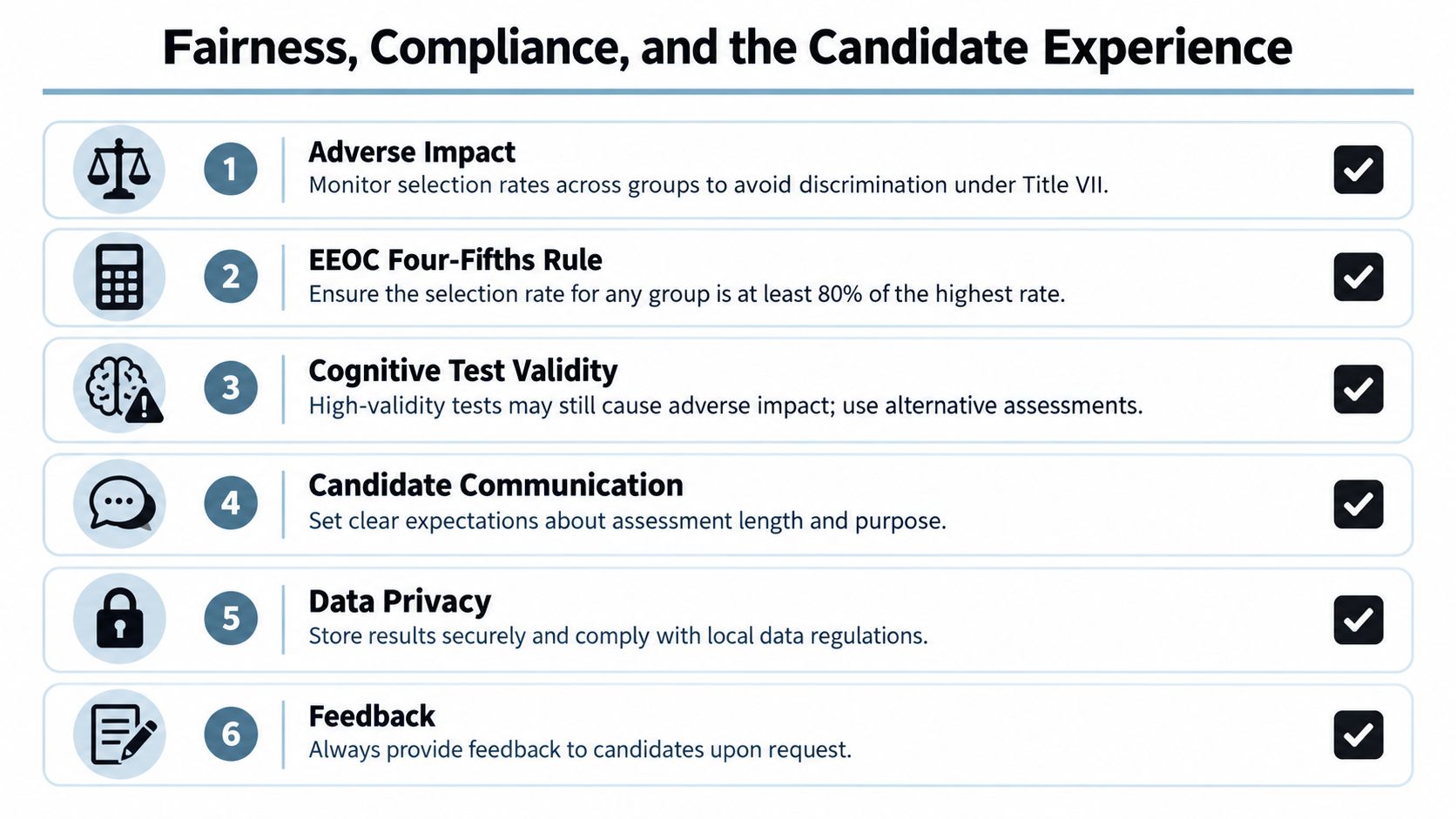
Candidate experience is part of the control system, not a separate communications exercise. Recent candidate-focused reporting identifies undisclosed AI screening and lengthy hiring processes as major friction points, with one summary reporting that roughly half of candidates view unexplained AI-led screening as unfair and more than a third say process length has the greatest effect on their experience ([candidate fairness and process-friction reporting](https://www.assesscandidates.com/hiring-trends-2025/?ref=examples.tely.ai)).
Before inviting someone to an assessment, explain:
Teams looking for practical ways to reduce subjective decision-making can review [how to reduce hiring bias](https://synopsix.ai/blog/how-to-reduce-hiring-bias). Transparency won't fix a weak assessment, but opacity can damage trust even when the underlying method is sound.
How to Roll Out a Pre-Employment Assessment Program
A rollout works best as a controlled experiment, not a company-wide launch. Start with one role where the success criteria are clear, the hiring volume is manageable, and the hiring manager will review outcomes after placement.
Use a disciplined sequence
1. Analyze the job. Identify the tasks, decisions, knowledge, and behaviors that distinguish effective performance. 2. Map criteria to methods. Choose cognitive, behavioral, situational, or skills measures only when each one connects to a defined requirement. 3. Pilot one role. Check completion, candidate feedback, score distributions, interviewer usefulness, and operational effort. 4. Standardize scoring. Give managers a rubric with observable anchors instead of asking them to interpret a score intuitively. 5. Train decision-makers. Explain what each score means, what it doesn't mean, and how to combine it with interviews and work evidence. 6. Monitor group outcomes. Review selection patterns, accommodations, and potential adverse impact across relevant demographic groups. 7. Review validity regularly. Compare assessment signals with later performance and update the tool when the job changes.
Layering too many tests creates a long process and can make candidates feel as if the employer is outsourcing judgment to software. Treat scores as evidence, not as the sole decision input. A manager still needs to consider motivation, relevant context, and information the assessment was never designed to measure.
Once an organization uses more than two assessment families across multiple roles, a dedicated platform can reduce administrative drag compared with stitching together disconnected point solutions. The advantage is consistency: one workflow can preserve instructions, scoring, permissions, reporting, and audit records while the team learns which signals matter.
Process discipline protects the predictive lift that justified the assessment in the first place. Without job analysis, standardization, monitoring, and review, even a strong method can become another source of noise.
Choosing Tools That Match the Signals You Trust
A polished interface doesn't make a hiring signal predictive. Before selecting a vendor, ask for published validity evidence tied to the constructs and roles you care about, a transparent scoring method, candidate-friendly access across devices, compliance documentation, adverse-impact reporting, and integration with the existing applicant tracking workflow.
Ask questions vendors should answer
Single-method vendors can work well when one construct dominates the role. Unified platforms make more sense when the organization measures multiple constructs across departments and wants one defensible workflow. Either way, ask for role-specific validity coefficients and candidate completion data before committing. Teams interested in improving their measurement practices can also review guidance on how to [build trusted metrics with AI](https://helpwithmetrics.com/blog/ai-data-analyst/).
Synopsix is one option for teams that want to combine behavioral assessment, comparable profiles, role-specific intelligence reports, predictive simulations, and team compatibility analysis in a single people-intelligence workflow. The platform translates assessment results into business-oriented guidance for hiring and talent decisions, so HR teams can evaluate whether its approach fits their roles, governance requirements, and evidence standards.
Stop asking whether your organization should assess candidates at all. Ask which combination of signals will support a hiring decision you can defend a year later, then pilot that combination against one clearly defined role.
---
Synopsix helps teams assess candidates, generate comparable behavioral profiles, and turn psychometric results into practical hiring guidance, simulations, and development actions. Visit [Synopsix](https://synopsix.ai) to review how its assessment and people-intelligence workflows could fit your next hiring pilot.