What Is Psychometrics? How Tests Measure People
By Synopsix · November 15, 2026 · 14 min read
What does a test score tell you about a person?
Psychometrics is the science of measuring attributes like personality, reasoning ability, attitudes, and values, then checking that the scores hold up. Published test-development studies commonly report reliability and content-validity figures for new instruments, and even strong results only support the decision the test was designed to inform.
That last part trips people up. A score can be perfectly consistent and still be the wrong evidence for the choice in front of you. The common mistake is reading a high result as a verdict on the person. A better reading treats it as one piece of evidence for one decision, such as coaching a manager or ranking applicants for a specific job. Those two uses ask different questions, and they deserve different levels of confidence.
What Psychometrics Means and Why It Matters
Psychometrics is the scientific study of measuring psychological attributes such as personality, abilities, attitudes, and values. You can't put a ruler against conscientiousness or anxiety. Psychometricians build tasks or questionnaires, score them with fixed rules, and compare the result with a reference group so a number means something beyond "this person answered a lot."
Think of a bathroom scale. It reads weight, not health. A doctor still has to decide whether that number matters for this patient, this visit, and this decision. A psychometric score works the same way. It is an inference drawn from selected answers, scoring rules, and a purpose. It is not a direct reading of the person.
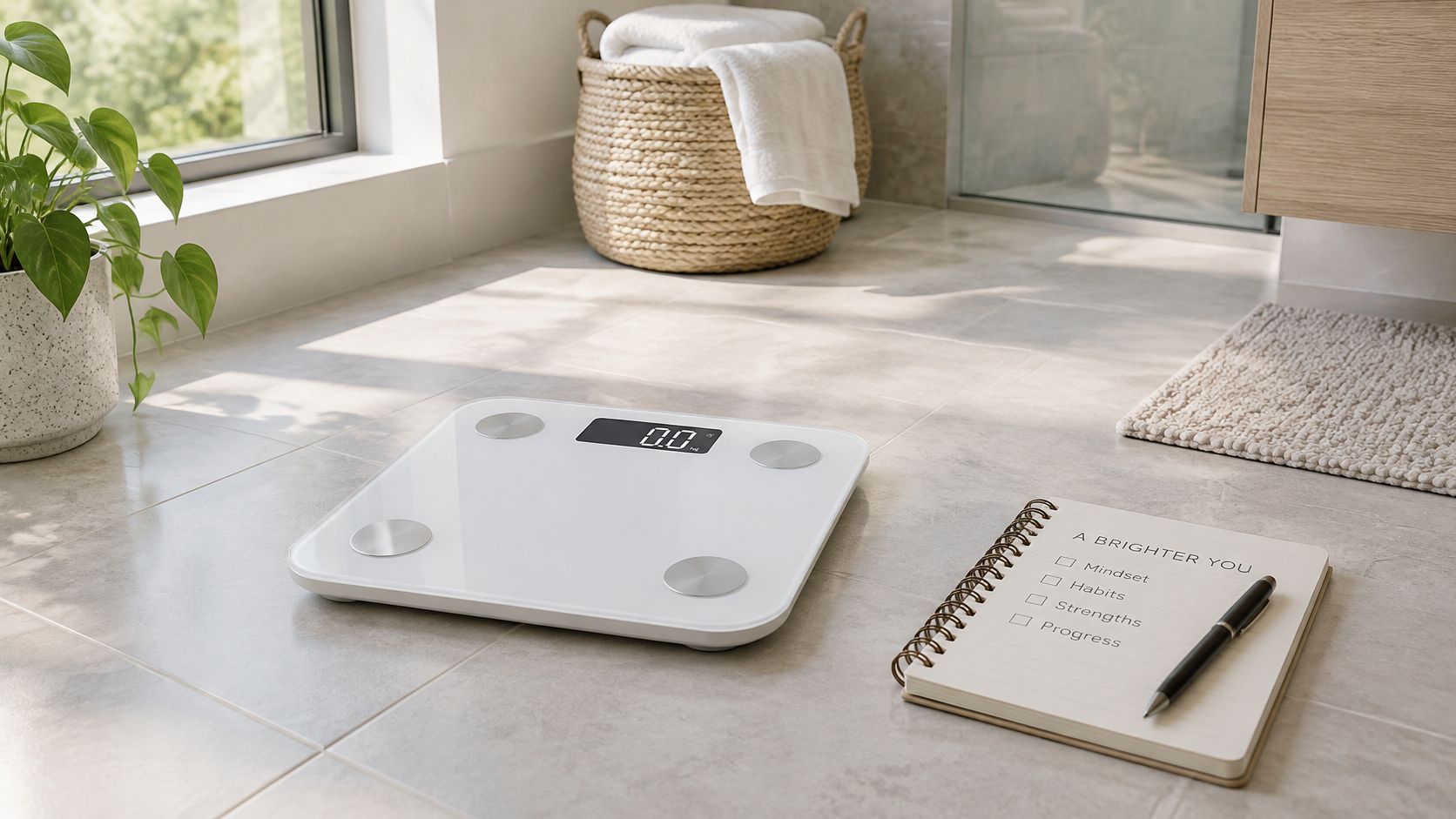
Two everyday cases show the range. A 30-question anxiety questionnaire adds item responses into a total. A numerical reasoning test times problem solving and places the result against norms, so you can say where someone sits relative to a comparison group. Both produce scores. Neither score, by itself, tells you what to do with the person.
The field learned that lesson early. In 1888, Francis Galton's anthropometric laboratory measured sensory acuity, including visual and auditory discrimination, on the hypothesis that sharper senses marked higher intellect, as the [Classics in the History of Psychology introduction to Binet](https://psychclassics.yorku.ca/Binet/intro.htm) recounts. By 1901, James McKeen Cattell and his students found no relationship between those sensory measures and academic grades, and researchers abandoned the approach.
> A measurable feature is not automatically a meaningful psychological construct, so the field exists to prove that scores mean what they claim.
That proof is the whole point of what is psychometrics in practice. A feature you can count still has to earn the interpretation you want to make.
How Psychometric Assessments Turn Answers Into Scores
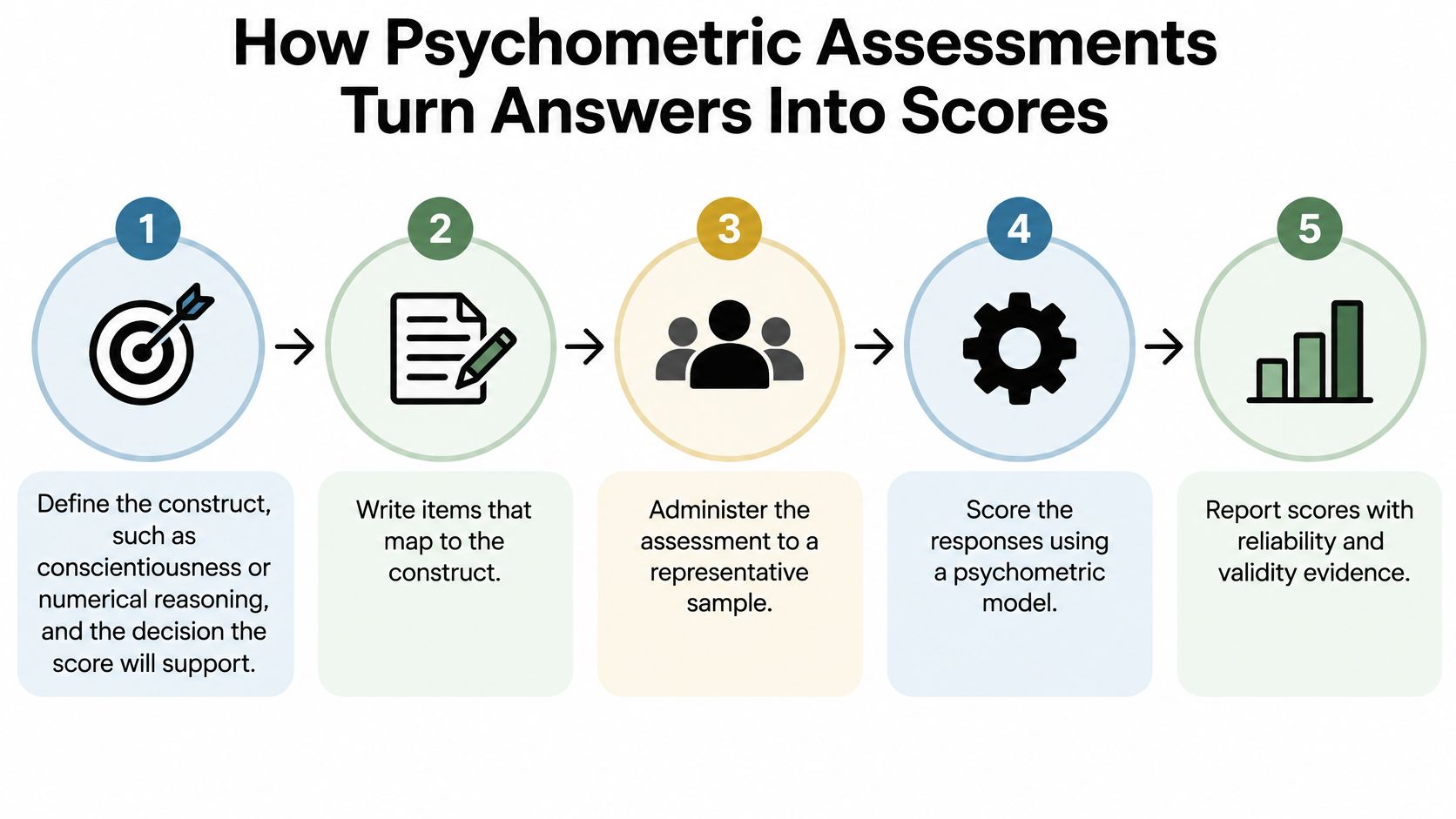
A score is the end of a chain, not the start. Skip a stage and the number looks finished while the inference is hollow. Work through these six stages whenever you review an instrument.
1. Define the construct and the decision. Name what you are measuring, such as conscientiousness or numerical reasoning, and name the decision the score will support. A coaching conversation and a hiring rank are different decisions. 2. Write items that map to that construct. Check wording clarity and reading level so people respond to the idea, not to confusing language. 3. Collect responses under standard conditions. Same instructions, same time limits, same setting rules. Otherwise you are comparing situations, not people. 4. Score with fixed rules. Turn item answers into a total or a domain score the same way for every person. 5. Compare the score with norms. A percentile of 70 means the person scored higher than 70 percent of the norm group. That comparison is meaningful only when the group resembles the person you are assessing. 6. Interpret only inside the validated purpose. A result built for development feedback is not automatically evidence for selection.
A latent trait can't be seen directly. You see answers, timings, and ratings, and you treat those as indicators. Correlation and factor analysis check whether items cluster the way the theory predicts, rather than reflecting one narrow task or random noise.
Construct types you will actually meet
| Construct | What it captures | Typical instrument | Common use | | --- | --- | --- | --- | | Cognitive ability | Reasoning, problem solving, and learning speed | Timed numerical or verbal reasoning test | Selection for complex roles | | Personality | Stable tendencies such as conscientiousness or openness | Self-report questionnaire with Likert-scale items | Development and team design | | Attitudes and values | Preferences, beliefs, and motivation | Attitude scale or forced-choice inventory | Engagement surveys and culture work | | Clinical outcomes | Symptoms, functioning, and change over time | Standardized rating scale | Monitoring treatment progress |
Before you buy or build anything, map the test onto the six stages and ask where each stage is documented. If norms, scoring rules, or the intended decision are missing, you don't yet have a score you can defend. For a closer look at reading a finished profile without turning it into a label, see [how to interpret an assessment](https://synopsix.ai/blog/assessment-interpretation).
Reliability and Validity Every Assessment Must Prove
Reliability is the consistency of scores across repeated testing. Test-retest reliability compares scores from the same people on two occasions. Interrater reliability measures agreement among observers who score the same responses. Internal consistency, often reported as Cronbach's alpha, asks whether items in one domain hang together.
Validity is a different claim. It is not a permanent property of a test. It is the degree to which evidence and theory support interpreting scores for a specific proposed use. Psychometricians look at several sources of evidence: test content, response processes, internal structure, relationships with other variables, and the consequences of testing.
A worked set of published figures
A 2025 psychological test-development study published by [Testing, Psychometrics, Methodology in Applied Psychology](https://tpmap.org/submission/index.php/tpm/article/view/3479) reported a Cronbach's alpha of 0.89, a split-half reliability coefficient of 0.85, and a content-validity index of 0.91. Read them as three different questions, not one grade. The alpha and the split-half coefficient speak to consistency. The content-validity index speaks to whether experts judged the items as covering the claimed construct.
Readers commonly treat a correlation or alpha of 0.70 as an acceptable floor and 0.80 or above as a stronger result. The 2025 figures clear that floor. They still don't prove the test predicts job performance, treatment change, or anything else you didn't study.
> A consistent ruler can be miscalibrated. High reliability gives you the same wrong length every time if the construct, the norms, or the decision don't match.
Evidence checks and common benchmarks
| Evidence check | Question it answers | Common benchmark | | --- | --- | --- | | Test-retest reliability | Do the same people get similar scores on two occasions? | Correlation of 0.70 or higher is usually acceptable | | Internal consistency | Do the items in one domain measure the same thing? | Cronbach's alpha of 0.70 or higher | | Interrater reliability | Do different observers agree on the same responses? | Agreement coefficient of 0.70 or higher | | Content validity | Do the items cover the construct the test claims to measure? | Expert-rated content-validity index, such as 0.91 in a 2025 study | | Criterion validity | Does the score relate to a real outcome for the intended use? | Correlation with the outcome, reported with sample size |
When you open a technical report, look for these checks and for a stated purpose next to them. A manual that quotes alpha and never names the decision is incomplete. A practical walk-through of both ideas sits in [reliability and validity for assessments](https://synopsix.ai/blog/assessment-validity-and-reliability).
Why Validity Depends on the Decision You Make
A test can be reliable, carefully written, and still support a poor decision. Consistency tells you the score repeats. It doesn't tell you the score is the right evidence for hiring, promotion, or coaching. Validity is use-specific. The same instrument can be useful for development and insufficient for selection.
The [U.S. Equal Employment Opportunity Commission](https://www.eeoc.gov/laws/guidance/questions-and-answers-clarify-and-provide-common-interpretation-uniform-guidelines) treats validation for selection as a prediction problem. Performance on a selection procedure should, on average, indicate how well a person will perform on the job after hiring. Criterion-related validation, especially predictive validation, matches that goal because assessment results are collected before performance outcomes. Concurrent validation collects the score and the outcome at the same time, which is faster and weaker as a forecast of future hires.
A coaching tool used as a hiring rank
Say a sales team adopts a personality questionnaire built for coaching and uses the totals to rank candidates. The scores may be stable. If nobody ever related those scores to sales results in that role, the ranking rests on no evidence. The questionnaire may still help a coach notice that one person plans carefully and another moves fast. It doesn't, on that record, tell you who will hit quota.
Before you let any score drive a people decision, ask three questions.
Practical rule: the decision determines the evidence required, so the same score can be strong evidence for one use and weak for another. Intuitive appeal is not that evidence.
Where Psychometrics Shows Up in Real Decisions
Hiring, leadership development, clinical care, and large education surveys all use psychometric scores. The evidence standard changes with the setting. A number that is enough for a coaching note can be too thin for a job offer, and a group survey score should not be treated as one student's result.
The [U.S. Office of Personnel Management assessment decision guide](https://www.opm.gov/policy-data-oversight/assessment-and-selection/reference-materials/assessmentdecisionguide) reports that general cognitive-ability tests predict job performance and training success across a wide range of jobs, with stronger usefulness as job complexity and training demands increase. OPM also notes that other predictors may add only small amounts of incremental validity when combined with cognitive tests. If you already have a cognitive measure matched to a complex role, test whether a personality scale improves prediction before you add it to the battery.
Four settings, four standards
| Setting | What is measured | Evidence needed | Main caveat | | --- | --- | --- | --- | | Hiring for complex roles | Cognitive ability and job-relevant traits | Predictive validity against job performance | Other predictors add little beyond cognitive tests | | Leadership and development | Personality, leadership style, and interaction style | Feedback reliability and coaching evidence | Scores describe tendencies, not fixed potential | | Clinical practice | Symptoms and everyday functioning | Responsiveness to change over time | Scores must match the specific clinical question | | Education surveys | Population-level skills and attitudes | Sampling and measurement error reporting | Results describe groups, not individuals |
Clinical scales have to match the clinical question. A depression rating doesn't answer an anxiety question just because both are "mental health." Education surveys such as PISA are built to describe populations of students. Sampling error and measurement error both sit in those group figures, so an individual score from that design is the wrong unit.
Take one sales manager and one questionnaire. If you use it to select candidates, the hiring standard applies, and the first check is whether the score predicted sales results in that role. If you use the same questionnaire for coaching, the development standard applies instead. You are describing tendencies a manager can work with, not issuing a forecast of quota. The score didn't change. The decision did.
Keeping Psychometric Decisions Fair and Explainable
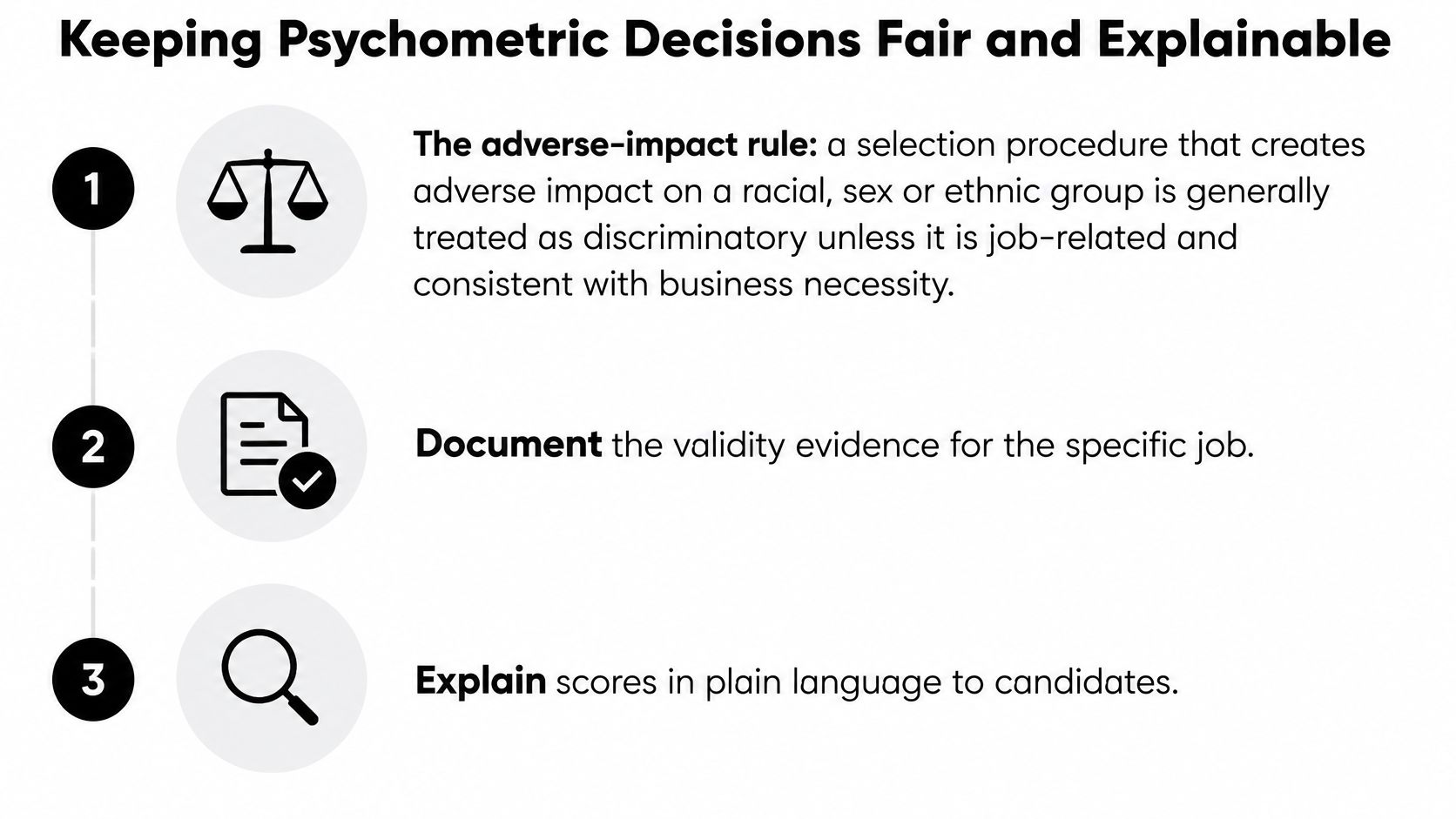
Fairness is part of the evidence, not a slogan you add after a high accuracy figure. Under the Uniform Guidelines, a selection procedure that creates adverse impact on a racial, sex, or ethnic group is generally considered discriminatory unless it is validated under the guidelines or the adverse impact is otherwise addressed, as the [EEOC's guidance on theories of discrimination](https://www.eeoc.gov/laws/guidance/cm-604-theories-discrimination) explains. The EEOC also says employers should look for an equally effective alternative with less adverse impact and adopt it when one is available. Other countries write their own rules, so a U.S. standard is a floor for thinking, not a global statute.
Four places bias can enter an AI-assisted assessment
Adding a language model doesn't retire classical checks. Recent work on AI-assisted measurement, including a review in [PMC](https://pmc.ncbi.nlm.nih.gov/articles/PMC13600520/), points to at least four checkpoints.
Large language models can reproduce biases tied to gender, race, age, language, disability, culture, and socioeconomic context. That risk isn't only a hiring problem. The same pressure shows up in exams, and [why students cheat on exams](https://form-timer.com/blog/why-do-students-cheat) is a useful reminder that scores get distorted when the conditions around a test aren't fair or well controlled.
A monitoring checklist
1. Track selection outcomes by group at each stage, from who is invited to who is hired. 2. Test job relatedness. Ask whether the assessment is job-related and consistent with business necessity. 3. Compare alternatives with lower adverse impact, and switch when one is equally effective. 4. Record human overrides. Write down why a reviewer departed from the score. 5. Explain the result. On request, tell candidates which factors drove their results. We provide explanations of the key factors behind a user's results on request, and our automated processing creates scores and narratives that are shared with the user and their employer.
Fairness is ongoing governance, not one adverse-impact ratio filed and forgotten. For the wider set of duties around consent, use, and explanation, read [ethics in assessment](https://synopsix.ai/blog/ethics-in-assessment).
<iframe width="100%" style="aspect-ratio: 16 / 9;" src="https://www.youtube.com/embed/-U9-Fq_LzXY" frameborder="0" allow="autoplay; encrypted-media" allowfullscreen></iframe>
Confirm the Evidence Before You Use Any Assessment
Start with the decision, not the brochure. What will this score inform, and what outcome should it predict? If you can't answer both in one sentence, you aren't ready to rank, coach, or diagnose from it.
1. Write the decision and the outcome. "Select account executives, and the score should relate to first-year sales" is usable. "Learn more about candidates" is not. 2. Ask for the documentation. Reliability figures, validity evidence, the norm group, and the sample size should be in the publisher's report, not in a sales slide. 3. Match the validation to your situation. Check role, population, and language. Then apply the three questions on outcome, sample, and the time gap between score and result. 4. Pilot against an outcome you already track. Performance ratings, training completion, or quality errors will show you whether the score moves with something you care about before you rely on it. 5. Record the decision path. Note the human review and the reason for any override so a later audit can see why the score was followed or set aside.
Run those five steps on the assessment you are considering this quarter, and start with the decision it will inform. If you want a personal look at traits, leadership style, and professional fit before you design a process for others, the personal professional assessment is free and takes about 10 minutes.
---
Synopsix turns scientifically validated behavioral assessments into role-specific evidence for hiring, team design, and development, so a score stays tied to a decision instead of becoming a label. You can see how that evidence is built, from profiles through simulations, and then judge it against the checks in this guide. Visit [Synopsix](https://synopsix.ai) to start with the free assessment and read your own results before you use any score on someone else.