What Is Sales Intelligence? a Guide to Smarter Selling
By Synopsix · September 7, 2026 · 13 min read
Sales intelligence is the process of gathering and analyzing data to help sales teams find, monitor, and understand prospects and customers, making better decisions about who to contact and when. The global market is projected to grow from USD 4.42 billion in 2025 to USD 9.15 billion by 2031, at a 12.89% CAGR.
You may already recognize the problem. A rep opens the CRM, selects an account that looks promising, and calls a contact whose title seems relevant. The company has since changed direction, the contact has moved roles, or the account is not considering a purchase. The rep spends time researching and reaching out, but the timing and message miss the mark.
Sales intelligence helps replace that guesswork with a clearer view of the market. Beyond this, it gives revenue leaders clues about the kind of people their sales motion requires, how existing reps should be coached, and whether the team can act on the information it receives.
Beyond the Contact List What Is Sales Intelligence
A sales team can have a large database and still make poor decisions. A contact list tells you who works at a company. It doesn't necessarily tell you whether the company fits your market, whether the person influences a purchase, what has changed recently, or whether the timing is appropriate for outreach.
Consider a software company selling to growing businesses. A rep calls an operations leader using an old CRM record and leads with a generic product pitch. The account recently adopted a competing technology, the contact now owns a different function, and the company has paused new purchases. Nothing is wrong with the rep's effort. The problem is that the information behind the effort is incomplete.
Sales intelligence adds context to contact data. It gathers information about companies, technologies, behavior, intent, professional activity, and relevant business events. It then organizes those signals so sellers can decide which accounts deserve attention, which message fits the situation, and which action should happen next.
> Practical rule: A data point becomes useful only when a person can connect it to a decision.
That distinction matters because sales intelligence isn't merely a database subscription. It's a working discipline that connects external market information with prospecting, qualification, account planning, and follow-up. Mordor Intelligence describes the category as software and services that gather, enrich, score, and deliver contact, account, and intent data across the sales funnel, with the market projected to reach USD 9.15 billion by 2031 [according to its sales intelligence market analysis](https://www.futuremarketinsights.com/reports/sales-intelligence-market).
A seller might notice hiring activity, a technology change, a funding announcement, or an executive move. None of those events guarantees a purchase. They do, however, create a reason to investigate. If you want a practical framework for recognizing those moments, Extrovert's guide to [how to spot buying signals](https://www.goextrovert.com/blog/what-are-buying-signals) offers useful context.
The human responsibility remains central. A platform can surface a possible buying signal, but a manager still needs to decide whether the signal is credible, a rep still needs to interpret it respectfully, and a hiring leader still needs to ask whether the team has the judgment and communication skills to respond well.
How Sales Intelligence Actually Works
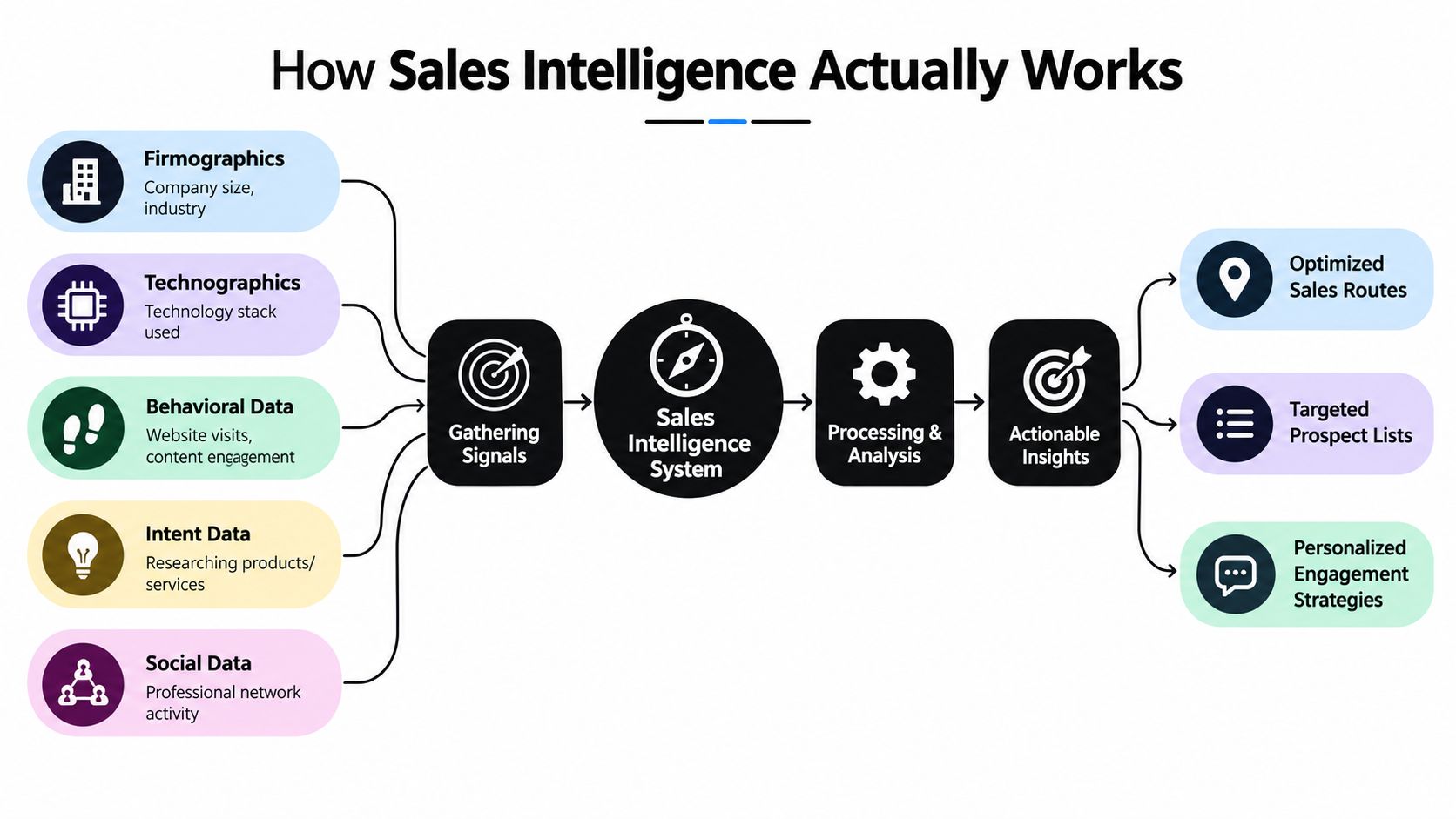
Think of sales intelligence as a GPS for account decisions. A GPS combines maps, location data, traffic conditions, and route logic. Sales intelligence combines company information, contact records, technology signals, behavioral activity, intent, social activity, and news so a seller can choose a more sensible route to an account.
The system generally works through four connected activities:
1. Gathering signals: It collects information from internal systems and external sources. 2. Normalizing records: It cleans inconsistent fields, joins related data, and enriches missing context. 3. Interpreting patterns: It scores accounts, identifies segments, and surfaces changes that may affect timing. 4. Recommending action: It helps teams prioritize accounts, tailor outreach, and coordinate follow-up.
The signals behind the recommendation
Firmographics describe the organization, such as its industry, structure, and size. Technographics show the technology environment a company uses. Behavioral data can include website visits or content engagement, while intent data indicates that an organization may be researching a relevant product or service. Social and news signals add context about professional activity, leadership changes, announcements, and market movement.
These signals become more valuable when combined. A company that fits the ideal customer profile may not deserve immediate attention if there's no evidence of a current need. Another account may become more relevant after a hiring push, a technology adoption, or executive turnover.
CRM and sales intelligence are different
A CRM primarily manages internal pipeline records, customer histories, activities, and deal stages. Sales intelligence focuses on external enrichment and predictive buying signals, then feeds useful context back into the CRM. IBM describes this distinction in its explanation of sales intelligence as a data-integration layer for B2B selling [in its overview of sales intelligence](https://www.ibm.com/think/topics/sales-intelligence).
The difference is practical. Your CRM may tell you that a rep contacted an account last month. Sales intelligence may help explain that the account has since changed its technology stack or shown renewed interest in a related topic.
That information still needs judgment. A recommendation isn't a command. Reps should validate the context, managers should monitor how signals influence behavior, and operations teams should check whether the underlying data remains trustworthy.
<iframe width="100%" style="aspect-ratio: 16 / 9;" src="https://www.youtube.com/embed/nUjGtVqj5_0" frameborder="0" allow="autoplay; encrypted-media" allowfullscreen></iframe>
The Core Components of a Sales Intelligence Engine
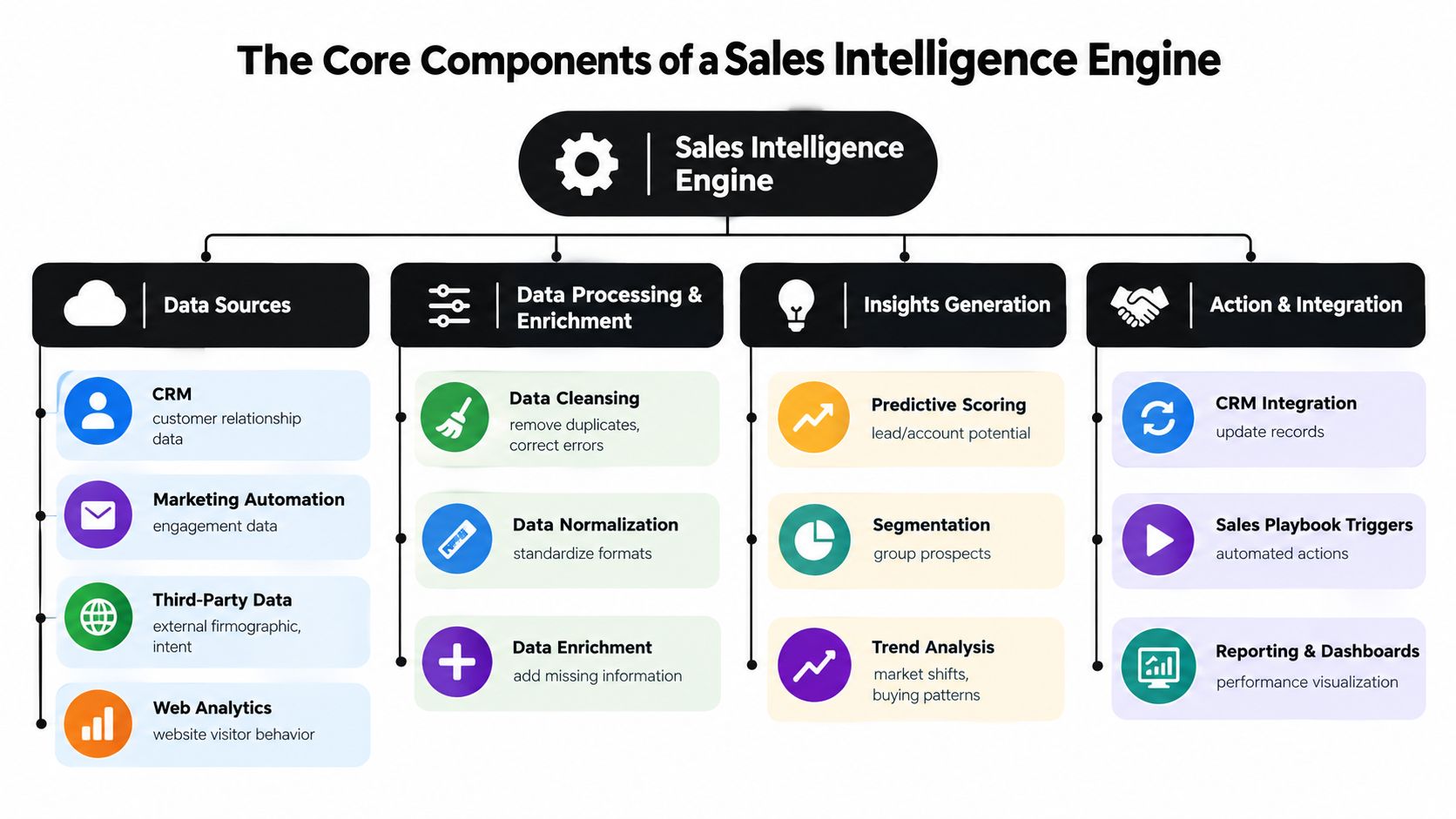
A sales intelligence engine turns raw information into usable decisions through several layers. Each layer adds value, but none can compensate for careless implementation or poor human judgment.
Data sources
The first layer collects information from places your team already uses and from external sources that add market context.
For example, firmographic data might indicate that a company fits your target industry and operating model. That makes it eligible for review, but it doesn't prove that the account should receive a call today.
Data processing and enrichment
Raw records often contain duplicates, inconsistent naming, missing fields, or outdated roles. Data processing cleans and standardizes those records. Enrichment adds information that the CRM doesn't hold, helping sellers see the account rather than a single isolated contact.
A practical test is simple: can a rep understand why an account appears in a priority list without opening several unrelated tools? If not, the system may be collecting data without making it actionable.
Teams comparing [B2B sales intelligence solutions](https://grouglobal.com/tools/subcategories/sales-intelligence) should examine the quality of this processing layer, not just the size of a vendor's database. Coverage matters, but freshness, transparency, compliance, and workflow fit matter just as much.
Insights generation
The engine can apply predictive scoring, segmentation, and trend analysis to identify accounts that deserve attention. Predictive modeling is useful when it supports a defined business decision, such as deciding which accounts to research first, rather than presenting a score without explanation. A related explanation of [predictive modeling](https://synopsix.ai/blog/what-is-predictive-modeling) can help teams understand why model outputs should guide investigation instead of replacing it.
A score should lead to a question: what evidence produced this priority, and what should the seller verify?
Action and integration
The final component places the insight inside the workflow. CRM synchronization can update records, playbook triggers can suggest actions, and dashboards can show whether teams are using the information consistently.
Here, people determine the return from the system. A well-integrated signal that no rep understands is just another notification. A clear signal linked to a useful coaching conversation can improve how the team researches, communicates, and follows through.
Business Benefits and Common Use Cases
Sales intelligence earns its place in a revenue stack when it improves the quality of decisions, not merely the quantity of records. The central benefit is better allocation of seller attention. Teams can spend less time sorting through accounts that lack context and more time investigating the opportunities that fit their strategy.
The category's commercial growth reflects that shift. The global sales intelligence market is projected to rise from about USD 4.42 billion in 2025 to USD 9.15 billion by 2031, as organizations operationalize enrichment, scoring, and intent feeds inside CRM and marketing automation systems [as reported by Mordor Intelligence](https://www.mordorintelligence.com/industry-reports/sales-intelligence-market).
Improving pipeline quality
A sales intelligence workflow can help teams define and maintain a sharper ideal customer profile. Instead of treating every account in a broad market as equally valuable, managers can create priority groups based on organizational fit, technology environment, relevant behavior, and observable change.
That improves the starting point for prospecting. It also gives marketing and sales a common language for discussing why an account should enter a campaign or receive direct attention.
Making outreach more precise
Personalization isn't the same as inserting a company name into an email. Useful personalization connects a prospect's situation to a relevant business problem. A technology change may create an integration conversation. A leadership transition may create a need to revisit priorities. A hiring pattern may suggest that a team is building capability.
The signal doesn't write the message for the rep. It gives the rep a reason to make the message specific.
Supporting account prioritization
Account-based teams can use intelligence to rank strategic accounts and coordinate activity across stakeholders. One account may show strong organizational fit but little current activity. Another may show a meaningful change event and engagement from several roles. The second account might deserve faster research, a coordinated message, or a manager review.
Finding expansion opportunities
Sales intelligence isn't limited to net-new prospecting. Customer-facing teams can monitor changes within existing accounts, identify new stakeholders, and notice developments that create opportunities for expansion. Account managers still need relationship knowledge and commercial judgment, but external signals can help them avoid relying only on historical notes.
Making forecasts more grounded
Forecasting improves when opportunity discussions include reliable account context and current activity, rather than only rep optimism or stale CRM fields. Intelligence can support a more disciplined review by prompting managers to ask what has changed, who is involved, and what evidence supports the opportunity's current position.
No platform can remove uncertainty from selling. It can help leaders ask better questions and help reps focus their limited time where investigation is most justified.
The Human Factor Using Intelligence for Smarter Hiring
Sales intelligence doesn't only reveal who to sell to. It can reveal how your market needs to be sold to, and that should influence hiring.
Suppose account signals show that your target buyers operate through long, complex buying processes with several stakeholders. A team built only around fast, transactional closing habits may struggle. The organization may need sellers who can map relationships, ask patient discovery questions, manage ambiguity, build consensus, and maintain momentum without forcing premature decisions.
The data doesn't identify those traits automatically. Revenue leaders must translate market conditions into a behavioral profile.

From account signals to role design
A useful people decision follows a chain:
This approach is more precise than hiring for a generic idea of a “strong salesperson.” It connects the actual sales motion to the behaviors that support it.
Synopsix is one option for this people layer. Its platform uses behavioral assessments to generate comparable profiles, role-specific intelligence reports, simulations, compatibility analysis, and development guidance. Leaders considering [sales candidate assessment](https://synopsix.ai/blog/sales-candidate-assessment) can use that kind of framework to make behavioral requirements clearer during selection.
Coaching the team you already have
Hiring is only part of the equation. Sales intelligence can show where the market offers opportunity, while manager observation reveals whether reps can act on it. A rep may receive a useful account signal but fail to investigate it, over-personalize the message, or abandon the account after one unanswered attempt.
Managers can coach the gap between the signal and the behavior. They can review account plans, listen for the quality of discovery, examine how reps interpret change events, and tailor enablement to the team's actual weaknesses.
For organizations building outbound capacity, resources about [Hire SDRs](https://hiresdrs.com/) can sit alongside a clear behavioral definition of the role. The important question isn't only whether a candidate can complete activities. It's whether the candidate can use evidence, adapt communication, and make sound decisions when the data is incomplete.
The strongest revenue teams pair external intelligence with human intelligence. Tools identify patterns. People decide what those patterns mean, how to respond, and who can be trusted to respond well.
Putting Sales Intelligence into Practice
Implementation should begin with a business decision, not a feature tour. Decide whether your immediate need is better account selection, cleaner records, stronger timing, more consistent qualification, or improved coaching. Then evaluate whether the platform can support that decision inside the systems your team already uses.
Look closely at data quality, freshness, integration, transparency, compliance, usability, and adoption. Ask vendors how information is sourced, how records are updated, how recommendations are explained, and what a rep must do to act on an insight. A platform that creates extra work or unclear alerts won't become part of daily selling.
Where it fits in the revenue stack
| Concept | Primary Focus | Key Output | |---|---|---| | Sales intelligence | External account, contact, intent, and market signals | Prioritized accounts and recommended actions | | Sales operations | Process design, systems, governance, and performance management | Reliable workflows, reporting, and operational discipline | | Revenue intelligence | Connected insight across pipeline, interactions, forecasts, and customer activity | Broader revenue visibility and decision support |
The boundaries can overlap, but the distinction helps. Sales intelligence generally supplies context about the market and buyers. Sales operations makes that context usable in repeatable processes. Revenue intelligence connects a wider set of signals across the customer lifecycle.
Measure behavior and outcomes
Choose a small set of measures that reflect both commercial progress and team adoption. You might track conversion rates, sales cycle duration, average contract value, account engagement quality, data completeness, and the percentage of priority accounts receiving a documented next action. The exact dashboard should match your sales motion.
Don't measure only whether reps logged into the platform. Review whether managers use signals in coaching, whether reps can explain why an account is prioritized, and whether hiring criteria reflect the behaviors the market requires. Guidance on [improving sales team performance](https://synopsix.ai/blog/how-to-improve-sales-team-performance) can help connect system adoption with management practice.
The right question is not, “How much data did we buy?” It's, “Which decisions are better because our people have trustworthy context, and are they capable of acting on it?”
---
Synopsix helps organizations turn behavioral assessments into practical guidance for hiring, team design, and sales development. Visit [Synopsix](https://synopsix.ai) to see how people intelligence can connect the sales motion your data reveals with the capabilities your team needs to execute it.