What Is Skills-Based Hiring and Why It Matters in 2026
By Synopsix · August 17, 2026 · 16 min read
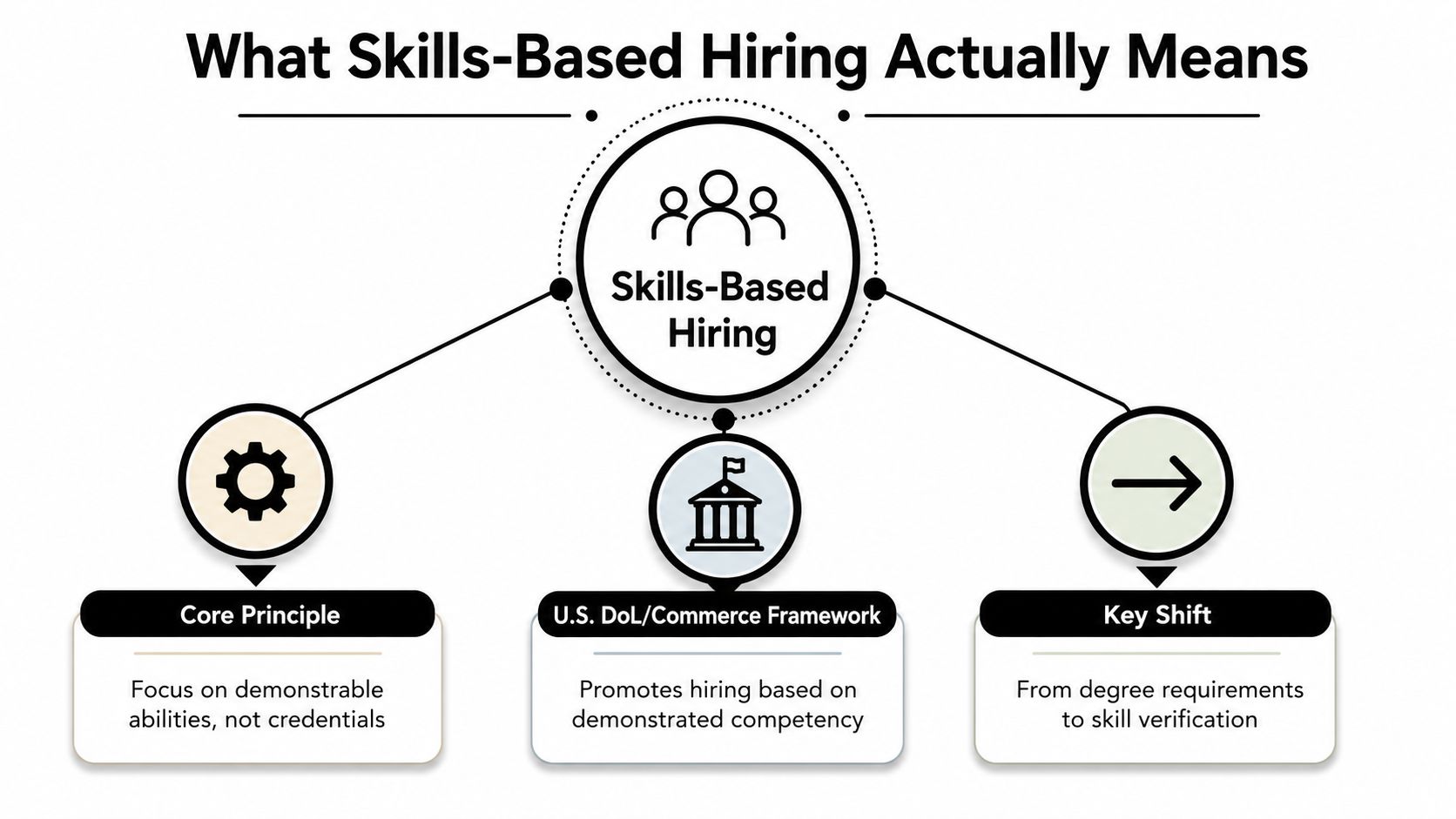
The U.S. Department of Labor and Commerce define skills-based hiring as hiring or promoting people based on the skills, knowledge, and abilities they can demonstrate, regardless of how or where they acquired them. In 2026, nearly 70% of employers use this model, and NACE reports that 70% of participating employers use it, with 71% applying it at least half the time.
That shift changes the central hiring question. Instead of asking, “Where did this candidate study or work?”, employers ask, “Can this person perform the work, and what evidence supports that judgment?” Skills-based hiring has become a mainstream talent model, but its success depends on much more than deleting a degree requirement. Organizations need a reliable way to define, assess, compare, and use skills data in real decisions.
What Skills-Based Hiring Means
Skills-based hiring evaluates demonstrated capability rather than pedigree. Evidence can include work samples, job simulations, structured assessments, portfolios, behavioral examples, or relevant experience gained outside conventional education and employment. The source of a skill provides context. The hiring decision should rest on evidence that the person can apply it to the work.
The [U.S. Department of Labor and Commerce guidance](https://www.dol.gov/newsroom/releases/osec/osec20241113) defines the model around skills, knowledge, and abilities workers can demonstrate, regardless of how or where they acquired them. The definition covers promotion as well as hiring, so the same approach can support internal mobility and external recruitment.
The [Global Skills Taxonomy Adoption Toolkit](https://reports.weforum.org/docs/WEF_Global_Skills_Taxonomy_Adoption_Toolkit_2025.pdf) adds the operating structure needed to make the model usable:
The distinction resembles judging a book by its cover versus reading its pages. A degree, job title, or recognizable employer can offer context, but each remains a proxy. A work sample or structured simulation gives the hiring team a closer view of how a candidate handles problems associated with the role.
Why the model is now mainstream
National University's [2026 hiring statistics summary](https://www.nu.edu/blog/67-hiring-statistics/) reports that nearly 70% of employers use skills-based hiring, up from 65% in 2024. NACE's 2026 employer survey found that 70% of participating employers used the approach, and 71% used it at least half the time.
These figures place skills-based hiring inside standard sourcing, screening, interviewing, and selection workflows. Adoption alone, however, does not create a reliable system. Employers still need shared skill definitions, consistent assessments, comparable evidence, and processes that convert results into hiring and team decisions.
The model covers technical and interpersonal capability. Leaders reviewing [career advancement skill balance](https://story.cv/blog/articles/soft-skills-vs-hard-skills) can distinguish task-specific expertise from communication, judgment, collaboration, and adaptability. Each skill needs a clear connection to successful performance in the role.
Skills-Based Hiring vs Traditional Credentials-Based Hiring
Traditional hiring often begins with a proxy. Recruiters screen for a degree, a familiar job title, a recognizable employer, or a specified number of years in a similar role. These signals can be useful, but they don't directly demonstrate whether a candidate can complete the tasks that matter.
Skills-based hiring changes the order of operations. The organization first defines the work, then identifies the capabilities needed to perform it, and finally chooses evidence that can test those capabilities. The World Economic Forum describes this as a move from proxy-based screening to direct measurement of job-relevant ability, a particularly important shift when job content changes faster than credential pipelines.
| Dimension | Credentials-Based | Skills-Based | |---|---|---| | Primary signal | Degree, job title, prior employer, or career history | Demonstrated ability, work samples, simulations, and structured evidence | | Connection to current work | Indirect, because the credential acts as a proxy | Direct, because the assessment reflects role-relevant tasks | | Risk of false negatives | Can exclude capable people with nontraditional backgrounds | Can identify capability that conventional screens overlook | | Candidate pool | Concentrated around familiar education and employment pathways | Broader, provided the organization defines and assesses skills consistently | | Hiring conversation | “Have you held a similar credential or title?” | “Can you show how you perform this task?” |
This doesn't mean credentials have no value. Regulated professions and roles with mandatory technical requirements may require specific qualifications. The problem begins when a credential is used as a blanket filter for work it doesn't directly measure.
A hiring manager may say that a customer success candidate needs a particular degree because the team has historically hired graduates from that pathway. A skills-based review asks a more useful question: can the person diagnose customer problems, explain a solution clearly, manage competing priorities, and protect the relationship during conflict?
That distinction also helps HR leaders explain the model to skeptical managers. Skills-based hiring isn't “lowering the bar.” It's replacing a vague proxy with a clearer performance standard. Candidates exploring a [vocational education UK pathway guide](https://accesscoursesonline.com/blogs/news/what-is-vocational-education) illustrate why this matters, because relevant capability can develop through routes that don't resemble a traditional academic sequence.
The Business Case and ROI of Hiring for Skills
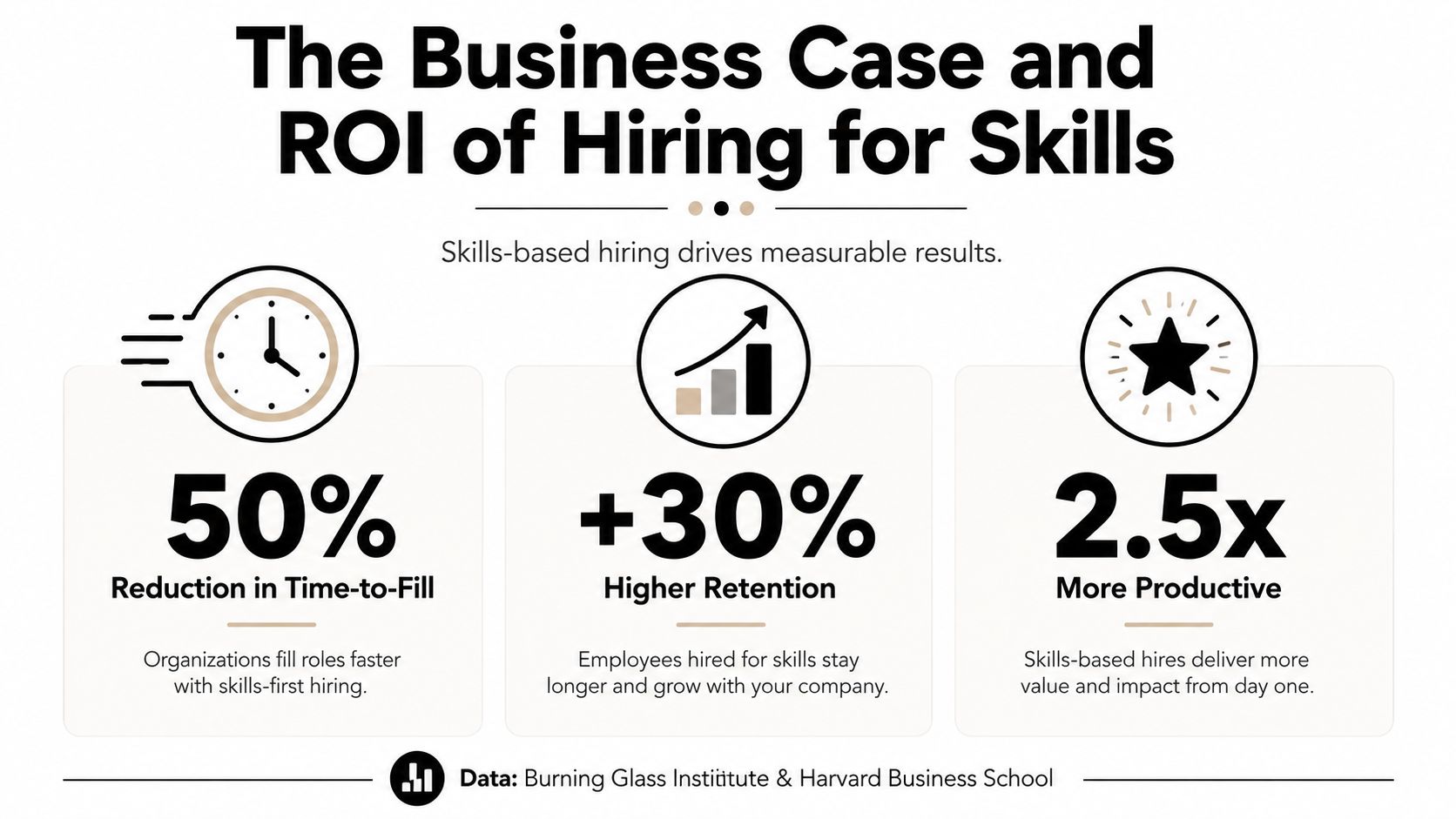
The strongest executive case for skills-based hiring is predictive quality. Research from the Burning Glass Institute and Harvard Business School reported that a skills-based hire was five times more likely to predict job performance than an education-based hire, with skills-based hires showing 9% longer tenure and only 2% lower promotion rates than traditionally hired peers. These findings are detailed in the Burning Glass Institute and Harvard Business School research.
For a CHRO, the implication is broader than a better candidate experience. More predictive selection can support quality of hire, reduce the cost of repeated replacement, and give business leaders stronger evidence that selection decisions connect to performance. Longer tenure can support workforce stability, while the small difference in promotion rates challenges the assumption that nontraditional hiring automatically limits advancement.
The same research found that skills-based job advertisements can describe roles in greater detail. Data-scientist postings averaged about 37 skills, compared with 28 skills in traditional versions, according to the cited study. A more precise role profile can help recruiters search for relevant evidence and help candidates understand what success requires.
Translating evidence into board language
A board memo shouldn't frame the investment as “removing degrees.” It should frame the work as improving the measurement system behind hiring.
SHRM found that 56% of employers used pre-employment assessments to gauge applicants' knowledge, skills, and abilities. Its research also found that 79% of HR professionals considered assessment scores as important as or more important than traditional criteria in hiring decisions, while 36% said a candidate with a high assessment score but insufficient experience was very likely to reach the final-candidate list, as reported by [SHRM's research on skills-based hiring](https://www.shrm.org/about/press-room/new-shrm-research-makes-case-skills-based-hiring).
> Executive test: If the assessment doesn't influence the decision, it isn't the primary hiring signal.
For teams designing evidence, a practical resource on [work-sample testing](https://synopsix.ai/blog/work-sample-testing) can help connect assessment design to the tasks candidates will perform. The business case becomes credible when leaders track the relationship between assessment evidence and later performance, not when they count how many job ads mention skills.
Why Most Skills-Based Hiring Programs Fail
A 2025 survey found that 85% of employers said they use skills-based hiring, yet employers still reported barriers such as assessing candidate skills, redefining roles and processes, and training hiring managers, according to the [State of Skills-Based Hiring 2025 report](https://www.testgorilla.com/skills-based-hiring/state-of-skills-based-hiring-2025/). The adoption figure shows intent, not whether the operating model works.
The gap appears when policy fails to change the workflow. An organization removes “bachelor's degree required” from a job advertisement, but recruiters still rank candidates by institution. A manager adds an assessment, then ignores the result during an unstructured interview. The guide says “skills first,” while the conversation returns to prestigious employers and familiar career histories.
Four common failure modes
The deeper failure is often data infrastructure. Brookings notes that skills-first hiring depends on trustworthy candidate data, verifiable credentials, and systems that match skills in job descriptions to candidate records, as discussed in this [analysis of what employers get wrong about skills-based hiring](https://www.phoenix.edu/workforce-solutions/workforce-resources/posts/leadership-development/what-employers-get-wrong-about-skills-based-hiring.html).
A durable program connects four layers: a shared skills language, evidence designed for the work, explicit decision rules, and comparable records. People-intelligence platforms can help turn those records into hiring and team decisions, but only when the organization agrees on what evidence means and who acts on it. Without that operating discipline, removing degree requirements changes the sign on the door, not the decision behind it.
A Step-by-Step Implementation Roadmap for HR Leaders
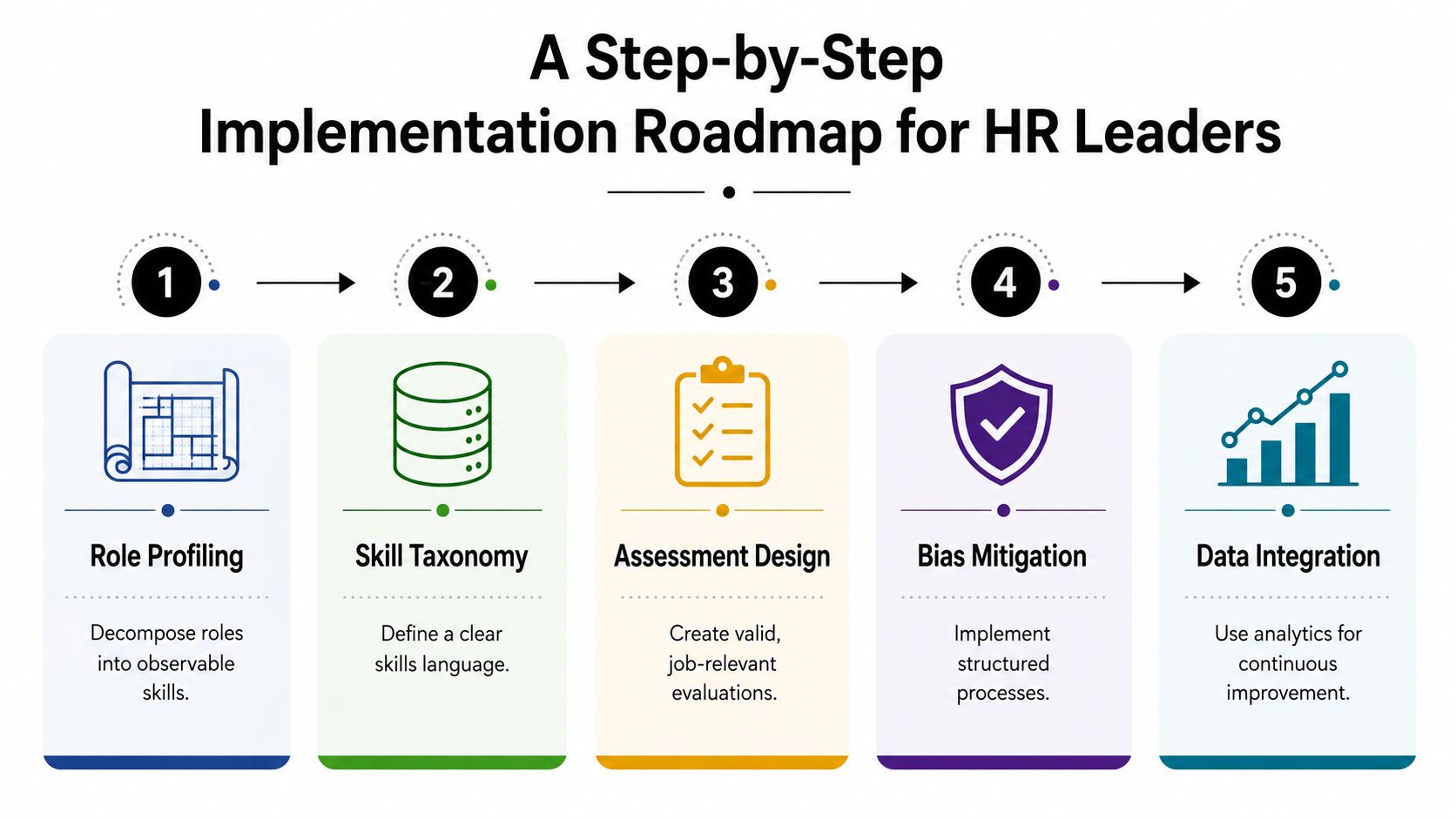
Skills-based hiring works best as an operating model. HR leaders can build it through five connected pillars, each answering a different question about how the organization will make decisions.
1. Profile the role
Start with the work, not the person who previously held the job. Break the role into observable outcomes, recurring tasks, technical capabilities, judgment requirements, and behaviors. Separate essential skills from skills that can be learned after hiring.
For example, a customer success role may require issue diagnosis, written communication, prioritization, stakeholder management, and commercial judgment. “Worked at a SaaS company” is background context, not a skill.
Decision for this quarter: Require every pilot role to have a documented skill profile before sourcing begins.
2. Create a shared skills language
A skills taxonomy gives recruiters, managers, assessment designers, and people analytics teams a common vocabulary. Define what each skill looks like in practice and distinguish beginner, working, and advanced evidence where appropriate.
A taxonomy shouldn't become a static library that nobody uses. Connect each skill to job descriptions, interview questions, assessments, employee profiles, and development plans. That connection allows the organization to compare capability across hiring and internal talent processes.
Decision for this quarter: Choose a limited set of role-relevant skills and define them with observable examples.
3. Design valid assessments
The U.S. Department of Labor guidance identifies structured tools such as job simulations and skills tests as ways to evaluate demonstrated capability. The [U.S. Office of Personnel Management guidance](https://www.opm.gov/chcoc/transmittals/2024/Skills-Based%20Hiring%20Guidance%20and%20Competency%20Model%20for%20Artificial%20Intelligence%20Work.pdf) emphasizes validated, job-related assessment tools and competency-based evaluation of demonstrated behaviors, skills, and abilities.
Choose an assessment because it reflects the work, not because it produces a polished dashboard. Define what a passing result means, who reviews the evidence, and how the result interacts with interviews and references.
Decision for this quarter: Validate one assessment against the tasks and behaviors that define success in the pilot role.
4. Source and interview differently
Write job ads around capabilities and outcomes. This can help reach career switchers, self-taught candidates, vocational learners, and people whose experience doesn't match the organization's usual pedigree pattern.
Then replace broad pedigree questions with structured prompts. Ask candidates to describe a situation, explain their actions, show the evidence, and discuss what they learned. Use work samples where the role allows it, and score every candidate against the same criteria.
Decision for this quarter: Publish one skills-first job ad and use a structured interview scorecard tied to its requirements.
5. Validate the system
A pilot isn't complete when someone is hired. Track how assessment results, interview scores, references, and later performance relate to one another. Review whether evaluators apply the criteria consistently and whether capable candidates are being screened out for reasons unrelated to the work.
This is also where an internal [skills inventory management](https://synopsix.ai/blog/skills-inventory-management) process can connect external hiring with workforce planning and development. OPM's competency-based approach supports this broader view because demonstrated abilities can inform both selection and talent growth.
Decision for this quarter: Establish a review point after one performance cycle and assign an owner for the findings.
A visual summary of the sequence is useful for recruiting teams:
The following video can supplement the roadmap with a practical explanation of skills-focused hiring decisions.
<iframe width="100%" style="aspect-ratio: 16 / 9;" src="https://www.youtube.com/embed/a5bsENheZuA" frameborder="0" allow="autoplay; encrypted-media" allowfullscreen></iframe>
A Skills-Based Hiring Workflow in Practice
Consider a fictional mid-sized SaaS company hiring a customer success manager. Its old process begins with a résumé screen for a degree, a customer success title, and experience at a recognizable software company. That funnel may reject a strong career switcher before anyone sees how the candidate handles a customer problem.
The new process starts with a role profile. The team defines the required capabilities as issue diagnosis, customer communication, prioritization, conflict management, and commercial awareness. The job advertisement describes those capabilities and the outcomes attached to them, rather than treating a specific academic path as the default entry point.
The first meaningful screen is a structured work sample. Candidates receive a customer scenario, review a short set of account information, write a response, and explain how they'd prioritize the next steps. The hiring team scores the response against predefined criteria, such as clarity, reasoning, ownership, and judgment.
What changes in the interview
The behavioral interview then examines patterns from the candidate's past. Instead of asking whether the person has held the exact title before, the manager asks for examples of calming an unhappy customer, coordinating with another team, or making a difficult prioritization decision.
References also become more specific. The company asks former colleagues to describe how the candidate communicated under pressure, learned unfamiliar products, and followed through on commitments. Titles still provide context, but the reference conversation verifies behaviors connected to the role.
A candidate who would've failed the degree or title screen can now progress through evidence. Candidates preparing their résumés can also use guidance on how to [format skills for recruiter scanners](https://resumey.pro/blog/how-to-list-skills-on-a-resume/), but the employer's responsibility is to assess those skills rather than rely on keyword presence alone.
The result isn't a looser funnel. It's a more explicit one. Every stage answers the same question: what evidence shows that this person can perform the work?
How People-Intelligence Platforms Operationalize Skills-Based Hiring
The infrastructure challenge is turning scattered evidence into comparable decisions. A résumé may describe skills in inconsistent language, a work sample may produce qualitative observations, and an interview may capture behavioral signals that different managers interpret differently. Without a system for organizing those inputs, the organization can claim to hire for skills while still making intuitive, pedigree-led decisions.
A people-intelligence platform can connect role requirements with structured behavioral and assessment data. [Synopsix](https://synopsix.ai/blog/talent-intelligence-platform) turns scientifically validated behavioral assessments into AI-powered guidance for hiring, team design, and talent development. Its stated workflow is to assess candidates and employees in under 30 minutes, generate comparable behavioral profiles, translate psychometrics into business-language signals, and support action through simulations, compatibility analysis, and development plans.
That workflow complements, rather than replaces, job-specific skills assessment. A work sample can show how a candidate performs a task, while behavioral data can help a team understand likely working patterns, communication preferences, and potential friction points. Leaders still need to define the role and validate the tools against actual performance.
From one hiring decision to team decisions
Synopsix includes Assessments & Profiles, role-oriented Intelligence Reports, Predictive Simulations, and Human Interlink views that visualize team complementarity and tension points. Used responsibly, these capabilities can extend skills-based hiring beyond a single vacancy into team composition, leadership pipelines, onboarding, and development planning.
The practical value lies in comparability. Hiring managers can review candidates against a consistent role frame, then examine how a prospective hire may interact with the existing team. HR can preserve evidence for later validation instead of losing it in interview notes and disconnected spreadsheets.
> Skills data becomes strategically useful when leaders can act on it consistently, not merely collect it.
Common Pitfalls and a Short Checklist for Your Next Hiring Cycle
Skills-based hiring becomes credible when the organization can verify evidence, compare candidates consistently, and review results after the hire. Removing a degree requirement alone leaves the decision system unchanged.
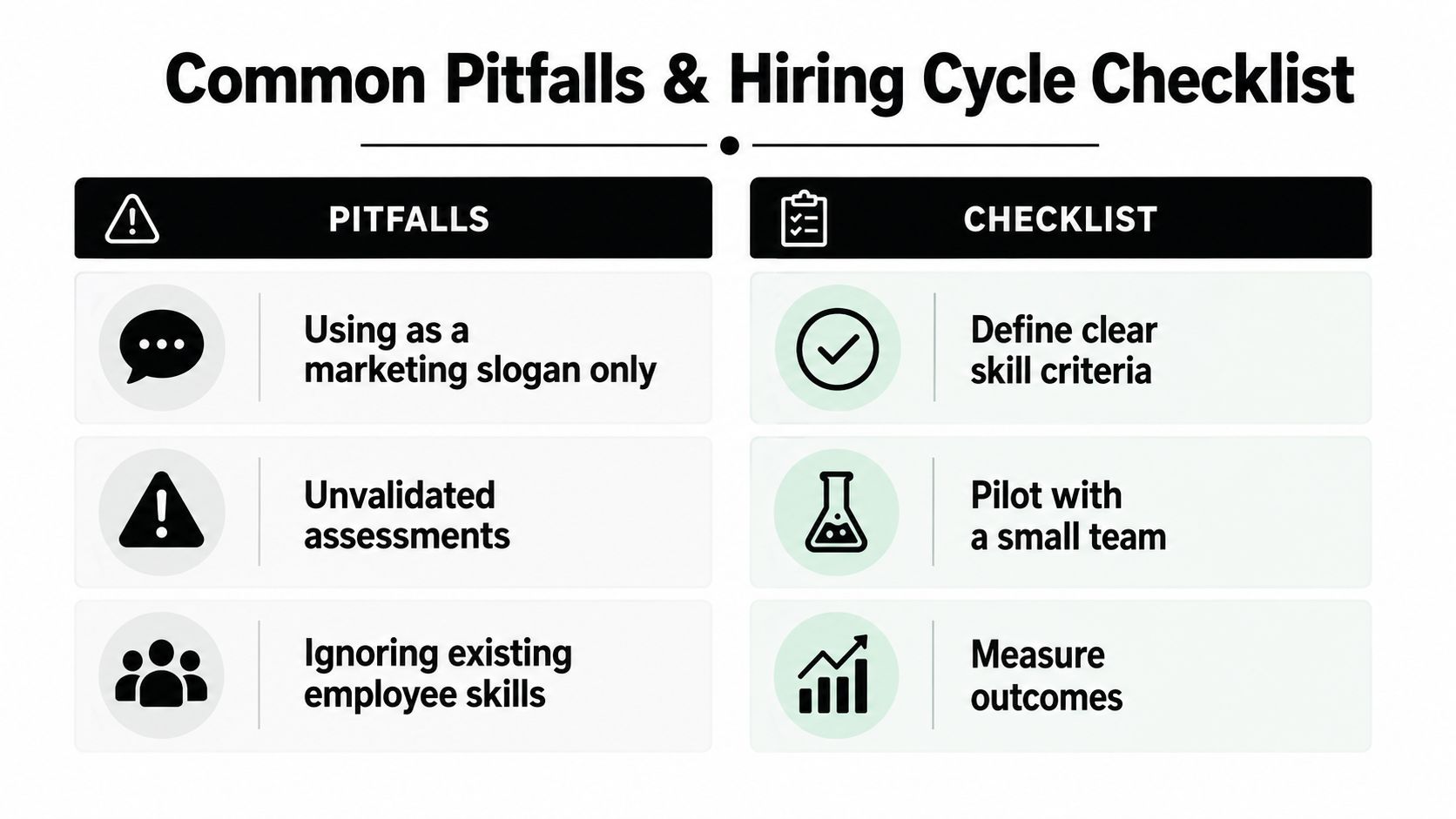
The main remaining risk is No outcome review. Hiring teams may track speed or volume while missing whether new employees perform well, stay, progress, and contribute to the intended business outcome. Set a review point after at least one performance cycle, then compare the original skills evidence with actual results. Revise the role profile, assessment, or scoring rules when the relationship is weak.
Ignoring current employees creates another blind spot. External hiring may fill a capability gap that already exists inside the organization. Map employees' demonstrated skills before opening a requisition, then consider internal mobility, targeted development, or team redesign alongside external hiring.
Use this checklist before the next hiring cycle:
1. Define the role: Document observable skills and behaviors tied to successful performance. 2. Choose the evidence: Select a validated, job-related assessment or work sample, and record why it reflects the work. 3. Structure the interview: Map questions and scoring criteria to the role profile. 4. Set decision ownership: Specify who reviews evidence, resolves disagreement, and makes the final decision. 5. Review the result: Track the decision process through at least one performance cycle, then adjust the model.
Start with one role, make the evidence explicit, and give managers a repeatable way to use it. A people-intelligence platform such as Synopsix can help preserve comparable profiles and connect hiring evidence with team and development decisions. The test is practical: can leaders show how skills data changed a decision and what happened afterward?