What Is Team Cohesion? Build Strong Teams in 2026
By Synopsix · July 27, 2026 · 14 min read
What makes one team move as a unit while another keeps missing handoffs, even when both have smart people and strong managers? The gap usually isn't talent. It's team cohesion, the part of team performance that tells you whether people merely share a calendar or share commitment, coordination, and accountability.
In organizational science, cohesion is not a feel-good slogan. It's a dynamic construct with distinct task and social subdimensions, and the literature recommends measuring it with both attitudinal and behavioral indicators because no single signal captures how strongly a group sticks together and executes toward goals ([research on multidimensional cohesion](https://journals.sagepub.com/doi/pdf/10.1177/0018720815578267?download=true)). That matters to CHROs because a team can like each other and still underperform if roles, goals, and work rhythms are misaligned. A “good atmosphere” is not the same thing as a reliable operating unit.
The practical question for leaders is not whether cohesion feels present. It's whether the team has the bonding, the shared mission, and the observable coordination needed to produce consistent results. That is why a serious people strategy has to treat cohesion as a diagnosable business system, not a soft morale issue.
What Team Cohesion Is Beyond the Buzzwords
Cohesion is often described as “getting along.” That's incomplete, and for leaders it's misleading. A more rigorous view defines cohesion as the bonding together of members that sustains their will and commitment to one another, the unit, and the mission, and it treats cohesion as a dynamic process rather than a fixed trait ([team cohesion definition and dynamics](https://psychiatry.ucsd.edu/research/programs-centers/instep/tools-resource/definitions/emergent-states/affective-emergent-states/team-cohesion.html)).
Why the distinction matters
The research split between task cohesion and social cohesion is not academic trivia. It tells you whether a team is aligned around execution or comfortable with one another. That distinction shows up in the way groups coordinate effort, hold each other accountable, and stay committed when pressure rises. A team with strong social bonds may still miss deadlines if it lacks shared direction, while a team with strong task alignment but weak relationships can become brittle and hard to sustain.
A useful diagnostic lens is to ask two separate questions. Do members feel bonded to the group, and do they reliably synchronize their work toward shared goals? A single “team spirit” score won't answer either question well enough for operational use. For that reason, a more evidence-based approach asks leaders to diagnose cohesion at the subdimension level instead of assuming one global feeling captures the full picture.
What this means for HR leaders
Many leadership programs go wrong. They collapse cohesion into trust, belonging, or engagement, then jump straight to activity-based team building. That skips the core issue, because cohesion is not just a social mood. It is an alignment mechanism that links relationships, shared objectives, and coordinated effort.
If you want a cleaner distinction between a collection of people and a true unit, [this explanation of how teams differ from groups](https://synopsix.ai/blog/difference-between-team-and-group) helps frame the operational gap. A group can share work. A cohesive team shares direction, identity, and follow-through.
> Practical rule: if you can't tell whether the problem is relationships, goals, or execution, you don't yet have a cohesion diagnosis.
The Core Components of a Truly Cohesive Team
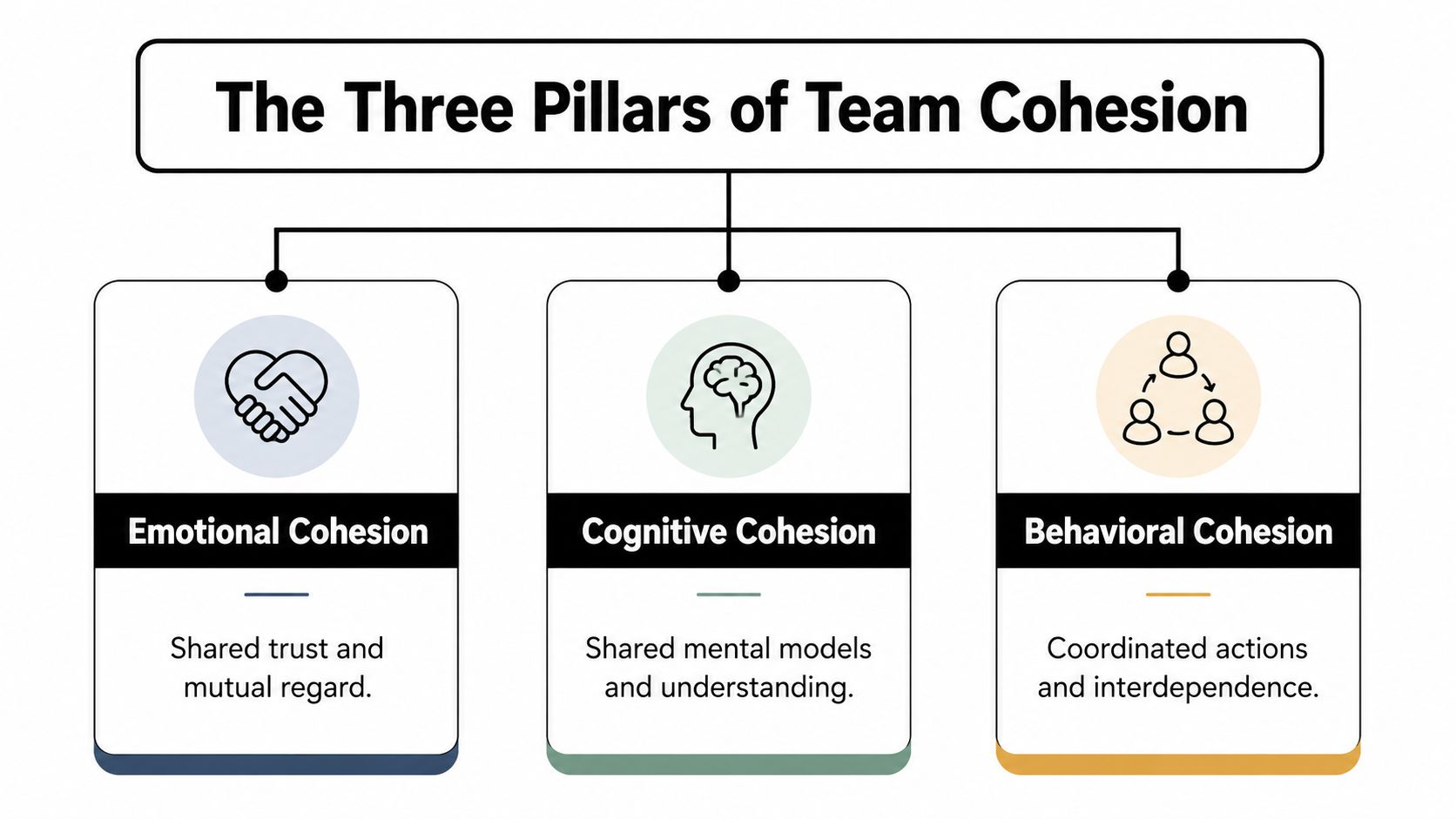
A useful definition from JiGSO describes team cohesion as the degree to which team members are connected and share common goals, values, and working styles, with emotional, cognitive, and behavioral components ([JiGSO on team cohesion](https://jigso.com/the-importance-of-team-cohesion/)). That framing is especially helpful for CHROs because it translates a fuzzy concept into three things leaders can inspect.
Emotional cohesion
Emotional cohesion is the felt sense of belonging, trust, and mutual regard. Corporate Finance Institute describes cohesive teams as having an attitude of “we-ness,” which captures the identity side of cohesion well ([CFI on team cohesion](https://corporatefinanceinstitute.com/resources/management/team-cohesion/)). If people don't feel they are part of the same unit, they'll protect themselves instead of backing one another under pressure.
This is the part most managers notice first, because it shows up in tone, openness, and willingness to ask for help. It's also the easiest dimension to overvalue. Friendly teams can still have weak task coordination, and that creates a false sense of health.
Cognitive cohesion
Cognitive cohesion is shared understanding. It covers common goals, role clarity, and the mental models people use to interpret work. When a team has it, members don't need constant translation to know what success looks like or who owns what. They can anticipate one another's decisions because they're operating from a similar map.
Behavioral cohesion
Behavioral cohesion is the observable side of team life. It appears in communication patterns, synchronized effort, follow-through, and mutual support. Research on cohesion emphasizes that behavioral indicators matter because feelings alone don't prove the team coordinates well ([multidimensional cohesion measurement](https://journals.sagepub.com/doi/10.1177/0018720815578267)). That is why behavioral cohesion is the most operationally useful pillar for managers who need evidence, not assumptions.
For a useful companion framework on team functioning, [this guide to effective teams](https://synopsix.ai/blog/qualities-of-effective-teams) helps connect cohesion to broader performance conditions. Cohesion is one component of effectiveness, not the whole story.
> When the three pillars line up, teams don't just feel better. They work with less friction, fewer clarifications, and stronger shared ownership.
A useful comparison for managers
That three-part lens is far more useful than “Do they get along?”
The Business Impact of Team Cohesion
Cohesion matters because it changes how work gets done, not because it makes the office nicer. The APA's synthesis of research on cohesive collectives says cohesion improves motivation, and motivation can in turn improve performance, creating a reinforcing loop ([APA spotlight on cohesion and motivation](https://www.apa.org/pubs/highlights/spotlight/issue-234)). This loop is the business story. Once a team sees itself making progress together, the group tends to invest more energy in the next cycle.
Why cohesive teams sustain performance
Cohesive teams are usually more willing to participate, stay engaged in the work, and coordinate around shared goals. The reason is straightforward. When members trust the unit and identify with it, they spend less energy guarding status or decoding motives, and more energy executing. That doesn't eliminate conflict, but it changes the default from self-protection to joint problem-solving.
Cohesion also helps resilience. When pressure rises, teams with stronger shared commitment are better positioned to absorb change without immediately splintering into isolated silos. That matters in restructures, fast growth, and periods of role ambiguity, where the team's ability to stay aligned can decide whether execution holds or drifts.
What business leaders should watch
The payoff is not just morale. It appears in the way teams respond to ambiguity, how quickly they recover from setbacks, and whether managers spend their time coaching or firefighting. Cohesion gives leaders a practical lever because it improves the conditions under which people choose to contribute. If the team identity is strong and the goals are clear, accountability becomes easier to sustain.
A useful reference point for event-driven team experiences is this [guide for event planners](https://pswevents.com/corporate-team-building-events/), especially if you're designing activities that support real working relationships instead of one-off entertainment. The point isn't the event itself. It's whether the event reinforces a shared identity and working rhythm.
The business case in plain language
Cohesion does three things that matter to enterprise leaders.
The strategic mistake is treating cohesion as an afterthought. It's part of the operating model.
When More Cohesion Is Not Always Better
The idea that cohesion is always good sounds sensible, but it breaks down in real organizations. The literature is clear that cohesion can strengthen commitment and resilience, yet the same forces can also produce conformity, resistance to dissent, and stronger in-group boundaries when a team needs fresh thinking or constructive conflict ([recent discussion of cohesion's limits](https://sirc.ca/articles/harness-power-team-cohesion/)). That's why maximal cohesion is not the goal.
The risk of over-attachment
Highly cohesive teams can start protecting the group's comfort instead of the organization's outcomes. People may hesitate to challenge a dominant view, especially if harmony has become a norm in itself. Over time, that can suppress debate and make the team less adaptable.
Leaders sometimes confuse unity with health. A team that never disagrees may look cohesive, but it may also be avoiding necessary tension. That kind of surface alignment can be dangerous in strategy, product, or transformation work, where dissent is often the only signal that a hidden risk exists.
Healthy cohesion needs boundaries
The goal is not to reduce cohesion. It's to balance it with psychological safety, diversity of thought, and a willingness to revise assumptions. That balance matters even more in hybrid settings and human-autonomy teams, where cohesion is increasingly shaped by both individual attitudes and group-level interactions rather than simple proximity or morale.
A related workplace trap is mistaking positivity for health, which is why a useful parallel is [this analysis of toxic positivity at work](https://synopsix.ai/blog/toxic-positivity-in-the-workplace). Both problems share the same flaw. They reward surface harmony and punish honest signals.
> Cohesion should help teams tell the truth faster, not keep them polite longer.
A healthy team can argue hard about the work and still remain united about the mission. That is a much better standard than “everyone gets along.”
Evidence-Based Strategies to Build Team Cohesion
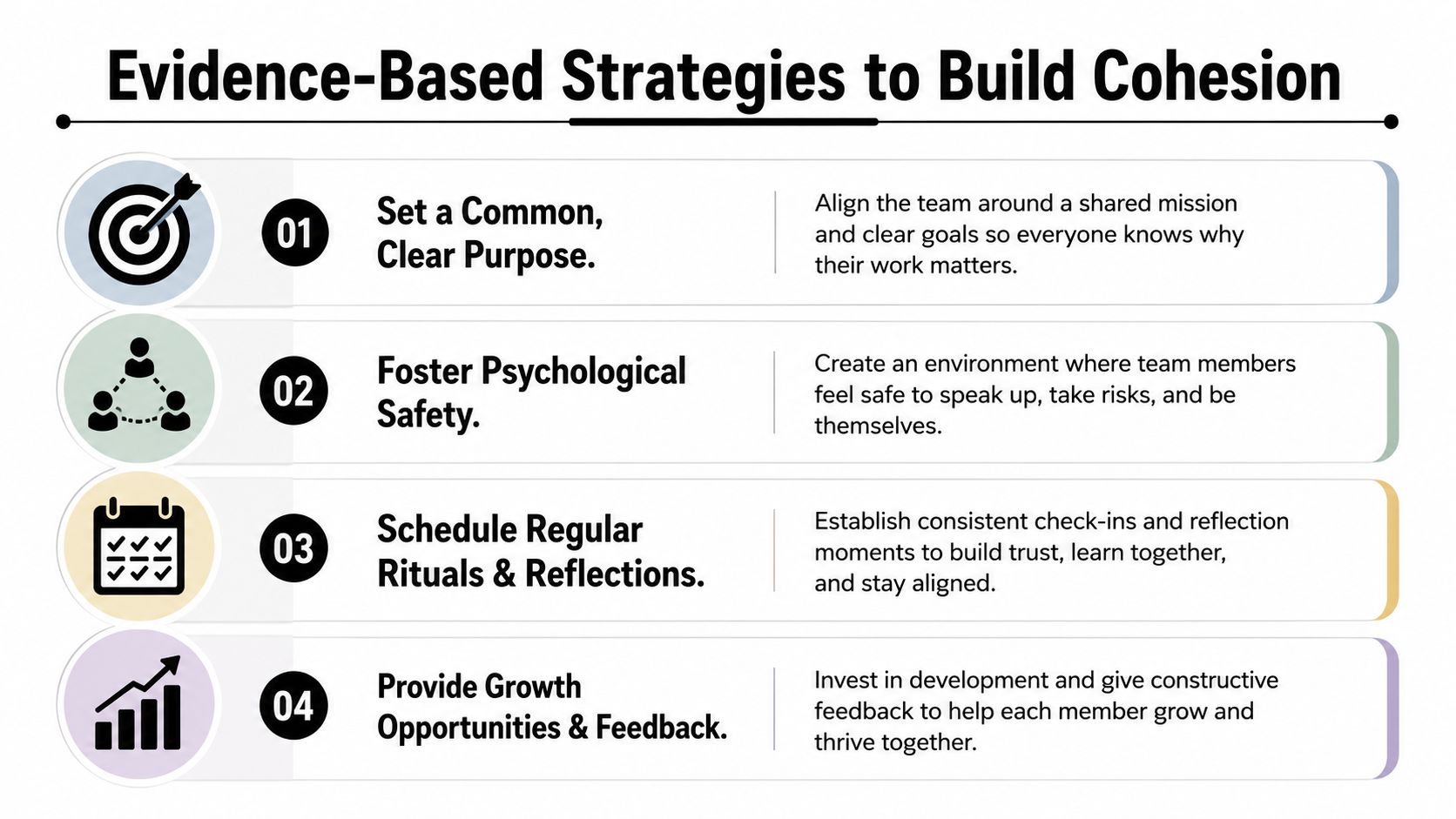
The strongest cohesion interventions are structural, not decorative. The APA identifies specific mechanics that increase cohesion, including strengthening existing interpersonal bonds, increasing the number of those bonds, using ritualized social interactions, and building a shared group identity through language like “we,” “us,” and “our” ([APA spotlight on cohesion and motivation](https://www.apa.org/pubs/highlights/spotlight/issue-234)). Those aren't icebreaker tricks. They are repeatable design choices.
Start with purpose and role clarity
Cohesion gets stronger when people know why the team exists and how their role contributes. That directly supports task cohesion because shared purpose reduces interpretation gaps. If one person thinks the team is optimizing speed and another thinks it is optimizing accuracy, friction is inevitable.
Build rituals that are actually useful
Ritualized social interactions matter because they create continuity. A regular team check-in, a consistent retro, or a shared kickoff format helps people anticipate how the group works together. The ritual only helps if it reinforces mutual trust and follow-through, so the content matters more than the ceremony.
Make interdependence visible
People bond when they can see their work affecting one another. Cross-functional handoffs, paired problem-solving, and shared deliverables turn cohesion from a feeling into an operating pattern. That's also where managers can reinforce accountability without making the team feel policed.
Use team language and shared identity deliberately
Language shapes belonging. When leaders consistently speak in terms of “our goals,” “our standards,” and “our responsibility,” they strengthen the identity side of cohesion. That doesn't create cohesion on its own, but it signals that the team is a collective unit, not a set of separate performers.
For managers who want a practical sequence for team development, this [practical guide to group dynamics](https://firacard.com/blog/tuckmans-stages-of-group-development/) is useful context. The key is to match the intervention to the problem. Don't use social bonding exercises to solve a role-clarity issue, and don't use a process workshop to fix mistrust.
A quick leadership checklist
Those actions are simple, but they work best when they're consistent.
How to Measure Team Cohesion Accurately
If cohesion is measured poorly, leaders often diagnose the wrong failure point. Research on cohesion recommends combining attitudinal and behavioral indicators, because no single measure captures how strongly a group stays aligned and coordinates toward shared goals. A one-item “Do you like your team?” survey misses the difference between sentiment, execution, and day-to-day working patterns.
Measure what people feel and what they do
Attitudinal indicators capture the internal side of cohesion. They show whether members feel bonded, committed, and willing to remain connected to the group.
Behavioral indicators show whether those attitudes show up in practice. That includes steady participation, reliable communication, and follow-through in collaboration.
A CHRO needs both because they answer different questions. Attitudes indicate whether the team is likely to stay together. Behaviors indicate whether the team is functioning as a unit. When those two views do not line up, the issue may be measurement, leadership, or a hidden role conflict that is distorting the team's operating pattern.
Separate task cohesion from social cohesion
Many organizations miss the distinction here. They use a single pulse item, then wonder why the results do not translate into better execution. Cohesion is multidimensional, so the measurement has to reflect that structure. Leaders need to know whether the weak point sits in relationships, shared goals, or coordination.
That separation also points to the right intervention. Low social cohesion may reflect weak trust or weak belonging. Low task cohesion may reflect unclear roles or limited commitment to shared objectives. Low behavioral cohesion may reflect inconsistent communication rhythms or vague working agreements.
Use team context, not just sentiment
A sound diagnostic process also accounts for the team's operating context. Teams in change-heavy periods, post-restructuring situations, or roles with high interdependence will show different cohesion patterns than stable, routine units. A qualitative review of meeting quality, handoff clarity, and cross-functional responsiveness can reveal more than a generic survey score ever will. The same logic applies to planned team experiences. A [guide for event planners](https://pswevents.com/corporate-team-building-events/) is useful only if the event is designed to support how the team works afterward, not just to fill a calendar.
The right question is whether the experience changed coordination after everyone returned to work.
> Measurement standard: if you cannot separate belonging from execution, you are not measuring cohesion. You are measuring mood.
Designing Cohesive Teams with People Intelligence
The hardest part of cohesion work is not understanding the concept. It's turning it into a repeatable decision system for hiring, team design, and development. That's where people intelligence platforms change the economics of the problem. Instead of relying on manager intuition, they translate behavioral assessment data into comparable profiles, fit signals, and team-level insights.
Why better diagnostics matter
Cohesion doesn't fail in the abstract. It fails in familiar places, like role mismatch, uneven communication styles, fragile trust, or teams that were assembled without enough attention to complementarity. A platform approach helps leaders see those patterns earlier by comparing people against one another and against the demands of a role or team environment. That's far more useful than waiting for conflict to surface in a quarterly review.
The value is especially clear for CHROs who need consistency across business units. When people data sits in separate spreadsheets, managers make subjective calls and hope the team chemistry works out. When behavioral profiles are structured and comparable, leaders can spot where coordination risk is likely to emerge before it turns into turnover, disengagement, or missed delivery.
From assessment to action
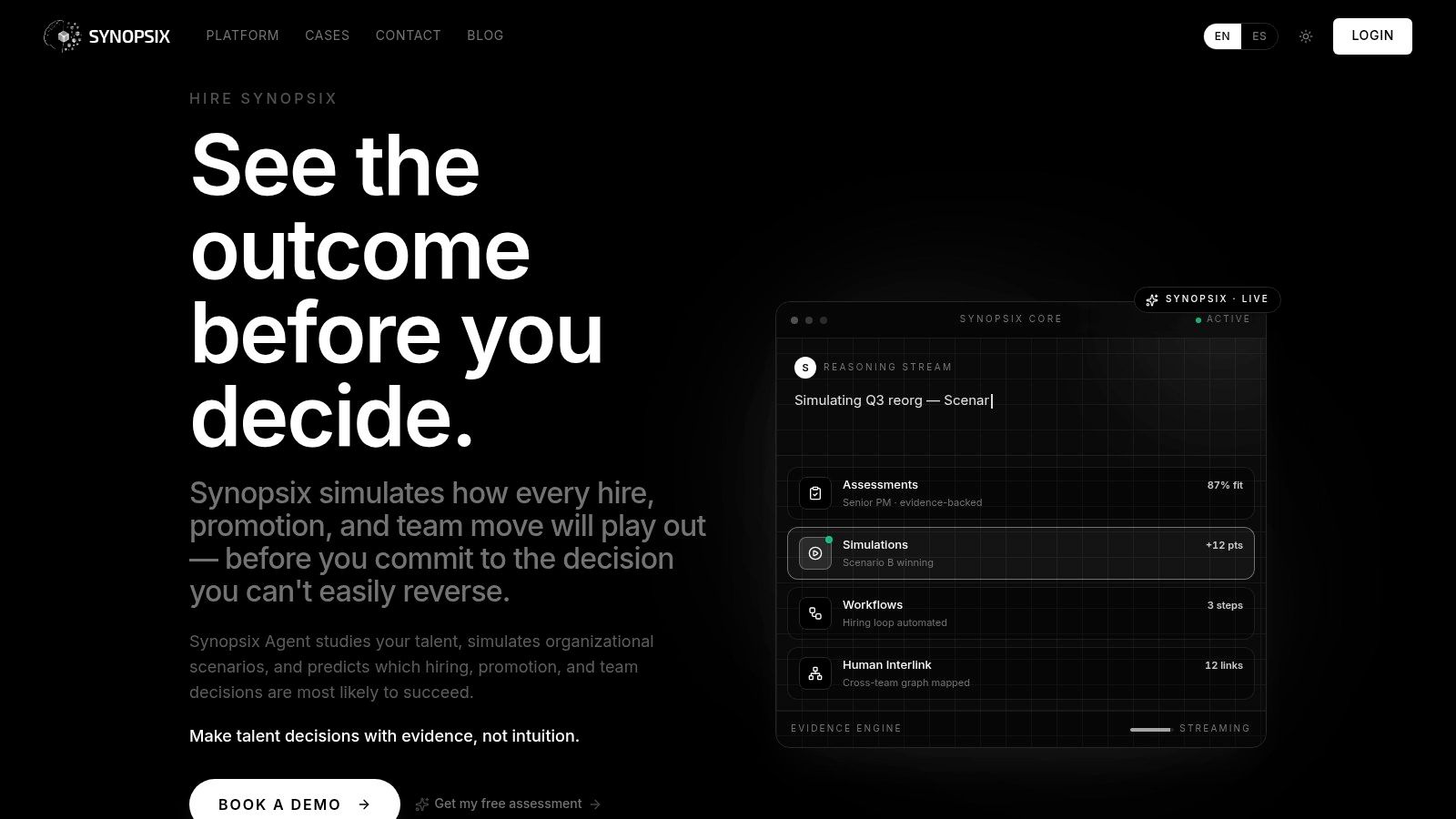
Modern people intelligence tools are strongest when they do four things well. They assess people quickly, generate clear behavioral profiles, translate psychometrics into business language, and then support decisions with compatibility analysis, simulations, and development planning. That workflow turns cohesion from a soft concept into a design variable.
The strategic point is simple. Team cohesion is too important to leave to chance, but too nuanced to manage with guesswork alone. The organizations that get this right will treat cohesion the way they treat finance or operations, as a measurable system with inputs, diagnostics, and intervention paths.
Later-stage leaders don't need more generic advice about team building. They need a way to design better team combinations, identify friction points early, and support managers with evidence they can act on. That's where people intelligence becomes a real operating advantage.
<iframe width="100%" style="aspect-ratio: 16 / 9;" src="https://www.youtube.com/embed/4OHdbtXofP4" frameborder="0" allow="autoplay; encrypted-media" allowfullscreen></iframe>
--- If you want to move beyond subjective team feelings and make cohesion measurable, Synopsix gives CHROs a structured way to assess behavior, compare team fit, and anticipate friction before it slows execution. Visit [Synopsix](https://synopsix.ai) to see how people intelligence can turn team design into a repeatable, evidence-based capability.