What Is Team Synergy and How to Build It
By Synopsix · September 4, 2026 · 16 min read
Most advice about team synergy starts in the wrong place. It tells leaders to improve trust, encourage collaboration, and bring people together, as if more interaction automatically produces better work. It doesn't. A team can coordinate quickly around a flawed assumption, duplicate effort while appearing highly engaged, or create so much communication overhead that capable people lose time to the team itself.
So, what is team synergy? It's best understood as a measurable coordination property. Synergy appears when people's actions, timing, and local decisions become interdependent enough that teammates can regulate one another during performance. That makes synergy a design question for CHROs and people leaders, not just a culture or morale initiative.
The practical objective isn't maximum collaboration. It's the right level of coordination for the work, supported by clear roles, visible expertise, psychological safety, and behavioral evidence.
Why Team Synergy Is Misunderstood
Business language often treats synergy as a pleasant outcome. The imagined team gets along, shares information freely, and produces more together than its members could produce separately. That description captures the emotional appeal of teamwork, but it misses the operating mechanism.
Synergy can be positive, negative, or inefficient. A group with shared blind spots may reach consensus faster because nobody challenges the underlying premise. A team with unclear ownership may schedule more meetings, exchange more messages, and still leave critical work undone. In knowledge work, every additional interaction carries a coordination cost, especially when people must repeatedly explain context, seek approval, or resolve overlapping responsibilities.
The distinction matters because team cohesion and team synergy aren't interchangeable. Cohesion concerns the quality of relationships and the desire to remain connected, while synergy concerns how effectively members coordinate their contributions. Leaders looking for that distinction can use this explanation of [what team cohesion means](https://synopsix.ai/blog/what-is-team-cohesion) as a complementary lens, but they shouldn't treat positive relationships as proof that work is being coordinated well.
Collaboration has a failure mode
Consider a product team preparing a release. Designers, engineers, product managers, and quality specialists may collaborate constantly, yet nobody owns the integration layer between the product and the customer workflow. Meetings increase, decisions circulate, and the release slips. The problem isn't a lack of goodwill. It's a missing coordination design.
The reverse problem also occurs. A team may divide work so rigidly that members protect their own tasks and fail to adapt when conditions change. Individuals perform their assigned duties, but no one sees the system. That arrangement can look efficient until an unexpected dependency appears.
> Practical rule: Don't ask whether a team collaborates more. Ask whether the team routes decisions, information, and accountability to the right people with the least necessary friction.
Research on dynamic teams distinguishes between external coordination, which is associated with improved team efficiency, and internal coordination, which is associated with improved individual learning [in the underlying team research](https://pmc.ncbi.nlm.nih.gov/articles/PMC5030782/). That finding gives leaders a useful trade-off. A tightly coupled operational team may need strong synchronization to protect throughput. An exploratory team may need enough coordination to connect expertise without constraining learning.
Synergy, then, is not a morale score. It's the fit between task structure and team coordination. The best team isn't the one with the most communication. It's the one whose communication helps members make better decisions, transfer knowledge, and adapt without unnecessary managerial intervention.
Defining Team Synergy as a Measurable Property
Sports science provides a more useful definition than the usual business shorthand. It treats synergy as a collective property of task-specific organization, where individual degrees of freedom become coupled so teammates can co-regulate one another during performance [as described in this research](https://pmc.ncbi.nlm.nih.gov/articles/PMC5030782/).
That sounds technical, but the organizational implication is straightforward. Team members don't merely act beside one another. Their timing, choices, and adjustments become mutually constrained by the task. A surgical team illustrates the point. The anesthetist, surgeon, nurses, and technicians each hold different responsibilities, but their actions must align around the patient, procedure, and changing conditions. The team's performance depends on the coordination between roles, not just the competence of each person viewed separately.
A sales pod works differently. One person may identify an opportunity, another may shape the commercial case, and a specialist may answer technical objections. Their work is interdependent, but the timing and intensity of coordination should match the sales process. Constant group involvement in every customer interaction would create drag. Targeted handoffs and clear escalation routes are more useful.
Coordination should match the outcome
The research distinction between external and internal coordination changes how leaders should design teams. External coordination directs attention toward the team's collective output. It helps members synchronize activities, manage dependencies, and improve efficiency. Internal coordination supports learning inside the team, allowing individuals to develop capability through interaction and adjustment [according to the same team dynamics research](https://pmc.ncbi.nlm.nih.gov/articles/PMC5030782/).
A product squad launching a well-defined feature may benefit from explicit planning, dependency tracking, and frequent synchronization. A research and development group working through ambiguity needs coordination that preserves experimentation. If leaders impose the same meeting cadence, approval path, and reporting structure on both groups, they may optimize one outcome while damaging the other.
This is why more coordination isn't universally better. The right question is whether a coordination mechanism reduces uncertainty or merely adds another checkpoint. People analytics teams can examine decision routing, handoff quality, duplicated work, unresolved dependencies, and the frequency with which managers must intervene. These are observable signals of how the team organizes itself.
A useful working model is:
The same team may need different forms of synergy at different stages. A new product launch may require tight external coordination, while the post-launch team needs more internal learning to improve its operating model.
The following video offers additional context for leaders thinking about team coordination as a system rather than a personality trait.
<iframe width="100%" style="aspect-ratio: 16 / 9;" src="https://www.youtube.com/embed/H4fIre6L_gI" frameborder="0" allow="autoplay; encrypted-media" allowfullscreen></iframe>
The Two Mechanisms That Engineer Synergy
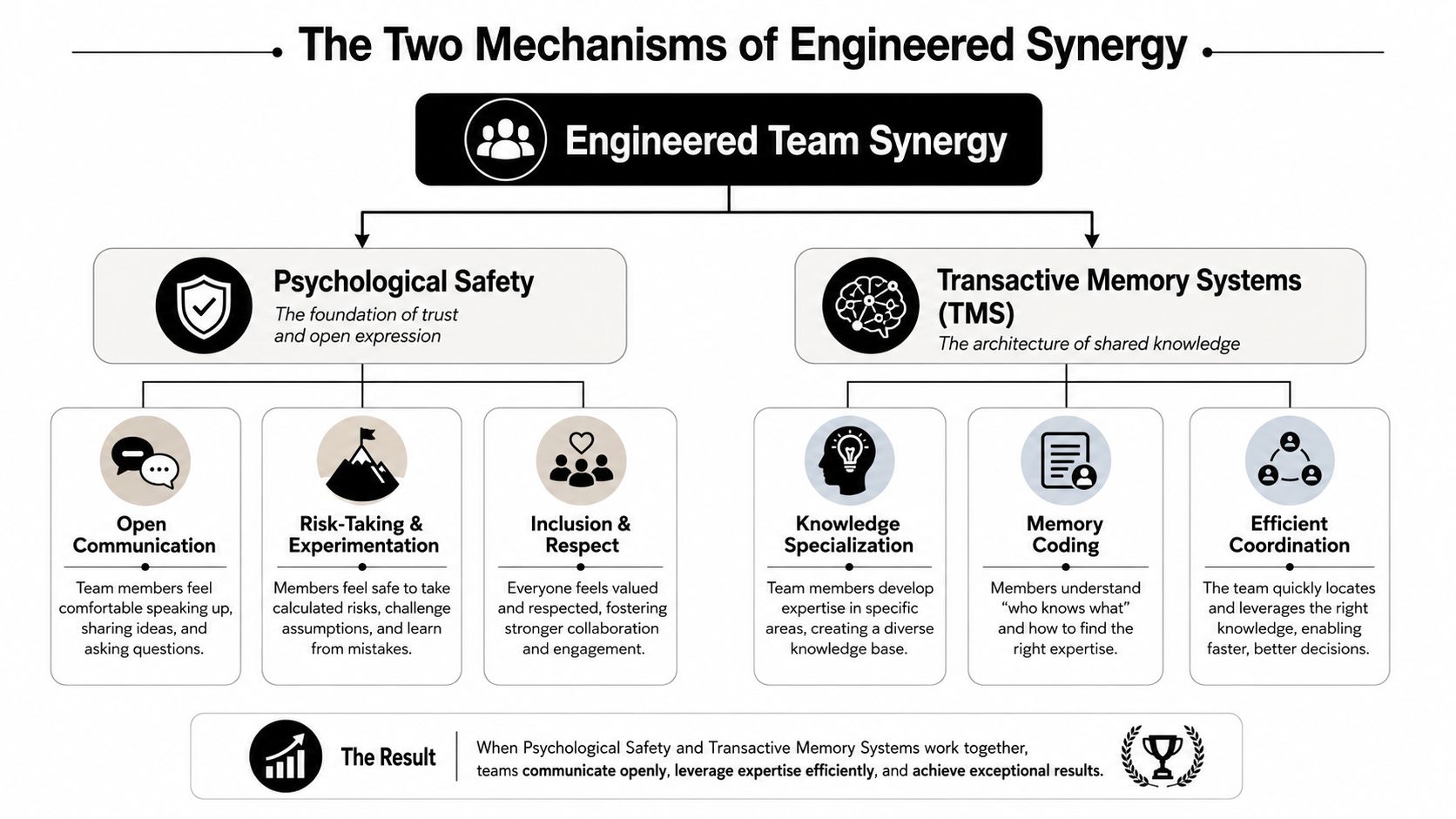
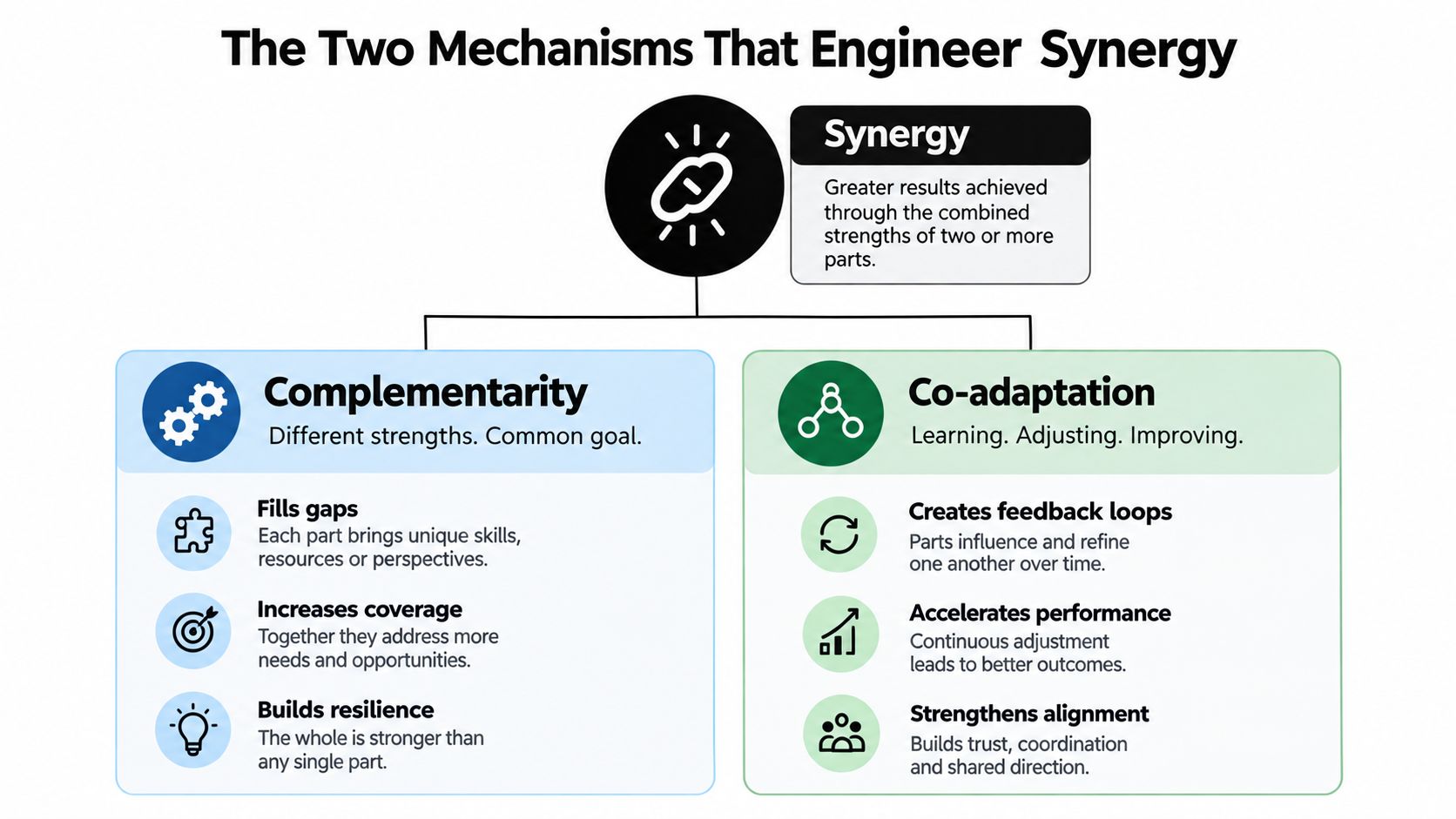
Good intentions don't create reliable synergy. Two mechanisms do most of the practical work: psychological safety and transactive memory systems, often abbreviated as TMS.
A TMS is a shared understanding of who knows what. It helps a team divide expertise across members, recognize whose knowledge is credible, and coordinate work without requiring everyone to know everything. In a functioning TMS, specialization doesn't isolate people. It gives the group a dependable routing system for questions, decisions, and problem-solving.
Psychological safety supplies the interpersonal condition that allows that routing system to operate. Members need to feel able to ask a basic question, admit uncertainty, challenge a decision, and surface an error without expecting humiliation or retaliation. Without that safety, a team may know who has the relevant expertise but still avoid contacting that person or reporting a problem.
Expertise needs a safe route
Research connects this combination to several team outcomes. In restaurant teams, TMS had a positive relationship with team performance and cohesion, while psychological safety mediated that relationship [in the referenced study](https://pmc.ncbi.nlm.nih.gov/articles/PMC3387583/). In virtual teams, psychological safety, team efficacy, and TMS were each positively associated with team learning behavior. In hospital ward teams, performance was associated with psychological safety, low interpersonal conflict, and strong TMS credibility and task-coordination features.
The common mechanism is practical. A team member sees a problem, identifies the person most likely to help, and feels safe enough to ask. The specialist contributes relevant knowledge, the group updates its understanding, and the work moves forward. If any link fails, the team either guesses, escalates unnecessarily, or waits.
> Diagnosis: When a team appears short on synergy, ask two separate questions. Do members know where expertise resides? Do they feel safe using that knowledge structure?
Leaders can strengthen TMS by publishing role ownership, documenting domain expertise, and making specialist contributions visible during onboarding and project reviews. They can strengthen psychological safety by rewarding early risk disclosure, responding constructively to dissent, and separating the quality of an idea from the status of the person proposing it.
A practical exercise is to use [developing collaborative perspective exercises](https://unitedwetransform.com/exercises/2-developing-collaborative-perspective/) to help members examine how colleagues may interpret the same situation differently. The value isn't the activity alone. Leaders should connect the discussion to actual work, such as who owns a decision, whose expertise is relevant, and what information people currently hesitate to share.
Engineer the conditions, not the mood
The combination produces a more useful leadership agenda than generic team-building. Psychological safety without expertise clarity can create open conversation that doesn't resolve ownership. TMS without psychological safety can create a map of expertise that people are too cautious to use.
The intervention target is therefore visible competence plus low interpersonal risk. Make it easy to identify the right specialist, and make it acceptable to ask that specialist for help.
Signs of High and Low Team Synergy
Leaders can diagnose synergy by observing how work moves, not by asking whether people like one another. High-synergy teams make interdependence visible. Members know when to involve colleagues, when to decide independently, and how to respond when new information changes the plan.
Low-synergy teams often look busy. Their members attend meetings, answer messages, and produce individual outputs, but coordination remains concentrated in a manager or hidden inside informal relationships. The team struggles when the manager is unavailable or when a project crosses a functional boundary.
| Dimension | High Synergy Teams | Low Synergy Teams | |---|---|---| | Decision speed | Routes decisions to the person with the relevant authority or expertise | Waits for a central leader or revisits decisions repeatedly | | Conflict pattern | Surfaces disagreements early and connects them to evidence or trade-offs | Avoids difficult conversations, then allows disagreement to reappear late | | Knowledge sharing | Makes specialist knowledge easy to locate and apply | Keeps expertise in individual inboxes or informal networks | | Role clarity | Members understand ownership, interfaces, and escalation paths | Several people assume others are responsible for critical work | | Adaptation | Adjusts responsibilities as conditions change | Protects local tasks even when the broader objective shifts | | Manager dependence | Uses the manager for direction, context, and exception handling | Requires the manager to coordinate ordinary interactions | | Effort allocation | Limits collaboration to decisions that need joint input | Pulls too many people into routine work |
What these patterns look like at work
A sales team with strong synergy might divide customer work according to demonstrated strengths. One member recognizes buying signals, another handles complex commercial concerns, and a technical specialist joins when the customer needs depth. The team doesn't need every person in every conversation because the members trust the routing system.
A product team with weak synergy may have talented contributors and a clear strategic goal, yet still ship late because no one owns the integration layer. Each function completes its visible portion. The unresolved interface remains invisible until the deadline makes it expensive.
The important diagnostic signal is not whether conflict exists. High-synergy teams can disagree frequently. The difference is that they expose disagreement while the team can still act on it. Low-synergy teams often confuse harmony with agreement and discover the cost of unspoken concerns near the end of the work.
> Look for the handoff: The quality of a team's synergy becomes most visible where one person's output becomes another person's input.
Track where work waits, who resolves ambiguity, how often teams duplicate analysis, and which decisions repeatedly return to senior leaders. These observations reveal coordination design more reliably than a broad engagement question.
Practical Interventions to Build Team Synergy
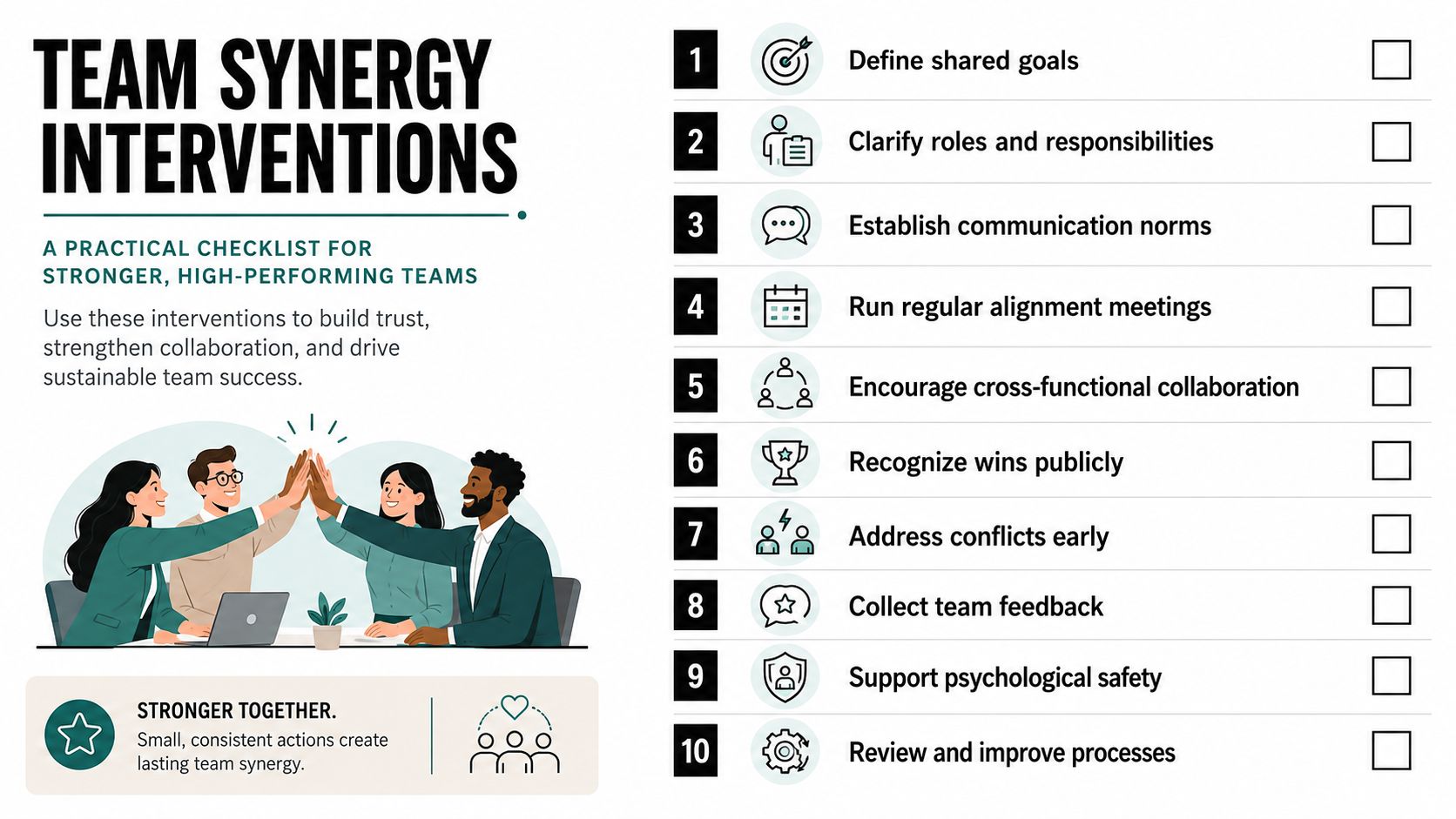
Synergy improves when leaders change the conditions under which people work together. Four intervention categories are especially useful: team design, role alignment, onboarding, and coaching.
Start with team design
Map the work before changing the people. Identify which tasks depend on one another, which decisions need shared input, and which activities should remain independent. A customer implementation team may need a daily handoff between delivery and support, but it doesn't need every specialist in every planning conversation.
The success indicator is cleaner coordination, not more meetings. Look for fewer unclear handoffs, faster ownership assignment, and fewer decisions that require managerial rescue.
Make expertise and ownership visible
Create a practical team map that shows each member's areas of knowledge, decision rights, dependencies, and preferred escalation route. Ask members to validate the map because formal job titles rarely capture the expertise people use.
For example, a finance partner may own forecasting, while an operations manager understands the data quality problems behind the forecast. Recording both types of expertise helps the team route questions to the right person instead of treating hierarchy as a proxy for knowledge.
The indicator is whether members can identify the right expert without asking the manager first. If they can't, the team hasn't built a usable transactive memory structure.
Use onboarding to create early connection
New members need more than an organization chart and a list of systems. Introduce them through the work. Give them a structured explanation of who owns which decisions, what the team is currently learning, and where previous projects encountered friction.
An early, bounded contribution can help a new employee learn the team's operating norms without requiring them to perform under maximum uncertainty. Pair that contribution with an explicit invitation to ask questions and challenge assumptions.
The signal to monitor is whether new members begin using the team's expertise network rather than working in isolation. Managers should also watch whether existing members make context available without waiting to be asked.
Coach the interaction pattern
Coaching should target behaviors, not personality labels. Practice concise disagreement, explicit handoffs, confirmation of ownership, and error reporting. After a project, ask where coordination helped, where it added friction, and which decision was harder to route than it should have been.
Teams can use [team-building strategies for structured development](https://synopsix.ai/blog/team-building-strategies) when they need a broader set of activities, but the activity must connect to a specific operating problem. A trust exercise won't repair an unclear interface between product and engineering.
Use the next 30 days to establish a baseline, publish the expertise map, clarify one critical workflow, and run a focused review of handoffs. The expected result isn't a sudden feeling of unity. It's observable movement in decision routing, ownership, and escalation.
Measuring Synergy with Behavioral Assessments and Simulations
You can't improve a coordination property that you never observe. A useful measurement system combines behavioral evidence from the work with structured assessments that clarify how people are likely to approach decisions, conflict, risk, and collaboration.
Start with team behavior. Examine communication density, decision routing, handoff failures, duplicated effort, unresolved dependencies, and manager intervention. These signals show how the team currently operates, but they don't explain every cause. Two teams may have similar communication volume while differing sharply in whether members use that communication to exchange expertise or compensate for unclear roles.
Add behavioral evidence carefully
Personality measures have demonstrated predictive validity for job performance, but selection depends on fit between the measure and the work. A meta-analysis reviewed 494 studies, used 97 independent samples, and included 13,521 participants. It found corrected mean validity of .29 for confirmatory strategies and .12 for exploratory strategies, while validity rose to .38 when job analysis guided measure selection [in the meta-analysis](https://onlinelibrary.wiley.com/doi/abs/10.1111/j.1744-6570.1991.tb00696.x).
A later cross-cultural synthesis covered 33 studies and 6,782 individuals and found similar Big Five validity across cultural contexts, with conscientiousness the strongest predictor across performance criteria [in that research](https://onlinelibrary.wiley.com/doi/10.1111/ijsa.12175). A broader synthesis spanning 54 meta-analyses, 2,028 study-level effects, and 554,778 participants found strong associations between Big Five traits and overall performance, while showing that predictive strength varies by trait and performance dimension in the quantitative review.
These findings don't justify labeling someone as a “synergy person.” They support a more disciplined approach: connect behavioral patterns to role demands, team interfaces, and likely interaction risks.
Turn profiles into team decisions
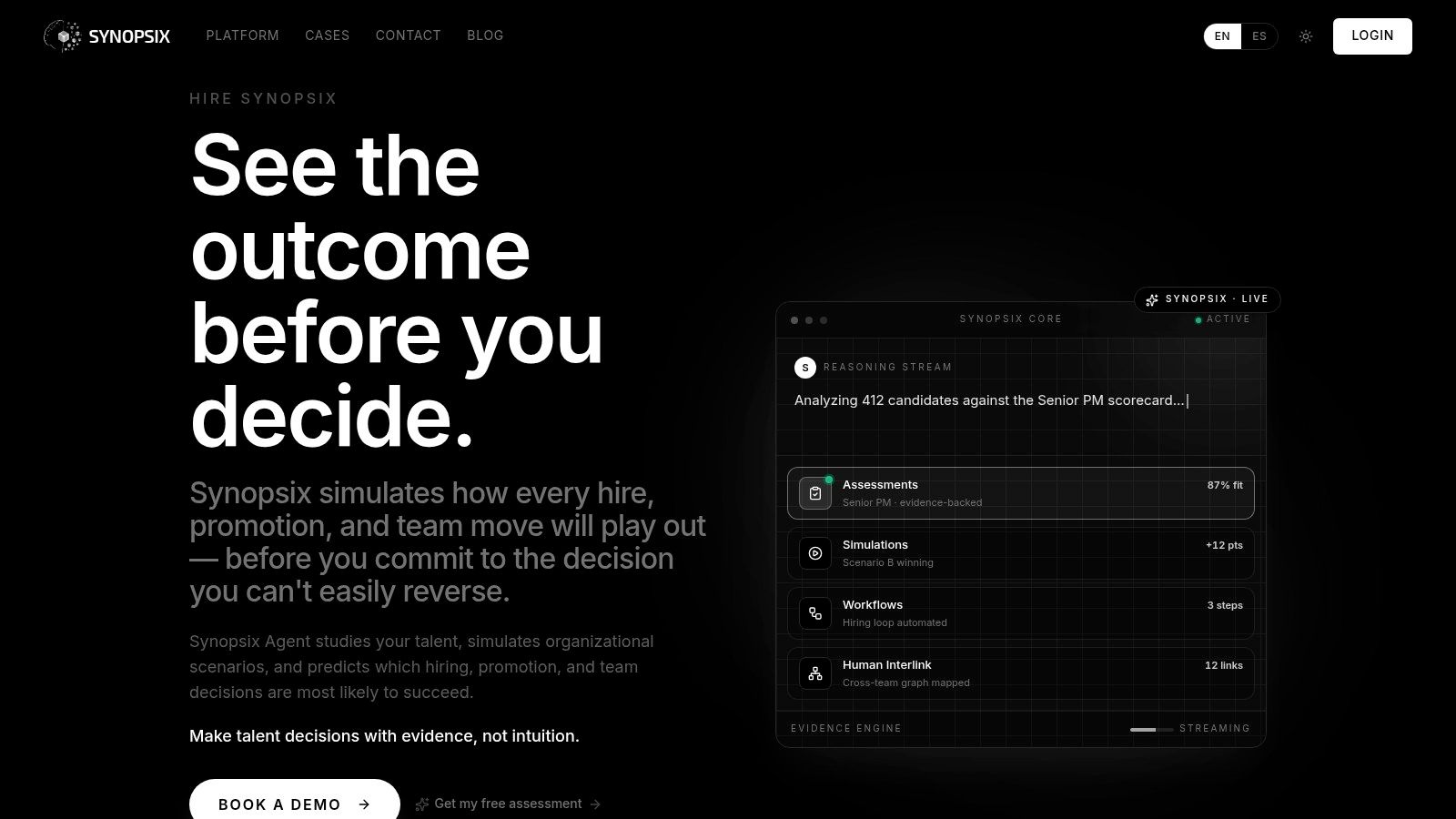
A platform such as Synopsix can assess candidates and employees in under 30 minutes, generate comparable behavioral profiles, translate psychometrics into business signals, and support decisions with simulations and compatibility analysis. Its Human Interlink capability is designed to visualize complementarity and tension points, while Predictive Simulations can help leaders examine possible friction and risk before they become operating problems. Leaders evaluating [behavioral assessment tools](https://synopsix.ai/blog/behavioral-assessment-tools) should still ask whether the tool connects assessment results to job analysis, observable behavior, and defensible decisions.
A practical dashboard might combine:
The measurement goal isn't to reduce people to scores. It's to give CHROs a common language for connecting role design, behavioral fit, and team performance.
Making the Business Case for Evidence-Based Team Building
CHROs shouldn't fund synergy initiatives because the word sounds positive. They should fund them when a team has a visible coordination problem, a measurable baseline, and a plausible intervention.
The business case can connect synergy to faster hiring decisions, fewer mis-hires, stronger team performance, and more reliable leadership pipelines. Synopsix reports 40% faster hiring decisions, 60% fewer mis-hires, more than 50K profiles generated, and claimed 98% assessment accuracy [through its platform information](https://synopsix.ai). Those figures should be treated as vendor-reported claims and tested against the organization's own baseline before they support a broader investment decision.
A credible pilot is deliberately narrow:
1. Select one high-stakes team with a clear performance or coordination issue. 2. Record the baseline, including decision delays, ownership gaps, manager escalations, and relevant team outcomes. 3. Assess the behavioral demands of the roles and compare how team members' patterns may complement or conflict. 4. Run one intervention, such as redesigning a handoff, clarifying ownership, or establishing a safer escalation routine. 5. Track the change and decide whether the evidence justifies scaling.
This approach answers common objections about cost, time, and psychometric skepticism without pretending that an assessment can solve a broken operating model. The strongest argument is not that synergy is a hidden magic ingredient. It's that leaders can inspect how people coordinate, change the conditions, and evaluate whether the team performs better.
---
Use Synopsix to translate behavioral assessments into comparable profiles, team compatibility insights, and predictive simulations for hiring and team design. Visit [Synopsix](https://synopsix.ai) to assess one important team, establish a coordination baseline, and identify the intervention most likely to improve how its members work together.