What Is Test Reliability and Why It Matters for Hiring
By Synopsix · June 27, 2026 · 18 min read
A hiring leader has seen this movie before. One candidate looks exceptional in interviews, gets the offer, and struggles within months. Another gets passed over, then thrives at a competitor. After enough of those cycles, the question stops being “Who impressed us?” and becomes “Which signals can we trust?”
That's where what is test reliability stops being a technical side note and becomes a business issue. If an assessment gives different answers each time you use it, or if different reviewers reach different conclusions from the same information, the tool isn't helping you reduce risk. It's just packaging uncertainty in nicer charts.
For HR executives, reliability matters because every talent decision compounds. A shaky signal at hiring shows up later as turnover, slower ramp time, friction on teams, and promotion mistakes. A dependable signal does the opposite. It helps people leaders make repeatable decisions instead of hoping their instincts happen to be right this time.
The phrase in the slug says it well: predict-human-behavior-synopsix-smarter-people-decisions. Predicting human behavior starts with measurement you can count on. Before an assessment can tell you anything useful about leadership potential, sales fit, or team risk, it has to produce consistent results.
Beyond Guesswork The Quest for Consistent Hiring Signals
A VP of Talent once described her hiring process to me in painfully honest terms. Some hires became top performers. Some looked just as strong on paper and in interviews, then stalled. The problem wasn't effort. Her team worked hard, interviewed carefully, and compared notes. The problem was that their process still relied on signals that shifted depending on who interviewed, what mood the candidate was in, and which details stood out that day.
That's the practical starting point for test reliability. At its simplest, reliability means consistency. If you use a measuring tape and it says a desk is one length in the morning and a different length in the afternoon, you wouldn't trust the tape. You wouldn't argue about the desk. You'd replace the tool.

Hiring assessments work the same way. If a behavioral or cognitive tool can't produce stable, dependable patterns, it can't support sound decisions. You're left with polished outputs built on unstable inputs.
Why consistency matters in business language
HR teams don't buy assessments because they love psychometrics. They buy them because they want fewer hiring mistakes and better performance signals. Reliability matters because it answers a blunt question: Will this tool produce similar results when the underlying person hasn't meaningfully changed?
If the answer is no, several things happen fast:
> A reliable assessment doesn't remove judgment. It gives judgment a steadier foundation.
That's also why operational tools around the top of funnel matter. If you're improving screening speed with [AI for faster hiring](https://matil.ai/en/blog/resume-parser-software), you still need downstream assessments that hold up under repeated use. Faster intake helps. Reliable evaluation makes that speed useful.
The shift from intuition to dependable signal
Most organizations don't suffer from a lack of opinions about candidates. They suffer from a lack of consistent evidence. Reliability is the first filter for separating the two.
When HR leaders understand reliability, they can stop asking only “Do we like this tool?” and start asking “Does this tool measure people in a stable enough way to support high-stakes decisions?” That question changes procurement, governance, and ultimately hiring quality.
The Four Pillars of Assessment Reliability
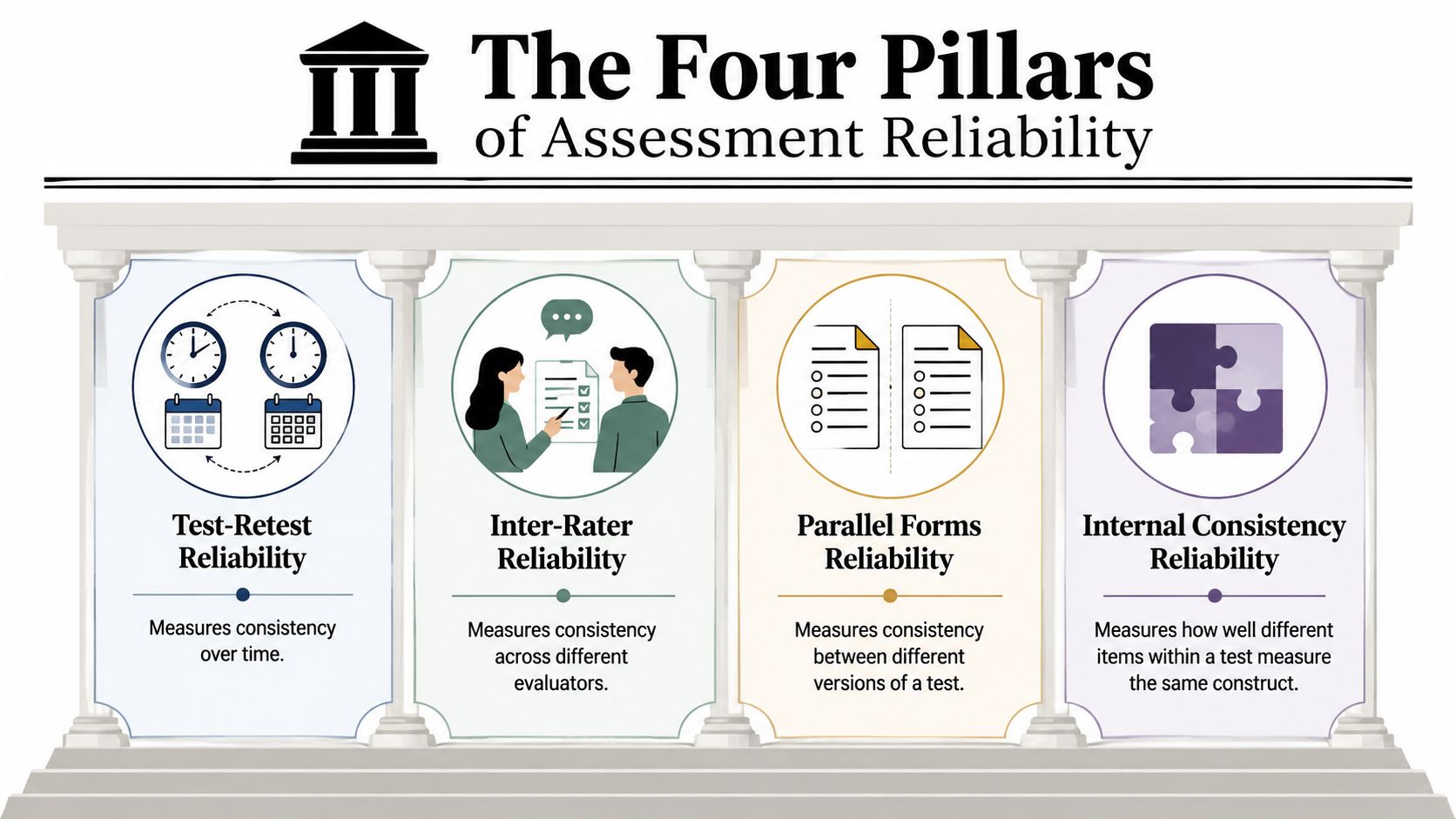
The easiest way to understand reliability is to break it into four distinct forms. Each one asks a different version of the same question: How stable is this measurement?
Test retest reliability
This is consistency over time.
Think of a bathroom scale. If you step on it twice within a short period and it gives wildly different readings, the scale is unreliable. In hiring, the equivalent question is whether a candidate's assessment score stays reasonably stable when the underlying trait hasn't materially changed.
This matters most for traits that shouldn't swing dramatically from one day to the next, such as broad behavioral tendencies or stable cognitive capabilities. Test-retest reliability examines that stability by correlating scores from the same test given to the same group twice, and more advanced agreement checks can use Bland and Altman's procedure, which expects 95% of differences to fall within two standard deviations of the mean ([Cambridge Cognition](https://cambridgecognition.com/what-is-test-retest-reliability-and-why-is-it-important/)).
If a sales candidate looks highly assertive one week and unexpectedly passive the next on the same measure, you have to ask whether the person changed or the tool did.
Internal consistency reliability
This is consistency within the test itself.
A good analogy is a survey about customer service where every question should point toward the same underlying quality. If one item measures patience, another measures listening, and another somehow captures a completely unrelated trait, the scale becomes noisy.
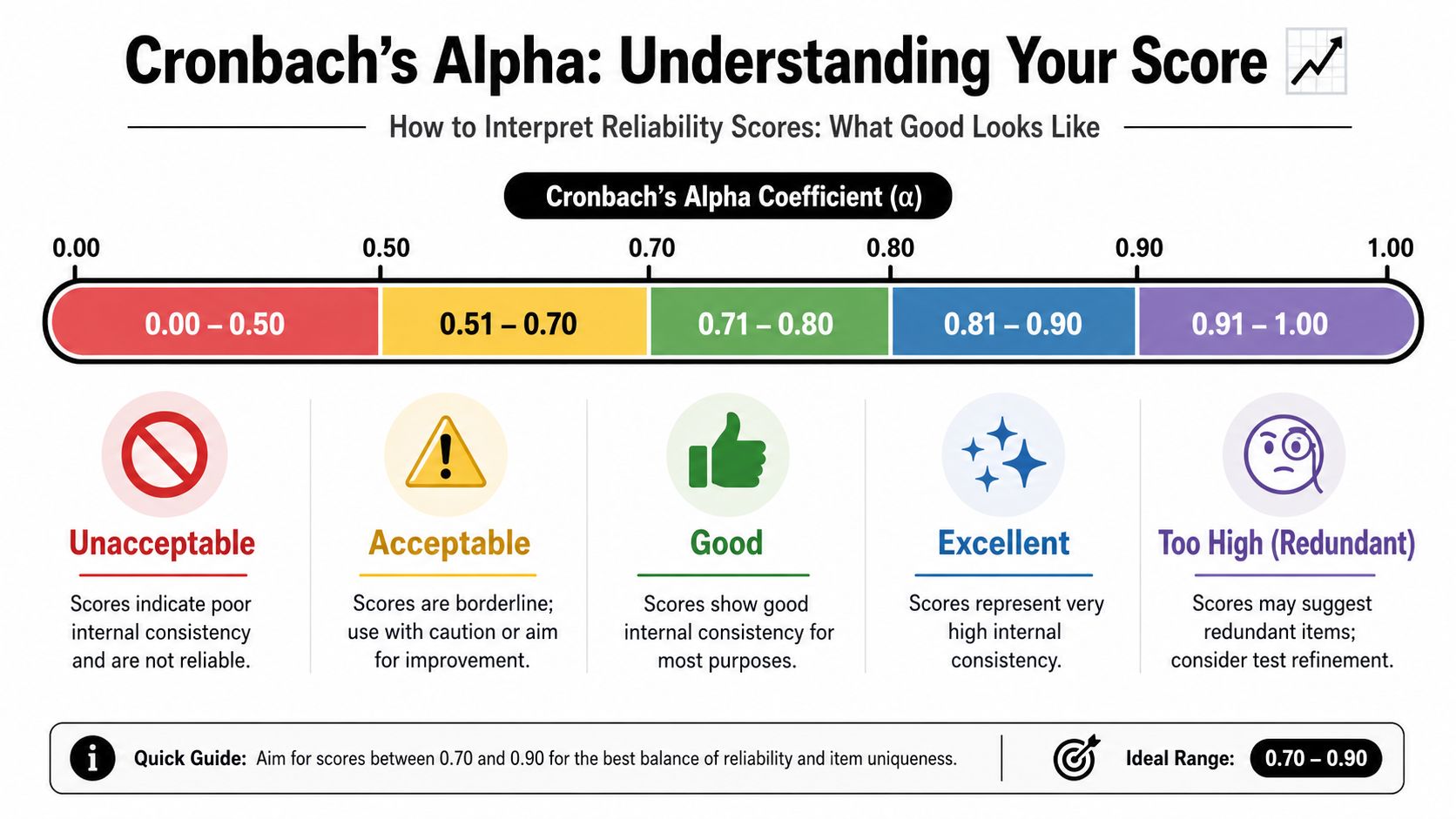
In psychometrics, internal consistency is commonly evaluated with Cronbach's alpha. Test reliability is quantified by internal consistency, where a Cronbach's alpha coefficient of 0.80 or higher is the established benchmark for acceptable reliability in questionnaire and behavioral assessment design, indicating strong inter-item correlations ([StatsDirect reliability overview](https://www.statsdirect.com/help/basics/reliability.htm)).
For HR, the plain-language version is simple. If a leadership assessment claims to measure decision style, its items should work together like parts of one instrument, not like unrelated questions stitched together.
> Practical rule: If the questions inside a scale don't hang together, the score at the end won't mean much.
Inter-rater reliability
This is consistency across evaluators.
Olympic judging is the classic analogy. If one judge gives a routine a top score and another gives it a very low score, the issue may not be the athlete. It may be the scoring system or how loosely judges are calibrated.
Hiring runs into this problem constantly. Panel interviews, structured role plays, and scored case exercises all involve human judgment. Inter-rater reliability asks whether different people reviewing the same performance arrive at similar conclusions.
A strong rubric is critical. If interviewers use vague labels like “executive presence” or “culture fit,” ratings drift. If they score clearly defined behaviors with shared standards, consistency improves.
Parallel forms reliability
This is consistency between versions of a test.
Think about two final exams in the same course. Form A and Form B should differ in wording and item order, but they should still measure the same knowledge at the same difficulty level. If one version is much easier, the scores can't be compared fairly.
In hiring, parallel forms reliability matters when an assessment provider rotates item banks, offers retakes, or uses alternate versions to reduce exposure. A candidate shouldn't get a materially different outcome just because they received Version B instead of Version A.
Four Types of Test Reliability at a Glance
| Reliability Type | What It Measures | HR Example | |---|---|---| | Test-Retest Reliability | Stability of scores over time | A candidate takes the same behavioral assessment twice and receives similar results | | Internal Consistency | How well items within one scale measure the same construct | Questions intended to measure conscientiousness produce a coherent overall score | | Inter-Rater Reliability | Agreement across different evaluators | Two interviewers score the same role play in a similar way | | Parallel-Forms Reliability | Equivalence across test versions | Two alternate versions of a sales assessment yield comparable results |
The four pillars don't compete. They answer different operational questions. Together, they tell you whether an assessment behaves like a dependable instrument or a moving target.
How to Interpret Reliability Scores What Good Looks Like
A hiring team narrows 200 applicants down to 6 finalists. Two candidates are separated by only a few points on an assessment, and one gets the interview slot. At that moment, the question is no longer academic. Are those score differences stable enough to trust, or are you making a high-cost decision with a faulty measuring tape?
Cronbach's alpha in plain English
Cronbach's alpha is one of the first numbers HR leaders see in a technical manual. It estimates how consistently the items in a scale work together. If ten questions all claim to measure conscientiousness, alpha helps you judge whether they are acting like one instrument or a loose pile of prompts.
The practical interpretation is simple. Higher alpha usually means less random noise in the score. Lower alpha means the score has more wobble, so small rank-order differences between candidates may not mean much.
Common benchmarks vary by use case. For higher-stakes standardized assessments, expectations are stricter. Guidance from the [University of Wisconsin testing office](https://testing.wisc.edu/Reliability.pdf) notes that professionally developed high-stakes tests are often expected to reach 0.90 or higher, while lower-stakes standardized tests are often expected to be around 0.80 to 0.85, and classroom tests are often considered acceptable at 0.70 or above.
That business logic matters more than the math. If a score is going to influence hiring, promotion, or succession decisions, the bar should be higher than it would be for a low-risk employee survey.
One caution helps avoid a common mistake. A very high alpha is not automatically better in every case. If items are too repetitive, the test may get longer without adding much new information. HR leaders feel that trade-off in completion rates, candidate fatigue, and drop-off. A longer test can raise reliability, but only up to the point where extra length starts hurting the candidate experience and the quality of responses.
How to read reliability scores like a decision-maker
A useful way to read a reliability coefficient is to ask one business question: how much confidence should I place in fine-grained score differences?
This is why the same score can be acceptable in one setting and weak in another. A development tool can still be helpful with moderate reliability if managers use it as one input among several. A selection test used to screen out applicants needs much tighter consistency because the cost of a wrong call is higher.
If your team uses assessments with heavy business weight, such as [cognitive ability tests in hiring](https://synopsix.ai/blog/cognitive-ability-test), this question gets sharper. The more influence a test has on who gets hired, the less room you have for noisy measurement.
ICC for agreement and stability
Some manuals report the Intra-class Correlation Coefficient, or ICC, instead of alpha. ICC is commonly used when the issue is agreement across raters or consistency across repeated measurements. In other words, alpha asks whether items on one scale hang together. ICC asks whether scores line up across people, occasions, or evaluators.
A widely cited review in medical measurement offers a practical set of thresholds: below 0.4 indicates poor reliability, 0.4 to 0.75 indicates fair to good reliability, and 0.75 or higher indicates excellent reliability ([PMC overview of ICC use and thresholds](https://pmc.ncbi.nlm.nih.gov/articles/PMC7908319/)).
For HR teams, that translates into a simple reading frame:
This matters most in structured interviews, assessment centers, work samples, and manager ratings. If two trained raters watch the same exercise and score it very differently, the problem is not just technical. It affects fairness, confidence in the process, and the credibility of the hiring decision.
> If a vendor cannot show reliability coefficients for the specific scales or rating processes you plan to use, treat that as a procurement risk.
What good looks like
Good reliability means the assessment is consistent enough for the decision you want to make. It does not mean chasing the highest possible coefficient in every case.
A sound standard for HR leaders is more practical than academic:
Reliable scores give you a steadier signal. That leads to cleaner shortlists, more defensible promotions, and fewer talent decisions driven by noise instead of genuine differences.
The Inseparable Link Between Reliability and Validity
A clock can be wrong in a very dependable way. If it's always ten minutes fast, it's consistent. You can predict its error. But it still doesn't tell the true time.
That's the cleanest way to understand the relationship between reliability and validity.

Reliable doesn't automatically mean useful
An assessment can produce stable scores and still fail the business test. It may consistently measure a trait that has little connection to sales success, leadership effectiveness, or customer service performance. In that case, the tool is reliable but not valid for the decision you're making.
The underlying rule is firm: reliability is a necessary precursor to test validity; if test scores cannot be assigned consistently across alternate forms, over time, or between raters, the test cannot be valid, even though high reliability alone does not guarantee validity ([test validity overview](https://en.wikipedia.org/wiki/Test_validity)).
That's why advanced HR teams ask two separate questions:
1. Is the measurement stable? 2. Does the measurement relate to the outcome we care about?
If the first answer is no, the second question barely matters. You can't predict job success with a shaky measuring tool.
Why this matters in hiring
Suppose an organization uses a beautifully designed assessment with polished dashboards and clean categories. If candidate scores bounce around depending on form version, timing, or evaluator, any later claim about predictive power is built on weak footing.
By contrast, a reliable instrument creates the base layer for meaningful validation work. That's where psychometrics becomes operationally relevant for HR, especially when leaders are trying to understand [what psychometric testing actually does in practice](https://synopsix.ai/blog/what-is-psychometric-testing).
A short explainer helps here:
<iframe width="100%" style="aspect-ratio: 16 / 9;" src="https://www.youtube.com/embed/NGsiNC8x3LU" frameborder="0" allow="autoplay; encrypted-media" allowfullscreen></iframe>
> Consistency answers “Can I trust the measurement?” Validity answers “Can I trust the decision built on it?”
When teams confuse those two ideas, they often overbuy confidence. They see a strong reliability number and assume the tool is automatically job relevant. It isn't. Reliability is the floor, not the ceiling.
Beyond the Numbers Practical Steps for HR Leaders
A common HR scenario looks like this. A new assessment launches, hiring managers like the polished reports, and early feedback sounds positive. Three months later, recruiters notice that interview ratings vary by manager, candidate score differences are hard to interpret, and completion rates drop on the longer version. The problem is not a lack of effort. The problem is measurement discipline.
Reliability becomes useful when you translate it into decision quality. If scores shift for reasons unrelated to candidate capability, your hiring process starts acting like a faulty measuring tape. Small differences look meaningful when they are not. Good candidates get filtered out. Weak fits can slip through. Teams then spend time debating noise instead of comparing signal.
Ask for evidence, not adjectives
When you review an assessment vendor, ask for the technical manual and read it with a business question in mind: can this tool support a high-stakes decision in our setting?
Focus on a few practical checks:
If your team builds or audits tools internally, this guide on [ensuring data collection quality](https://www.digna.ai/how-to-validate-a-data-collection-instrument) is a useful reference because it keeps attention on how the instrument is constructed, scored, and monitored.
Test length is a trade-off, not a trophy
Some HR teams assume a longer assessment is automatically more dependable. The logic sounds reasonable. More questions can give you a clearer read on a candidate, just as taking several measurements can reduce the odds of one bad reading. But that only works when the added questions are good questions.
A longer test can improve reliability when it adds relevant, well-written items that measure the same construct cleanly. A longer test can also hurt quality when it adds repetition, weak items, or fatigue. By the final pages, candidates may rush, lose focus, or start pattern-clicking. At that point, extra items add noise, not clarity.
That trade-off matters commercially. A slightly shorter assessment that keeps attention and preserves response quality can produce better hiring decisions than a longer one that drains candidates and muddies the signal.
Paper reliability and practical usefulness are not the same thing
A test can show respectable reliability statistics and still be too blunt for the decision you want to make. HR leaders run into this problem when they treat tiny score gaps as if they reflect real differences in readiness or fit.
Here is the practical translation. If two candidates score so closely that the gap falls within normal measurement noise, ranking one above the other with great confidence is risky. The same issue shows up in promotion reviews and development programs. If a manager says an employee's score increased only slightly, the tool may not be precise enough to confirm that the person changed.
The business lesson is simple. Reliability supports better decisions only when you also respect the limits of precision.
Run a simple audit of your current process
A useful internal review usually covers three areas.
1. Instrument check Are the reported reliability statistics strong enough for the stakes of your decision?
2. Process check Are interviewers, assessors, or managers using the same scoring rules in the same way?
3. Decision check Are leaders treating small score differences as meaningful when the tool may not support that level of precision?
For a broader people strategy, it helps to review [how assessments can be used across the employee lifecycle](https://synopsix.ai/blog/assessment-for-employees), not only at the point of hire. The same reliability discipline applies to development, promotion, team planning, and internal mobility.
One final rule helps keep teams grounded. Do not ask an assessment to make a finer distinction than it can support. That is where sound psychometrics turns into better business judgment.
Conclusion Building a High-Reliability Talent Strategy
The true cost of unreliable assessment isn't statistical. It's organizational. It shows up when a hiring team debates scores it doesn't trust, when managers override structured evidence because it feels inconsistent, and when a company keeps repeating the same expensive talent mistakes.
That's why understanding what is test reliability matters far beyond assessment jargon. Reliability is the discipline of asking whether your measurement system behaves consistently enough to deserve influence. In hiring, that means steadier candidate comparisons. In promotion, it means more defensible decisions. In team design, it means less guesswork about fit and friction.
The core ideas are simple, even if the math behind them can get technical. A reliable assessment produces stable results over time, coherence within its own items, agreement across evaluators, and consistency across versions. Strong coefficients help, but they're not the finish line. Leaders still need to ask whether the test measures something relevant to performance and whether the process preserves signal instead of adding noise.
The opening hiring problem usually isn't caused by a lack of effort. It's caused by inconsistent evidence. HR teams want better prediction, better fairness, and better business outcomes. Those goals start with dependable measurement.
A high-reliability talent strategy doesn't turn people decisions into machine decisions. It turns vague judgments into better-grounded ones. That's how talent functions become more predictable, more credible, and more useful to the business.
---
If you want to move from assessment scores to practical hiring, team, and development decisions, [Synopsix](https://synopsix.ai) offers a people intelligence platform built to translate behavioral assessment data into clear business guidance. It helps leaders compare profiles, spot role fit and team risk, and make smarter people decisions without getting buried in psychometric jargon.