Work Sample Testing: A Guide to Smarter Hiring Decisions
By Synopsix · June 23, 2026 · 16 min read
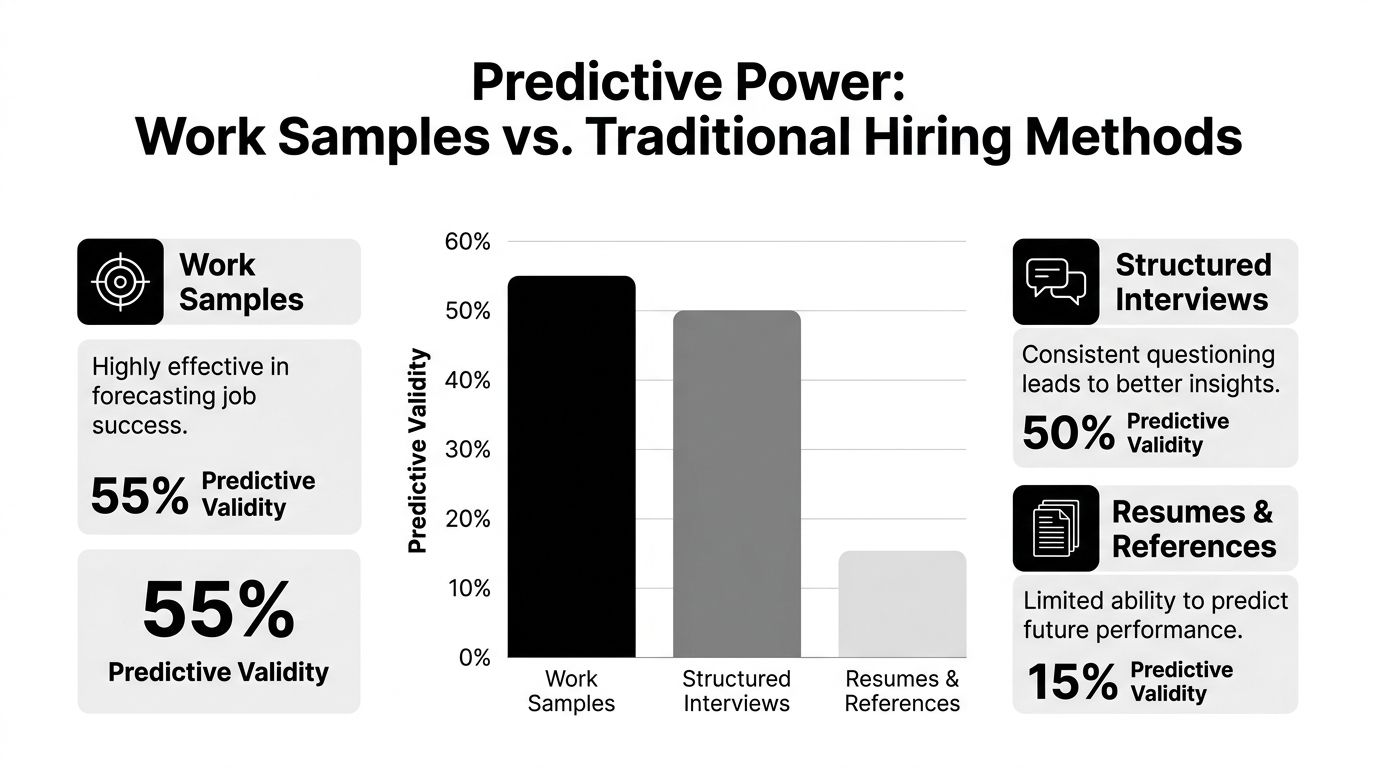
Work sample tests predict job performance with a corrected mean validity of about 0.54, according to a widely cited Schmidt and Hunter meta-analysis summarized in [Work Sample Testing](https://www.academia.edu/18135699/Work_Sample_Testing). That's the kind of number that should make any hiring manager stop relying on résumé polish and interview chemistry alone.
Most hiring teams still make decisions with partial evidence. They scan backgrounds, run a few interviews, compare notes, and hope the person they liked can do the work. Work sample testing changes the question from “Do we believe this candidate can do the job?” to “Have we seen this candidate do a realistic slice of the job already?”
That shift matters if you want to predict-human-behavior-synopsix-smarter-people-decisions in a way that holds up under scrutiny. The strongest hiring systems don't treat candidate evaluation as a single moment. They build a pattern from observed performance, structured judgment, and broader people data. Work samples are one of the clearest windows into that pattern.
The High Cost of Guesswork in Hiring
Hiring managers usually inherit a broken default. The process starts with résumé screens, moves into conversational interviews, then ends with a group discussion that often rewards confidence, familiarity, and storytelling more than actual capability.
That approach feels efficient. It often isn't.
A weak hire doesn't just create performance problems. The team absorbs rework, managers spend extra coaching time, peers cover gaps, and the process restarts. If you need a practical framing for that downstream impact, this breakdown of the [cost of a bad hire](https://synopsix.ai/blog/cost-of-a-bad-hire) is a useful way to discuss it with stakeholders.
What work sample testing actually is
Work sample testing is simple. You ask candidates to complete a task that reflects the actual job.
For a sales role, that might be a mock discovery call. For a marketer, it could be a short campaign brief. For an analyst, it might be interpreting a messy dataset and presenting recommendations.
> Practical rule: If the task doesn't resemble the decisions, constraints, and output quality the role requires, it's not a useful work sample.
The point isn't to create an elaborate obstacle course. The point is to observe how someone thinks, prioritizes, communicates, and executes when faced with work they'd encounter after they join.
Where teams get stuck
Many managers avoid work samples because they assume they'll be hard to administer or slow the process down. In practice, the bigger issue is usually poor design. Teams ask for too much work, score it loosely, or bolt the exercise onto the end of an already clumsy process.
A better approach is to use a focused task, clear instructions, and a clean evaluation method. Then close the loop quickly. Once you reach offer stage, operational basics matter too. Standardizing the final handoff with resources like these [editable offer letter templates](https://sheetmergy.com/blog/offer-of-employment-letter-sample) keeps the hiring experience consistent after the assessment work is done.
Why Work Samples Predict Success Better Than Resumes
Hiring teams make expensive mistakes when they confuse credentials with capability. Resumes help you screen for baseline fit, but they are still secondhand evidence. Work samples let you watch a candidate do the kind of thinking and producing the job requires.
Direct evidence beats proxy signals
A résumé tells you where someone has worked, how they describe their contribution, and whether their background looks relevant on paper. It does not show how they handle ambiguity, trade-offs, time pressure, or incomplete information. Those are often the factors that separate a solid hire from a disappointing one.
That gap matters.
I have seen candidates with polished resumes struggle on a realistic task, and candidates with less polished backgrounds produce clear, practical, high-quality work. Work samples surface that difference early, before the team turns confidence, charm, or pedigree into a hiring decision.
Why the method works
Work samples predict better because they test the behavior you need, not just the biography you hope maps to performance. Instead of asking candidates to talk about how they would approach the job, you observe how they approach it.
Three things improve when you use them well:
This also makes work samples a strong complement to other assessments. Cognitive tests can help estimate learning speed and problem-solving range, but they answer a different question. This guide to using a [cognitive ability test](https://synopsix.ai/blog/cognitive-ability-test) is useful if you are deciding what each assessment should contribute to the process.
Resumes still matter, just less than many teams assume
Resumes are useful for checking relevance, scope, and basic qualifications. They help narrow the funnel. The mistake is giving them final-round influence they have not earned.
A candidate may have the right employers, titles, and keywords, yet still miss the level of judgment the role demands. Another candidate may come from a less familiar path and still outperform on a task that mirrors the job. If the role depends on output, your process should include direct evidence of output.
The strongest hiring systems do not treat work samples as a standalone tool. They combine them with structured interviews, background data, and behavioral evidence to build a fuller candidate picture. Platforms like Synopsix make that easier by connecting assessment results with people intelligence signals, so teams can compare what a candidate says, how they work, and how those patterns relate to later performance. That is a better way to predict success than relying on resumes alone.
> When a manager says, “I just had a good feeling about them,” the process usually lacked enough observable evidence.
Designing High-Fidelity Work Sample Tests
A good work sample feels like a compressed version of the actual job. A bad one feels like homework, trivia, or a test of who has the most spare time.
The design principle that matters most is fidelity. Higher-fidelity work samples mirror the role more closely, and that tends to improve prediction. A meta-analysis of 54 work sample studies with N = 10,469 found an observed mean correlation of .26 between work samples and job performance, rising to .33 after correcting for criterion unreliability, as reported in [A Meta-Analysis of Work Sample Test Validity](https://home.ubalt.edu/tmitch/645/articles/a%20meta-analysis%20of%20work%20sample%20test.pdf).
Start with the role, not the test
Most weak exercises fail before they're written. The team starts by brainstorming a challenge, not by identifying the job's highest-value tasks.
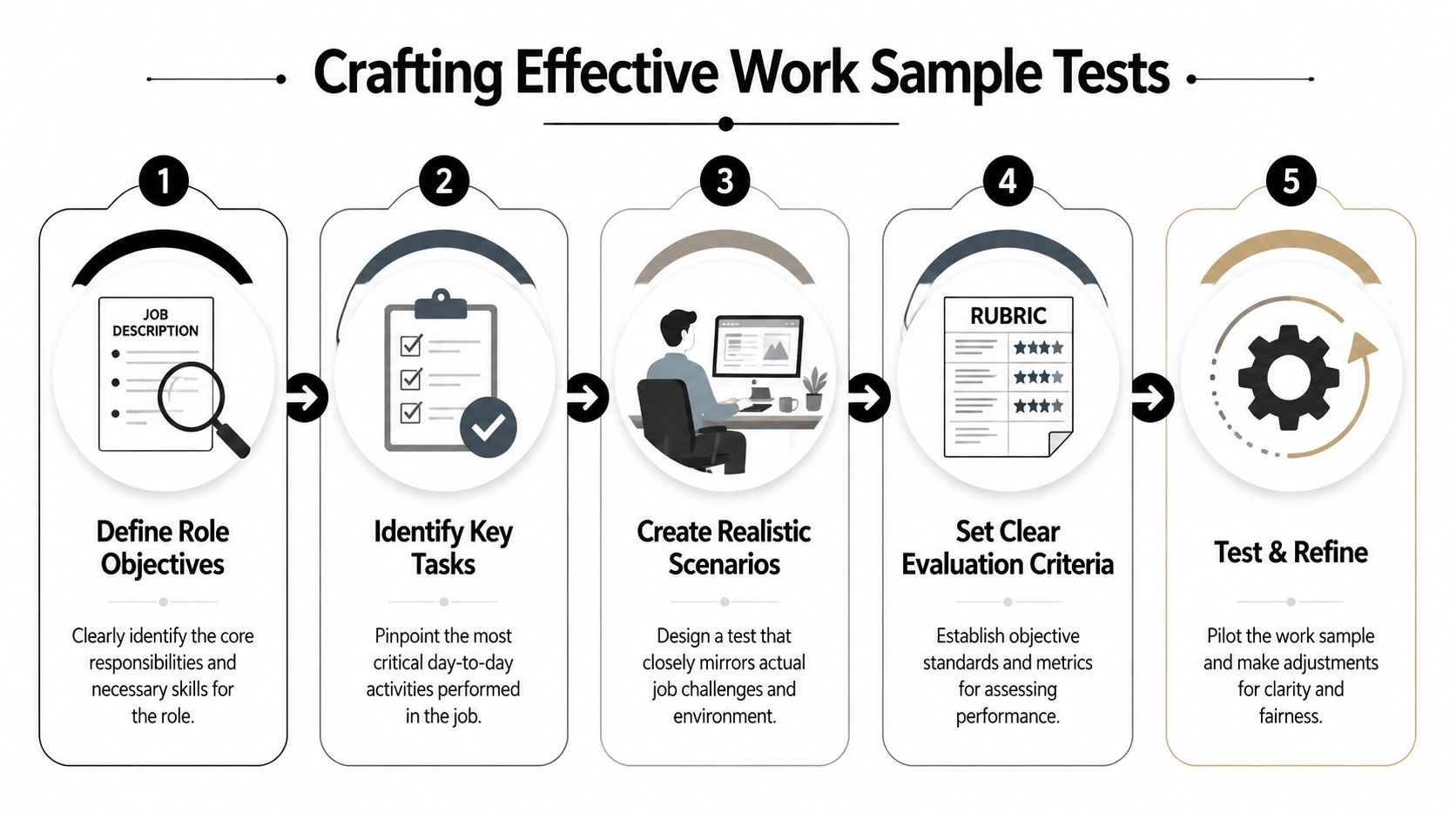
Use this sequence:
1. Define the role objective. What must this person reliably deliver? 2. List critical tasks. Which recurring tasks separate strong performance from weak performance? 3. Identify constraints. What tools, ambiguity, stakeholders, and time pressure shape the work? 4. Choose one slice. Build a small simulation of that slice rather than a giant multi-part gauntlet.
If you need a structured lens for identifying what matters in the role, a candidate scorecard built from clear [candidate evaluation criteria](https://synopsix.ai/blog/candidate-evaluation-criteria) will keep the exercise grounded.
Match the format to the work
The best work samples reflect actual output and actual decision patterns.
Here's a practical comparison:
| Role | Weak test | Better test | |---|---|---| | Sales | Generic personality prompts | Mock discovery call with buyer objections | | Marketing | “Create a full strategy” take-home | Short brief with channel choice and message rationale | | Engineering | Puzzle or brainteaser | Self-contained coding task with realistic requirements |
A few examples work well in practice:
This video is a useful companion if you want to see how teams think about realistic hiring exercises in practice.
<iframe width="100%" style="aspect-ratio: 16 / 9;" src="https://www.youtube.com/embed/o8g6vqYa5vA" frameborder="0" allow="autoplay; encrypted-media" allowfullscreen></iframe>
What high fidelity does not mean
High fidelity doesn't mean copying the entire job. It means preserving the parts of the job that generate the strongest signal.
That means you should avoid:
> A realistic test should feel like a micro-project, not unpaid consulting.
Standardization matters as much as realism
Even a strong simulation fails if every candidate gets different prompts, different context, or different scoring expectations. Standardize the brief, time limits, reviewer instructions, and scoring framework.
Consistency is what turns a realistic task into a comparable hiring signal.
Creating Fair and Defensible Scoring Rubrics
A work sample without a rubric turns into a conversation about preferences. One manager likes brevity. Another likes polish. A third rewards the candidate whose style feels most familiar. That isn't evidence. It's drift.
The fix is a scoring rubric with explicit criteria and behavioral anchors.
Build the rubric from observable outputs
Start with the few dimensions that matter for the role. Don't create a bloated matrix. A lean rubric is easier for reviewers to use consistently.
A solid rubric often includes a mix of these dimensions:
Then define what performance looks like at each level. “Strong communicator” is too vague. “Summarizes recommendation clearly, supports it with relevant evidence, and anticipates likely stakeholder questions” is usable.
Use anchors, not adjectives
A defensible rubric describes behavior. It doesn't rely on labels alone.
For example:
| Criterion | Lower signal | Stronger signal | |---|---|---| | Strategic thinking | Lists ideas without prioritization | Chooses a direction and explains trade-offs | | Problem solving | Jumps to solution without diagnosis | Frames the problem and sequences response logically | | Communication | Dense or unclear explanation | Clear structure, concise logic, audience-aware wording |
This reduces the chance that reviewers score based on instinct or presentation style alone.
Tighten the review process
The scoring tool matters, but reviewer behavior matters just as much.
Use a few practical controls:
> If a reviewer can't explain a score with examples from the task, the score isn't ready for a hiring decision.
A rubric does something subtle but important. It protects candidates from inconsistency, and it protects hiring teams from making a decision they can't later justify.
Navigating Legal Risks and Ensuring Equity
Work sample testing becomes risky when teams confuse “realistic” with “anything goes.” Legal defensibility starts with job-relatedness. The task must connect clearly to the role, the scoring must reflect business-relevant criteria, and the process must be applied consistently.
If you can't explain why the exercise maps to actual job demands, don't use it.

The unpaid labor problem
Many teams undermine their own process through long, unpaid assignments. These may look efficient to the employer, but they can screen out good candidates for reasons unrelated to capability.
The concern is not theoretical. Guidance summarized on the [OPM overview of work samples and simulations](https://www.opm.gov/policy-data-oversight/assessment-and-selection/other-assessment-methods/work-samples-and-simulations/) notes that long, unpaid work samples can worsen diversity by deterring applicants who can't risk time they might otherwise spend earning income or caring for dependents. It also notes that many guides suggest keeping tests under 3 to 4 hours, yet often fail to treat payment as a core fairness lever.
Safer operating rules
A conservative approach works best.
These choices aren't only about compliance. They affect candidate trust. People notice when a company asks for thoughtful effort but doesn't design the process with their constraints in mind.
What not to do
Some patterns create avoidable exposure:
| Risky choice | Why it backfires | |---|---| | Asking for open-ended project work | Candidates may spend wildly different amounts of time | | Scoring “culture fit” inside the exercise | The term is vague and easy to misuse | | Changing standards mid-process | Inconsistency weakens fairness and defensibility | | Reusing candidate output operationally | It blurs the line between assessment and free labor |
A legally sound work sample process is usually a disciplined one. The task is relevant. The effort asked is reasonable. The review method is consistent. The candidate experience respects the fact that people have jobs, families, and limits on unpaid time.
Scaling with People Intelligence Platforms
The first version of work sample testing usually lives in email. A recruiter sends a brief manually, the hiring manager downloads a PDF, someone else keeps scores in a spreadsheet, and feedback sits in private notes. That setup works for a few hires. Then volume rises, reviewer discipline slips, and comparisons become messy.
The operational problem isn't just speed. It's fragmentation.
Why standalone work samples hit a ceiling
The exercise is often still treated as a separate event. The candidate applies, interviews happen elsewhere, and the work sample sits off to the side as a one-off task with limited context.
That leaves useful questions unanswered. Was a weak performance caused by poor role fit, low learning agility, low resilience under pressure, or unclear instructions? Did a polished output reflect strong independent thinking, or did the candidate compensate for weaker judgment with extra time and presentation skill?
Research summarized in [this review of work-sample integration questions](https://digitalcommons.unl.edu/cgi/viewcontent.cgi?article=1072&context=qicwdumbrella) points to a gap here. Most content treats work sample tests as a standalone tool, rarely addressing how combining them with behavioral or cognitive data adds incremental validity. The same review notes that as organizations adopt AI-augmented assessment platforms, the challenge is balancing rigor with user experience and scalability inside end-to-end hiring workflows.
What a modern stack changes
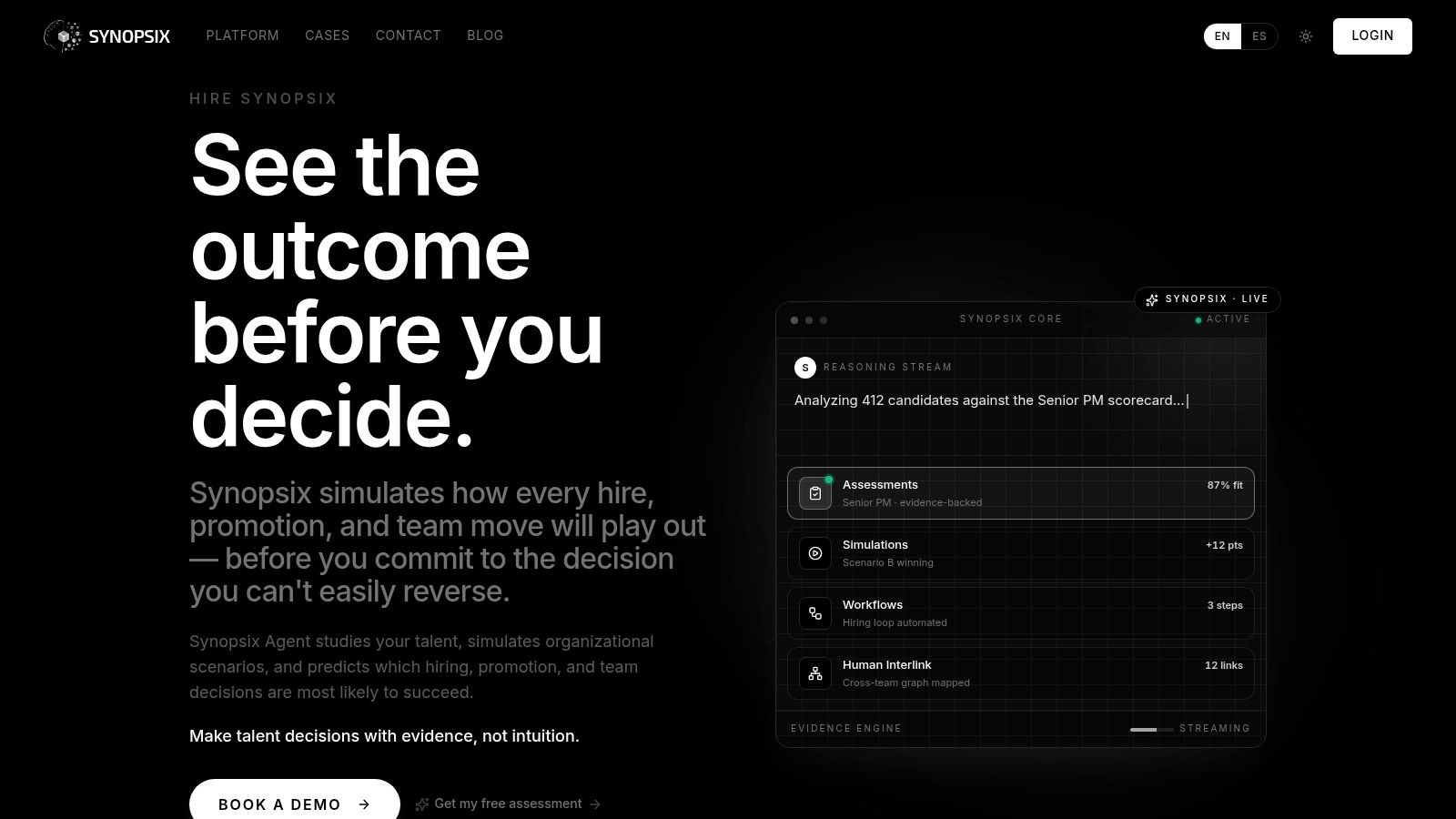
A people intelligence platform can turn work samples from a useful artifact into part of a coherent decision system.
That usually means:
Broader talent tooling holds significance. For example, teams that understand [how resume parsers work](https://www.digiparser.com/blog/resume-parser) often make better upstream decisions about what should be automated in screening versus what needs human review later in assessment.
The deeper advantage of integration
Significant gain comes from combining observed performance with broader people signals. A work sample shows what a candidate did in a defined scenario. Behavioral data helps interpret how that performance may generalize across pressure, ambiguity, collaboration, or ramp time.
That combination creates a more complete profile:
| Signal type | What it tells you | |---|---| | Work sample | How the candidate performed on a realistic task | | Structured interview | How they explain decisions and reflect on experience | | Behavioral assessment | How they're likely to approach work, change, and team interaction |
That's a smarter way to predict human behavior than treating any single assessment as the whole truth. It also helps teams shorten or target exercises more intelligently. Not every candidate needs the same depth of simulation. Some require more evidence. Some don't.
> The best hiring systems don't ask every candidate to prove everything from scratch. They collect distinct signals, then use each one where it adds the most value.
Measuring the ROI of Your Work Sample Program
If you want work sample testing to last, you need to measure more than completion rates and recruiter turnaround time. Process metrics help with administration. They don't prove business value.
Track outcomes that matter to hiring managers and executives.
What to measure
Use a small set of linked indicators rather than a giant dashboard:
How to make the data useful
Don't isolate the metric from the hiring decision. Review it by role family, hiring manager, and exercise type. A sales simulation may be excellent while a marketing take-home may be too broad. One rubric may be crisp while another produces noisy scoring.
Use the findings to refine the system:
1. Remove tasks that don't correlate with later success. 2. Tighten rubrics that generate scattered reviewer judgments. 3. Shorten assignments that create candidate friction without adding signal. 4. Split one generic test into role-specific versions when different jobs need different evidence.
The payoff from work sample testing rarely comes from having an assessment at all. It comes from having one that is relevant, fair, consistently scored, and connected to outcomes the business can see.
---
If you want a more complete way to evaluate candidates than résumés, interviews, or isolated assessments, [Synopsix](https://synopsix.ai) is built for that next step. It helps teams combine behavioral assessment data with practical hiring signals so they can make clearer, more consistent people decisions with less guesswork.